
unity
Here’s a terrific essay by my friend Rick Gibson on George Washington’s farewell address, national unity, and the possibilities and challenges of this moment.
UPDATE: Rick also shared with me today this powerfully and eternally relevant passage from Dorothy Sayers’s Introductory Papers on Dante:
If we refuse assent to reality: if we rebel against the nature of things and choose to think that what we at the moment want is the centre of the universe to which everything else ought to accommodate itself, the first effect on us will be that the whole universe will seem to be filled with an implacable and inexplicable hostility. We shall begin to feel that everything has a down on us, and that, being so badly treated, we have a just grievance against things in general. That is the knowledge of good and evil and the fall into illusion. If we cherish and fondle that grievance, and would rather wallow in it and vent our irritation in spite and malice than humbly admit we are in the wrong and try to amend our behaviour so as to get back to reality, that is, while it lasts, the deliberate choice, and a foretaste of the experience of Hell.
two quotations on prophecy
When one QAnon channel on the chat app Telegram posted a new theory that suggested Biden himself was “part of the plan,” a number of followers shifted into open rebellion: “This will never happen”; “Just stfu already!” “It’s over. It is sadly, sadly over.” “What a fraud!”But while some QAnon disciples gave way to doubt, others doubled down on blind belief or strained to see new coded messages in the Inauguration Day’s events. Some followers noted that 17 flags — Q being the 17th letter of the alphabet — flew on the stage as Trump delivered a farewell address.
“17 flags! come on now this is getting insane,” said one post on a QAnon forum devoted to the “great awakening,” the quasi-biblical name for QAnon’s utopian end times. “I don’t know how many signs has to be given to us before we ‘trust the plan,’” one commenter said. Yours truly, in How to Think:
In 1954 three social psychologists, Leon Festinger, Henry Riecken, and Stanley Schachter, read in the newspaper about a religious cult whose leader, a woman they called Marian Keech — her real name was Dorothy Martin — was prophesying the end of the world. Keech claimed that she had received messages from the inhabitants of a distant planet named Clarion, and from them she had learned that the world would be destroyed by a great flood on the twenty-first of December 1954. (She received these messages through automatic writing: she felt a tingling in her arm and a compulsion to write, but when she wrote, the words that emerged were not her own, nor in her handwriting. This was the method of communication the beings from Clarion chose to use to warn the world of its imminent destruction.) Those who heeded this warning and joined Keech’s group would be rescued by the arrival of a flying saucer from Clarion.See Festinger, Riecken, and Schachter’s book When Prophecy Fails.Festinger, Riecken, and Schachter pretended to be true believers in Keech’s message so that they might infiltrate and study the group. They had formulated a twofold hypothesis: first, that Keech was a charlatan; and second, and more interesting, that when the falsehood of her prediction was revealed her followers would not abandon her but rather escalate their commitment to the cause. […]
When the promised rescuers did not show up, and the threatened flood did not arrive either, the group was shaken. But then Keech felt once more the desire to write, and the message from Clarion was immensely reassuring: there was indeed a flood, but not a flood that kills, rather one that saves: “Not since the beginning of time upon this Earth has there been such a force of Good and light as now floods this room and that which has been loosed within this room now floods the entire Earth.” Because of their faithfulness, they had been spared, and not just the little band of believers, but the whole world! And it was now incumbent on them, further messages explained, to break their habits of privacy and secrecy and to share with everyone, insofar as they were able, this “Christmas Message to the People of Earth.” (To which one can only add: God bless us every one!)
why not with love?
A reader of my book The Pleasures of Reading in an Age of Distraction — in which I have some harsh things to say about the eat-your-broccoli approach to reading advocated by Mortimer Adler and Mark van Doren in their famous How to Read a Book — discovers that the professor and literary critic William Lyon Phelps got there many decades before I did:

two quotations on form
We will be back in some form.
It seemed to be a sort of monster, or symbol representing a monster, of a form which only a diseased fancy could conceive. If I say that my somewhat extravagant imagination yielded simultaneous pictures of an octopus, a dragon, and a human caricature, I shall not be unfaithful to the spirit of the thing. A pulpy, tentacled head surmounted a grotesque and scaly body with rudimentary wings; but it was the general outline of the whole which made it most shockingly frightful.
— H. P. Lovecraft
peacemaking
Can I get an amen for this powerful reflection by Justin Giboney? It gets a hearty amen from me.
Neither the warmonger nor the pious bystander is a peacemaker. Those too heavenly or high-minded to soil their ceremonial garb by touching common ground and advocating for their neighbors aren’t peacemakers. Moreover, those who exploit prayer as a copout to neglect the issues God has placed in their sphere of influence aren’t peacemakers either. Their silence condones a conflicted state of affairs and makes them keepers of a riotous status quo.
Peacemakers will engage the conflicts necessary to achieve racial justice, but they won’t be carried away by the moment. In the tensest times, they’ll watch their words, acknowledge their opponent’s human dignity, and guard their hearts from tribalism. They’ll address today’s bleak situation with tenacity and moral imagination, rather than cynicism. This means peacemakers will seek out approaches that transcend the inadequate options offered by ideological conservatives and progressives. They won’t run from reality, but they’ll attempt to reach higher ground rather than settling for the base terrain immediately available.
I’m tempted to quote the whole thing, but I’ll confine myself to the challenging conclusion:
No other group is better situated to bring healing to this land than the church. There are Bible-believing Christians on both sides of the political spectrum, and outside of politics we have a lot in common. We’re stuck with one another for good. We need each other. It’s time to set our partisan hang-ups aside, make peace, and do justice.
Now taking pre-orders for my new book, Republicans Are From Mordor, Democrats Are From Isengard.
a little moral clarity
My homie Daniel with a dose of moral clarity:
At the Texas Capitol, pro-Trump protesters gathered as officers from the Texas Department of Public Safety patrolled the grounds and guarded the entrance to the nearby Governor’s Mansion.A protester lounged against a stone wall, holding a semiautomatic rifle and smoking a cigarette. He declined to give his name, saying he was there to “observe what was going on.”
Daniel Hunter, a 34-year-old handyman, drove down from Waco on Sunday, he said, to ensure that no one assaulted the Capitol.
“If they do, I’ll get in front of them,” he said. “Storming the Capitol isn’t civilized behavior.”
do I feel fine?

The central idea of his interpretation is announced fairly early on, in a discussion of Ragnarök — and what comes after Ragnarök:
The end turns out not to be the end – Ragnarök turns the universe off and on again. We still can’t bring ourselves to come to terms with the total absence of life. Something must continue, something must exist. And so we are locked into a cycle – imagining an end to the story, but afraid to really bring it to an end once and for all. This, counter-intuitively, turns out to be one of the most reliable features of all the stories about the end of the world. A world ends. The world never does.In fact sometimes it does, and in texts Adam cites: Byron’s terrifying poem “Darkness,” the unsurpassably bleak vision at the end of H. G. Wells’s The Time Machine, etc. But yes, it is true that far more often than not the end of the world is the portal to a renewed cosmos: the New Heaven and the New Earth of John the Revelator’s vision; the end of this kalpa leading to the eventual emergence of another.
Having laid out this general framework, Adam moves on to instances, brief sketches of what we might call the various genres of conclusion: endings brought about by the gods, by zombies, by plagues, by machines, by the heat death of the universe, by climate change. You can see that for some of these the relevant phrase is “the end of the world,” while for others it’s “as we know it.” Climate change won’t end the world, though it will certainly reshape it; and as Adam writes, “the secret core of the zombie story” may be that it describes “not so much the end of the world, but the end of the values that underpin that world – not the end of humans as a species but of our very humanity.” (There’s a very stimulating comment in that chapter on Huxley’s Brave New World as a kind of zombie story.)
There’s also a fabulous digression on the horror of a world that won’t end: I’m compelled by Adam’s description of Groundhog Day as “a masterpiece of supreme existential terror.”
In his final pages he writes, “We use the stories to make sense of it all, to impose order on an uncaring and chaotic universe, creating the fantasy that we have some measure of understanding and control.” That’s something close to the book’s conclusion, but I think it conflates several different experiences. The problem lies in the phrase “understanding and control.” Understanding and control are not the same thing, and I’m not even sure they arise from the same impulse. After all, one of the things that we might understand about the world, or about our lives in more specific ways, is that we don’t have any meaningful control over it or them.
I think it’s fair to say that Adam shares the view articulated by Wells at the the of The Time Machine and by Byron in his great poem:
The waves were dead; the tides were in their grave, The moon, their mistress, had expir’d before; The winds were wither’d in the stagnant air, And the clouds perish’d; Darkness had no need Of aid from them — She was the Universe.If that vision is true, then to grasp that is certainly to understand something; but it is not to control anything, except perhaps — perhaps — our hopes for something better. The control of emotion that one achieves when one accepts what one cannot control: Stoicism in a phrase.
Which leads us back to one of Adam’s key points, that all of our stories about the end of the world are really, to some degree and often to a very great degree, refractions of our sense of our own ending, our own death. And Larkin, for one, didn’t think much of the Stoic answer:
Courage is no good: It means not scaring others. Being brave Lets no one off the grave. Death is no different whined at than withstood.One may control one’s fear, but that’s not the control that any of us wants. I think Larkin has understood something here.
For me, a Christian, everything about this, about what will happen to me when I die, about what will become of this sweet world, hinges on one question. As Auden put it: “Now did He really break the seal / And rise again?” The biggest of all Ifs, for me. But I’m staking my claim on “Yes.” And I think, along with the say-but-the-word centurion given voice by Les Murray,
If he is risen, all are children of a most real high God or something even stranger called by that name who knew to come and be punished for the world.
I’m sure others have said this, but the best favor anyone ever did for Donald Trump was Twitter’s suspension of his account. If he had been allowed to tweet for the past week he’d already be impeached and removed by now.
two quotations on recent events
Stand back, for a moment, and consider the enormity of his actions. As president, he tried to cling to power by overturning an election that he had unambiguously lost. First, he spread a big lie in a months-long campaign to convince his voters that the election was a fraud and that the media, the courts and the politicians who clung to the truth were in fact part of a wicked conspiracy to seize power. Then, having failed to force state officials to override the vote, he and his henchmen whipped up a violent mob and sent them to intimidate Congress into giving him what he wanted. And last, as that mob ransacked the Capitol and threatened to hang the vice-president, Mike Pence, for his treachery, Mr Trump looked on, for hours ignoring lawmakers’ desperate pleas for him to come to their aid.Peggy Noonan:In a democracy, no crime is higher and no misdemeanour more treasonous. Mr Trump needs to be punished for betraying his oath as head of state. He must be prevented from holding office again — or he may well stand in 2024. And, in case someone is minded to copy him, he must serve as an example of how vehemently America rejects a leader who tramples its constitution.
I just have a feeling our much-maligned establishments are saving the day. A former cabinet official said to me this week, “Trump never understood our institutions.” He never understood how strong and deeply layered they are. The agencies held, the military, the courts. Because Mr. Trump is purely transactional, he thought if he appointed Neil, Brett and Amy, they’d naturally do his bidding because that’s how the world works. But it’s not always how the world works. This week the Supreme Court blandly refused to fast-track his latest election appeal. They did it quietly, without comment.I have a feeling there was a lot of quiet stature around us all along.
And they were quietly thinking: Don’t mess with my country. But they didn’t say mess.


Texting with my son.
Manorial Technocracy
This morning I have a post up at the Hedgehog Review on “Our Manorial Elite.” The core idea, as you’ll see if you click through, comes from Cory Doctorow, or rather a historian friend of Doctorow’s. “[Bruce] Schneier calls [our current arrangement] ‘Feudal Security,’ but as the medievalist Stephen Morillo wrote to me, the correct term for this is probably ‘Manorial Security’ — while feudalism was based on land-grants to aristocrats who promised armed soldiers in return, manorialism referred to a system in which an elite owned all the property and the rest of the world had to work on that property on terms that the local lord set.”
What the rabble who stormed the Capitol building have unwittingly done is to consolidate (a) the social power of the enormous transnational tech companies and (b) the intimacy of those companies’ connection with the United States government. Given the recent usefulness of Facebook, Twitter, and Amazon to the currently dominant political party, what are the chances that a Democratic Congress will pass legislation curbing their power, or that, should some such bill emerge, a Democratic President would sign it into law?
So let me bang this antique drum one more time: You need to own as much of your turf as you can. I explain why and how, in detail, in this essay. Avoid the walled gardens of social media, because at any moment they could appeal to digital eminent domain and move the walls somewhere else, and if they did you’d have zero recourse.
Now, to be sure, even when you “own your turf” you don’t really own your turf — as the people who run Parler have recently discovered: they didn’t just lose their access to Apple’s App Store and Google Play, and their data storage account with Amazon’s AWS, they lost their text message and email service provider. I was reminded of just how vulnerable my own digital presence is last year when there were plans to sell the .org domain to a private equity firm. That situation has been avoided for now, thanks in large part to the efforts of the Electronic Frontier Foundation, but there are no guarantees going forward. When I’m on the open web, I own my data — which is a big deal, since the owners of the walled gardens also own your data — but I don’t own the power to share my words and images with others.
I hold no brief for Parler, which I am glad to see shut down — it has been a foul thing by any reasonable measure — but as I note in my Hedgehog post, the big social media companies are making up their rules as they go along, and in so doing setting the standards for other, smaller companies to follow. So are the other big companies: As Glenn Greenwald points out, the planning for the assault on the Capitol wasn’t done on Parler, it was done on Facebook — yet we don’t see Apple banning Facebook from its App Store, do we?
The smaller, the more vulnerable. If I were to say something controversial enough, my own hosting company, the wonderful Reclaim Hosting, could give me the boot. It’s not at all likely, of course, but my point is that it’s possible. I could be fired by Baylor, Google and Apple could shut down my accounts, I could probably be cut off by my ISP. I think the only thing left would be a landline phone, which, if I’m not mistaken, we in the USA still have fairly strong rights to use. But I don’t have a landline. (Maybe I should remedy that?)
It’s possible, then, for any of us to be not just shamed or dragged on social media but really and truly digitally shunned — to be completely cut off from every possibility of electronic discourse and community. I don’t see how you can’t be concerned about this possibility. So even a lawyer for the ACLU — which has in recent years explicitly refused to support speech that it doesn’t approve of — says, “I think we should recognize the importance of neutrality when we’re talking about the infrastructure of the internet.”
Until that neutrality in enshrined in law, we are all at the mercy of our manorial technocracy. But if we stay outside the walled gardens, we are safer and more free. I would encourage all of you to ditch Twitter, ditch Facebook (including Instagram), ditch all of them and learn how to live once more on the open web. The future of our democracy just might depend on it.
a time of reckoning
This essay by my dear friend James Davison Hunter is absolutely essential for our moment:
It is important to remember that times of crisis are always times of reckoning. Whether one admires [MLK] or agrees with his politics is not the question. In his day, public opinion was overwhelmingly against him, and even against today’s idealized and sanitized version of King, there are those who disparage the man and his achievements. The question, rather, is whether we have the requisite moral resources to reckon with our nation’s internal flaws and external challenges. King modeled a disposition, a voice, and a moral authority that could credibly compel such a reckoning in his own day, but in ways that made it possible for opponents to imagine a way forward together.
Although incomplete, his life and witness, his words and deeds, brought about constructive change in large measure because they were grounded in metaphysical and theological sources that transcended tribalized identities, prejudices, and shibboleths. King’s critique of America was radical, more radical than many today remember. But so too was his humanism. Dissent and solidarity were welded together — and could coexist precisely because they came from the same place. Both were rooted in an equally radical theological anthropology that demanded justice, refused ideological purity tests, and recognized the yearnings, fears, flaws, weaknesses, capacities, and aspirations that all human beings share — and, finally, obliged each of us to forgive our foes.
The particular moral resources that animated King and the clergy that surrounded him are certainly less available to us today. Their renewal is not impossible, but it is far from likely. But this only heightens the urgency of the question: What moral resources are available to us to come to terms with the crises we face?
That last question is the essential one. If you’re not meditating right now on your answer to it, you’re not serious about the challenge that faces us. James’s essay points us in the right direction. I am so grateful for his work and his witness.
The Year of Hypomone
A twofold something I already knew but that I re-learned this past week:
- During a crisis one turns instinctively and desperately to the internet for news;
- During a crisis the worst thing one can do is turn to the internet for news.
But you know what? It did me no good. I got mixed messages, unreliable reports, rapidly changing stories; and I heard repeatedly from fools and knaves. If I had waited a day, or two days, or three, I wouldn’t have had all the emotional upheaval and I wouldn’t have missed anything significant. What possible difference could it make to me to learn about the Capitol Disgrace on Wednesday or on the following Monday (which is my usual news-reading day)? The only answer: None. None at all.
And all this has been going on in the aftermath of a year, a true annus horribilis, in which I also realized that “Everything I care about and have written to defend has crumped, is crumping, will crump.”
All that as prelude. The chief point is this: I received a gift today, in the form of a post by Ian Paul. That post is about the Greek word hypomone (ὑπομονή), which means “patient eudurance,” “the capacity to hold out or bear up in the face of difficulty, patience, endurance, fortitude, steadfastness, perseverance.” The associated verb, hypomeno (ὑπομένω), means “to stay in a place beyond an expected point of time, remain/stay (behind), while others go away”; “to maintain a belief or course of action in the face of opposition, stand one’s ground, hold out, endure, remain instead of fleeing.”
Love, St. Paul says, “bears all things, believes all things, hopes all things, endures all things” — panta hypomenei (πάντα ὑπομένει). That’s 1 Corinthians 13:7, and I think I’ll make it my verse for 2021. My prayer for myself is that I will have the patient endurance, this year, to maintain my beliefs, my core commitments, “in the face of opposition”; to stand firm and defend what I care most about “beyond an expected point of time … while others go away.” I declare 2021 The Year of Hypomone.
for the record
First time I’ve seen anything like this in my eight years in central Texas, and I strongly suspect that if I live here the rest of my life I won’t see anything like it again. (Photos cropped but not filtered or otherwise edited.)





Walking around in my neighborhood I keep hearing, from down in the arroyo, the gunshot crack of snow-burdened branches breaking.
essential reading for skeptics (and others)
Some of my readers will have friends and family members who believe that the 2020 Presidential election was stolen from Donald Trump and that the recent invasion of the United States Capitol was therefore justified — or perhaps that the Capitol was actually invaded by leftist activists. Some of my readers may hold these views themselves. So I’d like to share some recent reporting, analysis, and commentary that may be helpful. All of what follows comes from conservative, Christian, and Republican sources — in some cases the writers are all three.
The links below are not, except for the last couple, opinion pieces. They report.
First and most generally: There are many “fact-checking” sites out there, but if you are a political conservative you can’t beat the one from The Dispatch. That link goes to their complete archive, but here are some especially important ones related to the election itself:
- Did Pennsylvania Have More Mail-In Ballots Recorded Than Were Requested?
- Did a Dominion Technician Manipulate Voting Data in Gwinnett County?
- Did a Georgia County Use ‘Sequestered’ Machines to ‘Break the Dominion Algorithm’?
- Did Detroit Poll Workers Scan the Same Ballots Over and Over?
- Did Joe Biden Receive Millions More Votes Than There Were Eligible Voters?
- Fact Check: Debunking Donald Trump’s Claims About Voter Fraud
Further, from the front lines:
- John McCormack of National Review reports on what it was like to be in the Capitol last Wednesday (may also be behind a paywall, sorry)
- Newly elected Republican Representative Peter Meijer, who was also there, on what he experienced — and what his party should learn from it
- This collection of videos from Parler, taken by people participating in the invasion of the Capitol, answers many questions about who the participants were and what they were doing
Rebutting enabling lies does not mean whitewashing the opposition. It does not mean surrendering your values or failing to resist destructive ideas. It does mean discerning the difference between a problem and a crisis, between an aberration and an example. And it means possessing the humility to admit when you’re wrong. It means understanding thatAnd the rebuttal has to come from within. The New York Times isn’t going to break this fever. Vox won’t change many right-wing minds. But courageous Christians who love Christ and His church have a chance. Amen, brother David — who also made a wonderful and powerful case, on a recent episode of The Dispatch’s podcast, for welcoming those who have recently come to see that their trust in Donald Trump was misplaced.no emergency is ever too great to stop loving your enemies and blessing those who persecute you.
It is extremely discouraging for me to see so many Christians, and so many churches, losing all sense of their mission and purpose — and at such a crucial time. Political conflicts and anxieties are at the forefront of American minds right now, but in another few days the catastrophic effects of the coronavirus will loom into our general view again. (They never should have left it.) I find myself thinking about all the ways that many American churches have soldiered on bravely through the miseries of the past year — and about all the ways that other churches have stoked political conflict, denied the truth about disease and elections alike, angrily demanded their rights … and ignored their mission, which is, after all, to seek and save those who are lost.
I’ve moved away from the business of evidence and fact-checking, but I’ve done so for a reason: None of us is likely to practice due diligence in finding out the truth if our hearts are not properly oriented, if we’re not primarily actuated by the double love of God and our neighbor. If we are so actuated, we’ll find ways to pursue our mission even in the darkest hours.
My patron saint in all these matters is the Reverend Pat Allerton, about whom I read in a recent piece by Harry Mount in the Telegraph:
In the first week of the first lockdown, as the Church of England shut its doors, the Reverend Pat Allerton, vicar of St Peter’s, in London’s Notting Hill, had a brainwave…. ‘I had an idea to take a hymn and a prayer to the streets of my parish, to lift spirits and bring a bit of joy. So, on the 26th March, I went out to the Portobello Road.’Allerton is not happy about his government’s restrictions on church services. He thinks they are shortsighted and unfair. But still, there’s the Gospel to be preached, people in need to minister to. So he gets to it.He was cautious about the effects of hitting the streets with a loudspeaker, blaring out Judy Collins’ “Amazing Grace” on Spotify. ‘I thought I might be told to do one,’ he says jauntily. ‘But I was amazed by the response. People were really moved. They clapped and invited me back! They probably regret that now. I believe God was coming alongside people, letting them know He’s there.’
Over the following weeks, Allerton did 64 walking services around London, helped by the amazing weather. Each service – with a hymn, a prayer and a 60-second sermon – took seven minutes. He invited people – up to 50 at a time – to join in from a window or doorway. ‘So many people commented on social media, saying things like, “I’m not religious but I’ve got goosebumps. There are tears coming down my face.” God’s presence was touching people.’
My own pastors have been getting to it for the past ten months. Preaching the Gospel, baptizing newborns, confirming young people, burying the dead, comforting the grieving — all of which are ways of preaching the Gospel. My wife Teri has certain pre-existing medical conditions that would make it very, very dangerous for her to contract covid, so we haven’t even dared the recently instituted outdoor socially-distanced Eucharistic services. No problem: our associate rector Neal McGowan recently brought the Eucharist to us. And would do it again any time we asked. Meanwhile virtual Morning Prayer continues, a six-times-weekly blessing and encouragement.
No protests, no insurrections, no complaints, no cries of persecution, no demands for rights: just ministry in the name of Jesus Christ, the Way, the Truth, the Life, the one who came to seek and save those who are lost. Christians who focus on that cannot go wrong. And caring enough about the truth to get our facts right is actually part of that ministry.
UPDATE: If you really want to get deep into the evidential weeds, this 124-page legal complaint against Sidney Powell by Dominion Voting Systems is jaw-dropping — and heavily, heavily documented. I don’t know how you could read this and still believe any word that comes out of Sidney Powell’s mouth, including “and” and “the.” (Hmmm, maybe I shouldn’t put it that way.) It’s also a thorough record of a much broader pattern of lies and deceptions, and reckless disregard for the truth, by others. The ironically-named American Thinker seems to have gotten the message: “It was wrong for us to publish these false statements. We apologize to Dominion for all of the harm this caused them and their employees. We also apologize to our readers for abandoning 9 journalistic principles and misrepresenting Dominion’s track record and its limited role in tabulating votes for the November 2020 election. We regret this grave error.” (Not sure which nine principles were abandoned.)
looking backward
I’m blogging too much, focused too much on the things of the moment, but I think the circumstances just may warrant it. It’s certainly hard for me to concentrate on anything other than the current political calamity. And since soon a new term will start and I’ll be back in my old books, here comes another round:
In my reflections on Donald Trump when he was running for President in 2016, I made one significant error: I didn’t think he would nominate responsible judges and Justices. I thought he would hand out judicial appointments like candy to friends and toadies. But it turned out that the judiciary couldn’t capture his attention, so he farmed out the decisions to others who acted on sound conservative principles. (Given how many of the very judges he appointed ruled against his recent frivolous lawsuits, precisely because they were honest conservative jurists rather than toadies, I wonder if he’s belatedly reassessing his priorities.)
But I think my more general assessment, made in June of 2016, has, except for one point, stood the test of time:
We all know what Trump is: so complete a narcissist that the concepts of truth and falsehood, right and wrong, are alien to him. He knows only the lust for power and the rage of being thwarted in his lust. In a sane society the highest position to which he could aspire is apprentice dogcatcher, and then only if no other candidates presented themselves.
If you put a gun to my head and told me that I had to vote for either Donald Trump or Hillary Clinton, I would but whisper, “Goodbye cruel world.” But if my family somehow managed to convince me to stick around, in preference to Trump I would vote for Hillary. Or John Kerry, or Nancy Pelosi. In preference to Trump I would vote for the reanimated corpse of Adlai Stevenson, or for that matter that of Julius Caesar, who perhaps has learned a thing or two in his two thousand years of afterlife. The only living person that I would readily choose Trump in preference to is Charles Manson.
The one point that I can’t now affirm is that last one, but only because Charles Manson is dead.
A few months later I published an essay about the Christian defenders and celebrants of Trump, in which I described the pastors who claimed that God had revealed to them that Trump was The Chosen One — perhaps in the mode of King Cyrus of Persia — and looked toward the possibility that his presidency might run onto the rocks:
These leaders have replaced a rhetoric of persuasion with a rhetoric of pure authority — very like the authority that Trump claims for himself. (“Nobody knows the system better than me, which is why I alone can fix it.”) Consequently, their whole house of cards may well collapse if the Trump presidency is anything other than a glorious success, and will leave those who have accepted that rhetoric bereft of explanations as well as arguments. Presumably the most fervent supporters of Trump will argue (as Trump himself will argue) that his failures have occurred because others have betrayed him, have rejected the man that God raised up to rescue America, but this will require the replacement of the Cyrus analogy with another one yet to be determined. We can only hope that no one compares a failed Trump to an American Jesus betrayed by American Judases.
These claims to divine revelation have certainly been perpetuated by Eric Metaxas, who claims to have all the evidence he needs right there in his heart to prove that the election was stolen, and who has asserted, in classic “name it and claim it” style, that, no matter how things appear, “Trump will be inaugurated.” I’m sure that as I speak Metaxas and the other Jericho March leaders are writing Donald Trump Superstar and are debating whether the role of Judas is to be played by Mike Pence or Mitt Romney. I’m betting on Pence. (Update: I changed my mind.)
More soberly, in that same essay I wrote this, wrapping up my reflections on the Christian True Trump Believers:
If all this sounds like a strange fantasyland of narrative, an imaginative world of what members of the Trump administration have taken to calling “alternative facts,” that’s because it is just that. The larger, and longer-term, effect of accounts like this is to encourage Christians to abandon the world of shared evidence, shared convictions, and shared possibilities, and such abandonment is very bad news for Christians and for America.
And lo, even as I foretold, it has come to pass.
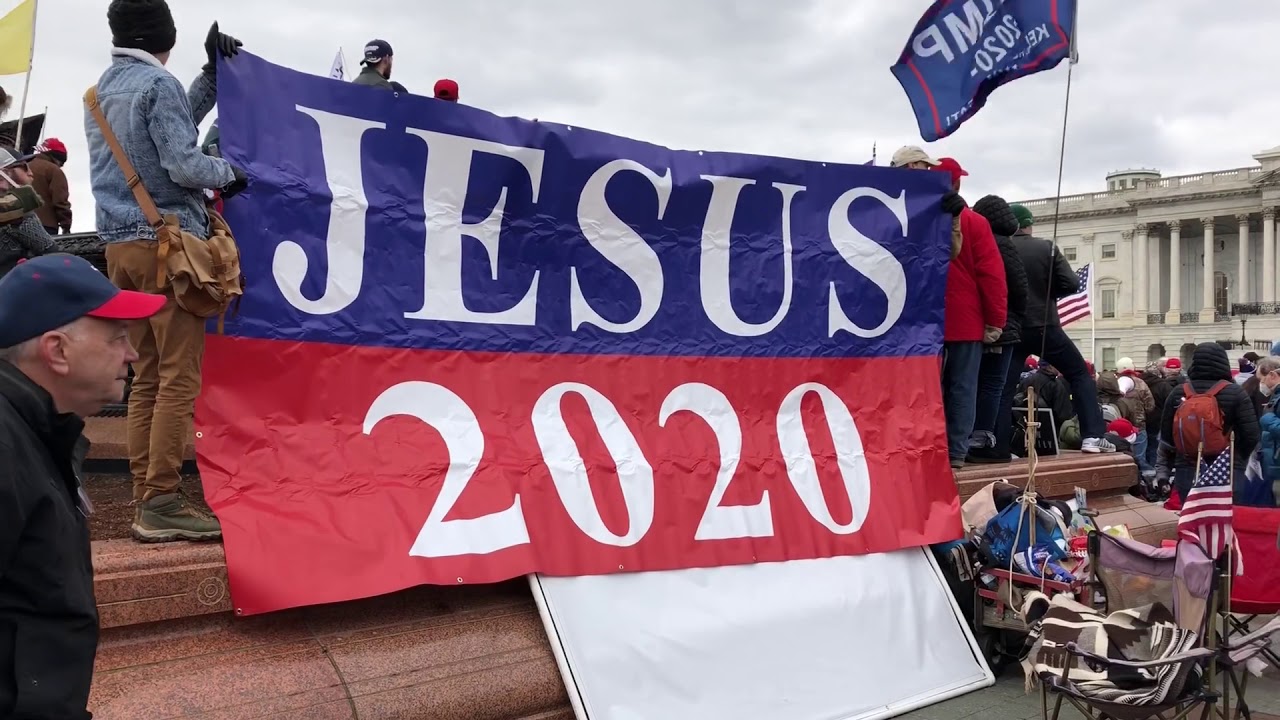
For alternatives to all this nonsense, I'd encourage you to reflect on two essays: one by Michael Gerson that I quoted yesterday, and a cautionary message, both prescient and wise, written by my friend and colleague Frank Beckwith five years ago.
scale, cont'd.
The other day I published, at the Hedgehog Review site, a little dialogue on scale, and the common human inability to understand the scale at which many of the events that affect our lives happen.
Something happens almost every day to confirm the points I make there, but you’d be hard-pressed to find a better illustration of the problem than the behavior of the people who assembled in anger at the U.S. Capitol building on Wednesday. I heard an interview with one protestor who shouted that the protestors were there because they knew they were being lied to and cheated by the deep state, by the lamestream media, by the Democrats, by RINOs — and they knew it, he said, because of “what we’ve seen with our own eyes.”
What did he mean? I can’t be sure, but I suspect that there are two chief elements to his claim.
- He has almost certainly attended Trump rallies and seen massive crowds cheering the President on (something that Trump himself has often commented on, contrasting the large size of his crowds to the meager attendance at Joe Biden’s drive-in-movie-style rallies); likewise, I would bet that, wherever he might live, in his neighborhood the pro-Trump lawn signs stretch as far as the eye can see, with nary a pro-Biden sign to be found.
- He has almost certainly seen video clips which, their posters falsely claim, show voting fraud in action. Those clips have been tweeted and retweeted, shared and faved, held up as evidence again and again by people disinclined to do any fact-checking.
To him, then, it is simply not possible that President Trump lost the election. The evidence of his own eyes tells him that the President won in what Trump himself called, in a since-removed tweet, “a sacred landslide election victory.”
What that man does not understand is that everything he has seen — even under the wholly untenable assumption that the viral videos show actual fraud — amounts to no more than a drop in the American electoral lake. It’s statistically insignificant; it’s not even a rounding error. He simply does not understand how big his country is, how many people vote in its elections.
And the point of my post was: That kind of understanding is extremely difficult to achieve. We are simply not cognitively wired to think on that scale. Which is why my little dialogue raises the possibility of a “School for Scale” to teach us. Because if we, all of us, don’t get a grip on these matters, we, all of us, will continue to perpetuate massive and massively consequential misunderstandings of our country and our world.