Went down to the river today to make sure it’s still there. ✔️


no, this isn’t about deconstruction
Everyone’s got their wishlist, and mine, like yours, starts with an effective vaccine for COVID–19 and peace and justice in the world. But after than mine probably diverges from yours: I want an end to essays and articles about literary and cultural theory written by people who have no idea what they’re talking about. Like this one by Elizabeth Powers:
These dogmas go by various names (among others, “postmodernism,” “multiculturalism”), but I will gather them under the term “deconstruction,” as it best encapsulates what is at their core. It consists of critiquing the writings of past authors, especially male ones, “deconstructing” them, which means exposing the submerged ideology of power, racism, misogyny, repression, and so on that is hidden below the overt text of a novel. This French cultural product, which began to occupy a prominent place in American university literature departments in the 1970s, has had the effect, over several student generations, of bringing literature departments, especially those of foreign languages, to extinction. Why? It is in the DNA of adolescents, even of those who have never heard of Jacques Derrida, to deconstruct, to tear apart the assumptions of their forebears. When professors stopped talking about Milton’s prose and began pointing out his treatment of his daughters, students got the point immediately. Why would 18-year-olds hang around to confirm what they knew only a year or two earlier, anyway: that anyone born before their own birth year doesn’t have a clue?In the immortal words of Bob Marley, I got so much things to say.
I will try to set aside my small annoyances — If students think anyone older than them is clueless, why would they listen to Derrida? Don’t literature classes read texts other than novels? — and focus on the bigger problem.
All the strategies of reading Powers despises — “exposing the submerged ideology of power, racism, misogyny, repression, and so on that is hidden below the overt text of a novel” [sigh] — are not examples of deconstruction, they are repudiations of deconstruction.
Several generations of students, and their professors too, have learned what literary theory is about primarily from one book: Terry Eagleton’s Literary Theory: An Introduction, now in its third edition (the first was published in 1983). I think almost everyone in my profession, including me, has assigned it at one time or another. A 2001 article in Times Higher Education says that at that point it had sold 750,000 copies, so surely it’s well over a million at this point.
Here’s Eagleton’s wittily polemical summation of deconstruction:
Anglo-American deconstruction largely ignores this real sphere of struggle, and continues to churn out its closed critical texts. Such texts are closed precisely because they are empty: there is little to be done with them beyond admiring the relentlessness with which all positive particles of textual meaning have been dissolved away. Such dissolution is an imperative in the academic game of deconstruction: for you can be sure that if your own critical account of someone else’s critical account of a text has left the tiniest grains of ‘positive’ meaning within its folds, somebody else will come along and deconstruct you in turn. Such deconstruction is a power-game, a mirror-image of orthodox academic competition. It is just that now, in a religious twist to the old ideology, victory is achieved by kenosis or self-emptying: the winner is the one who has managed to get rid of all his cards and sit with empty hands.There are several things to be learned from this passage:
- Deconstruction is fundamentally an inquiry into language and meaning, and in that sense continues the “close reading” model that traditionalists in our time tend to like, especially when it’s exemplified by the American New Critics rather than foreigners. It’s essentially formalist, even if it’s concerned with the dissolution of form rather than formal coherence.
- It is therefore politically quietist.
- Eagleton, as a Marxist, deplores this.
I don’t want to overstress this point. There were influential critics — Robert Scholes most notable among them in his 1985 book Textual Power: Literary Theory and the Teaching of English — who tried to redescribe deconstruction as a tool in the toolbox of the politically motivated professor. Scholes’s book is important because it explicitly describes the task of the teacher as liberating students from texts that have power over them, and giving those students the power to dominate texts. But in general the rise of theories of power — above all those articulated by Michel Foucault — meant an end to the dominance of theories of language. Deconstruction was not the beginning of our current regime of critique, it was the end of the previous regime.

punishing the innocent
Re: Yascha Mounk’s article on leftist mobs punishing the innocent: For the ones doing the mobbing, ruining the lives of innocent people is not a bug in their program, it’s an essential feature. There can be no reign of terror when only the guilty are punished.
Foucault’s Discipline and Punish is the great text for understanding this phenomenon. Punishment of the guilty is, from the perspective of social control, an implicit confession of failure. A social order that has proper control over its members will not have to punish them, because they will be obedient. And you make people obedient by instilling discipline: you carefully and thoroughly train them to say what you want them to say and do what you want them to do, and to refrain from saying or doing what you think inappropriate.
However, the disciplinary systems that do this work — schools, for instance — are scarcely less efficient than punishment. What must be created is an environment in which people discipline themselves. But they will only do this when they fear exposure (and subsequent punishment) so much that they will go to extreme lengths to perform their obedience. And people will only exert the energy to enact this ongoing self-policing if they believe that anything they do or say can be seen. They need to believe that they are living in a Panopticon.
This is where social media come in. If everyone has a smartphone and access to social media accounts, then anything you do or say might be recorded and published. Anything those to whom you are related do or say may be recorded and published, to shame you before the entire world. From the perspective of those who lust for social control, this is an ideal situation, because if they make you sufficiently fearful of exposure then you will not only police yourself, you will police your friends and family. And if you can be exposed and punished not only for what you intentionally do and say, but for what you inadvertently do and say, and for what people you know do and say, then you will become obsessively vigilant in your policing.
That is why, for those who want to effect social change by exposure and shaming, punishing the innocent is a feature of their system, not a bug. It increases fear, which increases discipline, not only of oneself but of others. And every employer who fires an employee because they’re afraid of a social-media mob draws us closer to a fully Panoptic society, a social tyranny with an efficiency beyond the dreams of totalitarian societies of the past.
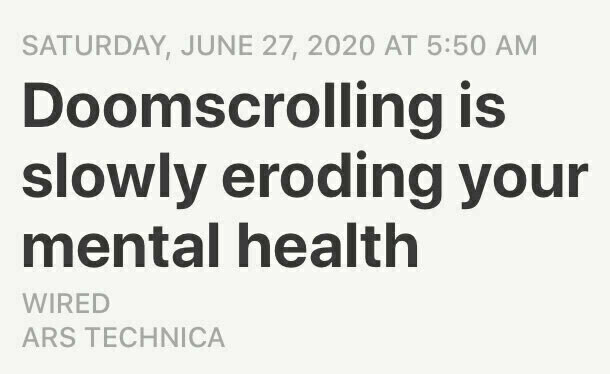
“Slowly”?
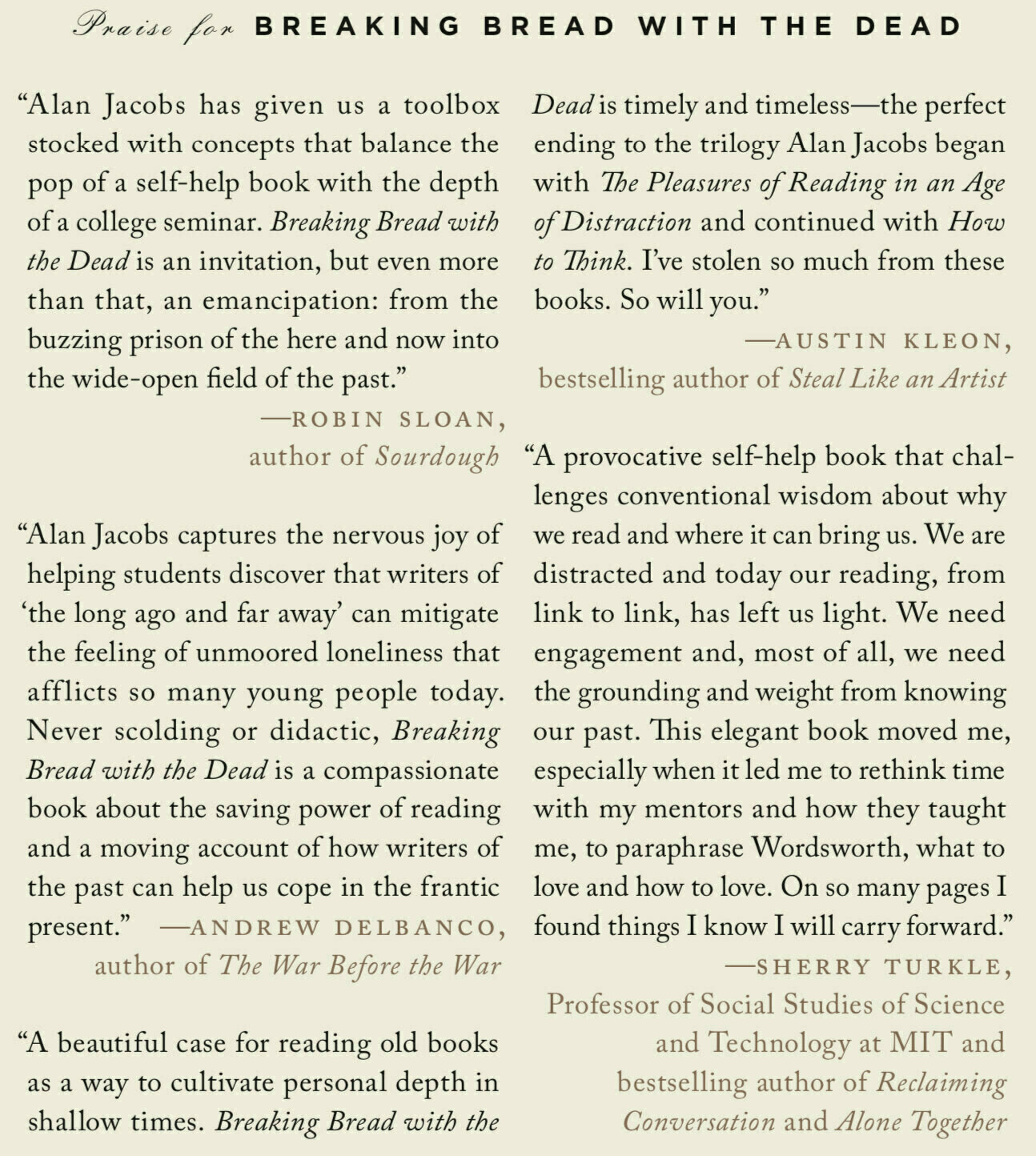
Couldn’t possibly be more delighted with the blurbs for my forthcoming book.

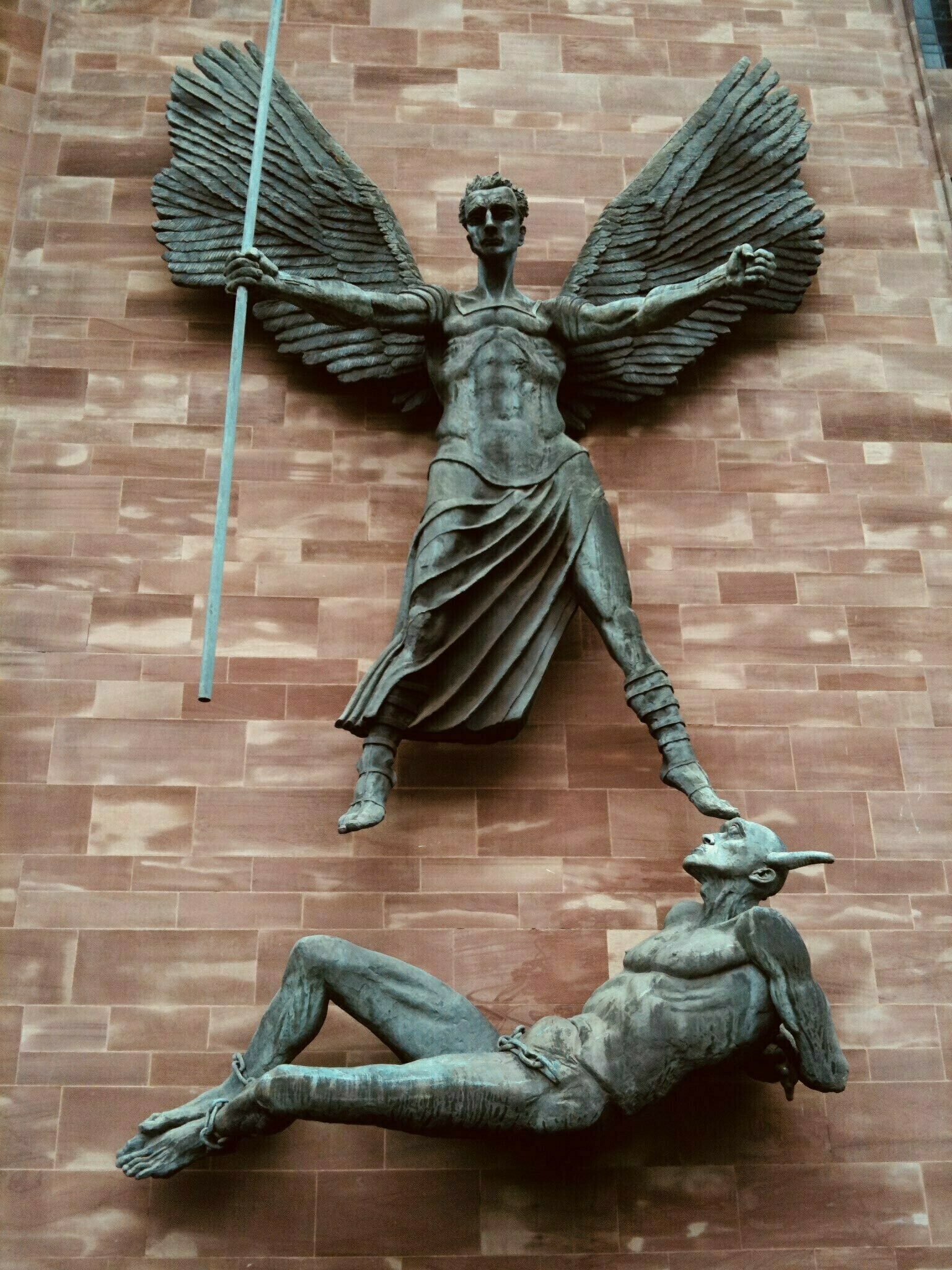
Jacob Epstein’s great sculpture of St. Michael’s victory over Satan at Coventry Cathedral — a memorable image of the ultimate binding of all the forces of evil and darkness.

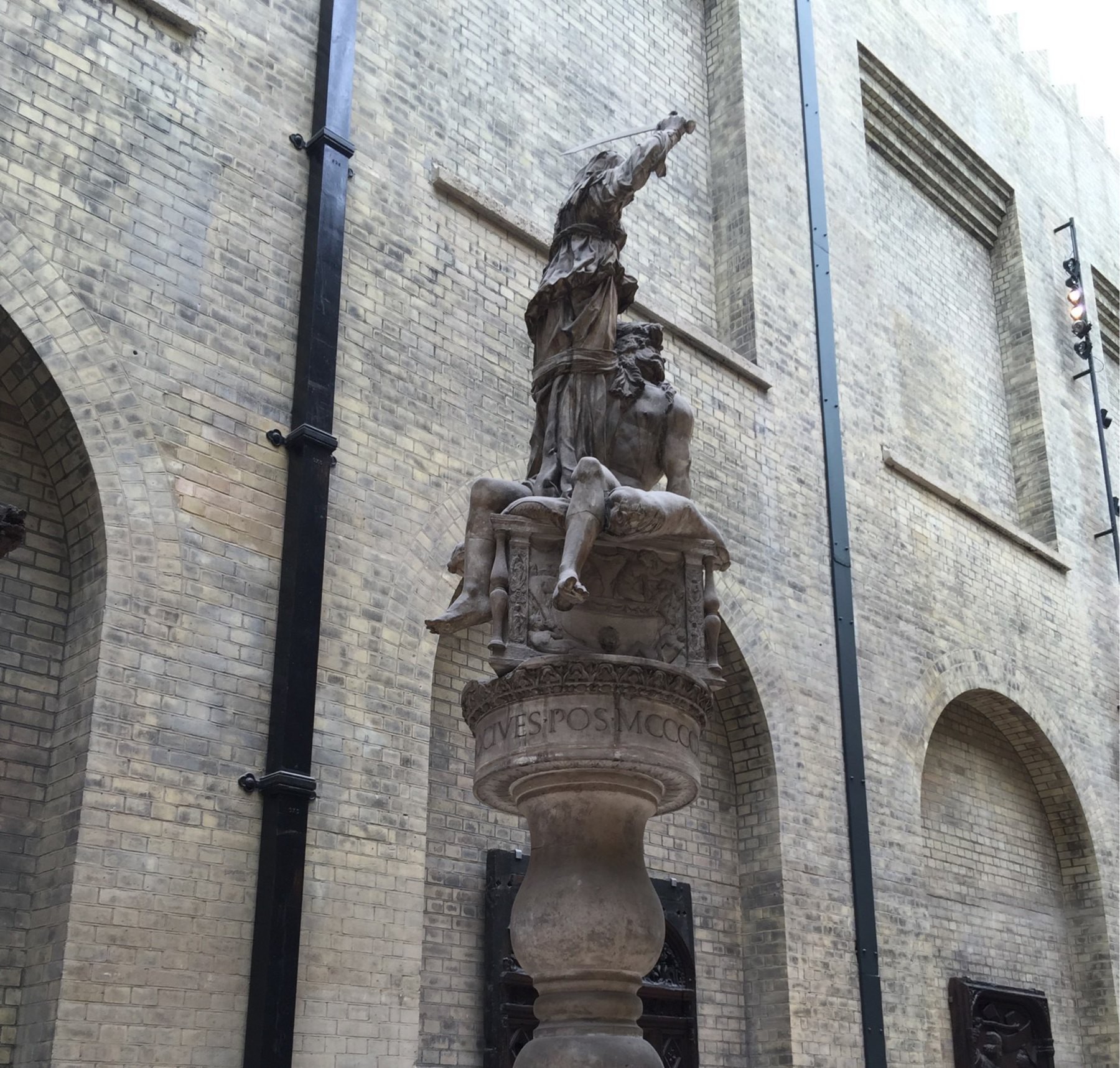
A more peaceful image from the same room

Victoria and Albert Museum, London (2016)
Hard to imagine a more damning chart. But what we will never be able to decide is who, primarily, deserves the blame: Federal government, state government, local government, … or an ungovernable people.

the web as it ought to be
I use Safari as my default browser on the Mac, and the feature I am most thankful for is Reader View. We all have the experience, probably every single day, of opening a webpage only to have the text we want to read obscured by popover ads, which we dismiss only to be assaulted by autoplaying videos and blinking ads. All that represents a money-making strategy I just don’t understand: yes, I know sites need to run ads, but ads that make it literally impossible to read their content? How can that be good? I just don’t get it.
So day after day I scramble to hit the Reader View button, and then set the browser to always open pages from that domain in Reader View. Then, finally, I can read the article … which, four times our of five, turns out not to be worth reading.
So let us now praise TidBITS, the venerable Applecentric website. Take a look at this article. What a clean, readable design! Nothing to interfere with my reading the article — and wow, what a fine article! Informative, clearly written, just the right level of detail. (I knew it would be good before I read a word because of Glenn Fleishman’s name on the byline — everything he writes is worth reading.)
Why can’t more of the internet be like this?
In gratitude, I went right to the Membership page and put my money where my typing fingers are. I would suggest you do the same for any websites that give you the same feeling.
First tomatoes from the garden, full-size + cherry.

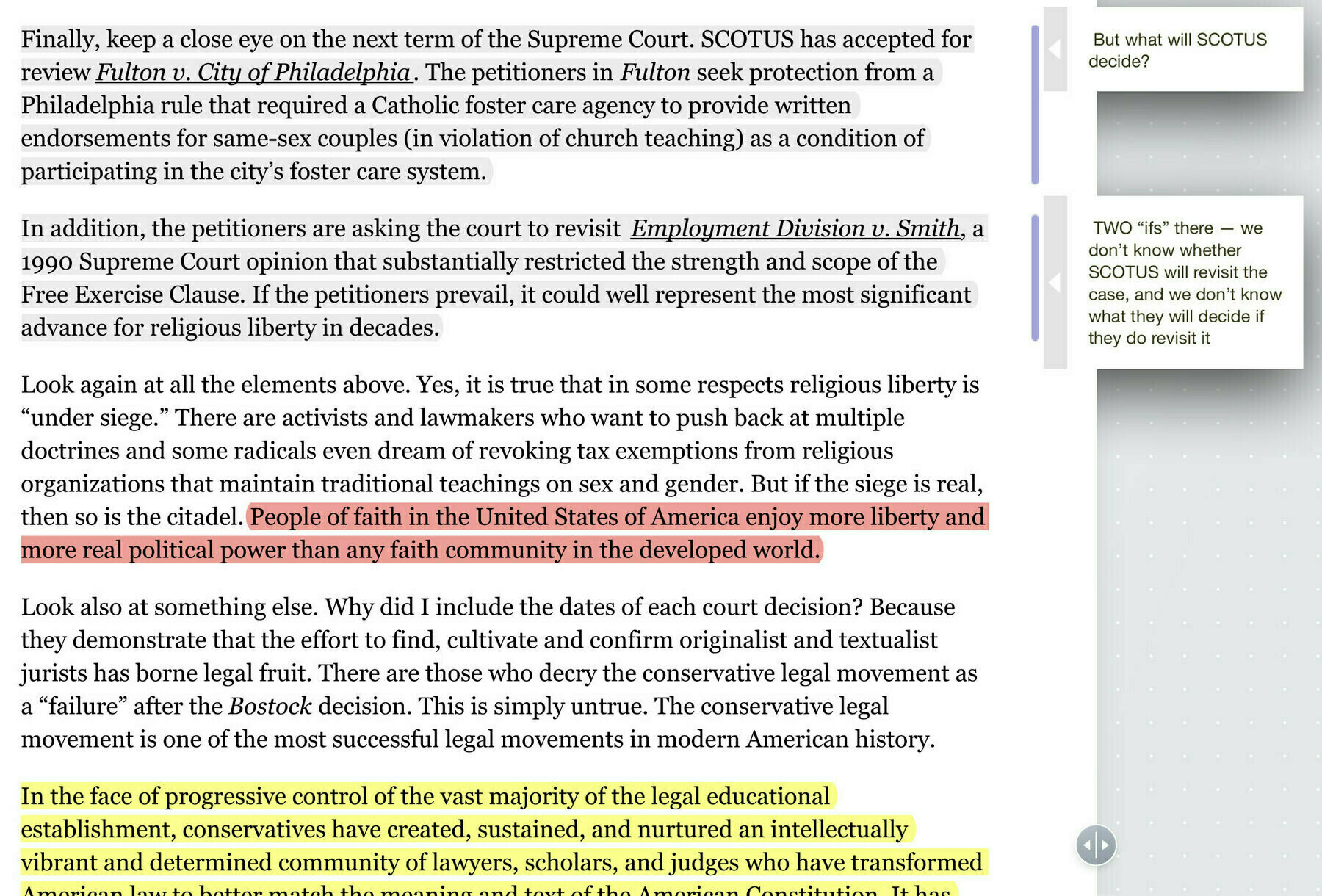
Not just reading David French’s newsletter, I’m annotating it.

unsolicited advice
Here in America, it’s a news week like any other.
- The President retweets, for political effect, a doctored video.
- Tucker Carlson says that Section 230 of the Communications Decency Act is “a special carve-out Google has received from the United States Congress,” even though, as Senator Mike Lee points out, Section 230 was passed by Congress in 1996, two years before Google was founded.
- The ACLU says that “The death penalty evolved from lynching.” Yes, really. Read the tweet and see.
Here’s what I’m trying to do, and what I would encourage you all to do the same: First, take note of the people, like the ones listed above, who do not care whether what they say is true, but only about whether it serves their preferred narrative.
Second, look for people — politicians, journalists, academics — who do care whether what they say is true.
Third, studiously ignore the people in the first group and pay close attention to the people in the second one.
It won’t be easy to find those truth-concerned people. Sometimes you’ll feel like Diogenes with his lantern. But it must be done, for the sake of our collective sanity.
Vieux Carré

Dear Apple
Dear Apple,
I bought my first Apple products — the original (512k!) Macintosh and an ImageWriter printer — in the spring of 1985, and in the decades since have spent thousands and thousands of dollars on things made by you. Do you know why I have been so loyal all these years? Two reasons. One, the quality of your hardware. Two, the quality of the software made by independent developers who create for your platform.
Your own software — operating system and apps alike — has been woefully inconsistent. Every OS release, on all your platforms, brings new features but also new bugs. Especially on the Mac I have perpetual problems with wi-fi, Bluetooth, window management, and support for external monitors. iOS is comparatively more stable but after ten years it’s still impossible even to select text reliably. Your apps are mediocre to poor, with only a few exceptions: GarageBand is a great app, as is Keynote; Preview for the Mac is excellent, and Pages and Numbers have gotten better and better. But again, those are exceptions. Mail is an unmitigated disaster. Safari is adequate but feature-poor and only to a limited degree extensible (though at least it doesn’t eat memory the way Chrome does). Messages is barely adequate on iOS, seriously underpowered on the Mac. Even your Settings and System Preferences apps are poorly designed, in the case of iOS shockingly so.
But you have some amazing developers writing apps for your platforms. Some of the best apps, in my experience:
- BBEdit for Mac
- MarsEdit for Mac
- Pixelmator for Mac and iOS
- Omnigraffle for Mac and iOS
- Drafts for Maxc and iOS
- All of Rogue Amoeba’s software for Mac
- All of Panic’s software for Mac and iOS
Your behavior has been so frustrating to the people at Rogue Amoeba that they have gotten out of the Mac App Store almost wholly — as Bare Bones, the makers of BBEdit, also did for a few years — but not every developer has the kind of widespread and loyal user base that Rogue Amoeba and Bare Bones do. And of course the iOS App Store is the only source for iOS apps, which may explain why Rogue Amoeba doesn’t make any iOS apps.
Apple, your arrogant and dictatorial behavior makes no sense. It’s not in your interest to frustrate your best independent developers. It’s in your interest to get smart, talented people excited about developing for your platforms. Heck, maybe you should be paying them. But short of that, there are three things you need to do:
- Apply your existing rules consistently.
- Alter those rules to promote maximum creativity and ambition in Mac/iOS software development.
- Take a smaller cut so more developers can stay in the game.
Ascending Wansfell Pike, 2011