
Oh great: “A new study suggests that explosive events in space have the potential to temporarily switch off the natural shield that protects us from harmful solar radiation.”
Jon D. Schaff: “Perhaps the great neglected work of our time is Alan Jacobs’s The Year of Our Lord 1943: Christian Humanism in an Age of Crisis.” I’m not here to disagree.
In Sartre's political world there were only oppressors and oppressed: fascism stood for the former, communism for the latter. Likewise, in Algeria, since the native Algerians were by definition the oppressed, they were incapable of sin; conversely, the pieds noirs, the French colonists, were reprobate and irredeemable. Thus Sartre endorsed the decision of the Algerian FLN (Front de Liberation Nationale) to kill any and all French men, women, and children in Algeria whenever possible, a position he was still taking in 1961 when he wrote a famous and lengthy introduction to The Wretched of the Earth, the major work by one of this century's greatest theorists of terrorism, Franz Fanon.
Camus, on the other hand, was himself a pied noir; his family's roots in Algeria went back a century and a half. Members of his family, including his mother, still lived in Algeria and were endangered daily by the FLN's random shootings and bombings. Yet Camus was not, nor had he ever been, indifferent to the abuses the French had inflicted on the Arabs of Algeria. Indeed, in the 1930s, at the beginning of his career as a writer, Camus had striven ceaselessly to call attention to these abuses, but he was generally ignored — by the French Left no less than the Right.
So he was not pleased to have a difficult and morally complex political situation reduced to an opportunity for French intellectuals to strike noble poses: to those who would "point to the French in Algeria as scapegoats ('Go ahead and die; that's what we deserve!')," Camus retorted, "it seems to me revolting to beat one's mea culpa, as our judge-penitents do, on someone else's breast."
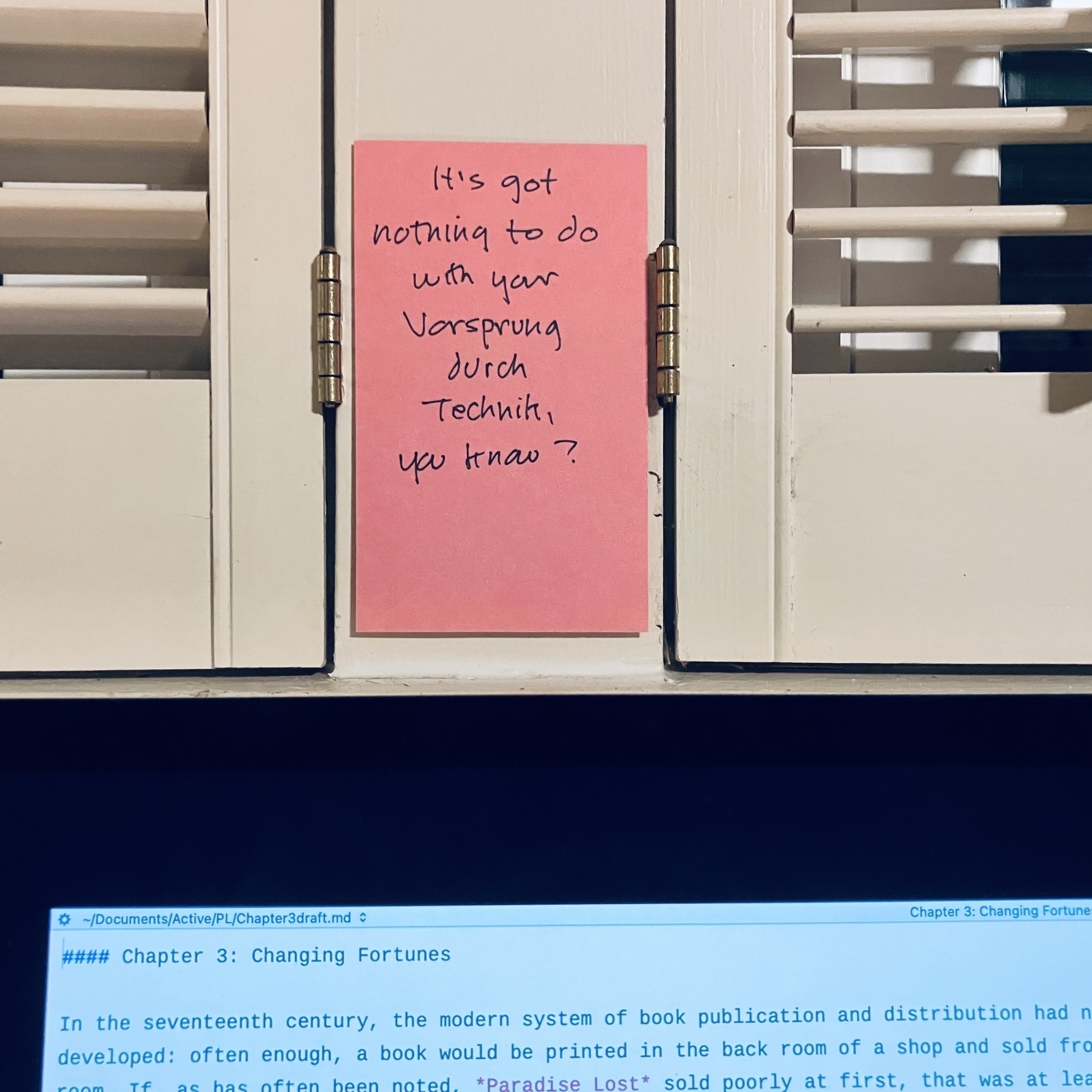
Everybody needs an inspirational quotation over their desk, and this is mine
Kevin Williamson comes to Waco to cover the Texas Nationalist Movement convention. “The Texas Nationalist Movement (TNM) has been making a pretty obvious effort to cut down on its kook factor, but the truth remains — they’re kooks.”
Mann's Joseph: 7
Last post in a series. Previous installments:
- Prelude
- One: the invention of God
- Two: the gods of the nations
- Three: Hermes and Thoth
- Four: Akhenaten
- Five: vertical oscillations
- Six: triangulations
Joseph, the next-to-youngest son of Jacob, rises in his father’s estimation and love, but then is cast down into a pit. He is lifted out of the pit, but then sold into slavery, taken to the underworld of Egypt. He is slave to a rich and powerful man named Potiphar (or, as Mann sometimes calls him, Peteprê), but then is falsely accused of sexual assault by Potiphar’s wife and cast into prison. But then, unexpectedly, Pharaoh Amenhotep IV, later to become Aktenaten, calls Joseph to him: he is in great need of one who can rightly interpret dreams. (“Behold,” his brothers had said, years earlier, “this dreamer cometh.”) And so Joseph rises once more, to become the teacher of the Pharaoh, the vizier of all Egypt, and, eventually, the provider for his family, whom, despite the years of separation, he has never ceased to remember and to love.
•

Thomas Mann wrote most of this fourth book, Joseph the Provider, in southern California, having done some planning and preliminary drafting while still in Princeton, where he had lived from 1938 to early 1941. In his house near the ocean, he lived the life of an exiled Prince of Literature — and in a matter befitting royalty, he gave audiences: for instance, he once served tea and conversation to “an embarrassed, fervid, literature-intoxicated child” — the 14-year-old Susan Sontag. And, thousands of miles from home, he wrote the story of a stranger in a strange land — a clever and victorious one.
During the years of World War II, a large and disorderly community of refugees assembled itself in the Los Angeles area, primarily in Pacific Palisades — a kind of emigré civilization unto itself. There were novelists (Mann, his elder brother Heinrich, Franz Werfel, Aldous Huxley), composers (Arnold Schönberg and Igor Stravinsky), philosophers (Max Horkheimer and Theodor Adorno), film directors (Fritz Lang and Max Ophüls), dramatists (Bertolt Brecht and Lion Feuchtwanger). They were mostly friendly with and grateful for one another — though one had to be careful to make sure that Schönberg and Stravinsky were never in the same room — and some of them stayed for the rest of their lives in California, though others returned to Europe when they fell under the indiscriminately hateful eye of the House Un-American Activities Committee and its associated organs. (Several books have been written about this little world of exiles, but you may read a skillful brief overview by Alex Ross here.)
For decades the brothers Mann had persisted in a slightly ridiculous practice: Every five years they booked a hall somewhere and invited an audience to come listen to each of them read a speech addressed to the other. These events combined sibling rivalry, mutual respect, and sheer pomposity — one German friend called them “ceremonial evaluations of each other” — but how could such an event possibly be staged in Pacific Palisades?
Enter Salka Viertel, whose comical attempts to get Schönberg a job composing a Hollywood film score I wrote about here. As far as I can tell, almost every Jew and anti-Nazi who escaped Europe during the war years was told to head for Los Angeles and get in touch with Salka Viertel. She was (in addition to her paid work as a screenwriter) a hostess, a therapist, a travel agent, an employment service, an introducer — and the maker of flourless chocolate cakes so extraordinary that Thomas Mann once showed up at a wedding of a couple he did not even know because he heard that Salka was baking a cake for the reception.
Of course Salka hosted the soirée for the brothers Mann.

She invited forty-five people, somehow squeezed them into her small house (bringing a ping-pong table inside to make a second dining table helped), and got a friend to make the dinner while she presided as mistress of ceremonies. A few others showed up, purportedly to help serve, but in fact just to hang out in the kitchen and listen to the goings-on. As Donna Rifkind notes in her fine book on Salka Viertel, “Every person in the house that night was an émigré.”
Writing decades later, Viertel primarily remembered the comical aspects of the evening. After Thomas gave “a magnificent tribute to the older brother, and acknowledgment of Heinrich’s prophetic political wisdom, his far-sighted warnings to their unhappy country, and a superb evaluation of his literary stature,” Viertel — not then knowing the brothers’ long practice — was surprised to see Heinrich stand up: “First, he thanked me for the evening then, turning to his brother, paid him high praise for his continuous fight against fascism. To that he added a meticulous literary analysis of Thomas Mann’s oeuvre in its relevance to the Third Reich.” (In fact, Heinrich toasted Viertel’s hospitality at the end of his speech, and a gracious toast it was too.)
But more than this was said. Near the end of his speech, Thomas declared,
Our Germans believe too strongly in crude success, in force, in war. They believe that all they had to do was create iron facts, before which humanity would surely bow down. It will not bow down before them, because it cannot. Be one’s thoughts of humanity ever so bitter and dubious — there is, with all the wretchedness, a divine spark in it, the spark of the intellect and the good. It cannot accept the final triumph of evil, of lies and force — it simply cannot live with it. The world, the one resulting from the victory of Hitler, would indeed be not only a world of universal slavery, but also a world of absolute cynicism, a world that flew in the face of every belief in the good, in the higher qualities within human beings, a world that belonged utterly to evil, a world submissive to evil. There is no such world; that would not be tolerated. The revolt of humanity against a Hitlerian world of the complete negation of what is best in human beings — this revolt is the most certain of certainties; it will be an elemental revolt, before which “iron facts” will splinter like tinder.
And near the end of his speech, Heinrich said,
We must preserve the hope of growing older than virulent hatred and sensation, which is the source of its own ghostly mischief. And, not to forget a wholesome measure of doubt: “When the world drags itself out of one mud hole, it falls into another; moral centuries follow centuries of barbarism. Barbarism is soon swept away; soon it comes again: a continual succession of day and night.” This was said in a century of morality — by Voltaire, and the age was moral only with him.
It was an early May evening in Pacific Palisades, and the view from the end of the block disclosed the beach and, beyond, the sun setting over the Pacific. Flowers were everywhere in bloom. And, Saska Viertel tells us, as the brothers Mann spoke their words of defiance and hope, the refugees hiding in her tiny kitchen wept.
That is the context in which the final volume of Mann’s tetralogy — what he called “this invention of God, this beautiful story” — was written.
•
All this may help to explain something that otherwise might seem odd: the almost complete disappearance from the story of all the metaphysical and mythological games that I have been tracing through each of the posts in this series. What we get instead is something simpler: a story of lost years redeemed, of enemies (including the enemies inside each of us) thwarted, and of the power of reconciliation.
One of the most extraordinary moments in the whole tetralogy comes when Joseph’s brothers beat him and throw him into a pit, and what’s extraordinary about it is Joseph’s reaction: For he realizes that they have only treated him this way because he had been very mean to them — belittling, arrogant, taunting. In the pit he begins to know himself.
This is not to say that the brothers are faultless. They are in many respects a nasty collective piece of work. They are needlessly cruel to their enemies and only slightly less cruel to members of their family. They scheme and deceive. And even after Joseph has done everything for them, they can’t escape their suspicious natures, they can’t stop scheming, they can’t stop fearing that Joseph might not be so much better than them after all. You can read the story here.
And here is the speech that Mann gives to his hero at the very end of the tetralogy, “this invention of God”:
“But brothers, dear old brothers,” he replied, bowing to them with arms spread wide, “what are you saying! You speak exactly as if you feared me and wanted me to forgive you. Am I as God? In the land below, it is said, I am as Pharaoh, and though he is called god, he is but a dear, poor thing. But in asking for my forgiveness, you have not, it appears, really understood the whole story we are in. I do not scold you for that. One can very easily be in a story without understanding it. Perhaps it was meant to be that way, and I have only myself to blame for always understanding too well the game that was being played. Did you not hear it from our father’s lips as he gave me my blessing, that in my case it has always been merely a playful game and an echo? And in his departing words to you did he even mention the nasty thing that happened between you and me? No, he said nothing of it, for he was also part of the game, of God’s playful game. Under his protection I had to rouse you, by my brazen immaturity, to do evil, but God indeed turned it to good, so that I fed many people and matured a little myself besides. But if it is a question of pardon among us human beings, then I am the one who should beg it of you, for you had to play the evildoers so that everything might turn out this way. And now I am supposed to make use of Pharaoh’s power, merely because it is mine, to revenge myself on you for three days of chastisement in a well, and again turn to evil what God has turned to good? Don’t make me laugh! For a man who, contrary to all justice and reason, uses power simply because he has it — one can only laugh at him. If not today, then sometime in the future — and it is the future we shall hold to.”
NYT: What’s an example of when a publisher or someone else in the [publishing] business disagreed with you and they turned out to be right?
Andrew Wylie: I don’t think that’s ever happened.
And then, later in the interview, Wylie answers a question witth a question:
Wylie: What are your goals?
NYT: To matter in the culture?
Wylie: No. Absolutely not. Who gives a [expletive]? You want to matter in this culture? Not me.
He’s a massive jerk, but boy is he right about that last thing.
Premier League players are acclimating themselves to the tyrannous reign of VAR: It’s become increasingly common for players who score to avoid celebration; instead they stand around and wait for the possible (likely?) overturning of the goal by someone not on the pitch. ⚽️
I would venture to guess that the people we would least like to spend a long time with are those who have answers to every question and plans for every contingency. There’s something slightly inhuman about that, because if we believe that our humanity is constantly growing, then there have got to be moments when we are taken beyond the familiar and the controllable. A growing humanity, a maturing humanity, is one that’s prepared for silence, because it’s prepared at important moments to say, “I can’t domesticate, I can’t get on top of this.”
God is that environment, that encounter, that we will never get to the bottom of and that we will never control. To understand that there’s something about silence that is profoundly at the heart of being human begins to open up a recognition: being Christian requires us more than ever to come to terms with those moments when silence is imposed on us, when we face what we can’t control.
Relevant to me.