I’ve almost completely given up on podcasts, but have become a heavy user of the BBC Sounds app. The 4-part BBC radio series on Seamus Heaney is worth a hundred podcasts. Ditto the new series on the Beatles narrated by Martin Freeman.
Starting the day listening to my friend Sara Hendren (@ablerism) interviewed by Krista Tippett. So great. I never say “Everyone should read/watch/experience X,” but really, everyone should listen to this interview (or read the transcript if that works better for you).
I’m rarely envious, but okay, I’m envious.
David Stoll: “The call to decolonize anthropology sounds as distinctively American as the Statue of Liberty. If even anthropologists must reinterpret everything we find in terms of U.S. anti-racism, who else will point out how poorly this paradigm illuminates the rest of the world?”
A significant change in Siri dictation over the past few months: commas. Commas that I don’t ask for. Lots and lots of commas. This has made dictation effectively unusable for me, and I wonder whether it’s time for me to start looking for a different phone. The degradation of Apple’s software quality on all of its platforms over the past couple of years has been, frankly, shocking to me. See, e.g., this post by Michael Tsai.
Slanted and disenchanted

The most delightful thing about Arthur C. Clarke’s famous comment that “any smoothly functioning technology gives the appearance of magic” is how obvious the point is once you read it. But because the point is so retrospectively obvious the phrase tends to get deployed unimaginatively. It’s actually more subtle, and perhaps consequential, than it appears to be.
Here’s another way to put Clarke’s point: Many or most human beings have in our intellectual toolbox a category – one that we that may for convenience' sake call “magic” – that we deploy in situations in which we perceive certain ends achieved but cannot perceive the means by which the achievement was accomplished. There’s a large metal box in my kitchen that is filled with cold air, this I know, but how it makes the air cold may not only be unknown to me but effectively unimaginable. Or: A tall black monolith has appeared in the midst of my small band of early-hominid hunter-gatherers, this we know, but how it got there and what it is we cannot guess.
If you read much of Clarke’s writings you know that Clarke doesn’t believe in magic – that is, in forces outside the laws of physics as we know them that produce effects in the physical world – but it’s worth noting that his point stands whether you believe in magic or not. Even if magic can be done, it remains true that any smoothly functioning technology etc. etc. That is to say, Clarke’s statement is not a metaphysical claim but a phenomenological one - it is about “appearance,” about what presents itself to us, about what we perceive. Whether we are perceiving accurately, and how what we perceive might be explained – these are epistemological questions. In this case, epistemology (theory of knowledge) is brought in to help us understand the gap (or, in some cases, fit) between what we perceive and what is.
In these respects, Clarke’s statement resembles Max Weber’s famous description of “the disenchantment of the world” (Entzauberung, unmagicking). Weber is not saying that once the world was filled with disembodied spirits subject only to metaphysical rather than physical description, spirits that have now departed. He’s saying that that’s what the world feels like – it reads to us like a place where transmissions from the far invisible have ceased. In such a phenomenological environment, what do we do when things happen that we don’t know how to account for – when we see the ends but cannot imagine the means?
And this can happen to us when we read fiction as well, an experience I can perhaps describe in this way: Any imaginatively conceived and coherently presented work of science fiction reads like a work of fantasy.
In Adam Roberts’s new novel The Death of Sir Martin Malprelate these very themes are pursued, these questions are posed, in a provocative and delightful way. What do you do if you are a rational man, a man of science, and begin to see things that science (as you understand it) cannot explain? What do you do if you’re reading a novel and can’t tell if it’s fantasy or science fiction?
If these questions interest you, you’ll very much enjoy (as I did) The Death of Sir Martin Malprelate.
I wrote about the importance, when thinking about politics, policy, and war, of learning what everything costs.
what everything costs
As long as resources are finite, any political or social policy helps some people at the expense of others. Any serious thinker will admit this and will be quite clear about who gets hurt. For instance, Marx & Engels in the Communist Manifesto say to the bourgeoisie, “In one word, you reproach us with intending to do away with your property. Precisely so; that is just what we intend.” And, they explain, we’re doing it because (a) you have immiserated the proletariat and therefore deserve to have everything taken away from you, and (b) revolution against your class is a necessary step towards social utopia. Couldn’t be more straightforward! (That said, M & E are not always so straightforward, as I will explain in a later post.)
I speak of political thinkers here because I take it as axiomatic that no politician will ever acknowledge the costs of his or her preferred policies.
Especially in time of war, few political commentators take even the first step towards this vital honesty, which is to admit that someone will be hurt. Significantly fewer still take the next step, which is to acknowledge the extent of such pain — they will make their calculations based on the best-case scenario, or indeed something rather better than that.
Commentators who frankly and openly acknowledge the real likely costs of their preferred policies are to be prized above rubies. But there will never be many of them, because — again, especially in time of war — almost every policy has higher costs than its supporters want to admit, and if readers see the probable consequences, they may well decide that the game isn’t worth the candle. And indeed, partisans and advocates are always (usually unconsciously) preventing themselves from thinking through what will happen if they get their way, because if they look clear-sightedly at reality they might lose their nerve. This is why, George Orwell, in the essay in which he says, “In our time, political speech and writing are largely the defence of the indefensible,” also says that people employ vacuous clichés because “at need they will perform the important service of partially concealing your meaning even from yourself.”
I just finished teaching Middlemarch, that incomparable book, and there’s an immensely touching moment near the end when Dorothea is preparing to embrace a more financially constrained life, and in her ardent way talks of how she will change her habits. She ends by saying, almost sobbing, “And I will learn what everything costs.” Socrates, what is best for men? Maybe it’s to learn what everything costs.
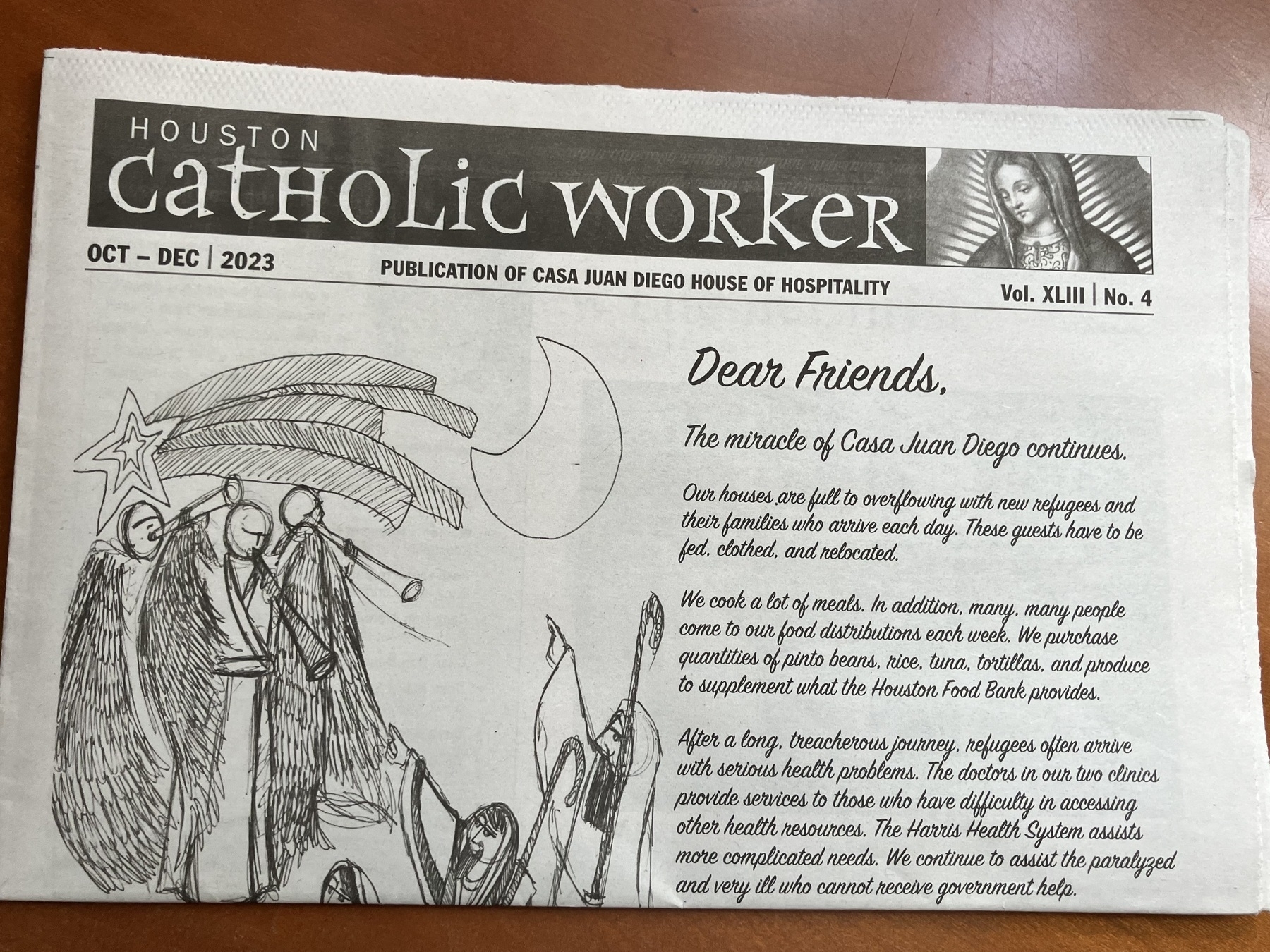
Many years ago, when I was teaching at Wheaton College, someone put me on the mailing list for the Houston Catholic Worker newspaper. No idea who, or why (I am not Catholic). But I liked getting it, and when an issue came in I always stopped to pray for their work. Then, soon after I came to Baylor, issues starting arriving at my office here! So I continued my practice of praying for what certainly seems to be a wonderful ministry.