
web design is getting worse and worse
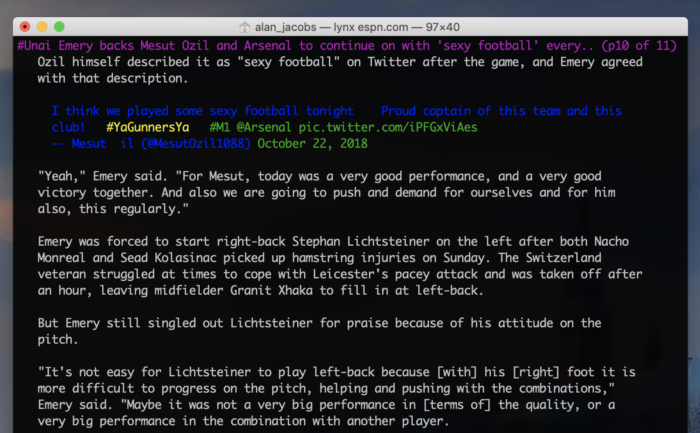
For instance, ESPN’s site is so ugly, so crowded, so impossible to navigate that when I really want to read ESPN stories this is how I’m doing it:


Breaking Bread with the Dead
I tweeted this news a while back, but am only now finding time to write about it at greater length: My next book will be called Breaking Bread with the Dead: The Case for Temporal Bandwidth, and will be published by Penguin Press in the autumn of 2020. You can find a kind of preview of the book by reading this essay I wrote for the Guardian.
I think of this book as the conclusion of my Pedagogical Trilogy, the first volume of which was The Pleasures of Reading in an Age of Distraction and the second of which was How to Think. Finding delight in reading, learning to think well in opposition to all the social forces that impede thinking, drawing on the wonderfully diverse intellectual resources of the past — these three themes encapsulate much of what I have tried to teach my students for the past thirty-five years.
If you’d like to pre-order the book from Amazon, you may do that here. I’ll add other sources as they become available.
Writing well ≠ dumbing down
This by Ian Bogost is exactly right:
I suspect that what scholars and other experts really mean when they express worry about “dumbing down” is that they don’t want to be bothered to do the work of reframing their work for audiences not already primed to grasp it. It’s hard to do and even harder to do well. That’s a fine position; after all, it’s the full-time job of journalists and non-fiction writers to translate ideas for the general public from their specialized origins. Not every scholar can, or should, try to do this work themselves (although, to do so exercises the generosity that comes from service.)I have done a great deal of writing for my scholarly peers and for broader audiences, and there is no doubt that the latter is more challenging. The great difficulty is to make what you have to say as simple as possible but no simpler — which means that you often have to work very hard to express certain ideas in ways that are accessible but non-reductive.But to assume that even to ponder sharing the results of scholarship amounts to dumbing down, by default, is a new low in this term for new lows. Posturing as if it’s a problem with the audience, rather than with the expert who refuses to address that audience, is perverse.
And — I hesitate to say this, but here goes — I think you usually have to know your stuff better to write well for a general audience. If you’re writing for your scholarly peers, there are certain critical buzzwords, voguish phrases, and terms of art that you can use to gesture in the direction of a concept, trusting that people who have used those terms themselves will pick up on what you’re saying. But you don’t even have to have a very clear understanding of the concepts in order to deploy the terms — you just have to have a sense of the kind of sentence in which they belong. By contrast, when you’re writing for a general audience who does not know the language of your guild, you have to understand those concepts well enough to translate them into a more accessible idiom.
Many academics who haven’t tried to write for broader audiences fail to understand the challenges. But I bet at least some of them have a pretty shrewd intuition of how hard it is — which gives them a good reason to sneer at it.

"drive out the wicked person"
Michael Ramsey, from The Anglican Spirit:
While holiness is both a fact and a potentiality, it is impossible to enforce the holiness of the church by rejecting people who do not conform to certain moral canons. That has been tried often in the history of the church, most notably by the early Puritans. When one says that the church is meant to be holy and therefore we will exclude those who are not holy, the inevitable happens. You can turn out the fornicators, the murderers, and those who apostasize in times of persecution; you can turn out sinners of every kind, but you cannot turn out the sin of pride. This sin, the most deadly of all, is always present but not always easily identifiable. So if you are going to purge the church of sinners, you will need to purge it of the sin of pride and turn everybody out. As Anglicans, we believe these attempts to purify the church by certain ethical criteria cause it to lose the reality of what it means to be dedicated to the holiness of God.St. Paul, from his first letter to the church at Corinth:
I wrote to you in my letter not to associate with sexually immoral persons — not at all meaning the immoral of this world, or the greedy and robbers, or idolaters, since you would then need to go out of the world. But now I am writing to you not to associate with anyone who bears the name of brother or sister who is sexually immoral or greedy, or is an idolater, reviler, drunkard, or robber. Do not even eat with such a one. For what have I to do with judging those outside? Is it not those who are inside that you are to judge? God will judge those outside. “Drive out the wicked person from among you.”So Ramsey is simply wrong, isn’t he? For when he says “we believe these attempts to purify the church by certain ethical criteria cause it to lose the reality of what it means to be dedicated to the holiness of God,” he certainly seems to be flatly disagreeing with St. Paul. And surely this is not acceptable — even for Anglicans.
Whether we leave it at that will depend, I suspect, on whether we think Paul’s list of those who must be driven from among us (“sexually immoral or greedy … an idolater, reviler, drunkard, or robber”) is exhaustive or illustrative. If the former, then Ramsey is absolutely and totally wrong, full stop. For Paul does not say that we are to drive the prideful from among us — nor, for that matter, the violent, the habitually dishonest, and so on.
But if Paul’s list is illustrative, and his point is that ecclesial communities should shun what the old prayer book calls the “open and notorious evil liver,” then Ramsey is still wrong, I believe — but despite being wrong he calls us to reflect on something important: that is is very easy to be highly selective, and selective in a fundamentally unprincipled way, about which sinners we shun. For in an environment where declining church attendance makes pastors disinclined to shun anyone, the low-hanging fruit is to drive out from among you those (a) whose sins are really obvious and (b) who are already unpopular with your regular attenders, your most generous givers.
It’s easy enough to say that when pastors discipline big donors — which no doubt sends said donors headed straight for the door — their people will really respect them for it. Unfortunately that isn’t true. People will just think those pastors are stupid. And few pastors actually are that stupid.
I really feel for pastors in this situation. I don’t know what they can do that isn’t either disobedient, self-destructive, or inconsistent (inconsistent at best, hypocritical at worst). The state of American Christianity today, with its inherent consumerism, means that any pastors who try to impose church discipline impartially will find themselves with an empty church or, more likely, find themselves out of a job. But, as Lyle Lovett once said in a rather different context, we have to try. What would we be if we didn’t try?
So the question is: What would a truly Christian, truly biblical, model of church discipline look like?
back to the Mac
I’ve spent a lot of time in the past year trying to leave the Mac behind and move full-time to iOS. I’ve done this in large part because the many and various problems I’ve had with the last several versions of Mac OS have convinced me that it’s not getting Apple’s best attention, that iOS is likely to be the more reliable platform in the future, and that I’d do well to start adapting my patterns and habits accordingly.
Of course, iOS isn’t the only option, and in fact, a couple of years ago I tried to move to Linux. But not only am I pretty heavily invested in the Apple ecosystem, my family members are also, and on Linux I really missed the convenience of sharing apps, answering phone calls on my computer, Messages, FaceTime, etc. So I was gradually sucked back into Cupertino’s orbit.
So, I tried Linux, and then I tried iOS. Now I’m back to the Mac. Why? There are many reasons, but here are the biggies:
- As many, many people have pointed out, text selection has never worked consistently in iOS and has not improved even a little bit over the past few years. And text selection is something I do a lot of.
- I have often sung the praises of pandoc — it is essential to my work — and there is simply no equivalent of pandoc on iOS. You can do most of the things pandoc does there, but with more steps, more effort, and less consistent results.
- Mojave has fixed all the problems I had with the previous two or three versions (I’m especially pleased that wifi and Bluetooth both work flawlessly now).
- On iOS, TextExpander works in some apps; on the Mac, it works everywhere. This is huge for me. I have developed a very large library of TextExpander snippets over the years, and when I’m writing in an app and they don't work I get weird glitches in my neural software.
American Airlines rejects my reality and substitutes its own
Yes, this is a kind of rant, but it’s also something more: an account of how transcendentally weird air travel can be these days.
A few days ago my wife and I were scheduled to fly on American Airlines from Dallas to Charleston. But our flight, which was to leave just after 11am, was delayed and delayed and delayed, and when we were told that our plan couldn’t be repaired and a new plane had to be found, Teri and I decided to see if we could be rebooked on another flight, the AA rep at the gate said that neither she nor anyone else at the airport could help us (!?) — we would have to call AA’s toll-free number. So, around 1pm, we did, and here’s what the customer service rep told us: “I can’t help you because your flight is already in the air.” I said, “I’m sitting here at the gate with maybe a hundred other people waiting for a new plane.” “I’m sorry, your flight is already in the air. It departed at 12:53pm.” And then she hung up. That’s when I took this screenshot of my just-updated AA app:

At this point we were at a loss, but as more time went by and there was no sign of a plane, we decided to give up and go home. Then each of us got busy seeking a refund (Teri’s return flight was different than mine, and her fare was purchased separately.)
Today I got an email from AA reading thus: “In fact flight AA2646 was only delay for 14 minutes before taking off on October 19, 2018. I would not be able to offer a refund for the ticket or waive the change fee.” Wait, 14 minutes??? Even the person who insisted that the flight was already in the air at 1pm thought it had just taken off, nearly two hours late.
Apparently no one in customer service at American Airlines has even remotely accurate data about the status of their flights. Moreover, that data seems to be in constant flux.
Well, maybe someone does, because about an hour before I got that email here’s what Teri got:

So, though we were booked on the same flight, hers was either cancelled or delayed so long that she got a refund, while mine was only 14 minutes late. Proof of the multiverse hypothesis, I guess?
But I’ll tell you this: I ain’t flying American Airlines again.

ancient feelings
Why doesn’t ancient fiction talk about feelings? “I’d often wondered,” says Julie Sedivy, “when reading older texts: Weren’t people back then interested in what characters thought and felt?” Let me put this as politely as I can: What the hell are you talking about?
If you read the Iliad you’d know how Achilles felt when Agamemnon took his “prize,” or how he felt when his beloved friend Patroclus was killed. If you read the Odyssey you’d know how Odysseus felt when his men were being eaten by Polyphemus, and how he felt when he fell, at last, into the arms of his beloved wife Penelope. If you read the Oresteia you’d know how Orestes felt when faced with the task of killing his mother. If you read Antigone you’d know how the title character felt when told she could not bury her brother. If you read the Aeneid you’d know how Aeneas felt when he saw his fellow Trojans painted on the walls of a palace in Carthage — sunt lacrimae rerum, there are tears for things, possibly the most famous line in ancient literature — and how Dido felt when she learned that Aeneas would leave her. If you read Beowulf you’d know how Beowulf felt when, after slaying a dragon, he lay dying, abandoned by all but one companion. If you read the Divine Comedy you’d know how Dante the pilgrim felt about everything, from getting lost in a selva oscura to disappointing his guide Vergil to meeting his old friend Casella the musician to being reunited with Beatrice.
I’m old as dirt and have seen people take many ridiculous positions in my time, but none more ridiculous than this.
Hastings House Book of Hours

The lovely Hastings House Book of Hours, from this great I Love Typography post, which has other cool images as well.
extremely spoilery thoughts about Better Call Saul
I’m a deeply committed fan of Better Call Saul, to the extent that after each episode I listen, hungrily, to the Better Call Saul Insider Podcast. I am endlessly fascinated to learn about the enormously complex, deeply intelligent, technically sophisticated, emotionally sensitive collaborative energy that goes into making a show like this. Every time I listen I discover something about the show that I had missed, something that makes its already-powerful story even more powerful.
It’s also fun to hear how closely the actors (there’s usually, though not always, one each episode) identify with their characters, in ways that reveal them, the actors, as often insightful and sometimes unreliable. When Michael Mando explains how he sees Nacho as motivated largely by shame — shame before his honorable father — I immediately see the truth of it. When Bob Odenkirk defends Jimmy’s indefensible actions, I just shake my head in disbelief. By far the most interesting of the actors on the podcast, though, is Rhea Seehorn, who is extremely articulate in analyzing Kim but insightful into other characters as well.
In sum: the podcast is a great supplement to the show.
What follows is super-spoilery.
In a vital scene in the just-released final episode of Season 4, Jimmy McGill breaks down weeping in his car. When that scene was discussed on the podcast, I was struck by the number of participants who believe that he was finally weeping for his dead brother Chuck. No, he definitely wasn’t.
Many of the people on the podcast, regulars and guests, believe that Jimmy is in the denial stage of grief, or something like that. On the show itself, Kim seems to think the same — you can’t be sure because neither Kim nor Jimmy tends to speak what they feel — but I believe that it’s her sense that Jimmy hasn’t processed Chuck’s death that prompts her to press him to seek counseling. But when, briefly, he says he will, it’s not because of Chuck: it’s because he got mugged by some punks when trying to run a scam and he’s concerned that he’s still acting like he’s 20 years old.
In my judgment Jimmy has never grieved Chuck’s death and never will. The last words Chuck said to him were, “The truth is, you’ve never mattered all that much to me.” And I believe that from that moment on Chuck was completely dead to Jimmy already.
So why does he cry in his car?
In the previous scene, Jimmy has sat in a conference room with a bunch of other lawyers interviewing high school students who have applied for a scholarship. Jimmy argues on behalf of a girl who had been convicted of shoplifting when younger but has put her life together; he says that at least one of their scholarships (there are three to distribute) should go to someone who isn’t perfect, who has made mistakes and triumphed over them. But that argument falls on deaf ears, and after the decision is made Jimmy catches up with the girl and gives her an impassioned speech explaining that people like her never get a fair shake and never will, and that she has to be bold, has to cut corners, has to do everything she can, no matter how ruthless, to maneuver around those people. So what, Jimmy says, if they’re sitting there on the 35th floor judging you? You don’t care because you’re gonna be on the 50th floor looking down at them.
And then he goes back to his car. His old, beat-up car, with a mismatched door, the same one he’s had since we first saw him. And, as is often the case, it won’t start. And that’s when he starts crying.
This episode begins with a flashback to Jimmy and Chuck, right after Jimmy is sworn in as a lawyer, going to a karaoke bar with friends and singing Abba’s “Winner Takes It All.” And Jimmy actually quotes that song to the girl who didn’t get the scholarship. (He doesn’t say, but he means, this line: “But I was a fool / Playing by the rules.”) The song tells us that the winner takes it all, but is also tells us that “the loser has to fall.” And what Jimmy is facing at this moment is, simply: he’s a loser. As Kim told him in a previous eposode, when he complained that she was “kicking a man when he’s down,” “Jimmy, you’re always down.” He’s not on the 50th floor looking down on anyone. He’s sitting in an old beater that won’t start, because that’s all he can afford. The loser has to fall, and does.
And I think this is the point of no return for Jimmy — the point at which it’s absolutely inevitable that he’ll become Saul Goodman, unscrupulous, lying, deceitful, dishonest, crooked as crooked can be. Because he tried, at least sometimes, playing by the rules and the result is, he’s always down. I don’t think he’ll play by the rules any more.
At the end of the episode and the season, Jimmy has just regained his law license — by faking sincerity more skillfully than he had faked it before —, and we learn that he’s not going to practice under his own name but under the name Saul Goodman. The key point is that Kim learns it at the same moment that we do. He hasn’t told her. He has shut her out, just as he had earlier shut out Chuck, though for far less reason, since Kim has been far better to him than he ever deserved. Kim now sees that there is nothing fully human behind the mask. I don’t see how she can ever trust him again.
a parable for our moment
In this moment when more and more people are calling us to denounce family members who vote the wrong way, I find myself thinking of a passage from an essay I wrote many years ago about Albert Camus:
Camus… was himself a pied noir; his family’s roots in Algeria went back a century and a half. Members of his family, including his mother, still lived in Algeria and were endangered daily by the FLN’s random shootings and bombings. Yet Camus was not, nor had he ever been, indifferent to the abuses the French had inflicted on the Arabs of Algeria. Indeed, in the 1930s, at the beginning of his career as a writer, Camus had striven ceaselessly to call attention to these abuses, but he was generally ignored — by the French Left no less than the Right.So he was not pleased to have a difficult and morally complex political situation reduced to an opportunity for French intellectuals to strike noble poses: to those who would ‘point to the French in Algeria as scapegoats (‘Go ahead and die; that’s what we deserve!’),’ Camus retorted, ‘it seems to me revolting to beat one’s mea culpa, as our judge-penitents do, on someone else’s breast.’ Those who are really so guilt-stricken at the French presence in Algeria should ‘offer up themselves in expiation.’
Camus boldly affirmed that his family, ‘being poor and free of hatred’ — and Camus really was raised in abject poverty — ‘never exploited or oppressed anyone. But three quarters of the French in Algeria resemble them and, if only they are provided reasons rather than insults, will be ready to admit the necessity of a juster and freer order.’ It should, then, be possible to give the proper rights and freedoms to Algerian Arabs without condemning and destroying the pieds noirs indiscriminately, or forcing them out of the only country they had ever known.
But such subtleties were lost on almost everyone involved in this conflict. When Camus received the Nobel Prize in 1957 and gave a press conference in Stockholm, he was bitterly condemned by an Arab student for failing to endorse the FLN. His reply was simple, direct, and forceful: ‘I have always condemned the use of terror. I must also condemn a terror which is practiced blindly on the Algiers streets and which may any day strike down my mother or my family. I believe in justice but I will defend my mother before justice.’
two quotations on democracy and the judiciary
In the face of an enemy Supreme Court, the only option is for progressives to begin work on a long-term plan to recast the role of fundamental law in our society for the sake of majority rule—disempowering the courts and angling, when they can, to redo our undemocratic constitution itself. This will require taking a few pages from the conservative playbook of the last generation. It is conservatives who stole the originally progressive talking point that we are experiencing “government by judiciary.” It is conservatives who convinced wide swathes of the American people that it is the left, not the right, that too routinely uses constitutional law to enact its policy preferences, no matter what the text says. The truth is the reverse, and progressives need to take back the charge they lost. To do so, they need to abandon their routine temptation to collude with the higher judiciary opportunistically. Progressives must embrace democracy and its risks if they want to avoid the stigma of judicial activism that still haunts them from the past.
The editors of First Things, 1996:
With respect to the American people, the judiciary has in effect declared that the most important questions about how we ought to order our life together are outside the purview of ‘things of their knowledge.’ Not that judges necessarily claim greater knowledge; they simply claim, and exercise, the power to decide. The citizens of this democratic republic are deemed to lack the competence for self-government…. The courts have not, and perhaps cannot, restrain themselves, and it may be that in the present regime no other effective restraints are available. If so, we are witnessing the end of democracy.
I have so many questions
These are all serious questions — not gotchas - they’re questions I don’t know the answers to and wish I did. And of course knowing the answers from any one person wouldn’t help very much: what I really need is access to the Zeitgeist on these points. But that knowledge isn’t available. Still, I can’t stop wondering. So here goes:
If you’re, let’s say, Alexis Grenell and you believe that women who supported the confirmation of Brett Kavanaugh are “gender traitors” who have made a “blood pact with white men,” what do you do if you find yourself sitting at dinner with such a woman? Say six of you are eating out somewhere and one woman you hadn’t previously met says that she would have voted to confirm Kavanaugh. Do you get up and leave? Try to persuade her that she’s wrong? Throw water in her face? Sit and steam?
What if you don’t throw water in her face but another woman at the table does? Are you okay with that?
If you could get her dismissed from her job, would you consider doing that?
What if the person who supports Kavanaugh is an old friend? Does that, for you, end the friendship?
Now, a question for people who support confronting and challenging politicians at restaurants and other public places. What is your goal? Is it simply punitive, or do you believe that by doing that kind of thing you can change a politician’s mind? (NB: If you’re the sort of person who shows up at a pizza parlor with a gun because of something you read online, you need not answer this question.)
How do you think you would respond if you were subject to the same protests? Would you be intimidated into voting the way the protestors want you to vote? Would you become more sympathetic to their cause?
Presumably you know that what one side does the other will soon copy. So if this escalates to the point where very few politicians of either major party are able to eat at restaurants, what precisely will we, as a nation and a society, have gained?
If you believe that, for example, Brendan Eich could not serve as the CEO of Mozilla because he opposed the legalization of gay marriage, do you think it would be okay for him to have some other, lesser job at Mozilla? If not, what sort of job do you think it would be acceptable for Eich to have?
Obviously the intensity of feeling on the left right now stems from the conviction that a Trump presidency + a long-term conservative majority on the Supreme Court = something close to an extinction event for American democracy — just as many on the right two years ago believed that the prospect of a Clinton presidency was so horrifying that America was faced with the “Flight 93 Election.” But most of these questions are addressed to the left because that’s where most of the anger is right now. (And if you think I’m soft on the right, use the search box on the left side of this page and enter the word “Trump.”)
Presumably not all positions held by the party you oppose are equally reprehensible; not all prompt your activist anger. For example, I doubt that very many people would confront a politician at a restaurant because he or she supports President Trump’s new tariffs, even if they think those tariffs are a very bad idea. So what are the issues that, if someone gets them wrong, place that person beyond the pale, mark him or her as someone you can’t have table fellowship with, as someone who can’t be allowed to live unconfronted? Kavanaugh, yes, but what else?
- Supporting Trump’s immigration policies?
- Opposing abortion on demand?
- Opposing abortion before viability?
- Believing that the killer of Laquan McDonald should have been acquitted?
- Supporting legislation like the North Carolina bathroom bill?
Almost all of these questions center on a particular concern of mine. There’s no doubt that we live in a rhetorically heated time — the most heated moment of my lifetime, I believe (though I can’t be sure about that). But what actions does our verbal anger lead to? If we speak about one another in the extreme ways we do today, how will we treat one another?
the lustful sex
This is a point in history where the old idea that women are the more lustful sex – which dominated western culture until the 17th century – is suddenly overturned and replaced by exactly the opposite presumption, that men are naturally promiscuous and can’t help it, and women are more chaste and naturally asexual.I’m pretty sure this isn’t true. Go all the way back to the Odyssey, where Penelope is expected to remain faithful to Odysseus — indeed, it’s pretty clear that if she were to shack up with one of the suitors the returning Odysseus would kill her — while when Odysseus and his men have sex with Circe and her fun girls they excuse themselves: “As we were men, we could not help consenting.”
Or think about Boccaccio’s great tale (the tenth story of day 3) about putting the Devil in Hell. It’s a story about a woman’s sexual passion, but note that Alibech shows no interest in sex until Rustico teaches her; that she becomes more enthusiastic about this, um, spiritual exercise than he is the reversal, the incongruity, that gives the story its humor.
A thousand more examples could be cited. Dabhoiwala‘s claim seems completely unsustainable to me.
UPDATE: But what do I know? I got an email from my former student Sarah Brom Lindsay, an actual medievalist, who sets me straight and reminds me — once again! I never learn! — of the dangers of too-quick reactions. Here’s Sarah:
I can’t speak to ancient Greek ideas about sexuality, but certainly in the middle ages women were generally viewed as the more lustful sex. This arises partially from the anti-feminist tradition that saw women as simply more sinful than men; Chaucer’s Wife of Bath rails against this tradition while simultaneously embodying its worst suspicions about women’s uncontrollable sexuality.The idea of women as more lustful also gained support from the association of women with the body and sensation rather than the intellect; while men could be expected to rationally control their impulses, women were seen as both feeling those impulses more strongly and lacking the rational ability to control their sexuality.
For an example, in her Book of the City of Ladies, Christine de Pizan spends a section addressing and refuting the ideas that few women are chaste and that women, even if they object, actually want to be forced. Christine’s work is one of the early entry in the Querelle des femmes and she is responding to broad claims about the inferiority of women, including the commonly-made claim that women are less chaste.
As for Boccaccio’s tale, I’d read the humor differently: the seduced woman may not have been interested in sex at first, but the priest should have known better than to awaken that desire precisely because it would soon outstrip his (although with the caveat that I’m not an Italianist or a Boccaccio scholar).
So the claim that the idea of woman as “the lustful sex” dominated western culture all the way back to ancient Greece may be overstated. But it certainly dates as far back as Jerome.
[caption id=“attachment_35998” align=“aligncenter” width=“700”]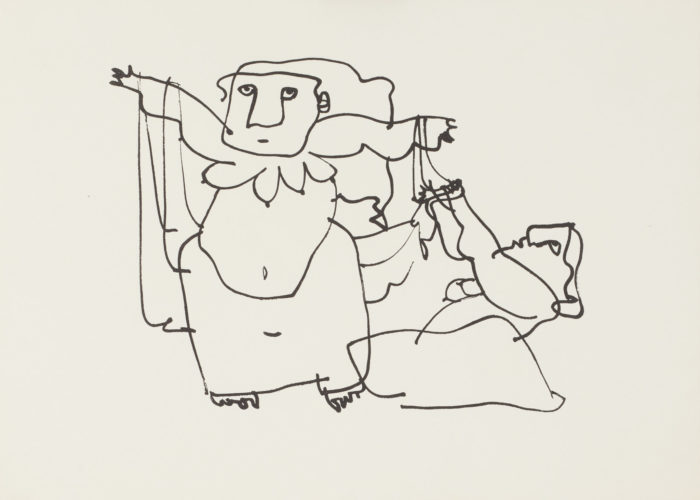 Geta Bratescu[/caption]
credibility
When a person testifies about some past event, and his or her listeners have no external evidence to corroborate or refute that testimony, those listeners will place a great deal of emphasis on credibility. “I find her a very credible witness.” “I just didn’t find him credible.” We know that con men make opulent livings through seeming credible to large numbers of people; if we search our memories we will discover scenes in which we believed people we shouldn’t have believed and disbelieved people we should have believed; but in the moment we human beings seem to have a nearly absolute confidence in our ability to assess credibility.
This is, of course, complete nonsense. None of us has the superpower of looking into speakers’ souls to discern their true character. Each of us is, in many circumstances, easily fooled. And perhaps on some level, somewhere deep in the recesses of our minds, we realize this. We remember those moments when we were so sure someone was lying when they weren’t, or telling the truth when they weren’t. So we peek around at our ingroup for confirmation. And we get it. They have the same impressions, the same feelings, the same assessments of credibility.
And that can scarcely be surprising, because we share our prejudices and presuppositions and assumptions and tendencies with other members of our ingroup — that’s in large part what makes them our ingroup. So tribalism both produces our impressions of credibility and confirms them. Which makes our impressions of credibility epistemically worthless.
But without them, what do we have? That’s a question that, it seems, few are willing to face. To doubt our impressions is to doubt much of what sustains us day by day. This morning Ross Douthat writes, “Only the Truth Can Save Us Now.” Yeah, good luck with that.
“in fact the mind was poorly understood”
Astounding, really, that Michel could consider psychology any kind of science at all. So much of it consisted of throwing together. Of thinking of the mind as a steam engine, the mechanical analogy most ready to hand during the birth of modern psychology. People had always done that when they thought about the mind: clockwork for Descartes, geological changes for the early Victorians, computers or holography for the twentieth century, AIs for the twenty-first…. and for the Freudian traditionalists, steam engines. Application of heat, pressure buildup, pressure displacement, venting, all shifted into repression, sublimation, the return of the repressed. Sax thought it unlikely steam engines were an adequate model for the human mind. The mind was more like — what? — an ecology — a fellfield — or else a jungle, populated by all manner of strange beasts. Or a universe, filled with stars and quasars and black holes. Well — a bit grandiose, that — really it was more like a complex collection of synapses and axons, chemical energies surging hither and yon, like weather in an atmosphere. That was better — weather — storm fronts of thought, high-pressure zones, low-pressure cells, hurricanes — the jet streams of biological desires, always making their swift powerful rounds…. life in the wind. Well. Throwing together. In fact the mind was poorly understood.
— Kim Stanley Robinson, Blue Mars