
our airport future

Two quotes from this interview with Stéphane Degoutin and Gwenola Wagon. One:
SD: The airport is where different promises of the modern world are concentrated: the promise of moving freely around the globe, the promise of unlimited shopping, the promise of a completely rational organisation and the promise of a perfect surveillance. It embodies the desire of mastering the world. Yet, it is also the place where these promises meet their limits and their contradictions.
And two:
GW: The airport is an archetypal place, in terms of both space and behaviour. In the book, we have a chapter about what we call “Cultural LCD”, which can be defined as the Least Common Denominator of world cultures. A universal code that would be as neutral as possible, a standardized interface that allows different individuals or cultural groups to communicate with each other. However, the airport model is expanding further and further and contaminating railway stations, institutions, monuments, stadiums, concert halls, museums, international hotels, malls and urban duty-free shops, restaurants, museums, schools, universities, offices, motorway service areas, etc.
This is fascinating and … horrifying.
For the Love of Mars
Once we come of cultural age into a mature, considered love for Mars, and see what happens when we act on that love, our crises and challenges on Earth can be recast, as can our menu of choices in meeting them. Rather than panic and rancor, scripted according to the prevailing social and political battle lines that have replaced the grand frontier, we will be more apt to find confidence, courage, and creativity. And rather than applying these virtues to the virtual world that draws us deeper into antihuman utopias, we’ll apply them to the metal-and-plastic, flesh-and-blood, brick-and-mortal world that forms an essential bridge between analog and digital life. It shouldn’t be a surprise that this approach will also happen to fit in logically with the reality that our younger kids now experience.
A really fascinating essay by James Poulos. The core of James’s argument, and it’s a point that deserves extended contemplation, goes something like this: We think all the time about the technologies we use or might use, but we don’t think at all about the object of our technological explorations, the sovereign end (telos) of our ingenuity. The pursuit of Mars, James thinks, can be a kind of collective focal practice (to borrow a term from Albert Borgmann) that brings order and purpose to our technological strivings.
Whether this proposal can actual work will depend, I think, on whether it has the follow-on effects that James believes it will — follow-on effects that make life on Earth better, as described in the paragraph quoted above. I’m no so sure. But what a wonderfully imaginative and provocative essay.
the church in Imminent America
So just as an intellectual exercise, let’s make a bold prophecy for the 2040s or so. Imagine a near future US where a state’s population corresponds to its degree of urbanization, and thus to its relative secularity. Imagine the most thriving regions of church loyalty being concentrated strongly in The Rest, those 34 states containing thirty percent of the nation’s people, especially in the Midwest and the Upper South. The metroplexes, in contrast, are very difficult territory indeed for believers of any kind, a kind of malarial swamp of faith. A situation much like contemporary Europe, in fact.
Catholics, of course, face special issues in this Imminent America, and all depends on how far they can retain the loyalty of that very large Latino presence.
Hmm, planning a church for the hyper-urban future ….
These are enormously complex demographic issues that every thoughtful Christian should be considering. I wonder whether the existing national structure of Christian denominations can survive a future in which the 16 states of Metroplex America and the 34 states of The Rest experience greater and greater cultural divergence. It might be that the forms of faithful Christian living in the one context look very different than those in the other, even when there is substantial theological agreement.
I’m inclined to think that every church that wants to live into the urban future should read the work of Mark Gornik, especially his book on African Christianity in New York City — an amazing tale. Very few people would believe just how many Christians there are in New York, especially (but not only) from the African diaspora. There are wonderfully thriving Christian communities that fly wholly under the radar of our cultural attention, and will probably never be noticed by the culture at large. But Christians who want to bear witness into the future ought to notice them.
And City Seminary, of which Mark was a founder, should be observed also, especially as a model for how to train bivocational Christian leaders for a world in which full-time ministry will, in all likelihood, be rarer and rarer.
the point of the sword
What my father seeks is not a return to times that were worse for women and people of color but progress toward a society in which everyone can get by, including his white, college-educated son who graduated into the Great Recession and for 10 years sold his own plasma for gas money. After being laid off during that recession in 2008, my dad had to cash in his retirement to make ends meet while looking for another job. He has labored nearly every day of his life and has no savings beyond Social Security.
Yes, my father is angry at someone. But it is not his co-worker Gem, a Filipino immigrant with whom he has split a room to pocket some of the per diem from their employer, or Francisco, a Hispanic crew member with whom he recently built a Wendy’s north of Memphis. His anger, rather, is directed at bosses who exploit labor and governments that punish the working poor — two sides of a capitalist democracy that bleeds people like him dry.
“Corporations,” Dad said. “That’s it. That’s the point of the sword that’s killing us.”

the moral ideal
When the guide of conduct is a moral ideal we are never suffered to escape from perfection. Constantly, indeed on all occasions, the society is called upon to seek virtue as the crow flies. It may even be said that the moral life, in this form, demands a hyperoptic moral vision and encourages intense moral emulation among those who enjoy it…. And the unhappy society, with an ear for every call, certain always about what it ought to think (though it will never for long be the same thing), in action shies and plunges like a distracted animal….Too often the excessive pursuit of one ideal leads to the exclusion of others, perhaps all others; in our eagerness to realize justice we come to forget charity, and a passion for righteousness has made many a man hard and merciless. There is indeed no ideal the pursuit of which will not lead to disillusion; chagrin waits at the end for all who take this path. Every admirable ideal has its opposite, no less admirable. Liberty or order, justice or charity, spontaneity or deliberateness, principle or circumstance, self or others, these are the kinds of dilemma with which this form of the moral life is always confronting us, making a see double by directing our attention always to abstract extremes, none of which is wholly desirable.
— Michael Oakeshott, “The Tower of Babel”
truth and lies
I’ve always had great admiration for those who, in the chaos that generally characterises the present, sensed from the start the enormous dangers of Nazi-fascism and courageously denounced it. But do we still have the capacity to be as far-seeing? Do the conditions exist today for the long view?Sometimes I think I understand why we women increasingly read novels. Novels, when they work, use lies to tell the truth. The information marketplace, battling for an audience, tends, more and more, to transform intolerable truths into novelistic, riveting, enjoyable lies.
unforeseen consequences
Another follow-up on my baseball post. I’m getting two kinds of feedback: (a) you’re a moron, sabermetrics is awesome, and (b) you’re absolutely right, sabermetrics is terrible.
Let me emphasize a point that I think is perfectly clear in the piece itself: I love sabermetrics. I started reading Bill James in, I think, 1981; I have written fan letters to him, Rob Neyer, and (later) Voros McCracken (for heaven’s sake); when James came up with the earliest serious attempt to evaluate fielding, Range Factor, I spent countless hours that should have been devoted to my doctoral dissertation trying to improve it — using (by the way) pencil, paper, and a TI SR-50 calculator. I was pontificating about the uselessness of assigning wins and losses to pitchers when Brian Kenny was scarcely a gleam in his father’s eye. If in those days one of those sabermetricians had offered me a job as an assistant, I would’ve dropped out of grad school in an instant.
So in many ways it has been enormously gratifying to me to see the undoubted insights and revelations of serious statistical study make their way into the practices of professional baseball. But such changes have had some unforeseen consequences, and my post was largely about those.
This, by the way, is what those of us with a conservative disposition are supposed to do: When everyone else is running to embrace some new exciting opportunity, we warn that there will be unforeseen consequences; and then, when we have been (as we always are) ignored, we help conduct the postmortem and point out what those consequences actually were. (I was, needless to say, not allowing my conservative side to have a voice when I was so absorbed in sabermetrics — but that was because I never for one second imagined that people running professional baseball organizations would pay attention.)
Now, we might actually like the new opportunity. We might think that on balance it’s worthy to be pursued. So we don’t necessarily stand athwart history shouting Stop. We might instead stand judiciously to the side and quietly ask Do you know what you’re getting into? Because there will be trade-offs. There are always trade-offs.
converging on rational standards: not always bad!
This is a follow-up to my just-posted essay on my unchosen-but-apparently inexorable declining interest in baseball. My chief point there is that baseball has increasingly converged on a set of Best Practices but that convergence has made baseball less interesting to watch. (And my secondary point is that this is ironic because the practices now being converged upon are the ones I used to cheerlead for when they were far less common.)
That’s the way it has turned out in baseball, but it doesn’t always turn out that way. Take basketball, for instance, and more particularly all the controversy in the last NBA season about Lonzo Ball’s peculiar jump shot: I can remember a time when Lonzo’s technique wouldn’t have been unusual at all. When I first started watching basketball, in the 1970s, there were some weird-looking shots, let me tell you. The most notorious of these was the Jamaal Wilkes slingshot, but Jamaal had a lot of competition. Gradually, though, coaches at all levels came to understood that certain ways of holding and releasing the ball simply made for far greater and more consistent accuracy than others, and players started getting the relevant guidance even in their first organized games. So we have seen a very widespread convergence on the Best Practices of Shooting a Basketball.
And the result has been great for the game. It wasn’t just implementing the three-point line that created the free-flowing, open, spread-the-floor offense that the Golden State Warriors delight us with; it was the rise of a generation of players who have the shooting technique to take advantage of that line. In at least this one situation in this one sport, standardization of technique has led to increased creativity and possibility; in baseball, I fear, just the opposite has happened.
(I am now thinking that I ought to write a short book or long essay called “Rationalism in Sports” to serve as a counterpart to Oakeshott’s “Rationalism in Politics.”)
suffering and not triumph
Are we then to deduce that we should forget God, lay down our tools, and serve men in the Church – as though there were no Gospel? No, the right conclusion is that, remembering God, we should use our tools, proclaim the Gospel, and submit to the Church, because it is conformed to the kingdom of God. We must not, because we are fully aware of the internal opposition between the Gospel and the Church, hold ourselves aloof from the Church or break up its solidarity; but rather, participating in its responsibility, and sharing the guilt of its inevitable failure, we should accept it and cling to it. — I say the truth in Christ, I lie not, my conscience bearing witness with me in the Holy Ghost, that I have great sorrow and unceasing pain in my heart. This is the attitude to the Church engendered by the Gospel. He who hears the gospel and proclaims it does not observe the Church from outside. He neither misunderstands it and rejects it, nor understands it and – sympathizes with it. He belongs personally within the Church. But he knows also that the Church means suffering and not triumph.
— Karl Barth, The Epistle to the Romans
The Event
An eye-opening post from Douglas Rushkoff, describing what happened when he was asked to give a talk about “the future of technology” — and ended up instead being peppered with questions by five high-powered hedge-fund managers:
They had come with questions of their own. They started out innocuously enough. Ethereum or bitcoin? Is quantum computing a real thing? Slowly but surely, however, they edged into their real topics of concern.What a world we live in.Which region will be less impacted by the coming climate crisis: New Zealand or Alaska? Is Google really building Ray Kurzweil a home for his brain, and will his consciousness live through the transition, or will it die and be reborn as a whole new one? Finally, the CEO of a brokerage house explained that he had nearly completed building his own underground bunker system and asked, “How do I maintain authority over my security force after the event?”
The Event. That was their euphemism for the environmental collapse, social unrest, nuclear explosion, unstoppable virus, or Mr. Robot hack that takes everything down.
This single question occupied us for the rest of the hour. They knew armed guards would be required to protect their compounds from the angry mobs. But how would they pay the guards once money was worthless? What would stop the guards from choosing their own leader? The billionaires considered using special combination locks on the food supply that only they knew. Or making guards wear disciplinary collars of some kind in return for their survival. Or maybe building robots to serve as guards and workers — if that technology could be developed in time.
Trollope and Brexit
Trollope’s Phineas Redux, like the other Palliser novels, has a domestic plot and a political plot, and the political plot here spins out from the decision by Mr. Daubeny, the Prime Minister, to come up with a bill for the disestablishment of the Church of England. (Daubeny is a stand-in for Benjamin Disraeli, who never did anything quite like this. But we’ll set aside the real-life correspondences for this post.) This a curious, indeed a shocking, decision because Daubeny is a Conservative, and the Conservative Party in the Victorian era was very much the party of the Church. How could be betray the very heart of his constituency this way?
The answer is that in the recent election his party lost their majority, and in ordinary circumstances it would be incumbent on him to resign. So he creates extraordinary circumstances. His idea, it appears — we are not privileged to know his mind — is that most of his own party will stand with him as a matter of disciplinary obedience, while the many Liberals who have long wanted disestablishment will vote with him across party lines. Thus, on the basis of this single bill-to-come — he hasn’t produced it yet, only announced his plan to — Daubeny can remain in his place as P.M.
Some Liberals are willing to join Daubeny; some, following their leader Mr. Gresham (= Gladstone), are determined to oppose him; some are uncertain. Those uncertain ones want to see the Church disestablished — and, by the way, not necessarily because they dislike the Church: some of the most devoted churchmen in England have long wanted disestablishment in order to free the Church to preach and teach the Gospel without political interference — but they do not believe that Daubeny would do the job properly. They suspect that anyone capable of acting as cynically as Daubeny does cannot possibly carry through the process of disestablishment in a competent and appropriate way.
All of which puts me in mind of Brexit. As a strong proponent of subsidiarity, I am temperamentally disposed to welcome any effort at devolution. I’d love to see Britain freed from accountability to Brussels — and, for that matter, Scotland freed from accountability to England. (I’m even open to the restoration of the Republic of Texas — but that’s a story for another post.) I will always seek to move in the direction of localism and will always be suspicious of institutional cosmopolitanism. I am therefore supportive of Brexit in principle.
But a Brexit designed and managed by these people? I don’t think so. They are more cynical than Mr. Daubeny and less — far less — competent. It’s a feeling I often have with the Trump administration as well: even on those relatively rare occasions when I think they have a good policy in mind, I simply don’t believe that they can carry out that policy honestly, fairly, and successfully. In politics, principle is important; but good principles can produce political disasters when implemented by buffoons.
 Peter Tarka,
 the blog garden
My friend Dan Cohen recently wrote,
Think about the difference between a blog post and a book: one can be tossed off in an afternoon at a coffee shop, while the other generally requires years of thought and careful writing. Not all books are perfect — far from it — but at least authors have to wrestle with their subject matter more rigorously than in any other context, look at what others have written in their area, and situate their writing within that network of thought and research.
This is absolutely true — as I know from long experience with both genres. But what if there’s a more enlightening comparison? What if, instead of comparing a book to a blog post, you compared it to a blog? If a bog post is too small to compare to a book, a blog might be too big — keep on blogging long enough and you can have enough words to fill several books. If that’s the case, then one might find it interesting to compare a book to, say, a particular tag on a long-standing blog.
An example: For some time now I’ve been thinking of writing a book about John Ruskin. And I still might. But I’ve been led to consider such a book by gradually gathering drawings and quotes by Ruskin on this blog (there are also a few Ruskin entries at Text Patterns). Suppose that, instead of architecturally writing that book, I simply contented cultivating my Ruskin garden? (See this post for the architecture/gardening distinction.) More images and more quotations, more reflection on those images and quotations. What might emerge?
Well, certainly nothing that any scholar would cite. (How would that even be done? All the handbooks to scholarly documentation are still struggling with how to cite websites and individual articles — citing tags is not even on their radar, I suspect.) But I would certainly learn a lot about Ruskin; and perhaps the sympathetic reader would also.
In some ways this would be a return to what I did a few years ago with my Gospel of the Trees site, which arose because what I wanted to say about trees just couldn’t be made to fit into a book, in part because it refused to become a linear narrative or argument and in part because it was so image-dependent and book publishers don’t like the cost of that. But the advantage of a tag over a standalone site is that each post can have other tags as well, which lead down other paths of reflection and information, in a Zettelkasten sort of way.
My friend Robin Sloan tweeted the other day — I’m not linking to it because Robin always deletes his tweets after a few days — that, despite the many calls these days to return to the good old days of Weird Indie Blogging, there are still plenty of charmingly weird things being posted on the Big Media sites, especially YouTube. Point taken: no doubt this is true. But for my purposes the problem with the Big Media sites is the absolute control they have over association: you don’t decide what is related to your post/video/audio, they do. “If you liked this you may also like....” A well-thought-out tagging system on a single blog creates chains of associated ideas, with the logic of association governed by a single mind (or in the case of a group blog, a set of intentionally connected minds). And such chains are powerful generators of intellectual and aesthetic value.
I really do think that the Back to the Blog movement, if we can call it a movement, is so timely and so important not only because we need to, as I have put it, tend the digital commons, but also because we were just beginning to figure out what blogs could do when their development was pre-empted by the rise of the big social media platforms. Given the accelerated pace at which our digital platforms have been moving in recent years, blogs may best be seen as an old, established, and now neglected technology.
I think it was also Robin Sloan who recently directed my attention to this Wikipedia page on the late Nintendo designer Gunpei Yokoi, who promoted what he called "Lateral Thinking with Seasoned Technology”: finding new and unexpected uses for technologies that have been around for a while and therefore (a) have clear patterns of use that you can rely on even when deviating from them, and (b) have decreased in price. Nintendo’s Wii system is the classic example in the gaming world of this way of thinking: some of us will remember that when the Wii was introduced critics were flabbergasted by its reliance on previous-generation processors with their limited graphics capabilities, and were certain that the console would be a total flop. Instead, everyone loved it.
Blogging, I want to argue, is a seasoned technology that is ripe for lateral thinking. The question for me, as I suggested in my previous post, is whether I am willing to set aside the conventional standards and expectations of my profession in order to pursue that lateral thinking — in order, that is, to give up practicing architecture and going in for a good deal of gardening.
new uses for old blogs
More ideas about ideas: Given my current interest in intellectual gardening rather than architecture, in allowing ideas to emerge rather than trying to generate them by a brute-force attack, I am reconsidering the way I have historically used my blogs, and wondering whether there’s not a better path to intellectual substance than the one I’ve been following.
This has been my M.O. going back to the relatively early days of Text Patterns, when I was working on The Pleasure of Reading in an Age of Distraction: Use the blog to generate and try out ideas, get feedback from readers, develop the ideas a little further … and then put on the brakes. But why did I put on the brakes? Because I knew that I was getting close to the point at which there would be so much of the book’s contents online that a publisher wouldn’t want to buy it. And so the idea-generating stage of the project would effectively come to an end.
Not altogether, of course; I could still write in notebooks or sketch ideas or whatever. But two things were missing: the felt need in writing a public post to achieve at least some minimal level of coherence, and the feedback from readers. Moreover, when you’ve been generating ideas using a particular method and then are forced to switch to another one, you tend to lose momentum. So effectively I found myself working with the ideas that I had generated to that point in the project — even when I didn’t feel that I had explored my chosen topics as thoroughly as I would have liked. And this happened more than once, most recently with my idea for a book on what I called Anthropocene theology.
So in these situations the limits and boundaries of my projects are set, not by the inner logic and impetus of those projects, but by the preferences of the publishing industry. But that’s a superficial take. Why, after all, should I allow the publishing industry to set those boundaries? Because in my line of work the highest-denomination currency is the book. I have my current job because of publishing books — Baylor simply would not have sought me out and hired me had I not been able to list several books on my CV.
Put it this way: If I had never blogged a single word I would have precisely the same job I have now; if I had blogged millions of words without publishing books I would not have a job.
But, you may say, at this point in my career why don’t I just do what I want? I have tenure; I have no administrative ambitions (indeed, just the reverse); I am a Distinguished Professor and there’s no such thing as an Extremely Distinguished Professor or Sun-God Professor. If I am feeling the demands of the publishing world as a heavy yoke why not just throw it off?
Well, I might. But I hesitate for two reasons, or maybe it’s one reason with two parts.
- My profession has never figured out what to do with online writing, except for a few peer-reviewed online journals. It is still devoted to finished products — and vetted products too, despite the manifest problems with peer review. Scholars will cite a dozen mediocre peer-reviewed published papers before they’ll cite even the most brilliant blog post.
- And working to the established standards of my profession is, as I have noted, what got me my current position, so that I can’t help feeling that if I were to strike out into unfamiliar writing territory I wouldn’t be keeping the implicit contract I made when I took this job.
But what if, by following SOP for my profession, I limit my ability to think? What if I curtail the development of ideas and end up fitting them into familiar boxes rather than following them to surprising and new and fascinating places? Isn’t that a heavy price to pay for professional adequacy?
More on all this in the next post.

control and surrender, architecture and gardening

Tom Phillips, Brian Eno oil on canvas 35.6 x 25.4 cm 1984-85 collection: the artist
Tom Phillips writes:I once devised a television project whose abbreviated ghost now forms, not inappropriately, an introduction to the film I worked on with Jake Auerbach (Artist's Eye: Tom Phillips, BBC2 1989). The title was to be Raphael to Eno: it traced the lineage of pupil and teacher back through Frank Auerbach, Bomberg, Sickert etc. until, after an obscure group of French Peintres du Roy, it emerged via Primaticcio into the light of Raphael. Thus I find that at only twenty removes I am a pupil of Raphael. Brian Eno as a student of mine (initially at Ipswich in the early sixties) therefore continues that strange genealogy of influence as the twenty-first.I cite that simply because it’s awesome.
The relationship between Phillips — one of whose most famous works is A Humument, an ongoing-for-decades collage/manipulation/adaptation of a Victorian book — and Eno is a fascinating one in the history of aleatory or, as I prefer, emergent art.
I’ve been talking about all this with Austin Kleon — whose newspaper blackout poems are descendants or cousins of A Humument — who not only knows way more about all this than I do but who also has been posting some great stuff lately on the themes of patience, waiting, and what I recently called “re-setting your mental clock.” See for instance this post on Dave Chappelle’s willingness to wait for the ideas to show up at his door.
And of course that post circles back to Eno — so many useful thoughts about being a maker of something circle back to Eno — quoting from this article:
“Control and surrender have to be kept in balance. That’s what surfers do – take control of the situation, then be carried, then take control. In the last few thousand years, we’ve become incredibly adept technically. We’ve treasured the controlling part of ourselves and neglected the surrendering part.” Eno considers all his recent art to be a rebuttal to this attitude. “I want to rethink surrender as an active verb,” he says. “It’s not just you being escapist; it’s an active choice. I’m not saying we’ve got to stop being such controlling beings. I’m not saying we’ve got to be back-to-the-earth hippies. I’m saying something more complex.”In another talk, one in which he also spoke of control and surrender, he developed another contrast, between creativity-as-architecture and creativity-as-gardening:
And essentially the idea there is that one is making a kind of music in the way that one might make a garden. One is carefully constructing seeds, or finding seeds, carefully planting them and then letting them have their life. And that life isn't necessarily exactly what you'd envisaged for them. It's characteristic of the kind of work that I do that I'm really not aware of how the final result is going to look or sound. So in fact, I'm deliberately constructing systems that will put me in the same position as any other member of the audience. I want to be surprised by it as well. And indeed, I often am.I was texting with Austin about all this earlier today:What this means, really, is a rethinking of one’s own position as a creator. You stop thinking of yourself as me, the controller, you the audience, and you start thinking of all of us as the audience, all of us as people enjoying the garden together. Gardener included. So there’s something in the notes to this thing that says something about the difference between order and disorder. It’s in the preface to the little catalog we have. Which I take issue with, actually, because I think it isn’t the difference between order and disorder, it’s the difference between one understanding of order and how it comes into being, and a newer understanding of how order comes into being.

This is all good for me to reflect on right now, in this season of heat and uncertainty.
also
Just one more quick thought about yesterday’s post: I’ve done this kind of thing before, but usually by trying to delete Twitter altogether. This time I’m continuing to use Twitter to share links, but I am making it very difficult to look at Twitter. And that seems to work much better for me.
victory paper
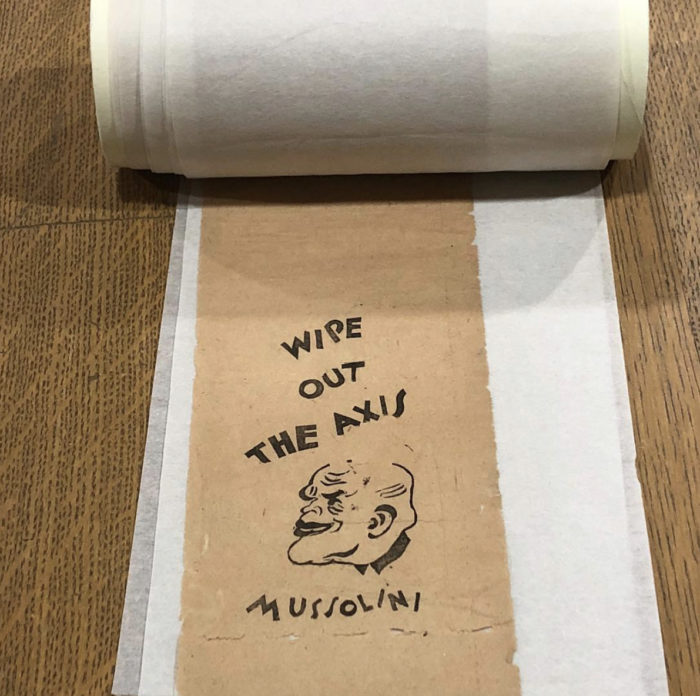
Made by the Randolph Novelty Company in Chicago during World War II; via the Newberry Library’s Instagram

