
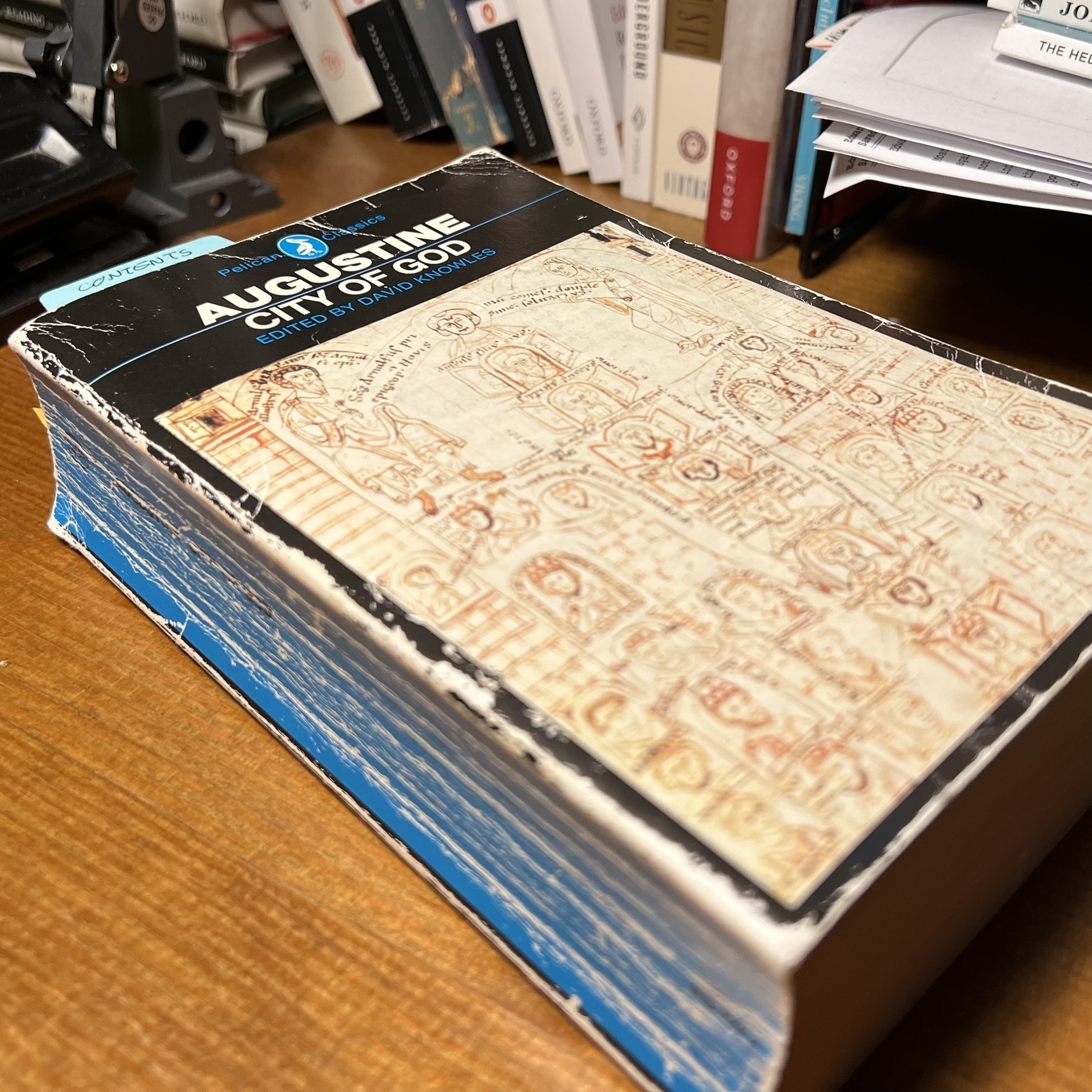
Bought this copy in the summer of 1980, for my first semester of grad school. I think it’s gonna hold together for the current reading….
Cities 3a: political theology
I got an email from a friend regarding this post: “What do you mean ‘Augustine isn’t interested in political theology or ecclesiology’???”
Hey, that’s not me (I say, evasively), that’s the great David Knowles. But Knowles makes a powerful point. His introduction to the 1972 Pelican edition of the City of God is by some distance the best brief commentary on the book I’ve ever read. Unfortunately, though that translation (by Henry Bettenson) is still in print, the move from Pelican to Penguin Classics was accompanied by the commissioning of a new introduction, and then, some years later, still another one. Neither is as insightful and useful as the Knowles original. (By the way, the chapter on Augustine in Knowles’s best-known book, The Evolution of Medieval Thought, remains, I think, an outstanding survey of Augustine’s mind.)
Anyway, in his introduction to the City of God Knowles writes this:
To our eyes it is remarkable that Augustine very rarely identities the City of God with the Catholic Church. He does so at least once: ‘The City of God, that is, God's Church’ (Bk xIll, 16). He identifies the other city with the course of Gentile kingdoms before Christ, and the City of God with the ‘People of God’ from Adam to the birth of Christ. After the resurrection those who believe in Christ, the City of God, are in fact the Church, just as those that disbelieve are in fact the Roman authorities and the pagans of the Empire, but there is no confrontation of Church and State. We can see the reason for this. The constituent qualities of the two cities are their two objects of love, the love of God leading to contempt of self, and the love of self leading to contempt of God (Bk XIV, 28). The two cities are therefore two loves, and these are an inward and spiritual, not an outward and political distinction.
Augustine repeatedly says that Abel is a citizen of the City of God, so that City not only precedes the Church, it precedes … well, almost everything in human history.
Later — this regarding political theology — Knowles notes Augustine’s comment (CD V.17) that because life is so short is really doesn’t matter much what kind of political order you live in. And he continues,
Certainly there is an entire absence of any doctrine of Church-State relationship in the City of God. No doubt it would anachronisic to expect anything of the kind. Yet to most historians who consider the beginnings of that age-old confrontation, the conversion and subsequent patronage, not to say tutelage, of the Church by Constantine marks an epoch, a point of no return, when the Church was first faced with a secular master, benevolent though he might be. Augustine says not a word on this matter, though it had occupied the mind of his father in God, Ambrose.
That is, for the argument of the City of God, the conversion of Constantine is not significant. Augustine has some things to say about Constantine - for instance, that he was happy (beatus) in a way that no pagan emperor would ever be happy, and was granted the privilege of founding a new city, Constantinople, that contained no temples to demons. But he gives no indication that the existence of Christian emperors changes anything about the characters and conditions of the two cities. Therefore, says Knowles, to think that Augustine is concerned with the nature of the Church or with the proper relationship between the sacred and secular powers is to impose our categories on a book that works in a different manner than we are accustomed to.
Thus for my current project the challenge for me as a reader — and I am just a reader, not a scholar or a theologian — is to try to read him in ways that don’t cram him into the Procrustean bed of my expectations and familiar categories.
Cities 4: Secondary Epic
My previous post discussed the way Augustine sets up his City of God as antithetical to the Aeneid. Auden’s witty poem “Secondary Epic” may be seen as a kind of pendant to Augustine’s critique. It focuses not on the prophetic narration of Anchises in Book VI, but rather on a complementary moment, the description in Book VIII of the Shield of Aeneas. About this description Auden has some questions:
How was your shield-making god to explain
Why his masterpiece, his grand panorama
Of scenes from the coming historical drama
Of an unborn nation, war after war,
All the birthdays needed to pre-ordain
The Octavius the world was waiting for,
Should so abruptly, mysteriously stop,
What cause could he show why he didn’t foresee
The future beyond 31 B.C.,
Why a curtain of darkness should finally drop
On Carians, Morini, Gelonians with quivers,
Converging Romeward in abject file,
Euphrates, Araxes and similar rivers
Learning to flow in a latinate style,
And Caesar be left where prophecy ends,
Inspecting troops and gifts for ever?
Wouldn’t Aeneas have asked: — ‘What next?
After this triumph, what portends?’
And then the poem concludes, returning to Anchises:
No, Virgil, no:
Behind your verse so masterfully made
We hear the weeping of a Muse betrayed.
Your Anchises isn’t convincing at all:
It’s asking too much of us to be told
A shade so long-sighted, a father who knows
That Romulus will build a wall,
Augustus found an Age of Gold,
And is trying to teach a dutiful son
The love of what will be in the long run,
Would mention them both but not disclose
(Surely no prophet could afford to miss,
No man of destiny fail to enjoy
So clear a proof of Providence as this)
The names predestined for the Catholic boy
Whom Arian Odovacer will depose.
The names of that “Catholic boy”? Romulus Augustulus. What poet could resist the irony?
Auden borrows the title of his poem from A Preface to Paradise Lost, in which C. S. Lewis distinguishes primary epic — poems like the Iliad and Beowulf that show no obvious awareness that what they’re doing is, you know, epic — from secondary epic, which is always aware of its tradition its inheritance. Poems like the Aeneid and Paradise Lost are always gesturing towards their predecessors to make sure you know they are indeed epics. Secondary epics tend therefore to be at least somewhat polemical, in tension with their predecessors, because after all if those predecessors has said everything and said it perfectly there would be no need for later poems. Virgil has therefore set himself up to make an argument through his narrative, an argument about the destiny of Rome and the nature of heroism, and Auden joins Augustine in pointing out that the argument doesn’t work: No poet writing in the midst of history can plausibly convince us that a historical city is eternal and that heroic service to it can therefore have eternal consequences. The Pax Romana is not a telos, it’s merely an event among other events, subject to varying interpretations and to the power of change. “No, Virgil, no.”
A terrific first-hand report/memoir by James Conaway on the rise and fall of Rajneeshpuram, Oregon. It’s such a bizarre story. Wikipedia gives more of the details.
Annotating Augustine’s City of God 📚 and listening to Dilla’s Donuts ♫. As one does.
Brian Phillips: “Talking about ‘prestige TV’ rather than good TV became a way to take the thorny question of aesthetic value out of the conversation. It was a way to sidestep difficult political discussions about representation and genre and how we distribute cultural spoils. But the faint derisiveness of the term also seemed to mark its user as more in the know, hipper, less naive about human motives. It was a way to talk about art that showed you weren’t enough of a sap to think art was really the goal. It showed you understood that the only things people really care about are gossip and money.”

Currently reading: City of God by Augustine of Hippo. Should’ve added this a week ago. 📚

Finished reading: Ursula K. Le Guin: The Complete Orsinia by Ursula K. Le Guin. Not Le Guin at her best; I think I’ll do an audio post soon. 📚
Crime scene snapshot

There’s a general sense among athletes that, as Sloane Stephens says here, racial abuse is getting worse. What I find especially strange about this is how important it is for many people to abuse people whose race differs from theirs. They’re risking arrest and maybe imprisonment, losing their jobs, lifetime bans from stadiums. Nothing deters them, because they feel that public declaration of race hatred is absolutely necessary — maybe a compulsion.