
Rory Smith: “Manchester City has the air of a machine, both in the way the project has been constructed and the manner in which the team plays. It should not be a surprise, then, that it should elicit roughly the same emotional response.”
But language-only models such as the original ChatGPT are now giving way to machines that can also process images, audio, and even sensory data from robots. The new approach might reflect a more human understanding of intelligence, an early attempt to approximate how a child learns by existing in and observing the world. It might also help companies build AI that can do more stuff and therefore be packaged into more products.
Because that’s the fulfillment of human destiny: more products packaged with more stuff.
Very pleased that my buddy Sara Hendren ( @ablerism ) has joined us here on micro.blog. Check out all the cool stuff she does.
I managed to write a few halting words about Tim Keller.
Tim Keller
Well, this is a day for tears. I don’t know Tim intimately, but he is a friend, and his presence in my life has been a great gift. When I look back through Tim’s emails to me over the years, the thread that runs through them is encouragement. The last words of his last email to me: “Main thing I wanted to say is how much I appreciate all you are doing.”
The main thing Tim wanted to say was always about someone other than himself: his mind seemed always to be focused on his family, his friends, those he pastored and mentored, and above all the God who is known to us in Jesus Christ. The criticism he received — almost all of it irrational and misinformed — slightly bemused him but otherwise left him unaffected; he had more important things to think about than his own reputation.
In one of his last books he wrote of
Christianity’s unsurpassed offers — a meaning that suffering cannot remove, a satisfaction not based on circumstances, a freedom that does not hurt but rather enhances love, an identity that does not crush you or exclude others, a moral compass that does not turn you into an oppressor, and a hope that can face anything, even death.
All I can say is Amen to that.
Above I spoke of my friendship with Tim in the present tense, for a good reason. I don’t know Tim intimately; but I hope to some day. Until then, I will miss him very much.
the culture question revisited
I want to get back to the question of what theologians talk about when they talk about culture. Earlier entries:
In that follow-up, Brad writes,
First, “culture” is one of those words (as Alan agrees) that is nigh impossible to pin down. You know it when you see it. You discover the sense of what a person is referring to through their use. The term itself could call forth an entire lifetime’s worth of study (and has done so). In that case, it’s reasonable simply to get on with the discussion and trust we’ll figure out what we’re saying in the process.
And yet — this intuition may well be wrong, and its wrongness may be evidenced in the very interminability of the post-Niebuhrian conversation. Granted! I’m honestly having trouble, however, imagining everyone offering a hyper-specific definition of “culture” or avoiding the term altogether.
But I don’t think we have to choose between (a) “a hyper-specific definition” and (b) no account at all of what we’re talking about. I’d be willing to settle for something a little hand-wavy in preference to nothing. So let me do a little hand-waving of my own.
Sometimes when people talk about “culture” they seem to mean pretty much everything that human beings do together. In such a case a theology of culture would be nearly indistinguishable from a complete theological anthropology. At other times when people talk about “culture” they seem to be talking primarily about the arts — music, literature, movies, etc. — in which case what’s called for is simply a theology of the arts.
One of the primary reasons I find Niebuhr’s Christ and Culture — or anyway the categorical scheme deployed therein — completely useless is that he very clearly hasn’t thought about these issues at all. (As can be seen when he opposes “revolutionary and critical powers in human life and reason” to culture, which he can do only if he thinks of culture as something like a stable social order — a place for “cultured” people. But that is a manifestly inadequate understanding of culture, and in any case is different than the implicit — always implicit, never explicit — understandings he gestures at in other parts of the book.)
So let’s try this. When some hunter-gatherers try to frighten off would-be predators, that’s not yet culture. But when they designate certain persons in the group to be their protectors, and find some means — clothing, decoration, modes of address, increased shares of food — to acknowledge the distinctive social role of the protectors, then they're making culture. This is why James Davison Hunter speaks of “‘spheres of symbolic activity,’ that is, areas of human endeavor where symbols are created and adapted to human needs.”
But hang on — aren’t we approaching politics here? Isn’t the creation of a group or class of protectors-of-the-community a political act? Indeed it is. So we need to decide whether when we’re articulating a theology of culture we need to include political theology as a component of it. Do we want to do that? Maybe, maybe not. We could
- envision a theological anthropology that contains a theology of culture that in turn contains a political theology. Russian dolls. Or we could
- envision a theological anthropology that contains a theology of culture and a conceptually distinct political theology.
I would prefer the former, because I think politics is one of the permanent and necessary expressions of the broader and more fundamental human activity that we call culture; but as far as I can tell most theologians think of political theology and theology of culture as effectively two different things — not wholly disconnected from each other, but different enough that you can discuss one without feeling obliged to discuss the other. If you take the latter course, you can write a book the size of, say, Oliver O’Donovan’s The Desire of the Nations; if you take the former course, you’ll need to write one the size of Augustine’s City of God. You pays your money and you takes your chance. But I think theologians need to be more explicit about the scope of their inquiries.
For what it’s worth: I think the theology of culture we need would combine an inquiry into the character of our power-knowledge regime — a study of powers and demons — with an iconology, an account of the deployment of the images and symbols meant to govern our perceptions and affections. Which is to say, I think we need a new City of God — though one produced by many scholars working in more-or-less conscious coordination with one another. We can’t expect another Augustine.
UPDATE: I think … I think … I think maybe I need to blog my way through the City of God. There, I said it.
Charlie Warzel: “When I look at a future dominated by generative-AI tools that are embedded in every nook and cranny of industry, I fear the coming grind. I see inboxes crushed under the weight of robot responses and rapid-generated slide decks. A sea of forgettable, lorem-ipsum emails whose sole purpose is to trigger other robots to reply to their polite, authoritative MBA-speak. I see creative industries strip-mined of their humanity in order to create content at the vertiginous scale of a generative-AI internet.” I think “grind” is precisely the right word.
Glad to see that my buddy Austin Kleon enjoyed my recitation!
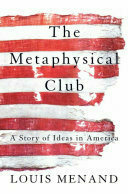
Finished reading: The Metaphysical Club by Louis Menand. A brilliant book — I should have read it years ago. 📚