But most of all, I am offended as a Muslim. In choosing to label this image of Muhammad as Islamophobic, in endorsing the view that figurative representations of the Prophet are prohibited in Islam, Hamline has privileged a most extreme and conservative Muslim point of view. The administrators have flattened the rich history and diversity of Islamic thought. Their insistence that figurative representations of Muhammad are “forbidden for Muslims to look upon” runs counter to historical and contemporary evidence. As Christiane Gruber, a professor of Islamic art at the University of Michigan at Ann Arbor, reminds us, Muslim artists since the 14th century have depicted Muhammad visually — images that were painted “by Muslim artists for Muslim patrons in respect for, and in exaltation of, Muhammad and the Quran.” Such images were, “by definition, Islamophilic from their inception to their reception.” Far from being forbidden, many Muslims, even today, appreciate such figurative representations. While more common among Shia Muslims, even Sunnis are known to have made such images. (In fact, the painting the professor showed was commissioned by a Sunni king in the 14th century.)“But one of our Muslim students claimed to feel marginalized and excluded! We had no choice!”
casting about
I recently re-read Walker Percy’s The Moviegoer and experienced an epiphany: the perfect Aunt Emily — and Aunt Emily is the most important character in the book to cast properly — would be Joanne Woodward, from her Mr. And Mrs. Bridge era. Absolutely perfect. I am now filled with regret that Terrence Malick never managed to make that movie that he so longed to make.
illusions and their removal
In The Point of View of My Work as an Author Kierkegaard explains why he writes sometimes under his own name and sometimes under pseudonyms. One of his primary goals — or, as he rather curiously puts it, one of the primary goals of “the authorship” — is to attack the illusions under which his fellow Danes are living, the chief among them being that they are living in a Christian society (which means that they believe themselves to have received Christianity as a kind of natural inheritance). The problem, Kierkegaard says, is that such illusions are hard to remove by direct attack — and indeed, the deeper the illusion is the more resistant it is to any direct confrontation.
No, an illusion can never be destroyed directly, and only by indirect means can it be radically removed. If it is an illusion that all are Christians — and if there is anything to be done about it, it must be done indirectly, not by one who vociferously proclaims himself an extraordinary Christian, but by one who, better instructed, is ready to declare that he is not a Christian at all….
There is nothing that requires such gentle handling as an illusion, if one wishes to dispel it. If anyone prompts the prospective captive to set his will in opposition, all is lost. And this is what a direct attack achieves, and it implies moreover the presumption of requiring a man to make to another person, or in his presence, an admission which he can make most profitably to himself privately. This is what is achieved by the indirect method, which, loving and serving the truth, arranges everything dialectically for the prospective captive, and then shyly withdraws (for love is always shy), so as not to witness the admission which he makes to himself alone before God—that he has lived hitherto in an illusion.
I especially adore this: “for love is always shy.” See also the magnificent tale of the king and the lowly maiden in the Philosophical Fragments.
There is much more that could be said about this, and how it relates to, for instance, Leo Strauss’s case for the value of esoteric writing in philosophy (something I have often mused on when engaged in my own writing). But for now I simply want to ask this question: What can I do to remove my own illusions?
I think it was A. J. Ayer — one of those 20th century Oxford philosophers anyway — whose highest praise of any other philosopher was “Yes, he’s very well defended.” I think almost all of us are well-defended against the dispelling of our illusions. This is why Kierkegaard said that the person whose life is governed by some powerful illusion must be as it were approached from behind. But how could I approach myself from behind? After all, as I recently wrote, the most dangerous lies are the ones we tell ourselves. Shouldn’t I take seriously my own position?
Well, for the past couple of years I’ve been trying to do just that. I’m not any less interested in theological reflection (or in being a Christian!) that I used to be, but I’ve been reading theology for so long that it’s hard for me to be surprised by it — hard for me not to assimilate whatever I’m reading to my existing categories. So I’ve been trying to read more stuff that evades those categories, that forces me into a less predictable and (ideally) more creative response.
That’s why I’ve been trying to learn from Russian socialists and Daoists and anarchists — they’re all people who are trying to address the same social and ethical issues that concern me, but who do so from different perspectives and with the use of different intellectual tools. But I’m now thinking that, having been fortified by my encounters with those traditions of thought, it may be time to return to my specifically theological concerns and see what they look like in light of what I’ve learned. For instance:
- What does Christian peaceableness look like in light of Alexander Herzen’s melioristic approach to social change?
- Is there really, as I have suspected, a kind of familial resemblance between Daoism and Franciscan spirituality?
- Can the “emergent order” of anarchism be a key to the building of what Martin Luther King Jr. called “the beloved community”?
In short: Can I, through these oddball explorations, remove the illusions that prevent me from seeing what I should see about myself and the world? Can I learn through these exercises to think more wisely and act more justly? I dunno. I hope so.


reading Pynchon
Some years ago I tried to write a book that I called Anthropocene Theology … well, actually, I did write that book, but once I had written it I wasn’t satisfied. It arose from a series of blog posts on my old Text Patterns blog, and perhaps for that reason I couldn’t make it sufficiently coherent. I dunno, maybe someone would have published it anyway, but I wouldn’t have been happy with it, and I don’t need another book on my CV. So I set it aside.
There was a lot about Thomas Pynchon in it, ideas that were and are important to me, so a couple of years ago I extracted all that and tried to make a book out of it also. But editors told me that the book was too short to be published in the form I sent it. (I own many shorter books, but hey, you can’t argue with editors about stuff like that.) Alas, it is also too long to be published as an essay. I will get it out into the world some day, even if only as a self-published thing, but in the meantime I want to share an offshoot of the project.
Pynchon is a notoriously difficult writer, but also, in my view, a very great one who is not read as widely as he should be. So it occurred to me that it might be useful for me to write a kind of introduction to Pynchon: an overview of his life and work that might entice new readers and guide them in their efforts. So I did, and here it is. I hope some of you will find it useful.
UPDATE: I’m very pleased to report that the long essay on Pynchon is not, after all, too long and will be published in the Summer issue of The Hedgehog Review!
Grief can be seen as a kind of exalted state where the person who is grieving is the closest they will ever be to the fundamental essence of things. You either go under, or it changes you, or, worse, you become a small, hard thing that has contracted around an absence. Sometimes you find a grieving person constricted around the thing they have lost; they’ve become ossified and impossible to penetrate, and, well, other people go the other way, and grow open and expansive.
Arthur’s death literally changed everything for me. Absolutely everything. It made me a religious person. I am not talking about being a traditional Christian. I am not even talking about a belief in God, necessarily. It made me a religious person in the sense that I felt, on a profound level, a deep inclusion in the human predicament, and an understanding of our vulnerability and the sense that, as individuals, we are, each of us, imperilled. Each life is precarious, and some of us understand it and some don’t. I became a person after my son died.

Currently reading: A Christmas Carol and Other Christmas Books by Charles Dickens [specifically The Chimes] 📚
movie cards
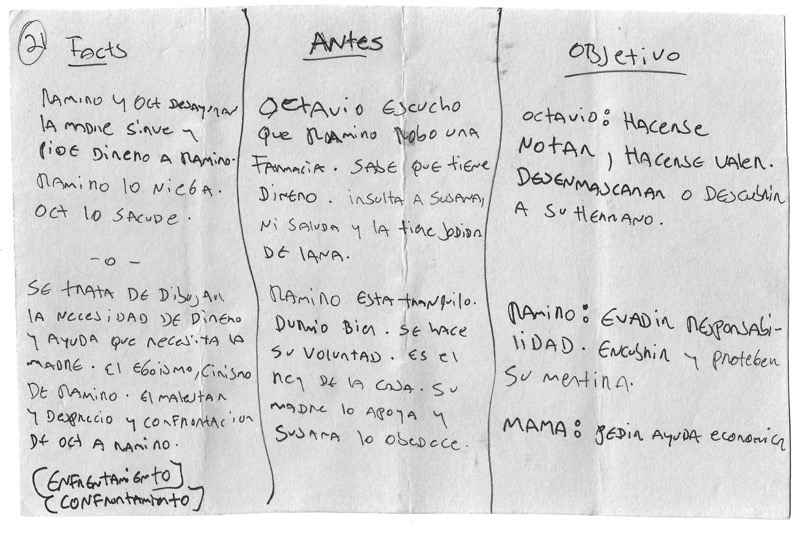
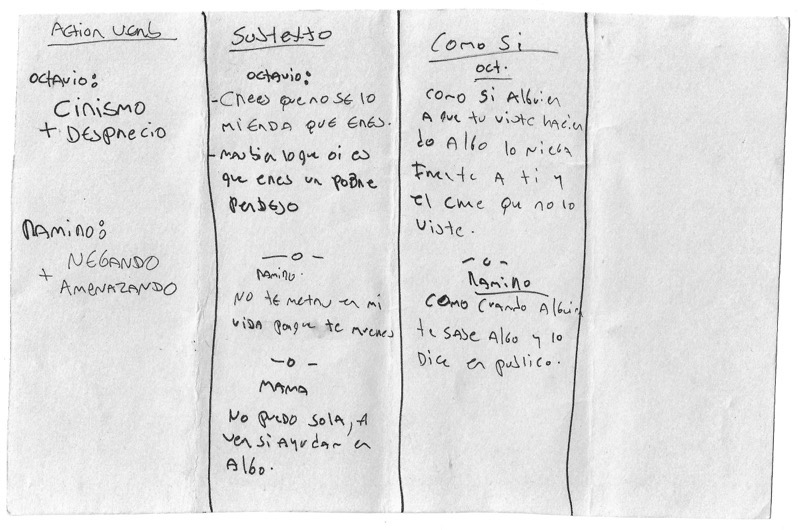
When preparing to shoot a scene, the film director Alejandro Iñárritu prepares note cards to help him organize his thoughts. ”During the production of a film, it’s easy to lose track of and forget the original intentions and motives that you had three years ago in your head and that are always so important.” Moreover, “As Stanley Kubrick once said, making a movie is like trying to write poetry while you’re riding a roller coaster. When one is shooting a film, it feels like a roller coaster, and it’s much more difficult to have the focus and mental space that one has during the writing or preparation of a film.”
So to forestall these problems, Iñárritu grabs a blank note card and divides it into columns, usually featuring six categories:
- He begins with the facts. “I try to write down the facts in a neutral way. What is happening in this particular scene?”
- “The second part is that I try to imagine what happened immediately preceding the moment in question. Where have the characters come from?”
- “The third column details the ‘objective.’ What is the purpose of this scene? … Here I try to dissect the objective of the scene as a whole and what it’s about, as well as the objective of each of the characters who appear…. Each character has a need, and it’s important for me to know what it is.”
- “The fourth part of these cards — the ‘action verb’ column — is particularly difficult … and extremely helpful, too, in further clarifying a character’s objective so that the actor can execute the scene. If one character wants something from another character, one way of achieving the goal is by seducing the other character. Another way is by threatening him. Another way is by ignoring or provoking him. Within a scene, there can also be several action verbs — these kinds of transitions in tactics for obtaining the same objective are important because they bring a scene to life and add color to it.”
- “The subtext … is often almost more important than the text. The text can often be contrary to the subtext, and the subtext is what should be very clearly understood. In other words, if one person says to another, ‘Go away, I don’t want to see you again,’ it is very possible that what they really mean is ‘I need you now more than ever.' The words we use can often oppose what we feel, and I believe that acknowledging this human contradiction can help give great weight to a performance.”
- Finally, the ‘as if' column. There are two ways I believe one can take on a performance — one is through the actor’s own personal and emotional experience, applied to a scene through an association with it, and the other is through imagination.… I have been in situations where an actor, at a given moment, lacks imagination for some personal reason or does not have emotional baggage that he can refer to. In such a case, I sometimes like to have an image that I can leave with an actor or actress. Our body is the master. Sometimes, with a physical or sensorial experience (a burn, cold, etc.), the actor or actress will know already how that feels, and that can help in channeling that feeling.”