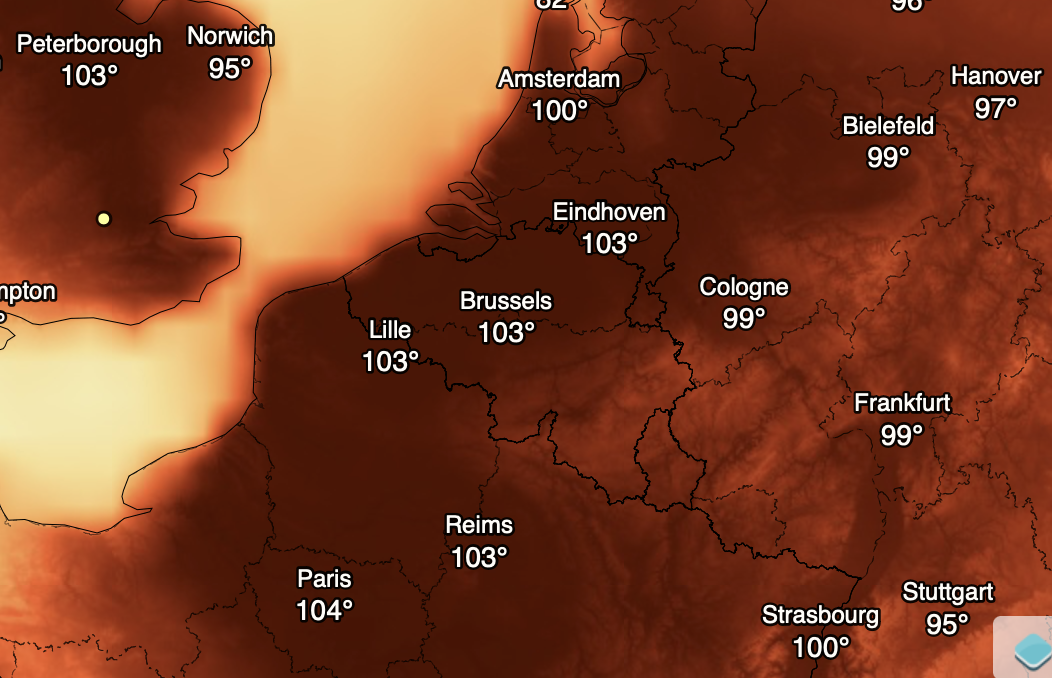
Being in London this week has been like having your home teleported somewhere else: You look around and everything is the same, but isn’t. The air is like Florida’s, hot and heavy to touch, the haze like a postcard of Los Angeles. My son went to school this morning in shorts, a vest, and a baseball cap that he turned backwards, as if he were actually in America. A mosquito buzzed in my ear as I sat in my darkened living room, the curtains drawn tight to keep the sun out. We don’t have air-conditioning in England, you see. That is the kind of thing people have in other countries, where the weather is extreme, where you go indoors to escape the heat—and where there are mosquitoes.
I just wrote an email to my friend Adam Roberts, who, like almost everyone in southern England and Western Europe, has been having a rough go of it:
Two years ago, when we had the Big Freeze here in Texas — three days without power, 35º F in most of the house, some warmth generated in one room only and by a rapidly diminishing supply of firewood (a friend eventually brought some over in his pickup) — the people responsible for the power generating stations said that their equipment wasn't prepared for that kind of cold, and why should it have been, it was a freakish thing, once in a lifetime, etc. To which more reasonable people replied that that excuse works only once at most. From now on, they said, given the swings of temperature that we'll surely be seeing, the Texas power grid will need to prepare for cold the way it prepares for heat.
It seems to me that the opposite may need to happen in northern Europe: an infrastructure preparing for heat the way it prepares for cold. And a mild-weathered place like Britain might need to invest in better preparation for both ends of the thermometer.
Fortunately, your nation and my state are blessed with exceptionally competent governments — they really know how to Level Up!!
what's done
Things without all remedy Should be without regard: what's done, is done.As regular visitors to this blog know, I recently read the four extant volumes of Robert Caro’s biography of Lyndon Johnson, and if there is a single message that Caro hammers relentlessly home it’s this: LBJ was a titanically horrible person – mean, vindictive, cruel, thieving – who nevertheless made vital things happen (electricity in the Texas Hill Country, massive national civil rights legislation) that would have been delayed a decade or longer if anyone else but him had been manipulating the levers of power. And then Caro leaves you, the reader, to decide whether you’re okay with the trade-off. Whether the good outweighs the bad.
Which brings us to the final season of Better Caul Saul, and particularly the ninth episode of the season, which explicitly calls into question our usual practices of double-entry moral bookkeeping.
Throughout the series, but especially in the last couple of seasons, we have seen the two sides of Kim Wexler: on one hand the woman who enjoys, with her lover and then husband Jimmy McGill (AKA Saul Goodman), con-artist “Fun and Games” – the bitterly ironic title of this episode – and on the other hand a dedicated public defender, a friend of the friendless, a skilled lawyer who even when she worked for a fancy law firm insisted on leaving plenty of time to do pro bono work for the insulted and the injured. Doesn’t the good outweigh the bad?
Season 6 episode 9 is the moment when Kim decides that the answer is No. Or rather: It’s the wrong question, the wrong system of accounting. She’s not willing to do the comparative weighing any more. She doesn’t know what she’ll do next, but she won’t do that.

Almost simultaneously, Mike Ehrmantraut visits the father of Nacho Varga, the young drug dealer and servant of the cartel who died in the third episode of this season. Mike wants to tell Mr. Varga that his son “had a good heart,” that he wasn’t like the other criminals, “not really.” Mike is surely thinking of his own son, whom he taught to be a crooked cop; and perhaps of himself also. But Mr. Varga isn’t having it. “You gangsters,” he says. “You’re all the same.” He won’t participate in double-entry accounting. And, along the same lines, he scorns Mike’s claim that “justice” will come to the Salamanca family at whose hands Nacho died. He knows that it’s mere vengeance.
“What’s done can be undone.” That’s what Jimmy/Saul says when Kim rejects the balancing act she’s been performing for almost the entire series. But the entire message of this fictional world — from Breaking Bad to Better Call Saul — is that it can’t be. Lady Macbeth knew: “What’s done cannot be undone.” Thus we’re all left to pick up the pieces, if we can. No system of accounting can rescue us from that dark obligation.

LOST, NOT STOLEN: The Conservative Case that Trump Lost and Biden Won the 2020 Presidential Election [PDF] — very well done, patiently detailed and thorough.
Is there a more user-hostile website on the internet than Patheos? I saw that my colleague Philip Jenkins had a new post and — momentarily forgetting what a bad idea this is — clicked the link rather than sending it straight to Instapaper. This is what I saw. Patheos thinks it a good idea to make the writing they publish impossible, and I mean impossible, to read without in some way bypassing the site itself. (The Mac/iOS Reader View usually works to achieve this, but occasionally gets confused by all the ads.) Even more than readers I feel sorry for the site’s writers, since many visitors will leave without discovering what those writers say.


Currently reading: Collected Poems by C. P. Cavafy 📚
Posted an update to my Buy Me a Dragon page.
Instagram’s transformation into QVC is now complete and absolute. Instagram is dead — or at least the Instagram I knew and loved is dead. It is no longer part of my photographic journey.
It’s way past time for anyone who actually cares about photos, and sharing photos, to ditch Instagram. Om himself has a photo blog, which is also how I’m using micro.blog. My friend Sara Hendren just told me about finite.photos, which looks promising. Glass isn’t, I think, quite right for me, but it’s lovely. Heck, there are even people still using Flickr, though my experience there was horrible. But anything is better than Instagram.
Sympathy for my northern European friends. (I could say “At least it won’t last long,” but they might reply, “At least you have A/C.”)