
improving
Education Doesn’t Work 2.0 - Freddie deBoer:
Entirely separate from the debate about genetic influences on academic performance, we cannot dismiss the summative reality of limited educational plasticity and its potentially immense social repercussions. What I’m here to argue today is not about a genetic influence on academic outcomes. I’m here to argue that regardless of the reasons why, most students stay in the same relative academic performance band throughout life, defying all manner of life changes and schooling and policy interventions. We need to work to provide an accounting of this fact, and we need to do so without falling into endorsing a naïve environmentalism that is demonstrably false. And people in education and politics, particularly those who insist education will save us, need to start acknowledging this simple reality. Without communal acceptance that there is such a thing as an individual’s natural level of ability, we cannot have sensible educational policy.Or: “Put more simply and sadly, nothing in education works.” By which he means: We haven’t yet found a system of education that reliably changes students’ success relative to other students. Young children who are the smartest in their cohort are almost certain to become adults who are the smartest in their cohort, and the same is true on down the line. Sobering, but, it seems, incontestable.
My own experience, for what little it’s worth, is that sometimes you get students who undergo dramatic changes in their academic performance, for good or for ill, but those changes have nothing to do with intelligence. Someone’s performance drops because of illness or emotional upheaval. Or, conversely: Many years ago I had a student who took several classes from me and never got anything better than a C. At the beginning of his senior year he came to my office and asked me why. I reminded him that I had always made detailed comments on his paper; he said, yeah, he knew that, but he had never read the comments and always just threw the papers away. So I explained what his problem was. He nodded, thanked me, went away, and in the two classes he had from me that year he got the highest grades in the class.
indestructible
This long post by Jesse Singal makes one key point perfectly clear: People on Twitter may know that 10,000 alarmist posts about their political enemies have been thoroughly debunked and discredited, but when that ten-thousand-and-first comes along they’ll instantly retweet it and add, “CAN YOU BELIEVE THIS CRAP???” And of course the lies will get a hundred times the exposure of the corrections. We all do well to remember Mark Twain’s “Advice to Youth”:
Think what tedious years of study, thought, practice, experience, went to the equipment of that peerless old master who was able to impose upon the whole world the lofty and sounding maxim that “Truth is mighty and will prevail” — the most majestic compound fracture of fact which any of woman born has yet achieved. For the history of our race, and each individual's experience, are sown thick with evidences that a truth is not hard to kill, and that a lie well told is immortal. There in Boston is a monument to the man who discovered anesthesia; many people are aware, in these latter days, that that man didn't discover it at all, but stole the discovery from another man. Is this truth mighty, and will it prevail? Ah, no, my hearers, the monument is made of hardy material, but the lie it tells will outlast it a million years. An awkward, feeble, leaky lie is a thing which you ought to make it your unceasing study to avoid; such a lie as that has no more real permanence than an average truth. Why, you might as well tell the truth at once and be done with it. A feeble, stupid, preposterous lie will not live two years — except it be a slander upon somebody. It is indestructible, then, of course, but that is no merit of yours.
My friend Chad Holley — lawyer, teacher, writer — describing a bold pedagogical decision:
If it was sage to leave well enough alone, I slipped up last month adding Solzhenitsyn’s lecture to the syllabus of a Law and Literature course I’m teaching at a local law school. Surely now I needed some intelligible comment on it, some ready defense. At least one faculty member, after all, had pushed back against the course on grounds of, well, frivolity. Fortunately, the dean who hired me had a delightfully simple view: the course would make students better people, and better people would make better lawyers. It carried the day, who am I to quibble? But for the Solzhenitsyn piece I was on my own. In the end I muttered to myself something about it offering an aesthetic that relates literature to morality, politics, and even the global order without succumbing to the instrumentalism of the savage. Eh. Close enough for adjunct work.
But did I say I added the piece to the syllabus? Friend, I began the course with it. We introduced ourselves, shared reasons for being here, covered some ground rules. Then I said, as distracted as I sounded, “Allll righty …so …” I had not anticipated just how much respect, how much admiration, I would feel for this small, diverse, self-selected group. They had read War and Peace “twice, but in Spanish,” their families had fled Armenia to escape Stalin, they were raising children, running businesses, staffing offices, nearly every one of them holding down a full-time day job while attending law school in the evenings, on the weekends. Had I really required these serious, ass-busting, tuition-remitting people to read an essay suggesting — I could barely bring myself to mouth it — beauty will save the world? What was I going to say for this in the face of their withering skepticism, their yawn of silence?
Read on to find out.
Didn’t think this guy was going to bloom this summer, but we returned from a few days away to find him going gangbusters.

Vast resources have been devoted over time to efforts to intervene in, ameliorate, and perhaps cure the mysterious conditions that constitute mental disorder. Yet, two centuries after the psychiatric profession first struggled to be born, the roots of most serious forms of mental disorder remain as enigmatic as ever. The wager that mental pathologies have their roots in biology was firmly ascendant in the late nineteenth century, but that consensus was increasingly challenged in the decades that followed. Then, a little less than a half century ago, the hegemony of psychodynamic psychiatry rapidly disintegrated, and biological reductionism once again became the ruling orthodoxy. But to date, neither neuroscience nor genetics have done much more than offer promissory notes for their claims, as I shall show in later chapters. The value of this currency owes more to faith and plausibility than to much by way of widely accepted science. […]
But the fundamental point remains: the limitations of the psychiatric enterprise to date rest in part on the depths of our ignorance about the etiology of mental disturbances.
Well hello


Small detail from Wildflowers (2017) by María Berrío
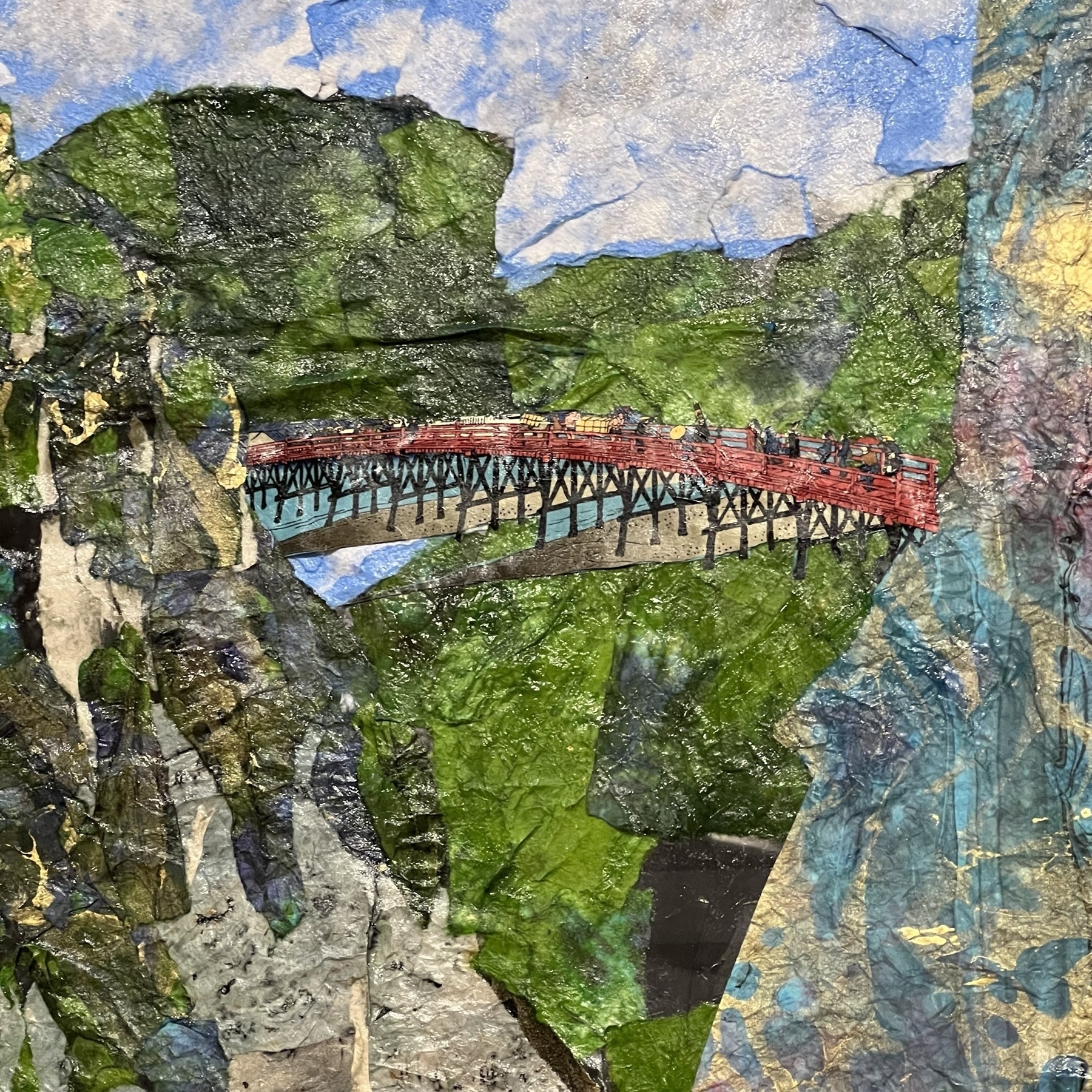
At The Modern in Forth Worth today, I was totally captivated by the mixed-media paintings of María Berrío.