

Currently reading: What They Heard by Luke Meddings 📚

Learning a lot from this FIFA map. For instance, Denver is now where Bozeman used to be; Dallas where Kansas City used to be; Kansas City where Des Moines used to be; Cincinnati where Toledo used to be; Nashville where Louisville used to be; and Atlanta where Nashville used to be. Gotta remember this for upcoming drives.
P.S. I ended up finally reading Tono-Bungay because, at a bookstore in Austin, I found a beautiful old Heritage Press edition of the novel for eight bucks! Perfect condition first edition from 1960.


It even included the Heritage Press newsletter that accompanied its books:
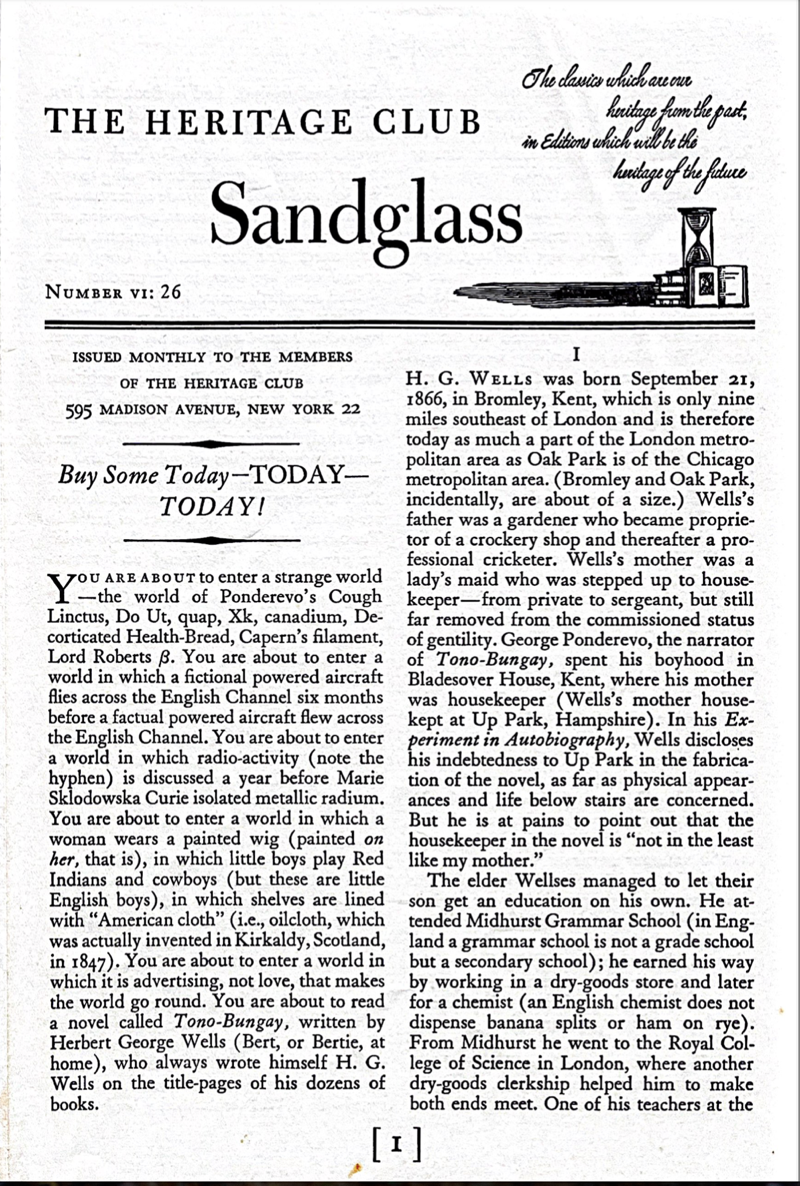
A delightful way to read an outstanding novel.
Tono-Bungay
My friend Adam Roberts has written extensively about this book, but because I knew I wanted to read it, I have avoided reading Adam’s account. I’ll now go back to see what he says, which may make me repent of everything I say here. But there’s value in just getting your thoughts down without too much editing. Also: many spoilers ahead.
H. G. Wells’s Tono-Bungay is a powerful but oddly constructed novel. It’s a bit difficult to describe that structure but here are what I believe to be the key elements:
-
It is most famously a story about commerce, and especially commerce based in advertising. Tono-Bungay is a patent medicine that does no one any good and might do them a little bit of harm – though its inventor, Edward Ponderevo, thinks that it might have positive psychological benefits that would justify his selling it. (Placebo effect, etc.) So the part of the novel most often commented on, what many critics would describe as the story, is about how Tono-Bungay is manufactured, advertised, and distributed throughout the United Kingdom. The business is, of course, a house of cards that is bound to collapse and eventually does.
-
But this is also a story about a man who is repeatedly thwarted in love. George Ponderevo, the narrator and protagonist, has a failed marriage, some casual affairs, and an unrequited or at least unfulfilled love for a woman – named, ironically enough, Beatrice – whom he meets when they are children and whom he definitively loses when they are middle-aged. One of the first important scenes in the book concerns his initial infatuation with Beatrice and – except for a coda which I will describe later – the book concludes with his final sight of her. (Because they are mismatched socially, the whole situation is quite like that of like Pip and Estella, with the unhappy rather than the happy ending.) Because his love for Beatrice is so prominent at the beginning and at the end of the novel, and because the middle of the novel is so occupied by his failed marriage to a woman named Marion, if I had to say whether this book is a story about commerce in advertising or a story about failed love, I would choose the latter.
-
The third element of the story is a contrast between the fixed character of social life in the world of English countryside and its small towns — a world controlled by a declining and ossifying aristocracy — and the immense energy and mobility of life in London. After early chapters establishing the rigidity of life on a country estate where George’s mother is the housekeeper, and in a sleepy small town dominated by another aristocratic family, the scene moves to London. We’re then treated to an extended panoramic celebration of the city narrated by the awestruck young George. “I got London at last with an exceptional freshness of effect, as the sudden revelation of a whole unsuspected other side to life.” More:
I came to it on a dull and smoky day by the South Eastern Railway, and our train was half an hour late, stopping and going on and stopping again. I marked beyond Chiselhurst the growing multitude of villas, and so came stage by stage through multiplying houses and diminishing interspaces of market garden and dingy grass to regions of interlacing railway lines, big factories, gasometers and wide reeking swamps of dingy little homes, more of them and more and more. The number of these and their dinginess and poverty increased, and here rose a great public house and here a Board School and there a gaunt factory; and away to the east there loomed for a time a queer, incongruous forest of masts and spars. The congestion of houses intensified and piled up presently into tenements; I marveled more and more at this boundless world of dingy people; whiffs of industrial smell, of leather, of brewing, drifted into the carriage; the sky darkened, I rumbled thunderously over bridges, van-crowded streets, peered down on and crossed the Thames with an abrupt eclat of sound. I got an effect of tall warehouses, of grey water, barge crowded, of broad banks of indescribable mud, and then I was in Cannon Street Station — a monstrous dirty cavern with trains packed across its vast floor and more porters standing along the platform than I had ever been in my life before. I alighted with my portmanteau and struggled along, realising for the first time just how small and weak I could still upon occasion feel. In this world, I felt, an Honours medal in Electricity and magnetism counted for nothing at all.This contrast between country and city is really key to everything else: surely Tono-Bungay is one of the great London novels. When Edward Ponderevo, George’s uncle, lives in a small town, trying to eke out a living as a chemist, he continually complains about the impossibility of making anything happen in such a catatonic place, and only when he is forced by bankruptcy to move to London and take up a menial job does he actually have the opportunity to create Tono-Bungay – and more important, to create a market for Tono-Bungay. It is the concentration of people in London that enables his creation to go viral. London, the viral city, in multiple ways.Afterwards I drove in a cab down a canyon of rushing street between high warehouses, and peeped up astonished at the blackened greys of Saint Paul’s. The traffic of Cheapside — it was mostly in horse omnibuses in those days — seemed stupendous, its roar was stupendous; I wondered where the money came from to employ so many cabs, what industry could support the endless jostling stream of silk-hatted, frock-coated, hurrying men.
London also puts people in touch with one another who in the countryside or in small towns would either not meet at all or meet only in constrained circumstances. George marries Marion, whom he has little in common with – something he comes to understand even before their marriage – but it’s only because they both live in London that they ever encounter one another. They have certain trivial habits or quasi-interests in common; everything between them arose from a chance encounter of strangers, the kind that almost never happens in the countryside but happens a dozen times a day in London. Their marriage ends because George has an affair with a young woman who works as a typist for his company – again, a connection that only the energy, congestion, and economic drive of the city makes possible.
It is noteworthy that George’s failed relationship with Beatrice happens almost wholly in the countryside, while his failed marriage to Marion happens in the city. His love for Beatrice is doomed by a world that’s too inflexible; his attachment to Marion – which he sees as a “hunger,” not as genuine romantic love – is produced by a world that’s too unbounded.
So one of the things that Wells wants to talk about here is London as a kind of universal solvent, a force powerful enough to disintegrate the long-established social structures of British life, and while we know where Wells’s sympathies lie – he despises the old division of social classes – nevertheless he is quite aware that a universal solvent will occasionally end up dissolving things that shouldn’t be dissolved.
At the end of the book, we get an epilogue in which we’re treated to another vista of London, this time as it appears from the Thames:
To run down the Thames so is to run one’s hand over the pages in the book of England from end to end. One begins in Craven Reach and it is as if one were in the heart of old England. Behind us are Kew and Hampton Court with their memories of Kings and Cardinals, and one runs at first between Fulham’s episcopal garden parties and Hurlingham’s playground for the sporting instinct of our race. The whole effect is English. There is space, there are old trees and all the best qualities of the home-land in that upper reach. Putney, too, looks Anglican on a dwindling scale. And then for a stretch the newer developments slop over, one misses Bladesover [the country house in which the book begins] and there come first squalid stretches of mean homes right and left and then the dingy industrialism of the south side, and on the north bank the polite long front of nice houses, artistic, literary, administrative people’s residences, that stretches from Cheyne Walk nearly to Westminster and hides a wilderness of slums. What a long slow crescendo that is, mile after mile, with the houses crowding closelier, the multiplying succession of church towers, the architectural moments, the successive bridges, until you come out into the second movement of the piece with Lambeth’s old palace under your quarter and the houses of Parliament on your bow! Westminster Bridge is ahead of you then, and through it you flash, and in a moment the round-faced clock tower cranes up to peer at you again and New Scotland Yard squares at you, a fat beef-eater of a policeman disguised miraculously as a Bastille.We are moving through time: from the ancient English countryside to the city whose function was, for a long time, to consolidate the power of the rural elite, and now into modernity:
And then the traditional and ostensible England falls from you altogether. The third movement begins, the last great movement in the London symphony, in which the trim scheme of the old order is altogether dwarfed and swallowed up. Comes London Bridge, and the great warehouses tower up about you, waving stupendous cranes, the gulls circle and scream in your ears, large ships lie among their lighters, and one is in the port of the world. Again and again in this book I have written of England as a feudal scheme overtaken by fatty degeneration and stupendous accidents of hypertrophy.Somehow we have moved, in the course of one novel and about forty years, from social sclerosis to “fatty degeneration.” Varieties of poor health: one world in which, as Edward Ponderevo always said, “nothing happens,” and another in which too much is happening; atrophy and hypertrophy. “Amidst it all no plan appears, no intention, no comprehensive desire. That is the very key of it all. Each day one feels that the pressure of commerce and traffic grew, grew insensibly monstrous, and first this man made a wharf and that erected a crane, and then this company set to work and then that, and so they jostled together to make this unassimilable enormity of traffic.”
And from there out into the Sea – the strongest possible contrast. “The river passes — London passes, England passes…”
Wells tries at the end of the story to make an accounting of What It All Means, but I will set that aside. I think what he narrates tells a rather different story than what he means to tell, though in a way he knows that there is a key “symbol,” as he calls it, here. George Ponderevo is making this final passage through London on a warship, a “destroyer” that he has built. It’s worth noting that he had begun his career as an engineer in the immediate aftermath of his divorce from Marion; and has returned to it after his final goodbye to Beatrice. A classic case of sublimation: “Eros, builder of cities” – but in this case Eros, builder of warships. At this point George has seen the loss of some he loves and the deaths of others; indeed, he himself is a murderer; and after the failure of all his loves he motors down the Thames and through the great city of London as an avatar of Thanatos. And that, I think, is what this powerful and sad book is all about: not the manic energies of Commerce but rather the end of Eros and the triumph of Thanatos.
Silver Jubilee - by Damon Krukowski - Dada Drummer Almanach:
[Maurizio Lazzarato:] “Small and sometimes very small ‘productive units’ (often consisting of only one individual) are organized for specific ad hoc projects, and may exist only for the duration of those particular jobs… Precariousness, hyperexploitation, mobility, and hierarchy are the most obvious characteristics of metropolitan immaterial labor. Behind the label of the independent ‘self-employed’ worker, what we actually find is an intellectual proletarian… It is worth noting that in this kind of working existence it becomes increasingly difficult to distinguish leisure time from work time. In a sense, life becomes inseparable from work.”
This matches my long-term experience with digital media far better than Gates’s “content is king.” Content is not what is rewarded in this online economy, because content is produced by immaterial labor, and labor is in no better a political state to demand fair compensation now than it was before digital technology. If anything, our ability to organize has been reduced as we have been isolated by the processes described in Lazzarato’s essay. After all, the foreman is right here in our homes. I’m typing on one now.
See: Self-taylorizing.

Currently reading: Tono-Bungay by H. G. Wells 📚

You always try to console yourself. Yesterday I said, “Hey, the temp didn’t hit three digits today!” Today I’m saying, “Hey, at least I don’t live in Phoenix.” So many bills coming due in the next decade or two….
My friend and colleague David Corey:
I share Fukuyama’s hope that liberalism can be maintained. I hold this hope in part because (like Fukuyama) I see no better alternatives to liberalism for the pluralist, freedom-loving West; but I hold it too because I view liberalism not as an essence, but as a human practice that results from prudential choices people make; and I therefore think that liberalism can be made and remade in light of lessons that we learn in the doing. The chief lesson to be borne in mind today is that the alternative to liberalism is violence, whether that takes the form of physical violence or the coercive power of the state. And violence leads to grievous suffering, especially for the weak and powerless. Sober reflection on this fact should lead us to look at the possibilities of liberalism with renewed energy. It is, without doubt, an imperfect way of practicing politics. But Fukuyama is right that it is the best way we have for managing diversity in peace.
I think David is right about this. And the refusal of our various illiberal movements to confront the violence they encourage is the primary sign of their essential frivolity.