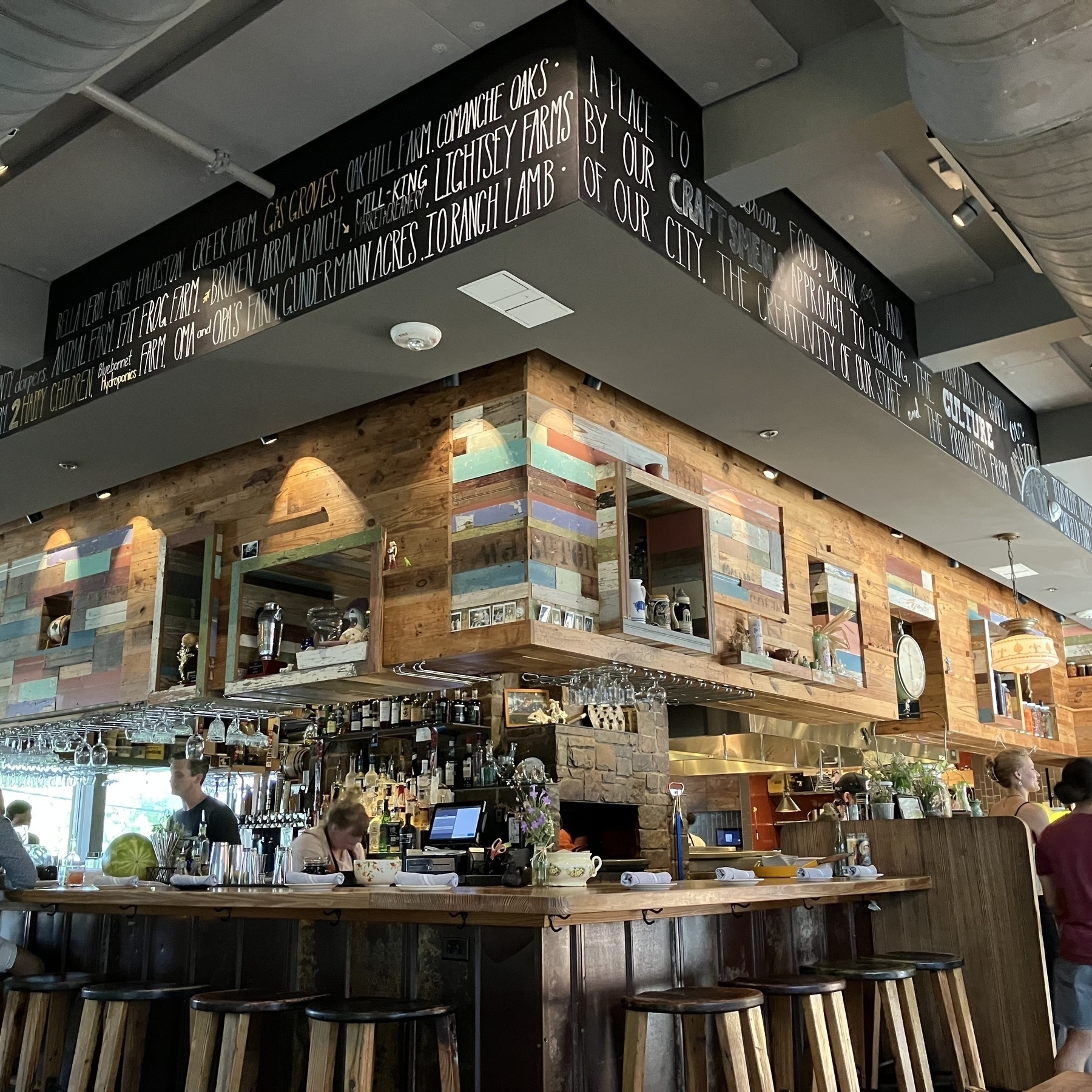
Remembering a visit to Sanibel with dear friends….


Currently listening: Wood Works by Danish String Quartet ♫
less Tono, more Bungay
After writing my reflection on Tono-Bungay, I read Adam Roberts’s thoughts in his excellent literary biography of Wells — you can read almost the same account in this blog post — and was interested to see that Adam talked about all sorts of really important things that I had totally neglected. And yet I still think that my take on the book is valid and useful. It’s an indication of the book’s quality, I think, that such widely divergent readings can nevertheless capture real insights into its world.
One brief thought: Adam’s portrayal of Uncle Ponderevo as a cokehead — twitching, full of nervous energy, increasingly obese and yet simultaneously somehow withered — echoes Wells’s portrayal of modern London as hypertrophied, massively diseased. Uncle Ponderevo as London in microcosm; London as a macrocosmic Uncle Ponderevo. (Which is, by the way, a very Adam-Robertsian theme: see, e.g., Swiftly, the first novel of his I read, with its conceit that Gulliver’s Travels was reportage, not fiction.)
I wrote about mechanization, illiberalism, and the attempt to create a monoculture. Part of my ongoing work on plurality and pluralism.
Mechanization and Monoculture, by me:
Indeed, it seems to me that the one indisputable thing we can say about our current illiberalisms, of the left and the right (and this is the first of several theses I seek to promulgate here): All illiberalisms are intrinsically mechanistic. It is always their goal for mechanization to take command—as long as mechanization serves their ends. It does not seem to occur to them to ask, with Giedion, whether mechanization ever actually does serve human ends. Which leads us, I think, to a corollary thesis: Insofar as illiberalism is mechanistic, it is inhuman.
I have to admit that I like this essay — I think it’s a step forward in my attempts to think through the virtues of the plural world and the dangers of monism, to which so many are tempted. This essay is a step forward because it properly describes the end product of monism, which is a monoculture — I’m framing my analysis in ecological terms, which are, I believe, the right terms.
Natural ecology, media ecology, social ecology — that’s what I need to be thinking about, especially since all of these ecologies overlap to create a single planetary ecology in which Homo sapiens is the apex predator, but one that often preys on itself.
excerpt from my Sent folder: nodes
I try to make the best of the blogging environment, but I have always been fascinated by Jorn Barger's early-web idea of what he called “single-layer web design” — it's ironic that he is sometimes called the inventor of the weblog, because while he was one of the first to create a reverse-chronological list of links, that's pretty much all they were, links, not developed ideas. Almost all of his Robot Wisdom site has disappeared since he abandoned the web some 20 years ago — I think the only thing left is this mirror of his James Joyce page.
But when I started making my actual home page, this is the model I had in mind: all the relevant information and necessary links on a single page, written in absolutely bare-bones HTML. And if I had the technical chops to do it, I'd ditch the blog and make my entire web presence a series of about five pages, each of which would be a kind of topical node, and each of which would continually in revision. Maybe one of them would be a Barger-style link-weblog, or I might just use micro.blog for that.
For example: like you, I am deeply attached to revising my posts — one recent case:

Thirteen revisions is on the low side for a longer post. Often I'm correcting spelling errors or tweaking the style, but sometimes I go in and use a <mark> tag to highlight; I might add an UPDATE, or, if I don't like the way an update would make the post look, I'll hop over to txt.fyi and write up an appendix and then link to it (I should probably make a page at ayjay.org, since txt.fyi could disappear at any time, but usually I'm too lazy). I also will sometimes help generate what I think of as internal dialogism — sorry for the fancy language — by using the <details> tag.
But what I really want is the ability to make several pages that use all these tricks and more: highlights, details, footnotes, appendices, digital sticky notes, and (maybe above all) versioning — the ability for readers to diff, as it were.
Four or five topical nodes, ever-expanding, linking out and back, commenting on itself, inviting commentary from others, etc. etc. THAT would be the coolest thing ever, to me. In fact, I might start experimenting with a basic page structure that would allow a first approximation of this vision....
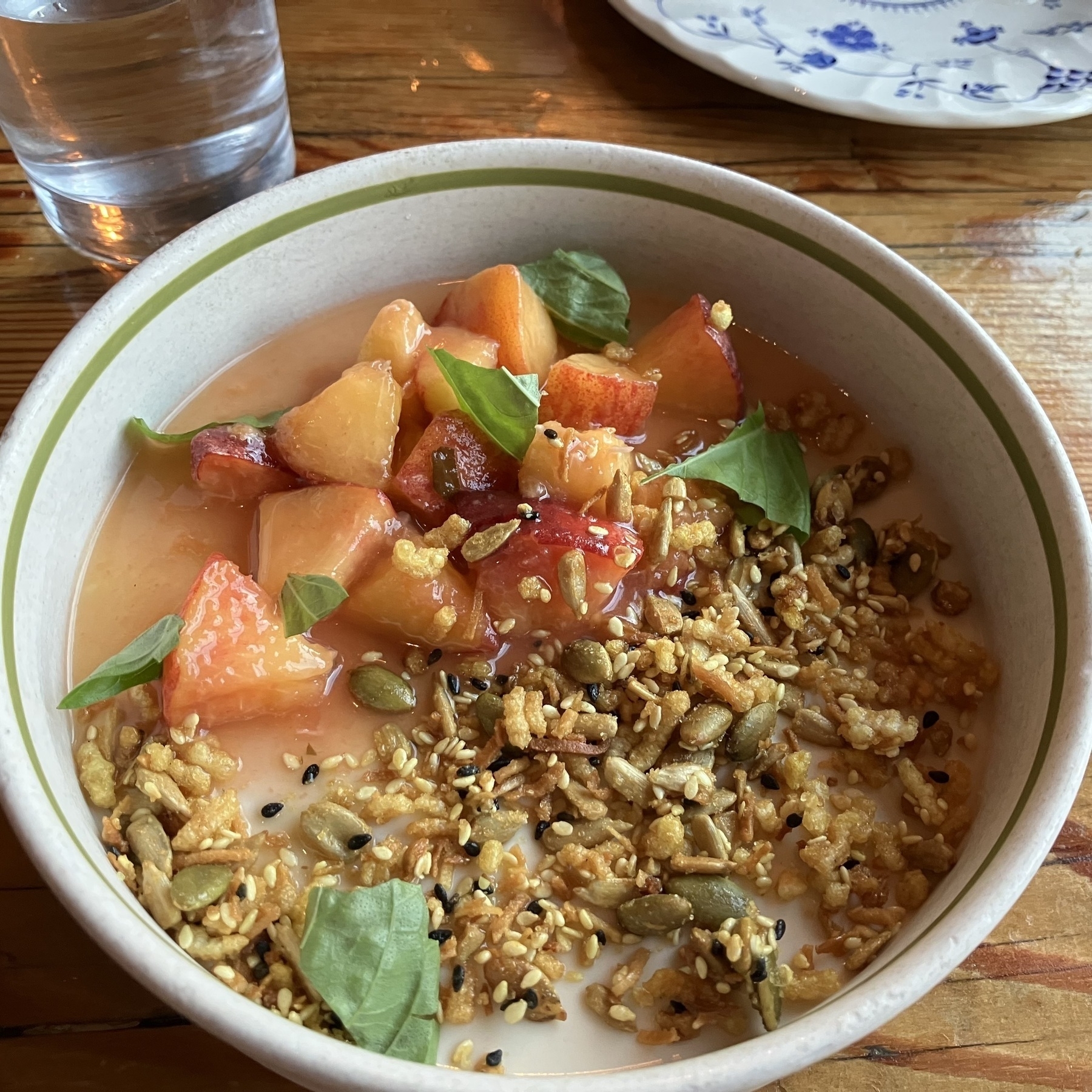
And this Yaupon tea pannacotta with fresh peaches and granola … I don’t even have words.
Odd Duck Austin is one of my favorite eating/drinking places.