
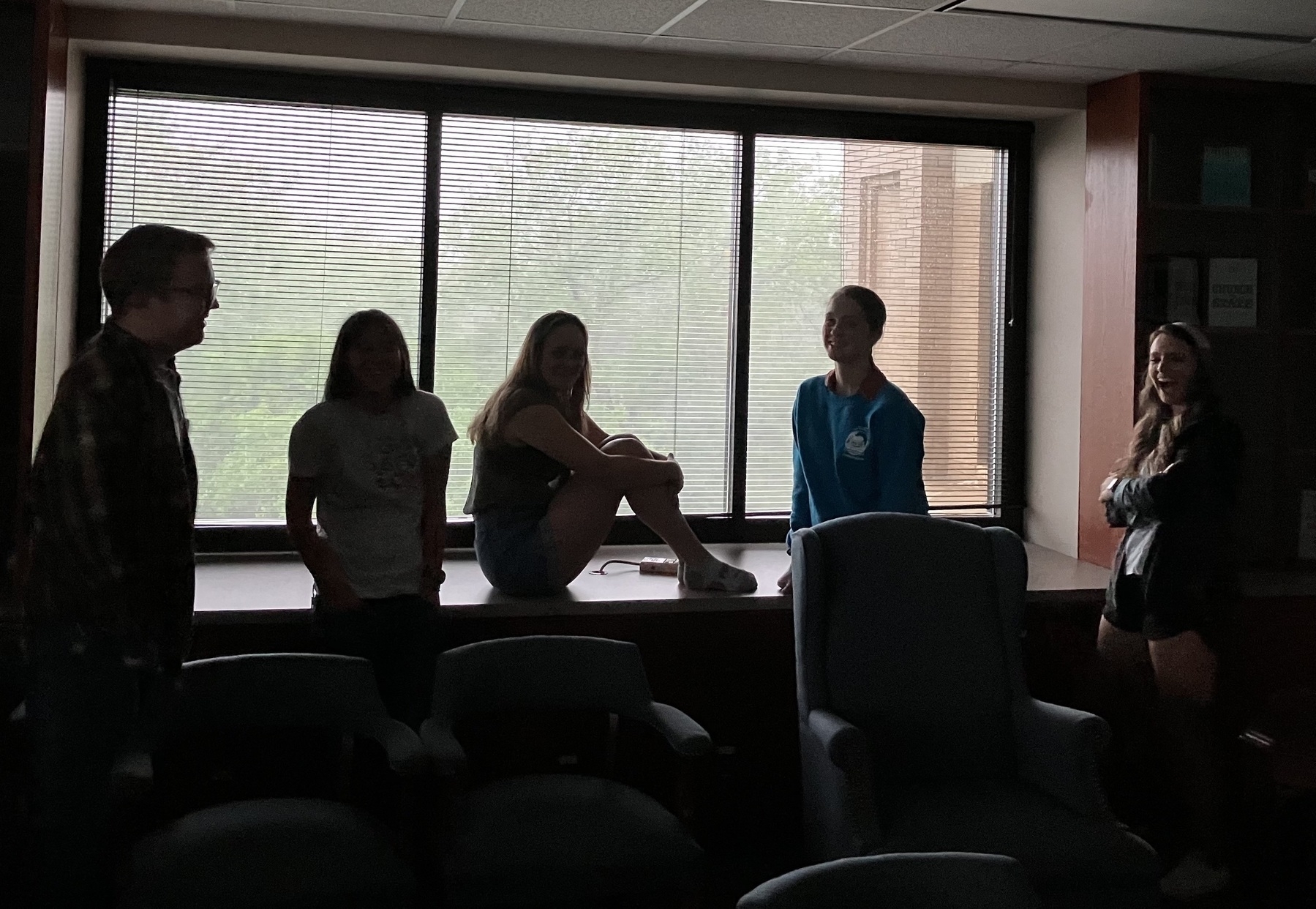
Last day in my Reading the New Testament class – a semester-long thought experiment in trying to place ourselves in the minds of the very first members of the Jesus sect – and it happened in the midst of a huge thunderstorm. So we turned out the lights and spent some time watching the rain and lightning.

Happy 83rd birthday to the McDonald Observatory!
the old women of Nishapur
My point is simply that when a capability is acquired there is no longer a temporal interval between judging according to a universal rule and acting in a particular situation in the way Kant conceptualizes ethics—they are morally the same instant. Of course, the fact that a capability is embodied does not guarantee that you will act morally any more than acting according to conscience guarantees it. The act of recognizing a rule, judging how it can be applied in a particular context, and then applying it, reflects a different temporality from one where one acts according to a capability that is dependent on a collective form of life that sustains a transcendent vision. This, I think, is what Ghazali meant when he reputedly said: Oh! if only I had the implicit faith of the old women of Nishapur! Meaning: To live without having to go through the process of verification and application of moral rules, to live at once in the time of this world and the time of eternity.
Picking up on this point, Katherine Lemons argues — in a post that’s part of a series on this trope — that the three key elements of the faith of the old women of Nishapur are:
- Time: “They live in a temporality of simultaneity where the eternal is ever-present in everyday life. Such simultaneity enables ethical action (that is, action oriented toward the Hereafter) without the need to weigh, to calculate, or to reason. Ethical action, that is, whose telos is immanent to it.”
- Indifference: “The temporality of the old women’s knowledge emerges from a faith for which doubt is an irrelevant category. It also gives rise to indifference in the face of scholarly knowledge.... Thus, [one] old woman was reportedly unimpressed by Fakhr al-Din Al-Razi’s one thousand proofs of God’s existence, inciting envy in the scholar. Asad’s mother was likewise [uninterested] in defending Islam or extolling its virtues and her ‘embodied religion did not offer itself to hermeneutic methods.’”
- Obstinacy: One old woman “lives with the hereafter and it informs her decisions, even when everything in worldly life hangs in the balance. Her certainty ... allows her to exhibit obstinacy in the face of temporal power.”
All this is reminiscent of what Rebecca West calls “idiocy” — something I have commended. It may also be related to another strategy I have commended, that of practicing silence, exile, and cunning. But I think I like these interlocking practices even more. I will have things to say about them in the future. I am always looking for resources to keep me committed to restoration and renewal while also protecting be from the always-present temptation of building fascist architecture of my own design.
Strong readings of the Iliad tend to focus on the final encounter between Achilles and Priam, and Achilles' return of the body of Hector, Priam's son, whom he has killed. To [Jasper] Griffin, that scene affirms the value of a human life in the face of death. To [James] Porter, it makes the Iliad a poem of war, not death: Homer, “however we understand the name,” reveals the inexplicable, violent loss of life, not just the finality of death. I agree with Porter, as it happens. But while Porter and Griffin engage in critical single combat, we may want to listen to how the Iliad actually ends. The last word does not belong to Priam or Achilles, but to the women of Troy. At the funeral of Hector, their ritual laments insist on one theme: their dependence on the deceased. He meant different things to each, we learn, but they all relied on him. This is a theme that Achilles, in his great wrath, has difficulty grasping. It is also a theme that, from the position of combative criticism, can escape attention. From the perspective of the women of Troy, however, it is painfully obvious that people can only flourish when they look after each other and, in shared ritual, take care of the dead.
making a difference
This is one of those I-want-to-think-further-about-this posts.
A couple of years ago, Shoshana Zuboff wrote an essay for the NYT in which she summarized the major themes of her enormous book The Age of Surveillance Capitalism. Thus:
Our digital century was to have been democracy’s Golden Age. Instead, we enter its third decade marked by a stark new form of social inequality best understood as “epistemic inequality.” It recalls a pre-Gutenberg era of extreme asymmetries of knowledge and the power that accrues to such knowledge, as the tech giants seize control of information and learning itself. The delusion of “privacy as private” was crafted to breed and feed this unanticipated social divide. Surveillance capitalists exploit the widening inequity of knowledge for the sake of profits. They manipulate the economy, our society and even our lives with impunity, endangering not just individual privacy but democracy itself. Distracted by our delusions, we failed to notice this bloodless coup from above.Later in the essay she shifted to a more hopeful tone: “Still, the winds appear to have finally shifted. A fragile new awareness is dawning as we claw our way back up the rabbit hole toward home.” Maybe. But it seems clear now that that awareness proved to be too fragile.
In the intervening two years nothing has changed, and most people seem to have moved on to other, newer outrages. The big tech companies made the bet that they could know everything about us – that they could conscript us as foot-soldiers in their information-harvesting army by flattering us as “creators” – and that (a) we would be too enamored of convenience, or too distracted, to care and (b) our political representatives would be too feckless and incompetent to take action. It seems to me that they won that bet. Congress dragged a few of the Tech Bosses into their chambers, grandstanded for a couple of days, and then lost interest. If there was ever a real chance for significant change, it seems to me that the moment has passed.
Recently, just after revisiting Zuboff’s essay, I read Dorothy Wickenden’s profile of Wendell Berry in the New Yorker, and as I did a question formed in my mind: Who has made more of a difference, Shoshana Zuboff or Wendell Berry? The Harvard Business School professor or the farmer-poet from Kentucky?
Neither of them has been able to achieve what they would most want: to constrain, if not eliminate, certain large-scale forces they (rightly) believe to be diseases attacking the common weal — surveillance capitalism for Zuboff, industrial agriculture for Berry — but which of them has managed to make the greater contribution to their goals?
I am inclined to think that, despite Zuboff’s superior social location — as a longtime professor at one of our most elite institutions, and a person capable of leveraging that status to get attention in rooms of powerful people who have never heard of Wendell Berry — it is Berry who has achieved more, because in addition to critique he has commended and modeled a set of healthy practices — a kind of habitus.
I think of Eno’s famous line that the Velvet Underground’s first record only sold 30,000 copies in its first five years, but everyone who bought it started a band. Wendell Berry isn’t a best-selling writer, but his work — combined with his example — has caused a a number of his readers to change their lives, and not many writers can say that.

Currently reading: The Big Screen: The Story of the Movies by David Thomson 📚

Andrey Mir (note Mir's definition: "Postjournalism is journalism that is economically forced to take a political side and produce polarization and anger in order to trigger the audience’s loyalty and donations in the form of subscription"):
There are two parallel and intertwining processes defining the conditions of agenda-setting. First, journalism is mutating into postjournalism, and the largest news media orgs are turning into the crowdfunded ‘Ministries of post-truth’. Second, old media in general are becoming a part of the digital media environment dominated by social media with their own intrinsic polarization bias. As a result, old and new media are conjointly and interdependently contributing to polarization. The mechanisms and motives, however, are different. Social media polarization is a side effect of better user engagement for better ad targeting. Old media polarize the audience for better soliciting of support. But both produce polarization because of the very design of their business models.
Fake news is not the principal problem in this new media environment. The impact of fake news is already mitigated by the users’ growing immunity and also by the growing noise that diminishes the potency of fake news’ impact. The critical issue of the new media environment is polarization. It is systemic and profound; no ecosystem factor is seen on the horizon that might limit or counteract the polarizing effect of new and old media. Even the ongoing decline of old media will not solve the problem, as they will remain the discursive platform for the public sphere for another 5–10 years. This is sufficiently long enough to cause significant damage in the area where the affective and agenda-setting polarization of social media gets articulated and transferred into political discourses that shape the public sphere, politics, policies and electoral outcomes.

Currently reading: Death and the King’s Horseman: A Play by Wole Soyinka 📚
(I’ve been adding books I’m teaching to these “Currently reading” posts, but this will be the last of those until 2023 – classes end this week and then I’m on research leave for the Fall term!)
My newsletter is intermittent these days, but here’s a new issue.