
the glazing of eyes
The older I get, the more common this experience becomes: finding that I am simply unable to read essays and articles on certain topics. I may, out of a sense of duty, begin to read something on these topics, but almost immediately my eyes begin to wander, or to glaze over. I strive to refocus; I re-read the same few sentences; but before long my mind has wandered elsewhere. Eventually I give up.
I used to be able to read about some of these things, but the way The Discourse asymptotically approaches the point of absolute stupidity — a stupidity than which no stupider can be conceived — has now rendered my brain dysfunctional w/r/t the following:
- Critical race theory
- Trans issues
- Productivity
- Burnout
- The New Right
- Denominational break-ups and church splits
- Elon Musk
- And, now of course, abortion (The Discourse around which has always been brain-dead, but was usually avoidable)
One nice feature of Feedbin is the ability to create actions based on filters. So, for instance, I have just created an action to set any new article that contains the word “abortion” as read; that way it won’t show up in my “unread” feed, which is the only feed I look at. A couple of weeks ago I created a similar action for the term “Elon Musk”; I had already targeted posts that have “Burnout” or “Productivity” in their titles — if the Bad Words are not in the actual title then maybe their use in the text is innocuous. We’ll see how it goes; I’ll adjust as necessary. Keeping my sanity requires constant vigilance — unless I want to go offline altogether, which, believe me, I often consider.
On the other side, things I find that I want to read more about these days:
- China, present and past, especially religion in China
- Daoism
- Anarchism
- Infrastructure
- Materials science
- Scientific innovation, especially regarding climate-change mitigation
- Water, and places where it is (a) scarce or (b) overabundant
- Late antiquity in the West
- … and one more topic I’ll talk about in a future post.
[I thought I had this post scheduled to go out tomorrow, but obviously I messed up. Consider this, then, a proleptic disclosure of the eschaton.]
Andy Crouch on invitation and repair
From Andy Crouch’s new book:
To rebuild households would begin to undermine Mammon itself. If we lived this way together, we would begin to fundamentally change our economy in the most literal sense and eventually change the structure of economic life more broadly — what we value, measure, and reward. To begin this kind of economic restoration does not require us to change the practices of Wall Street, the Federal Reserve, or the European Central Bank — or even to know, exactly, what ought to replace them. We just (just!) have to redirect our energies away from Mammon’s domain and turn toward a realm where Mammon has nothing to offer. And then we need to invite others to join us under that new shelter.
Well, there’s Invitation & Repair right there. (Also a rhyming with my recent stuff on principalities, powers, and demons.)
One name for “a realm where Mammon has nothing to offer,” as Wendell Berry noted in his 1984 essay “Two Economies,” is the Kingdom of God:
For the thing that so troubles us about the industrial economy is exactly that it is not comprehensive enough, that, moreover, it tends to destroy what it does not comprehend, and that it is dependent upon much that it does not comprehend. In attempting to criticize such an economy, it is probably natural to pose against it an economy that does not leave anything out. And we can say without presuming too much, that the first principle of the kingdom of God is that it includes everything; in it the fall of every sparrow is a significant event. We are in it, we may say, whether we know it or not, and whether we wish to be or not. Another principle, both ecological and traditional, is that everything in the kingdom of God is joined both to it and to everything else that is in it. That is to say that the kingdom of God is orderly.
Andy and Mr. Berry between them have said much of what I would want to say about Invitation and Repair! (But there may be a few elements of what Berry calls the Great Economy still remaining to be explored.)
Brad East has an outstanding essay-review on Andy's book at The New Atlantis. Please read it -- and The Life We’re Looking For!

Currently reading: The Gulag Archipelago 1918-1956: An Experiment in Literary Investigation by Aleksandr Solzhenitsyn 📚
Migration into the state has remained steady for a decade (it is the number leaving that has changed). California continues to attract the same share of foreign immigrants as ever, roughly a quarter, even though the total fell. And, remarkably, demographic decline has gone hand in hand with higher educational and living standards. In the 2010s, according to the Public Policy Institute of California, a research group, more college graduates moved to the state than left, at a time when people with only high-school education were flooding out. Incomers tended to be wealthier, too. Perhaps you have to be rich and educated to move to California.
Mr Newsom may be right. California is still where the future happens first: a future of ageing, declining populations, ethnic diversity and educational advance.

a memory

At UVA, they’re stripping Alderman Library pretty much down to the frame, which may mean that this room won’t be long for the world. (I don’t know the details of the plan for renovation, but the photos on the linked page look pretty stark.) I still have a vivid memory of an afternoon forty-two years when I heard a talk there by Jean LeClercq, the Dominican monk and scholar. We sat in an intimate semicircle and he spoke quietly of monastic life in the Middle Ages. When it was over I headed for Heartwood Books to buy a copy of The Love of Learning and the Desire for God — which I still have:

It’s a great book. Maybe time for a re-read?
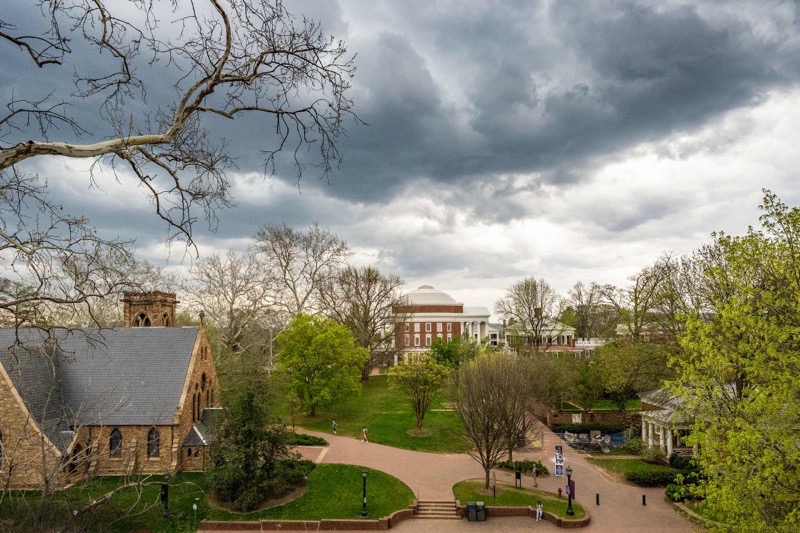
Also, UVA’s photographer Sanjay Suchak has used the rebuilding of the library as a chance to get up high for an unusual view of the Rotunda and its corner of the Grounds:
DNA
It’s natural to find the thought that what we build in our life will die with us disturbing. (Though forms of its lasting can also be distressing; in his poem “Posterity,” Philip Larkin imagines being summed up by an irritated, unenthusiastic future biographer with “Oh, you know the thing / That crummy textbook stuff from Freshman Psych.”) No one wants to die. To ourselves, we matter, and we want what we do to matter to somebody else. We want our sacrifices to be worth it in a transcendent sense, our pain to have a purpose, our achievements to be permanent. A handful of life paths — intellectual and artistic work in particular — are about trying to create, as Horace wrote, “a monument more lasting than bronze.” They are a calculated gamble that a life dedicated to the difficult and narrow path will continue after our death, however unrewarding it might have been to experience. […]
Most scholarship is also not going to live forever. Is it therefore not worth doing? I wouldn’t say so. It’s worth it to maintain gardens and repair buildings and restore artworks. No one’s work lives forever on its own. It stays alive because someone keeps it so. Here again, greatness requires humility: other people’s. The task of thinking is worthwhile even if your thoughts prove to be of limited usefulness. The tasks of reading, of appreciation, of interpretation, are worthwhile, even if next year there is a new essay that supersedes yours, or a new book. If we have chosen to live our lives this way, it is because something about it strikes us as the best way we can spend our time.
When I was in graduate school I read a book by a scholar named Michael O’Loughlin with the unwieldy title The Garlands of Repose: The Literary Celebration of Civic and Retired Leisure: The Traditions of Homer and Vergil, Horace and Montaigne. I was greatly taken with it. Before I read that book, it had never occurred to me that there could be different kinds of leisure, with different purposes, different characters; nor had I thought about just how essential leisure is to human culture. (Maybe O’Loughlin hadn’t thought about that either, before reading Josef Pieper.) I also loved the way O’Loughlin identified thematic harmonies that linked works written over a period of 2000 years. It seemed to me a model of what my own literary criticism could be.
When I read the book, I was expecting to become a specialist in seventeenth-century literature, but my path veered in a different direction, so I have rarely had the opportunity, over the years, to cite it. But it has had a lasting effect on my thinking. For instance, it has deeply informed the way I read W. H. Auden, that most Horatian of modern poets. My critiques of technocracy and my interest in “repairing the world” stem from a belief that one of the best things we can do for our culture, and for those who join it after us, is to create a space for healthy leisure. Even my recent thinking about Taoism is influenced by what I read in The Garlands of Repose all those years ago.
Another way to put that is to say that O’Loughlin’s book — I believe the only one he ever published — became a part of my intellectual DNA. And maybe something I write will spark something for a reader — a scholar or a writer or a pastor or teacher or who knows what — and become part of her DNA. Maybe she’ll never quote me — maybe she’ll never even realize that she wouldn’t have had that idea if she hadn’t read my essay — but in that way my thought will become part of someone else’s intellectual genome, and through her will make some difference in the world. If so, then her thought will be indebted to a scholar she probably has never have heard of: Michael O’Loughlin.
As with my writing, so with my teaching. Maybe some word of mine will become a part of a student’s intellectual or moral or spiritual inheritance, and in that way play a role in his life, and then, through his influence, in the lives of others. Just as my own voice is shaped and formed by the voices of others — Bakhtin taught me this — so others will appropriate for themselves and their purposes ideas they first heard in my voice.
I don’t expect that anyone will be reading my stuff after I die — I expect that I’ll be wholly forgotten before I die, if I live to a good age — but I almost never think about that. At the end of Middlemarch George Eliot says of Dorothea that “the effect of her being on those around her was incalculably diffusive: for the growing good of the world is partly dependent on unhistoric acts,” and that captures better than I can my convictions on this point. Diffusive is the key word: an influence that subtly spreads, perhaps without anyone noticing. I find that model of influence more encouraging and comforting than any hopes for fame could ever be.
This is gonna be fun

I estimate that 73% of my RSS feed is stories about Twitter. Enough is enough, folks!