

Took me this long to get it in two. Will I ever get it in one? Doubtful.

The risks of netwar and cyberwar are consequences of convenience. Communications networks became widespread, delivering previously unthinkable quantities of bespoke content instantly. As they ballooned and megascaled, they offered more opportunities for exploitation that might affect larger populations much more rapidly. Meanwhile, business and government operations elected to take on new vulnerabilities in their computer infrastructure in order to win operational conveniences. Those conveniences once seemed worth it. Not anymore.
Maybe – but when have we ever been willing to give up on our conveniences, no matter how dangerous?
On my first visit to Moscow, I met one of Lenin’s embalmers. “When I began, the body was in a poor state”, said Styopa, whose expertise was the use of electricity. Skin grafts and a new partial-vacuum glass sarcophagus had helped to inhibit decay, but Styopa’s shock treatment had reversed it. “Once every two or three months, a high-voltage charge was applied to keep up the tone. But the first time we tried it I overestimated the power needed. Lenin suddenly sat up from the table, his arms shook, and his lips started to quiver. I thought he was going to speak. It was quite a shock. After that, we reduced the voltage.”
doing your own research
In 2016, director Dean Fleischer-Camp — known for his work on the viral hit, Marcel The Shell With Shoes On — released Fraud, a “meta-documentary” composed of a series of home videos. They follow a family with a mounting pile of debts participating in a crime spree to wipe the slate clean. Though the videos that make up the film are real, the story itself is entirely fabricated: Fleischer-Camp made the film after stumbling onto an account holding hundreds of hours of home videos. By methodically going through this vast archive, he was able to recombine these clips into a crime narrative. Suddenly, a clip of a woman spraying her carpet becomes a woman about to burn down a home.
In a Q&A following Fraud’s premiere at Toronto’s Hot Docs festival, Fleischer-Camp was called a “con artist” and “liar” by audience members who were disturbed by his working methods. These viewers took issue not with the film’s plot, but its construction. Unlike Loose Change, which purports to discover the truth in a lie, Fraud explicitly attempts the reverse, showing that one could convincingly tell any story with materials found on a site like YouTube. Ironically, it’s Fraud that, to its critics, defies the open, truth-leaning and “collaborative” ethos that people associate with the platform.
Fleischer-Camp’s unforgivable sin is showing people who pride themselves on “doing their own research” that they don’t have the first idea what research is or how to do it, and that, as a direct consequence, they are easy marks for crooks who know how to play to their intellectual self-assessment. As Kim says in his concluding paragraph:
YouTube is a space where the successors of Burroughs, Gysin, and Bachman meet, where author and viewer at least appear to collapse, and the possibilities of the webpage open up. The ability to engage as a viewer has never been so substantive. But this sense of engagement is double-edged: it can allow for new innovations in narrative, but also in persuasion and propaganda. The feeling of engagement is not the same thing as actually engaging. “Do your own research” is less an imperative than a strategy of flattering one’s audience: the implication is that you have done your own research simply by watching the film. Despite controlling the playback, the user is just as passive as ever.
Injured Parties
I have an essay in the new Hedgehog Review — behind a paywall, but shouldn't you subscribe? Yes indeed you should. The essay is called "Injured Parties," and it begins thus:
In 1923, the American movie star Dorothy Davenport lost her husband, the actor and director Wallace Reid, to an early death resulting from complications of morphine addiction. After the tragedy, Davenport took up the job — an unusual one for a woman in Hollywood in that era — of film producer. Starting with Human Wreckage, a movie about the dangers of drug addiction that appeared just months after Reid’s death, Mrs. Wallace Reid, as she now called herself, oversaw a series of films on pressing social issues. For instance, the third one she produced, and which she personally introduced in a prologue, The Red Kimono (1925), portrays the dark personal and social consequences of prostitution.
All of Davenport’s moral-crusading films were popular, but also controversial: Some were banned by the British Board of Film Censors and by the guardians of public morals in many American cities. The Red Kimono had other problems, though, problems related to one Gabrielle Darley. Darley was a young woman who in the second decade of the twentieth century had worked as a prostitute in Arizona for a pimp named Leonard Tropp. She fell in love with him and they moved to Los Angeles, where she gave him money to buy a wedding ring — for herself, she thought, but in fact Tropp planned to marry another woman. When Darley discovered this, she shot Tropp dead. In 1918, she was put on trial for murder, but had the great good fortune of being represented by an exceptionally eloquent defense attorney named Earl Rogers — a close friend of William Randolph Hearst — who presented her as having been, before meeting Tropp, “as pure as the snow atop Mount Wilson.” The jury couldn’t get enough of this kind of thing and enthusiastically acquitted Darley.
One of the journalists covering the trial was Rogers’s daughter, Adela Rogers St. Johns, who was already well on her way to earning her unofficial title as “World’s Greatest Girl Reporter.” (For many years she worked for Hearst newspapers, and may have reached the height of her fame in her reporting on the 1935 trial of Bruno Richard Hauptmann for kidnapping and murdering the young son of Charles and Anne Morrow Lindbergh.) She wrote a short story, based on the trial, called “The Red Kimono.” It caught the attention of Dorothy Davenport, who immediately commissioned a screenplay and started filming. The name she chose for the film’s protagonist? Gabrielle Darley.
I describe Darley’s claim to having been defamed by the film — to being injured reputationally — and the ultimate decision of the Supreme Court of California in her favor.
From there I go on to explore the meaning of defamation and how it has changed over time, with a particular focus on the early modern period, during which, as I learned from reading that wonderful scholar Debora Shuger, defamation was very differently understood. I indulge my suspicion that we — immured in a social-media environment for which defamation is more or less the coin of the realm — might have a few things to learn from that era, and also from Erving Goffman. Yeah, I know it sounds weird, but trust me, it all holds together. I think. Ultimately I am trying to imagine charity as both a legal and a social concept. The point of the essay is not to settle any current issues but rather, by looking into the past, to discover alternative and superior moral vocabularies with which to address our disagreements.
Subscribe and read, please!
Half the point I want to make is that I have had a charmed life. I was whisked out of the way of the Nazis, bundled out of the way of the Japanese army, and, after a safe and happy four years in India, found myself in England instead of returning to Czechoslovakia in good time to grow up under communism. But I haven't made my point even yet. I wasn't merely safe, I was in the land of tolerance, fair play and autonomous liberty, of habeas corpus, of the mother of parliaments, of freedom of speech, worship and assembly, of the English language. I didn't make this list when I was eight, but by 18 I would have added the best and freest newspapers, forged in the crucible of modern liberty, and the best theatre. When I was 19 there occurred the Hungarian revolution, and my first interest was in how the story was being covered. On my 23rd birthday I panicked because I'd written nothing except journalism, and wrote a derivative play. When I was 31, Russian tanks rolled into Prague, and my wife got angry with me because I was acting English and not Czech. She was right. I didn't feel Czech. I had no memory of Czechoslovakia. I condemned the invasion from the viewpoint of everything I had inherited at the age of eight, including my name. During all that time, I had never been without a bed, or clothes to put on, or food on the table, or without medicine when I was sick, or a school desk to sit at. As I grew up I never had to put on a uniform except as a boy scout. As a journalist and writer I had never been censored or told what to write. As a citizen I never had to fear the knock at the door. The second half of the point I want to make is that if politics is not about giving everybody a life as charmed as mine, it's not about anything much.
Big Bend National Park, taken a while back.

The mothership … um, I mean the newsletter has landed.
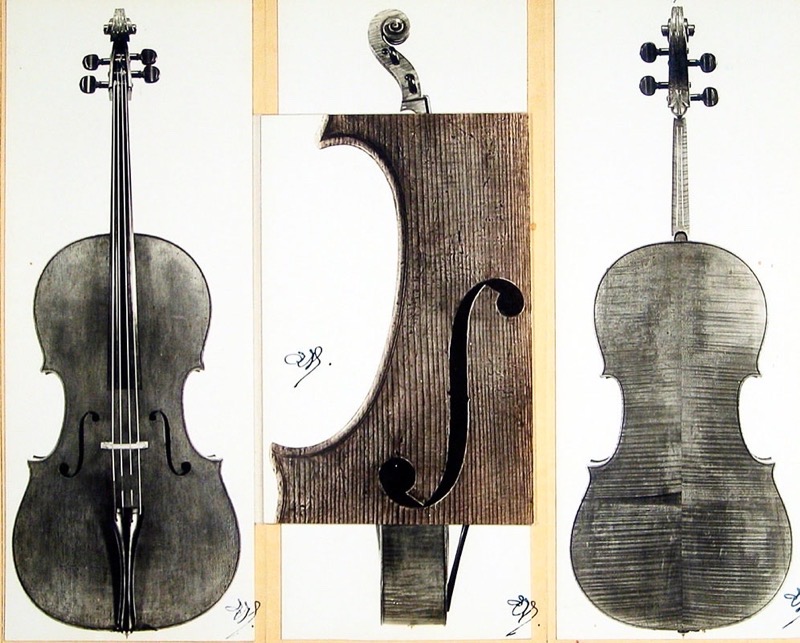
Antonio Stradivari, the ‘Davidoff’ cello (1712)