
attentional norms
Me at the Hog Blog on “attentional norms” and Zoom:
It has been interesting to watch over the last two pandemic years as the norms associated with videoconferencing have coalesced. My experience strongly suggests that the attention level expected on Zoom (and other videoconferencing platforms) is quite remarkably low — medieval-churchgoing low. Obviously, there will be exceptions to this norm — no one feels free to look away when the Boss is giving a speech — but I can’t remember the last time I was on a Zoom call in which participants were not regularly cutting their video and audio, or just their audio, to talk to people in the room with them. Or they just walk out of frame for a few minutes. Or they type away furiously on Slack or email or WhatsApp or iMessage. And no one who does this acts inappropriately, because such fidgeting and alternations of attention are permitted by the norms that have emerged.
It’s fascinating to me how these norms emerge. No one chooses them, they just happen; and when a lot of people are using one technology, they happen quickly. As I say in the essay, they also change, but they seem to change a lot more slowly than they emerge; and there’s nothing any one person can do to change them. When you’re a teacher, as I am, you have to be very observant about those attentional norms and choose the technologies that match your pedagogical purposes. Because you’re wasting your time if you try to enforce norms that are different than those people have absorbed from everyone else.
UPDATE: Everything I try to say here is said better by Rands: “Do you want to know why you’re fatigued at the end of a long day of video conferences? It’s because your brain has been straining to collect essential information that is no longer there.”
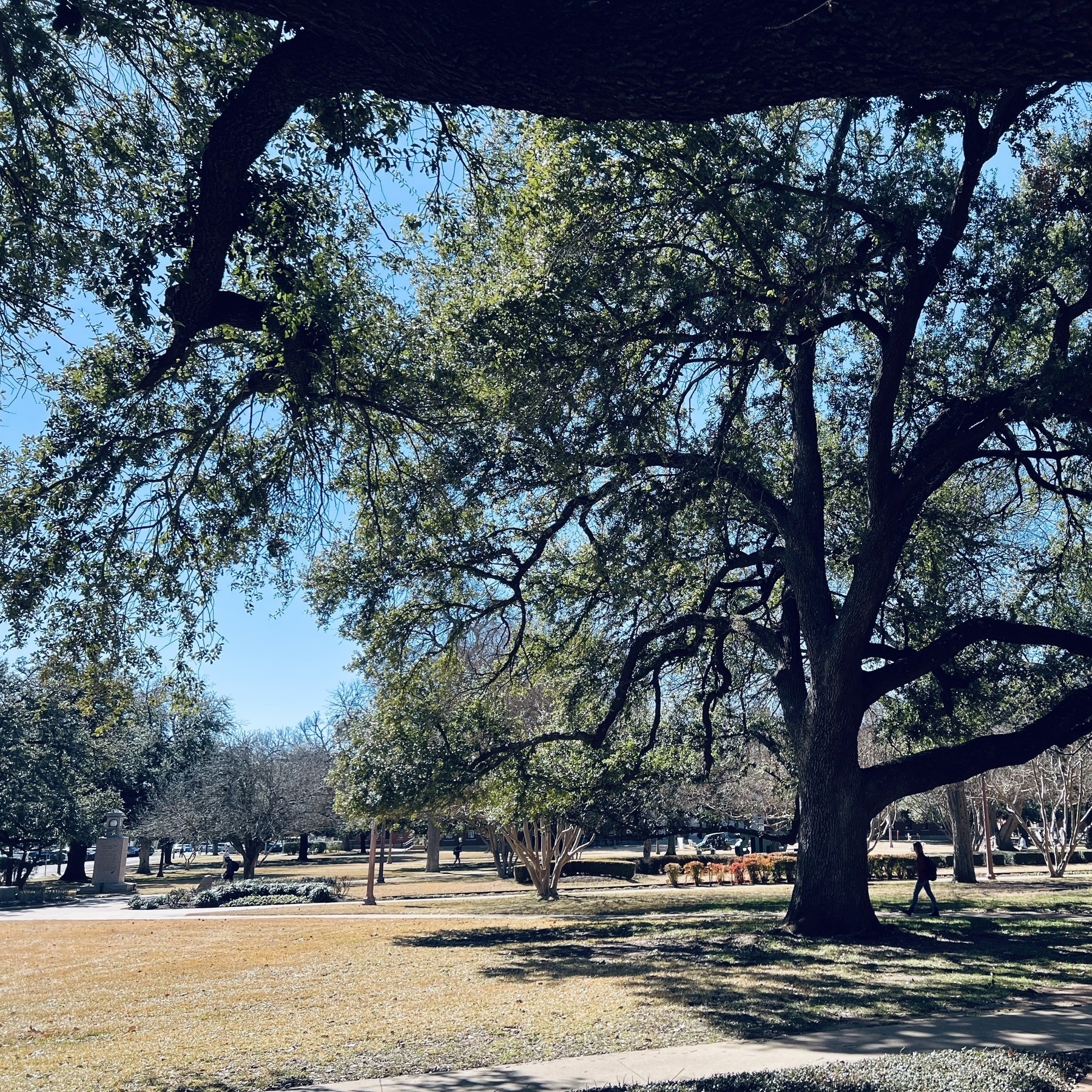
Gorgeous day on campus today.

Currently reading: A Room of One’s Own by Virginia Woolf 📚
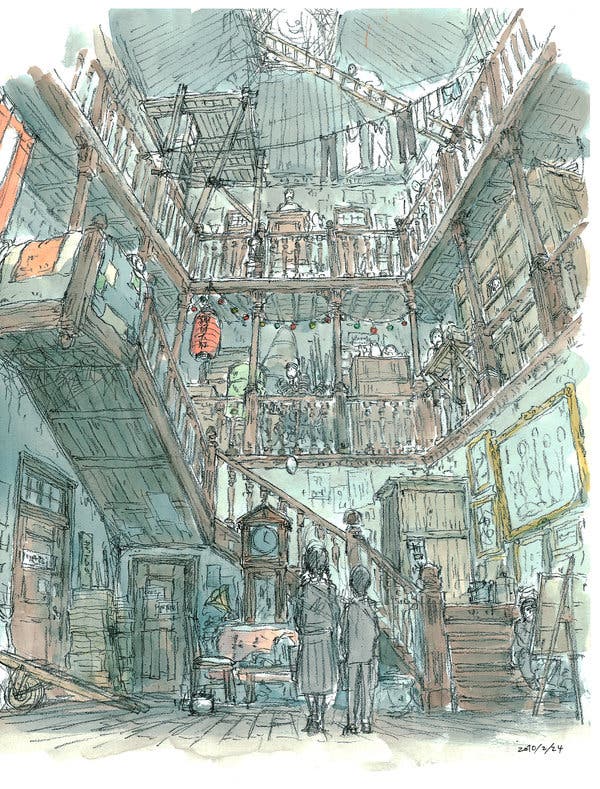
the view from Poppy Hill
When I talk about invitation and repair, I think the concept of invitation is a pretty simple and straightforward one. I want to invite people to participate with me in this project of repair. But what is it that I want to repair and how do I want to repair it? … Goodness, it’s hard to say. Strange that I would have so much difficulty articulating even the most basic elements of my project. But let me try:
I believe that that our political and social order is broken, but (a) I am not properly positioned, either professionally or temperamentally, to do anything about that, and (b) I believe that our social and political order are broken because we have failed to care for the underlying culture that alone can give integrity and character to that order. As I've said many times before, I completely agree with Yuval Levin that it is indeed a time to build (or rebuild) our institutions, but the problem is that nobody wants to rebuild the institutions and they don't want to rebuild them because they don't care about them, they don't value them, they don't see what purpose they serve; for them an institution is simply an impediment to the achievement of their desires. In this kind of environment, I don't see the rebuilding of the institutions as an immediate possibility. Americans today perceive institutions as repositories of resources for them to exploit. If you have any doubt about that, just observe how our Representatives in Congress behave. They have absolute contempt for that which they are pledged by their oath to serve. They raid the institution to scavenge money and status. As our leaders, so their followers: What people do with institutions, with any commons, with all (theoretically) shared resources, is to strip-mine them for anything fungible.
This is a massive problem, and not one to be fixed by passing laws prohibiting this or that, mandating this or that. We have to look deeper, deeper into the culture that precedes and shapes the institutions.
SO: I think by repair I mean first of all making our broken cultural inheritance lovable again. For me, that means holding up visual art and music and writing and trying to show its beauty so that other people will also think that it's worth conserving and transmitting to the next generation.
Which brings me to …

My friend Robin Sloan suggested to me that the Studio Ghibli movie From Up on Poppy Hill might be relevant to my Invitation and Repair project and because Robin is a smart guy I decided that I should watch it. It's been on my watchlist for quite a while; I suppose the main reason I have never gotten around to it is that I knew it was not directed by Hayao Miyazaki (though he co-wrote it) but rather by his son Gorō. That gave me a suspicion that it was probably second-tier Ghibli. And maybe in some senses it is; it certainly quite different than the usual Miyazaki movie, especially in the complete absence of mystical or magical elements. It's a straightforward adolescent love story – but, let me quickly add, an absolutely delightful one. I would adore this movie if only for how well it tells a simple tale of first love.
But there's more to it than that.
The event that brings our two lovers together, in the early 1960s in Yokohama, Japan, is a threat to a battered old house known by those who use it as the Latin Quarter. On the grounds of a an architecturally bland and sparely modern sparely modern high school sits a ramshackle building comprised of multiple architectural traditions, Western and Japanese, thrown together in what I believe to be an utterly charming way. But in relation to the ideals of modern education, it is not fit for purpose, and plans are underway to have it demolished. Advocates for the demolition speak the language of the New, of the need for Japan to become more cosmopolitan, to be seen as “a modern and peaceful nation.” Lurking behind the whole story is the upcoming Olympic Games in Tokyo in 1964, and there is a palpable anxiety among many to eliminate those aspects of Japanese culture that might be disapproved by visiting foreigners.
The Latin Quarter is comprised of a dizzying array of subordinate units: a tiny philosophy club, a laboratory for aspiring chemists, an editorial office for a student newspaper, and many more. (I don’t think we ever see what’s going on in the tent that has been erected in one of the open hallways.) The only things holding the endeavor together are the gender of the people who use it — all of whom are boys — and a certain obsessive nerdiness about whatever it is that any given participant in the life of the Latin Quarter happens to find fascinating.
Umi, the movie's protagonist, starts to fall for a young man named Shun, who works on the newspaper and is prone to taking wild leaps, both literal and metaphorical. She helps him with his work, and then when he communicates to her his alarm over the impending demolition of the Latin Quarter, she agrees to help him. She does so first by gathering together a large group of volunteers to clean the place up and throw out its decades of accumulated garbage, making it, they hope, sufficiently attractive that the would-be demolishers will have second thoughts. But though Umi assembles a mighty army of volunteers and the girls and boys of the school work together harmoniously, their efforts don't change the hive-mind of the Powers That Be. So Umi agrees to go with Shun and Shirō, the editor of the student newspaper, to Tokyo, where they hope to gain an audience with a wealthy businessman, an alumnus of the high school who chairs its Board of Trustees. They urge him to visit and see the newly renovated Latin Quarter and, if he is impressed by it, to intercede on their behalf.
There is so much, so so much, invitation-and-repair fodder here.
I want to call attention to a few things. First, I’ll note the point that Shun makes in a debate among the high school’s students about the future of the Latin Quarter: To the modernizers, he says, “Destroy the old and you destroy our memory of the past. Don't you care about the people who lived and died before us? There is no future for the people who worship the future and forget the past.”
In a Japan somewhat maniacally focused on modernization in advance of the Olympic games, this is a minority viewpoint, but one that might resonate with those who know a little bit about historic Japanese culture and its instinct for continuity.

Umi has perhaps another reason to be disposed towards protecting the Latin Quarter: she lives in a big rambling house up on Poppy Hill, overlooking Yokohama harbor, that at one point was a small hospital and that is now, because of the poverty of her family in the aftermath of her father's death a decade before, a kind of boardinghouse. But Umi and her family take great care of the place: everything is spotlessly clean and anything in need of restoration has been restored. Umi is very proud of the beauty and the dignity of her old house, and when she shows it to Shun he is immediately struck by the difference between the condition of her house and the condition of the Latin Quarter. So this, perhaps, makes him receptive when Umi suggests that if he and the other boys love that old clubhouse then perhaps they should do more to care for it.
Which brings me to what may be the most moving moment in the whole movie to me. When Umi and Shun and Shirō manage to get an audience with that wealthy businessman in Tokyo, he is friendly but also wants to know how why the Latin Quarter should be preserved. After all, he reminds them, the population of the school is growing and there's no question that a new building is needed. How can the Latin Quarter be allowed to stand in the way of that? And Umi – I think it's very important that it's Umi who replies to his question, not the two boys whom she has accompanied, and that she uses the first-person plural – Umi answers with simplicity and directness: “Because we love it, and because it makes us feel connected to our past.”
Well, that's it in a nutshell, isn't it? We care for old stuff, stuff the world doesn't have time or patience for, filth, the fractured and grimy culture we have inherited, because we love it and it makes us feel connected to our past — and therefore, as Shun understood, to our future, to those who will inherit it after we’re gone. That's the project of invitation and repair. A simple imperative, presented to us through a simple story.

Preview of coming attractions
It’s clobberin’… um, I mean, newsletter time!
Monday morning, at the desk, preparing to clear my head.
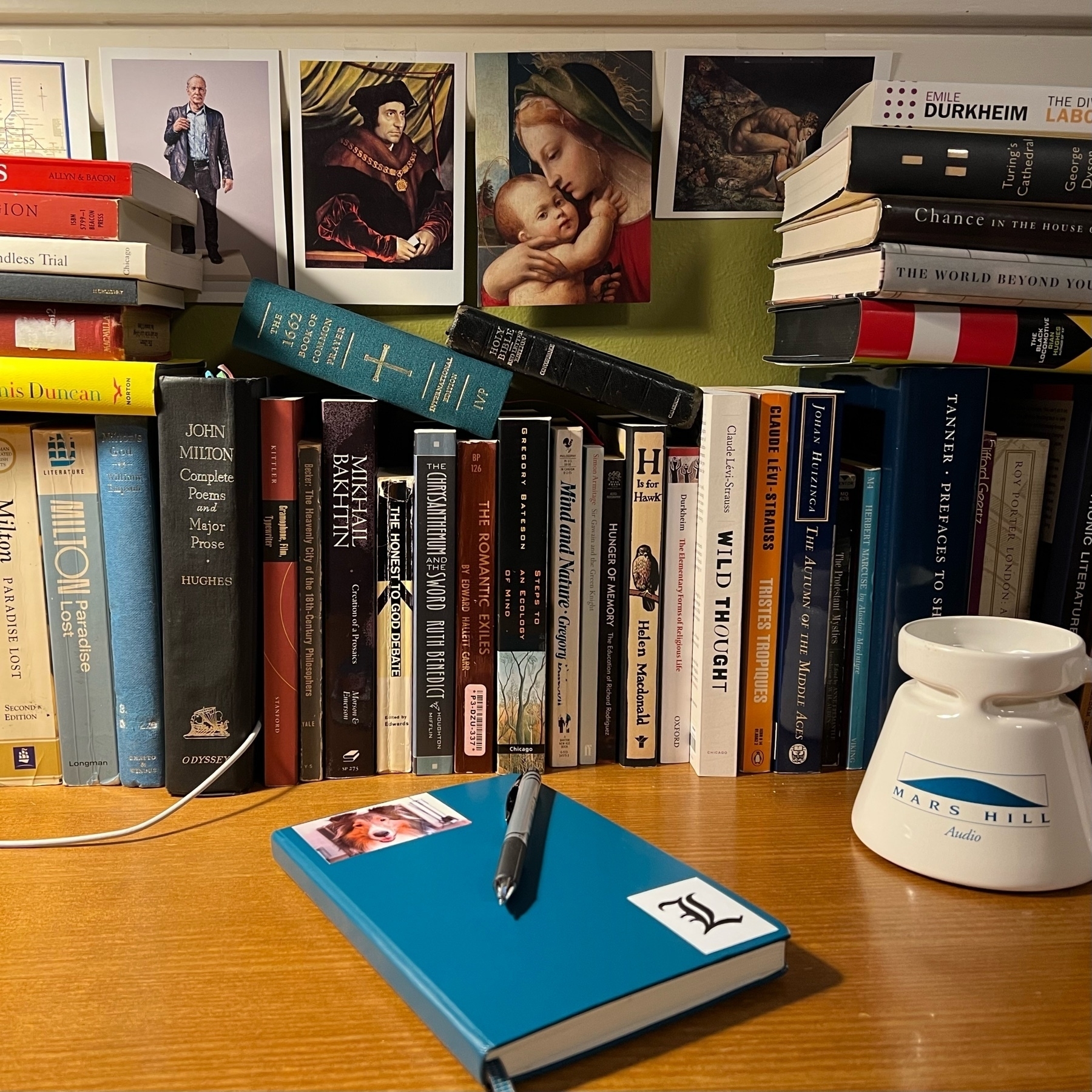
the graveyard of ideas
What Was the TED Talk? - The Drift:
The story goes like this: there are problems in the world that make the future a scary prospect. Fortunately, though, there are solutions to each of these problems, and the solutions have been formulated by extremely smart, tech-adjacent people. For their ideas to become realities, they merely need to be articulated and spread as widely as possible. And the best way to spread ideas is through stories — hence Gates’s opening anecdote about the barrel. In other words, in the TED episteme, the function of a story isn’t to transform via metaphor or indirection, but to actually manifest a new world. Stories about the future create the future. Or as Chris Anderson, TED’s longtime curator, puts it, “We live in an era where the best way to make a dent on the world… may be simply to stand up and say something.” And yet, TED’s archive is a graveyard of ideas. It is a seemingly endless index of stories about the future — the future of science, the future of the environment, the future of work, the future of love and sex, the future of what it means to be human — that never materialized. By this measure alone, TED, and its attendant ways of thinking, should have been abandoned.
I know I’ve made this point about fifty times — the first time here, I think — but once more: “People who habitually traffic in symbolic manipulation — which includes pretty much everyone who spends a great deal of time, vocationally or avocationally, on the internet — tend to overestimate quite dramatically the power of symbolic manipulation.”


Martin Niemöller, writing to his wife from Moabit Prison in Berlin, 18 August 1937: “You don't have to worry about me; I live my day and it's never long, and should there be occasional rough weather and storms on the surface, at a diving depth of twenty meters there is total calm.”