
tenants
Zuckerberg had shifted his company away from the open platform of the browser and onto a closed system where Apple set the terms. For a long time, that was a very good deal for Facebook — but when Apple decided to alter the deal, Facebook didn’t really have much recourse.
There’s a lesson in that, even if you aren’t planning to launch a media site, or a social media platform. Our ferocious arguments about who should be kicked off Spotify, or Twitter, are fundamentally about the same problem: So much of our public life takes place on a handful of technology platforms, where what we see and whom we reach is determined by policies set by some faceless programmer in Silicon Valley. We are all of us tenants of the digital manor — even, it turns out, some of the lords.
See also my brief reflection on our manorial elite.
The lesson Megan identifies is one I am always seeking to internalize. For the last few years I have been trying to move more and more of my life out of the control of our tech overlords. I read less on the Kindle and buy more codexes; I stream less music and movies and buy more CDs and Blu-Rays; I hang out on the open web and avoid the walled gardens. (I really enjoyed Jonathan Goldstein’s podcast Heavyweight but when it went Spotify-only I cheerfully gave it up.) I don’t want my access to art I love and ideas that interest me to be determined by the whims of the Lords of the Manor. Of course, this means that I have to be more discriminating: I can’t buy everything I might want to read or watch or listen to, so I have to make a point of buying what I think I stand a good chance of experiencing repeatedly. Which is also in itself a win for me, isn’t it?
Christianity in sum
I’ve mentioned in my newsletter how deeply I have been touched and healed in recent months by the Church of England’s Daily Prayer. This morning as I was listening to Morning Prayer — that is, the service for the fourth of February (that link should take you directly to the recorded service plus the text) — and it occurred to me that this one service contains almost everything you would need to understand the ancient Christian faith in all its beauty and all its strangeness: gorgeous music crying out to God; the précis of revelation (general and special alike) in that greatest of ancient lyric poems, Psalm 19; the scandal and offense of the Binding of Isaac; the hope beyond hope of the Resurrection narrative; and the sparely beautiful liturgical structure in which they are all embedded. It’s all there, in little more than 20 minutes: a summation of the whole story in which we Christians participate.
makers and making
Let’s think about three ways in which technological making can go wrong, using some Ludlumesque naming conventions.
First, there’s the Zuckerberg Imperative: “Move fast and break things” in order to achieve DOMINATION. This is evil by intention: it openly rejects moral responsibility.
Second, there’s the Oppenheimer Principle: which I describe here: “When you see something that is technically sweet, you go ahead and do it and argue about what to do about it only after you’ve had your technical success. That is the way it was with the atomic bomb.” This is not purposefully evil, but it often leads to evil through neglect of moral responsibility.
And third: the Fëanor Temptation.
Many readers of Tolkien’s Silmarillion tend to think that Melkor (effectively the Satan of Tolkien’s legendarium) is the central figure in that collection of myths and tales, but he isn’t. The central figure is an Elf named Fëanor, who makes the Silmarils, the three jewel-like and yet somehow organic objects for which the book is named – because so many of the conflicts that deface Middle-earth (and even places beyond) are brought about by love and desire for the Silmarils.
Let’s approach the significance of Fëanor in a somewhat roundabout way, as Tom Shippey – whom I’m basically stealing my ideas from, straight no chaser – does in his superb book The Road to Middle-Earth. Shippey asks whether the Elves are fallen in the same way that Men, according to Tolkien’s Catholic faith, are. If so:
A natural question is, what was their sin? To keep the pattern consistent, it ought not to be the same as that of Adam and Eve, by tradition Pride, the moment when, as [C. S.] Lewis said, ‘a conscious creature’ became ‘more interested in itself than in God’. In fact the elves seem much more susceptible to a specialised variety of pride not at all present in Paradise Lost, not quite Avarice or ‘possessiveness’ or wanting to own things (as has been suggested), but rather a restless desire to make things which will forever reflect or incarnate their own personality. So Melkor has the desire ‘to bring into Being things of his own’; Aulë, though subjecting himself to Ilúvatar, creates the dwarves without authority; Fëanor forges the Silmarils. One might rewrite Lewis’s phrase to say that in Valinor, as opposed to Eden, the Fall came when conscious creatures became ‘more interested in their own creations than in God’s’. The aspect of humanity which the elves represent most fully – both for good and ill – is the creative one.
Further:
Significantly Fëanor learns not from Manwë, nor Ulmo, but from Aulë, the smith of the Valar and the most similar of them to Melkor; Aulë too is responsible for the despatch of Saruman to Middle-earth…; Aulë is the patron of all craftsmen, including ‘those that make not, but seek only for the understanding of what is’ – the philologists, one might say, but also the scopas, the ‘makers’, the fabbri, the poets. Tolkien could not help seeing a part of himself in Fëanor and Saruman, sharing their perhaps licit, perhaps illicit desire to ‘sub-create’. He wrote about his own temptations, and came close to presenting the revolt of the Noldor as a felix culpa, a ‘fortunate sin’, when Manwë accepts that their deeds will live in song, so that ‘beauty not before conceived [shall] be brought into Eä’; fiction, poetry, craftsmanship are seen as carrying their own justification and as all being much the same thing.
And finally, Shippey brings us to the heart of the matter, with a reference to Tolkien’s comment, in one of his prefaces to The Lord of the Rings, that his story is not an allegory of our era but may well have “applicability” to our era:
Love of things, especially artificial things, could be seen as the besetting sin of modern civilisation, and in a way a new one, not quite Avarice and not quite Pride, but somehow attached to both. In that view The Silmarillion would have something like the distinctively modern ‘applicability’ of The Lord of the Rings and The Hobbit, for all its archaic setting.
You can see from all this that what I am calling the Fëanor Temptation is closer to the Oppenheimer Principle than to the Zuckerberg Imperative. There is no direct intention to dominate, no thought of controlling or even influencing others. We are told that “Fëanor and the craftsmen of the Noldor worked with delight, foreseeing no end to their labours” – they find their work “technically sweet,” you might say.
But in the making of the Silmarils there was something of greater dignity, a love of something not made by Fëanor or any other of the Children of Iluvatar (i.e. Elves and Men): “For Fëanor, being come to his full might, was filled with a new thought, or it may be that some shadow of foreknowledge came to him of the doom that drew near; and he pondered how the light of the Trees, the glory of the Blessed Realm, might be preserved imperishable.” The desire to make the Silmarils, then, arises from a delight in the light of the Two Trees made by the Valar, the archangelic demiurges of this imagined cosmos.
But is there in Fëanor, perhaps, a certain desire to compete with the Valar? The Valar themselves seem not to have been concerned: “Varda [the Queen, as it were, of the Valar] hallowed the Silmarils, so that thereafter no mortal flesh, nor hands unclean, nor anything of evil will might touch them, but it was scorched and withered; and Mandos foretold that the fates of Arda, earth, sea, and air, lay locked within them.” Yet there is cause for concern in the next sentence: “The heart of Fëanor was fast bound to these things that he himself had made.”
So strong is the hold of the Simlarils over Fëanor that when Melkor offers him shelter for them he is briefly tempted; and though he fiercely rejects Melkor – indeed he is the one who renames Melkor as Morgoth, the Black Enemy; and when Morgoth kills Fëanor’s father we are told that “his father was dearer to him than the Light of Valinor or the peerless works of his hands.” He is no monster; or not for a long time. But when Morgoth steals the Silmarils Fëanor becomes (quite literally, I think) insane with rage, and he and after him his sons are willing to defy the Valar and kill anyone who might stand between them and the recovery of those gems.
They swore an oath which none shall break, and none should take, by the name even of Ilúvatar, calling the Everlasting Dark upon them if they kept it not; and Manwë they named in witness, and Varda, and the hallowed mountain of Taniquetil, vowing to pursue with vengeance and hatred to the ends of the World Vala, Demon, Elf or Man as yet unborn, or any creature, great or small, good or evil, that time should bring forth unto the end of days, whoso should hold or take or keep a Silmaril from their possession.
The gems are good; their making was at least potentially innocent; but afterward arose a lust for owning and controlling that led to great tragedy. Shippey again: the Fall of the Elves occurred “when conscious creatures became ‘more interested in their own creations than in God’s’. The aspect of humanity which the elves represent most fully – both for good and ill – is the creative one.”
And this is why “making” in and of itself is not the answer to our decadent moment. “Love of things, especially artificial things, could be seen as the besetting sin of modern civilisation, and in a way a new one, not quite Avarice and not quite Pride, but somehow attached to both” – and this is the Fëanor Temptation. It is in light of this temptation that I advocate repair, which is a mode of caring for what we have not made, but rather what we have inherited. We will not be saved by the making of artifacts — or from the repair of them, either; but the imperative of repair has these salutary effects: it reminds us of our debt to those who came before us and of the fragility of human constructs.

Currently reading: The Metamorphosis: And Other Stories by Franz Kafka 📚
It’s revealing that, before the arrival of the net, people didn’t talk about “authenticity” as we do today. They didn’t have to. They understood, implicitly, that there was something solid behind whatever show they might put on for public consumption. The show was not everything. The anxiety of the deep fake had not yet taken hold of the subconscious. The reason we talk so much about authenticity now is because authenticity is no longer available to us. At best, we simulate authenticity: we imbue our deep fakeness with the qualities that people associate with the authentic. We assemble a self that fits the pattern of authenticity, and the ever-present audience applauds the pattern as “authentic.” The likes roll in, the views accumulate. Our production is validated. If we’re lucky, we rise to the level of influencer. What is an influencer but the perfection of the deep-fake self?
This is usefully provocative of reflection — Nick specializes in that — but I don’t think he’s right about authenticity. See Lionel Trilling’s Sincerity and Authenticity, based on lectures given in 1970. He already saw the shift from an ethos of sincerity to one rooted in an ever-elusive quest for authenticity. See also Charles’s Taylor’s The Ethics of Authenticity (1992), where the fourth chapter is a brilliant capsule history of the the various meanings of “authenticity.” It’s especially interesting that Taylor believes that the debased and trivial way that authenticity is defined today is not the only one — that there is a nobler understanding of authenticity as a “moral ideal” that is worth defending.
UPDATE: Also, see the recent Hedgehog Review issue on authenticity.
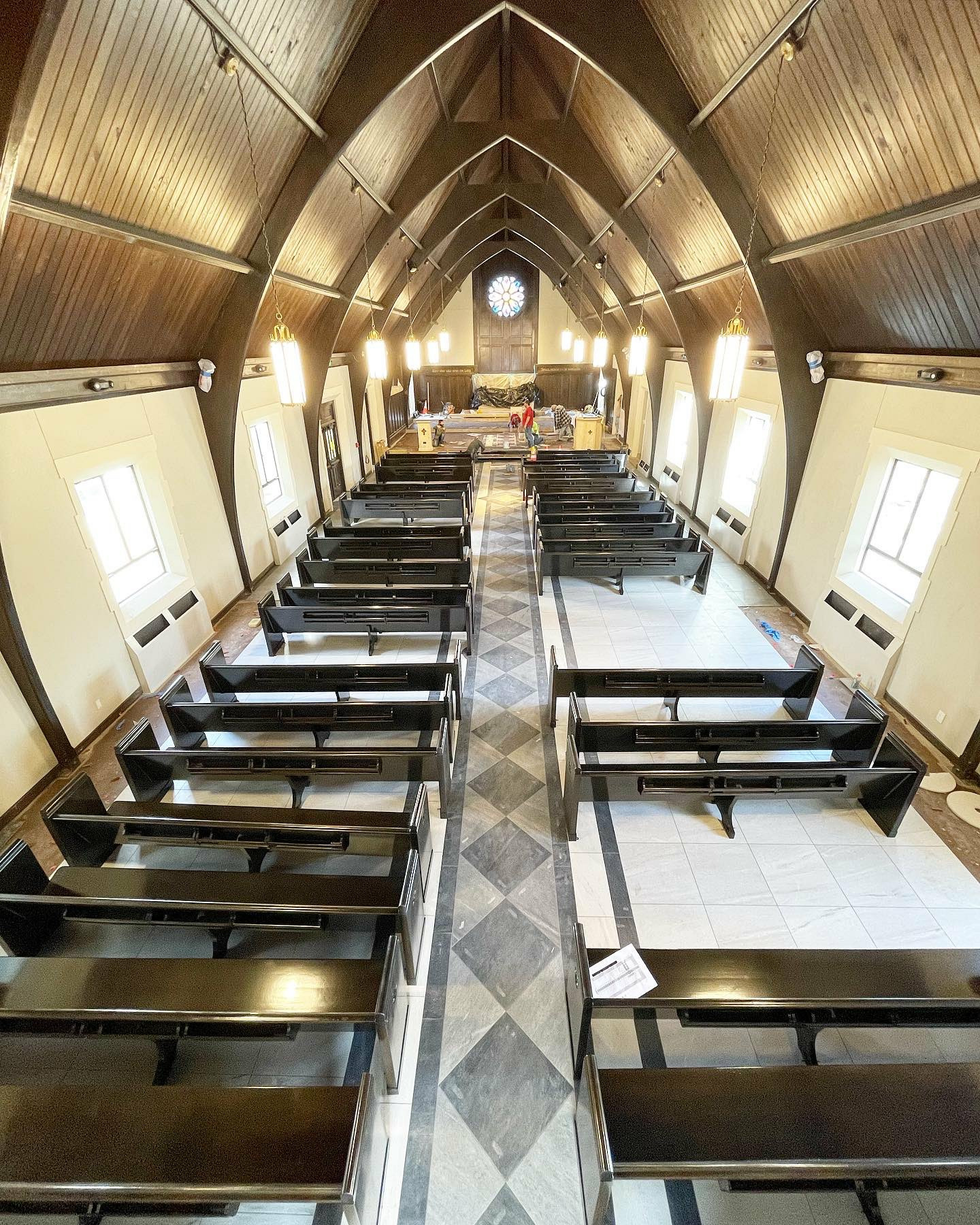
I like this photo of the renovations being done at my church because it reminds me how the nave of a church gets its name (from navis, ship). We’re all in this ark together.
two quotations: ears to hear
This objection to the free will argument seems decisive. It raises the most uncomfortable questions about why God bothered to create the world at all. If Heaven was not created on earth, then earth is a testing-ground for Heaven. But there is something more. For a world without freedom would be a world in which God controlled all our actions, it would be a world in which God spoke directly to us without the need of faith. We would all believe. Faith is, apparently, part of the test visited on us. I have always found Philip’s cry to Jesus in John 14, piercing: ‘Philip saith unto him, Lord, shew us the Father, and it sufficeth us.’ It seems obvious to theologians like Richard Swinburne that a world of limited freedom and absolute transparency of knowledge, in which not one of us was in any doubt about our creator, would be a limited, useless place. But it would not, presumably, be useless to God. It is what Heaven would be like; and why, before Heaven, must we move through this unhappy, painful, rehearsal, this desperate antechamber in which so few of us can find our way?
There are people who claim to be able to break this perplexing code (albeit only in part, never fully); but they do not necessarily attribute their success to some kind of gnostic initiation or privileged access to an esoteric treasury of knowledge. Rather, they claim to have adopted a special spiritual attitude, opened themselves up to the voice of the meaning-carrying mind; and they say that anyone can “tune in“ in this way. They might be wrong, of course, and certainly those of us who do not wish to hear this voice cannot be brought round by their arguments; rather, we will classify them as victims of delusions. But if they are right, and the voice really is audible to anyone who wants to hear it, then the question “Why is the message hidden?" is the wrong question.
Let’s be clear about the meaning of this silly practice of hosting international matches in cold-weather cities: U.S. Soccer is afraid that our lads can’t beat any of those countries in warm-weather cities, where in any case the opponents would have more fans in the stadium than the U.S. would. Playing outside the Land of Frozen Tundra is a risk the bosses dare not take, and that fearfulness tells us just how far the side is from living up to its talent — and also gives a very good indication of why the USMNT so consistently underperforms. The current management, from top to bottom, needs to go.
When it comes to performance, religiously restrained students who live their life for God fare better because they are conscientious and cooperative. This is the case regardless of students’ social class upbringing. Working-class abiders have better grades than working-class nonabiders, middle-class abiders have better grades than middle-class nonabiders, and so on. But this story changes when we look at the next stage involving educational choices.
Since religiously restrained students have better academic performance in high school, we would expect them to make more ambitious choices about higher education.
This is generally the case, except in one social class group: adolescents from the professional class. When it comes to the transition to college, students from the professional class who live their life for God make less ambitious choices about where to attend college than we would expect given their stellar report cards. God-centered students undermatch in the college selection process because educational decisions are social decisions that highlight the effect of the home environment on norms and values surrounding education. God-centered students make choices that reflect their familial and social ties rather than choices that optimize their social class standing. Millions of young men and women do not live to impress college admissions counselors. For them, it is God who matters.

