
New issue of my newsletter today – and as always, the version on the Comment website looks especially nice.


Let’s say Hogarth sees religion less in terms of mystic or transcendent aesthetic intensities, and more in terms of real-world life and engagement, social and human interaction, the moral logic of lived experience and the dignity and beauty of life as informed (actually, not idealistically) by the divine. Hogarth’s ‘scenes from the Bible’ paintings are busy, varied, human-populated scenes, and so are almost all his paintings. His is all religious art.
So: Hogarth didn’t fill exhibition halls with immaculately beautiful Virgins Mary in blue velvet dresses, but it strikes me as impossible to ‘read’ a masterpiece like ‘Gin Lane’ without understanding that the woman in the centre of the composition is, designedly, an anti-Madonna, her infant tumbling away, the sores on her legs parodic stigmata, a satiric engagement that works, as a sort of semiotic photographic-negative, to affirm precisely the religious meanings that are so dulled and diluted by the thousand polished perfected Prado Madonnas.
The Tufte theme by @pimoore is just amazing. With its shortcodes you could use micro.blog as a full-scale essay-writing environment – and a better one than anything you could readily get on other platforms. Tempting!
As someone whose guitar playing is severely compromised by damage to my fingers – thanks to decades of playing basketball – I have a lot of sympathy for these injured musicians.
heads up
I’ve been re-thinking my approach to blogging, and here’s my decision:
- Blogging has been rather parasitic on my essay-writing, so for the rest of this year and all of 2022 I am putting this blog on hiatus. We’ll see if that will help me to write more essays. Right now I’m working on one about anarchism.
- I will continue to issue my weekly newsletter.
- I will use my micro.blog, which for some time I have devoted only to photos, as a kind of online scrapbook, with links to interesting articles — including ones written by me — and brief commentary thereon. (I also my use it to record at least some of the books I read because micro.blog has a nice Bookshelf feature.)
See y’all at micro.blog! — and, I hope, elsewhere.
Hogarth
Ferdinand Mount on the new Hogarth exhibition at the Tate Britain:
Here we need, I think, to notice two large absences from Hogarth and Europe. These absences are not unique to the treatment of Hogarth – I have seen similar curatorial treatment in other recent exhibitions – but they are certainly conspicuous here. The first is the virtual absence of any aesthetic discussion. The emphasis instead is on the social background, the changing nature of the cities where the artists worked, the systems of patronage, the commercial networks. The sole mention of [Hogarth’s book] The Analysis of Beauty comes en passant, to explain the inscription of “the serpentine line of beauty” in the margin of the self-portrait with the pug. Yet the argument in The Analysis is highly relevant to any discussion of Hogarth’s Europeannness. As Joseph Burke points out, it is “in part, a sustained and at times brilliant rationalization of observed rococo principles”, the same principles which animated Watteau and Boucher. The serpentine line is intended not as another mechanical principle, such as the Golden Section, but rather as a means of imbuing art with life and movement. […]
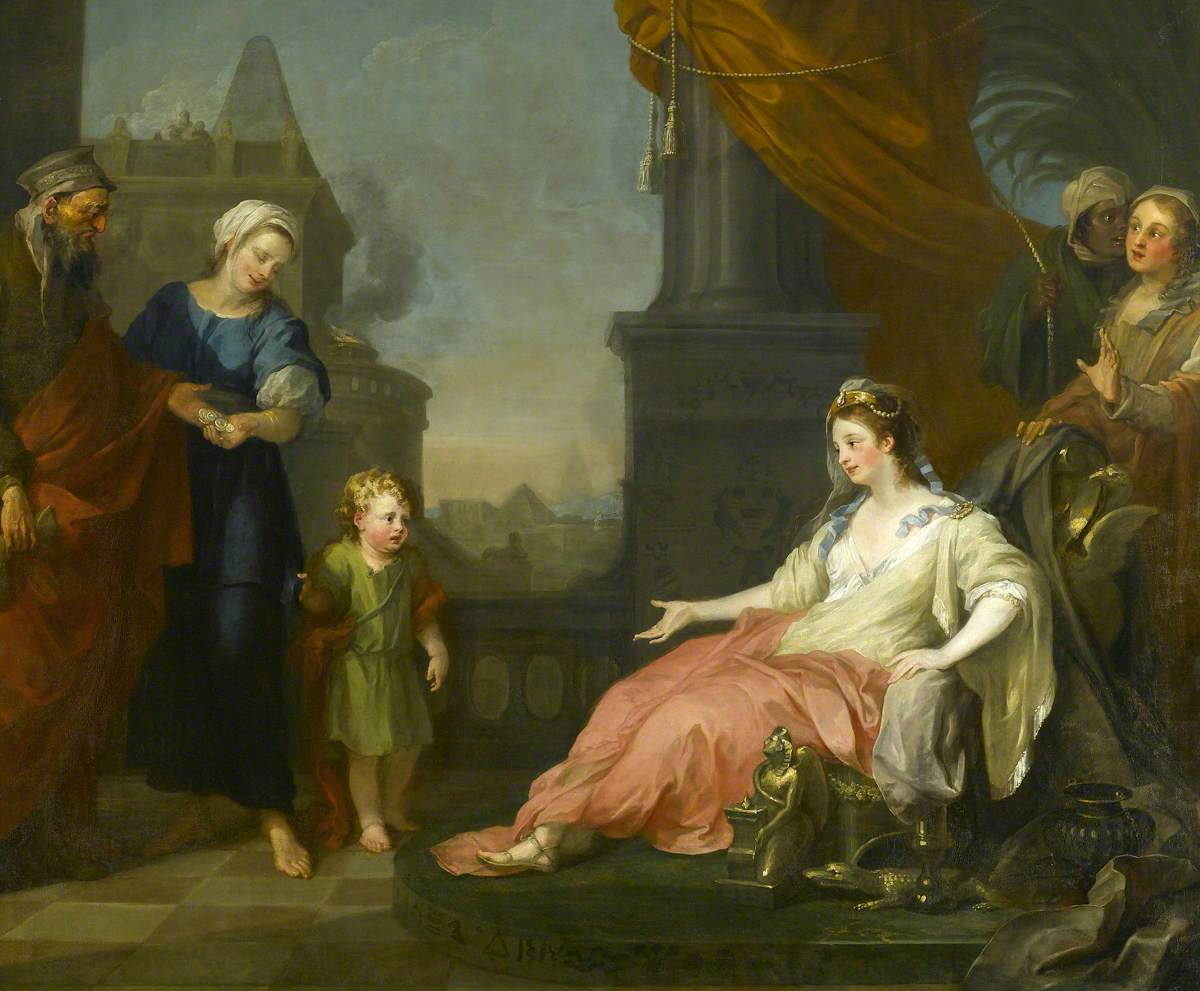
A second and no less conspicuous absentee from these walls and these pages is religion. There is no mention at all of Hogarth’s huge early paintings, “The Pool of Bethesda” (1736) and “The Good Samaritan” (1736–7), on the staircase at St Bartholomew’s Hospital, or of the even more gigantic triptych of “The Ascension” (1755–6) at St Mary Redcliffe, Bristol. Most striking of all these absences perhaps is that of the Foundling Hospital’s “Moses Brought Before Pharaoh’s daughter” (1746). In the catalogue the only reference to the Foundling Hospital, to which Hogarth devoted so much of his time and energy, is an illustration of the elaborate plaster ceiling in the Court Room there.
Interesting that this critique touches on the same general points as my essay on the Tate’s Blake exhibition of two years ago. There is a kind of nervous narrowness to so many exhibitions and catalogues these days, an ongoing fear that the curators will speak of artistry or religious belief and fail to be sufficiently rigorous in focusing on the purely social and political.
language, language
Capitalism, fascism, neo-liberalism, structural racism, transphobia, wokeness: these giant, airborne nouns, which float around the discourse like zeppelins, are unavoidable in some ways. We probably have to use them. But we should be aware that there is a price to be paid, in clarity and intelligence, for doing so. I sometimes read passages of writing that consist of almost nothing else. I try and use them as sparingly and as precisely as possible, wincing a little inside as I do so. And sometimes when I search for a way to say what I’m saying without using the obvious word, I find a more powerful way of saying it.
On the other hand, keeping your language vague and abstract can be a smart rhetorical tactic. It minimises your exposure to counter-evidence and argument. It means you can send luridly coloured smoke signals about where you stand without having explain or defend your position in any depth (cough, Judith Butler). It allows you to pump out feelings of animosity and outrage without defining the offence, which is why culture wars thrive in this environment.
I used to complain that people just recite the currently approved phrases (“diversity, equity, and inclusion”) and therefore should look for less predictable and more vivid ways to say what they mean. Then I realized that reciting the approved phrases is the whole point. I might as well have been asking people to vary the language in the Pledge of Allegiance.
In closely related news, I have a post up at the Hog Blog on why people say that stanning for an Anglo-Saxon king is “woke tosh.”
tribulation
Hannah Anderson in Christianity Today:
Just as we do not choose our biological families of origin, there’s a sense in which we do not choose our religious families of origin either. Those of us who have been birthed or shaped by evangelicalism will never not be affected by it. You can be a former evangelical or a postevangelical. You can be a neo-evangelical. You can be a recovering evangelical — even a reforming evangelical. But you will never not be defined by your relationship to evangelicalism.
At the same time, acknowledging your evangelical roots does not mean turning a blind eye to the challenges facing the movement, nor does it mean defining evangelicalism so narrowly that you can absolve yourself of responsibility for it. To extend the family metaphor, evangelicalism may be comprised of your crazy cousins, embarrassing uncles, and perhaps even dysfunctional homes, but it’s still your family.
One thing that I almost never see in the current Discourse about evangelicalism is an acknowledgement by people who were raised evangelical that their upbringing might have provided something, anything to be grateful for. When I hear people denouncing their evangelical or fundamentalist “family,” I remember something Auden said about Kierkegaard: “The Danish Lutheran Church may have been as worldly as Kierkegaard thought it was, but if it had not existed he would never have heard of the Gospels, in which he found the standards by which he condemned it.”
For decades now I have been puzzled, bemused, and sometimes frustrated by people who speak as though being raised a fundamentalist Christian is a uniquely terrible tribulation. And I have met many such people. I was not raised evangelical myself, and only in a nominal sense was I raised a Christian. We knew we were Baptists, because denomination was a social marker in Alabama sixty years ago, but we very rarely went to church. (Occasionally someone would feel a sense of responsibility and we’d attend for three or four weeks in a row, but then a year or more might pass before we returned.) We didn't pray; I don’t believe I ever prayed or was prayed for at home. At some point in my childhood — during one of those brief spasms of church attendance, I suppose — I learned John 3:16, for which I’m very grateful! But I didn’t learn the Lord’s Prayer until I became interested in Christianity in college.
Moreover, my father was in and out of prison throughout my childhood, and the best years were the ones when he was locked up, because when he was home he was usually drunk and when drunk was often violent. Once, when I was 12 or 13, I injured my arm playing a pickup football game and came home holding it gingerly, which for some reason caused him to fly into a rage and smash my injured arm with his fist. The next day we learned that my arm was broken. On another occasion he became angry with me for something and snatched my glasses off my face and crumpled them in his hand. I’m very nearsighted, so I stumbled around at school for the next couple of weeks until he allowed my mother to buy me a new pair. He never once in all his life told me he loved me; never once offered me a word of praise. My mother, while peaceable, was mostly silent and didn’t express affection either, though I’m now sure that she felt it. (Curiously, I never once saw my father angry with my mother.) We lived with my paternal grandmother, who was very loving towards me; without her, I don’t know how I could have made it into adulthood in one piece. My father regularly berated her for “spoiling” me.
That was home life. At school, because I started first grade at age five and skipped second grade, I was two years younger than my classmates and therefore the subject of relentless bullying until in high school I finally grew to slightly-above-average height. So I spent my childhood in more-or-less constant fear. My only refuges were (a) my books and (b) the friends I hung out with during school vacations. On days without school I made a point of leaving our house right after breakfast every day and not returning until dinner. I spent a lot of time hanging out in friends’ houses or yards and sitting under trees with books, dreading the time when I had to return home. (Another thing I’m grateful for, as I have often remarked: we had a house full of cheap paperbacks so there was always something to read.)
I don’t know how much it would have helped if anyone had taught me to cry out to God for support, or explained that Jesus encouraged those who are heavily-burdened to come to him for rest, or noted that he had sent the Holy Spirit to comfort his disciples. But such instruction wouldn’t have hurt; and it might have been a lifeline.
So when people whose parents loved them and expressed that love, cared for them and prayed for them, encouraged them in goodness and consoled them when they were hurt, tell me that their upbringing was terrible because those same parents were legalists and fundamentalists, well ... let’s just say that I have a somewhat different perspective. I am not referring, of course, to those who suffered genuine abuse, and I see how abuse done in the name of God can be especially traumatizing. But those whose parents were merely legalistic and moralistic, narrow in their views, suspicious of mainstream culture, strict about movies and music — sure, all that’s not cool. But it could have been so, so much worse.
To those people, I say: While you’re rejoicing in your discovery of a more gracious and merciful God than your parents taught you to believe in — which is indeed something to rejoice in! — try to extend to them some of the same grace and mercy that you’ve received. And while duly noting what they failed to teach you, seek to have some gratitude for what they managed to provide. It was more and better than a lot of us get.