shy
If “shy” Trump voters were a thing, for example, you might expect a difference in how respondents reply to surveys conducted via telephone versus those anonymously submitted online — the idea being that social desirability bias is less likely to kick in when a respondent is dealing with a faceless computer instead of a real person. However, as Morning Consult’s new 2,400-respondent study shows, Trump performed about the same against Joe Biden, regardless of whether the pollster interviewed respondents by phone or online.
Note that this point holds only if people believe that “surveys … anonymously submitted online” actually remain anonymous. And I know a number of people who don’t believe that — yes, people who plan to vote for Trump but who will only say so to those whom they wholly trust, because they certainly do not trust the anonymity of online surveys and are terrified at the social consequences if their support for Orange Man becomes known. I couldn’t tell you how many of them there are around the country; maybe not a statistically significant number. But I know some.
I’ve heard Nate Silver make a version of this claim also, usually pointing to the apparent lack of such Shy Trump Voters in 2016. But the intensity of hatred for Trump has ramped up since then, so I’m not convinced that 2016 is a reliable guide. You can see why anyone working for FiveThirtyEight would be skeptical of the existence of STVs: If people don’t trust anonymous polls and either avoid them or lie, then the FiveThirtyEight model is in trouble. But it’s noteworthy that reluctance to believe in STVs leads Silver et al. to neglect what is after all a pretty obvious question about anonymous polling and surveying.
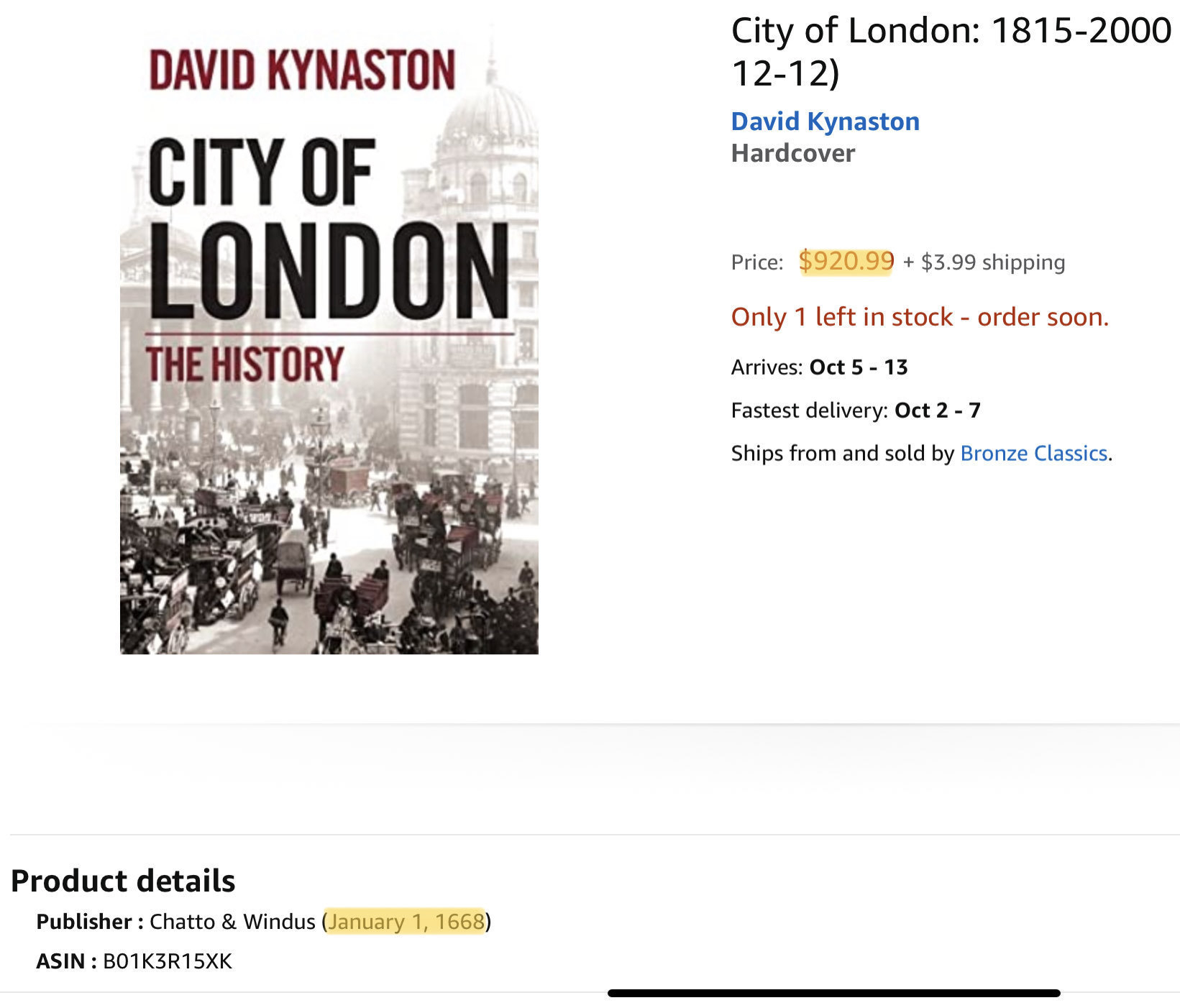
Well of course it’s expensive, it’s a 350-year-old book.
Gaslighting
One of the more pernicious quirks of English usage to arise in the past few years is the employment — by a remarkably large number of people, it seems to me — of the term "gaslighting" as the default explanation for disagreement. Nobody just disagrees with me anymore, they’re trying to gaslight me.
Let's remember where the phrase comes from: a 1944 film in which a husband attempts to make his wife think that she's crazy. To say that someone is gaslighting you is to say that they know you’re right but are pretending not to. They’re maliciously trying to get you to doubt yourself. They are dishonest, deceitful, manipulative. The charge of gaslighting is an extreme form of Bulverism: Instead of claiming You say that because you’re a man or You say that because you’re an American it’s You say that because you’re a moral monster.
It’s a useful tactic to deploy if you’d prefer never to think about whether any of your assumptions are correct. Your opponents are not only wrong, they are wicked, and why should you engage with arguments that are obviously made in bad faith and for evil purposes? These convictions keep your echo chamber hermetically sealed.
What I find especially interesting about this usage is that it seems to have been adopted with equal eagerness by extremists on the left and the right. (Unlike the structurally very similar red pill/blue pill meme, which has been totally co-opted by the right.) It's one of the many ways in which the far left and the far right are continually borrowing language, rhetorical strategy, and in some cases even direct political strategy from one another. It would be nice if we could ship them all off to their own island where they could fight it out, or, perhaps, discover that they can't tell one another apart.
limiting power
As I noted in my previous post, there is no political system, no ordered social life, in which one can wholly escape being subject to power. As Burke says in his Reflections, “Men cannot enjoy the rights of an uncivil and of a civil state together. That he may obtain justice, he gives up his right of determining what it is in points the most essential to him. That he may secure some liberty, he makes a surrender in trust of the whole of it.” Rousseau tried to evade this stark choice by inventing the idea of the “general will,” to which we all supposedly give free assent even when we are being brought to the guillotine. But of course the “general will” is a pious fiction for autocrats, and Burke’s contrast, in all its starkness, is certainly true.
Anarchism, as I understand its best exponents, does not deny Burke’s contrast but rather openly acknowledges the truth of it and yet attempts to blunt its force. This can never be done completely. A spontaneously self-organized environment, an emergent order, such as anarchism favors, is still an order and in any order some people at some times have power over others. And when they have such power they will sometimes use it wrongly.
The best fictional depiction of anarchism in practice is Ursula K. Le Guin’s The Dispossesed, and I find it fascinating that the pivotal conflict of this novel — which largely celebrates the austere beauty of an anarchist world — centers on a power struggle among anarchists. Insofar as Shevek, the book’s protagonist, has an antagonist it is his fellow physicist Sabul, whose role in the Physics syndic on Anarres allows him control over the publication and distribution of scientific papers — especially papers that come from the nearby capitalist world of Urras. (Anarres is the moon of Urras, largely uninhabited until a group of anarchists were allowed to settle there two centuries before the time in which the novel is set.)
It occurred to [Shevek] once that Sabul wanted to keep the new Urrasti physics private — to own it, as a property, a source of power over his colleagues on Anarres. But this idea was so counter to Shevek’s habits of thinking that it had great difficulty getting itself clear in his mind, and when it did he suppressed it at once, with contempt, as a genuinely disgusting thought.
But disgusting or not, the thought is true, and Shevek has to find a way to work with Sabul, to deal with Sabul, so he can get his own highly speculative work into the hands of Urrasti physicists — because there is no one on Anarres who understands what he is trying to do. “He wanted to publish what he wrote and to send it to the men who could understand it, the Urrasti physicists; he needed their ideas, their criticism, their collaboration.” And in order to make that happen, “He needed Sabul.”
So they had bargained, he and Sabul, bargained like profiteers. It had not been a battle, but a sale. You give me this and I’ll give you that. Refuse me and I’ll refuse you. Sold? Sold! Shevek’s career, like the existence of his society, depended on the continuance of a fundamental, unadmitted profit contract. Not a relationship of mutual aid and solidarity, but an exploitative relationship; not organic, but mechanical. Can true function arise from basic dysfunction?
But all I want to do is get the job done, Shevek pleaded in his mind, as he walked across the mall towards the domicile quadrangle in the grey, windy afternoon. It’s my duty, it’s my joy, it’s the purpose of my whole life. The man I have to work with is competitive, a dominance-seeker, a profiteer, but I can’t change that; if I want to work, I have to work with him.
Ursula Le Guin was profoundly attracted to anarchism. As she wrote in a description of her novel’s genesis,
The Dispossessed started as a very bad short story, which I didn’t try to finish but couldn’t quite let go. There was a book in it, and I knew it, but the book had to wait for me to learn what I was writing about and how to write about it. I needed to understand my own passionate opposition to the war that we were, endlessly it seemed, waging in Vietnam, and endlessly protesting at home. If I had known then that my country would continue making aggressive wars for the rest of my life, I might have had less energy for protesting that one. But, knowing only that I didn’t want to study war no more, I studied peace. I started by reading a whole mess of utopias and learning something about pacifism and Gandhi and nonviolent resistance. This led me to the nonviolent anarchist writers such as Peter Kropotkin and Paul Goodman. With them I felt a great, immediate affinity. They made sense to me in the way Lao Tzu did. They enabled me to think about war, peace, politics, how we govern one another and ourselves, the value of failure, and the strength of what is weak.
So, when I realised that nobody had yet written an anarchist utopia, I finally began to see what my book might be.
Le Guin says she set out to write “an anarchist utopia,” but the subtitle which has been attached to the book since a copywriter for an early edition came up with the phrase calls it “an ambiguous utopia.” Le Guin as political thinker wanted construct an ideal, but Le Guin as novelist — as a close and shrewd observer of “the crooked timber of humanity” — couldn’t do that. She had to acknowledge the flaws that creep into every social order because every social order is comprised of people.
This chastened view of anarchism strikes me as the proper one. The founders of the anarchist colony on Anarres certainly wanted to make it impossible for anyone to become Sabul — thus especially their constructed language, Pravic, which tries to remove from lanugage and therefore from thought the idea of possession or ownership — but Sabuls there will always be. The feasible goal of anarchist order is to reduce the number of Sabuls and, when they arise, limit their power over others.
an alternative
A couple of years ago Corey Robin wrote,
Under capitalism, we’re forced to enter the market just to live. The libertarian sees the market as synonymous with freedom. But socialists hear “the market” and think of the anxious parent, desperate not to offend the insurance representative on the phone, lest he decree that the policy she paid for doesn’t cover her child’s appendectomy. Under capitalism, we’re forced to submit to the boss…. The socialist argument against capitalism isn’t that it makes us poor. It’s that it makes us unfree.
But consider this slight modification of Robin’s argument:
Under socialism, we’re forced to defer to the government just to live. The socialist sees government control of the means of production as synonymous with freedom. But capitalists hear “the government” and think of the anxious parent, desperate not to offend the bureaucrat on the phone, lest he decree that the national health service will not authorize her child’s appendectomy. Under socialism, we’re forced to submit to the government…. The capitalist argument against socialism isn’t that it makes us poor. It’s that it makes us unfree.
Is one of these passages more rational than the other? I don’t think so. The fears in both cases are, I believe, perfectly rational.
If you don’t want to be in the situation that Robin describes — which is to say, if you don’t want to be vulnerable to arbitrary power — then the alternative isn’t socialism. To replace capitalism with socialism is to meet the new boss, same as the old boss. There is no complete and perfect alternative to the power disparities Robin deplores, but the closest approximation to it is anarchism. And for that reason, if for no other, anarchism should be taken seriously as a vision of our common life.

advice for journalists
Online is increasingly where people live. My average screen time this past week was close to ten hours a day. Yes, a lot of that is work-related. But the idea that I have any real conscious life outside this virtual portal is delusional. And if you live in such a madhouse all the time, you will become mad. You don’t go down a rabbit-hole; your mind increasingly is the rabbit hole — rewired that way by algorithmic practice. And you cannot get out, unless you fight the algorithms to a draw, or manage to exert superhuman discipline and end social media use altogether. […]
In the past, we might have turned to more reliable media for context and perspective. But the journalists and reporters and editors who are supposed to perform this function are human as well. And they are perhaps the ones most trapped in the social media hellscape. You can read them on Twitter, where they live and and posture and rank themselves, or on their Slack channels, where they gang up on and smear any waverers. They’ve created an insulated world where any small dissent from groupthink is professional death. Watch Fox, CNN or MSNBC, and it’s the same story.
Point out missing facts or context, exercise some independence of judgment, push back against the narrative — and you’ll be first subject to ostracism and denunciation by your newsroom peers, and then, if you persist, you’ll be fired. The press could have been the antidote to the social media trap. Instead they chose to become the profitable pusher of the poison.
This is precisely and tragically correct.
I immediately wrote to Andrew to tell him that he needs my new book, stat. But even Andrew, who writes on a weekly basis, who has stepped back from the moment-by-moment insanity of journalistic Twitter (and from the hour-by-hour insanity of the old Dish), probably doesn’t have time to step back a bit further still over the next few weeks and read some old books.
Or doesn’t believe he has time. Maybe, and maybe for journalists more than for anyone else, this is in fact the perfect, the ideal, the necessary moment to recover “real conscious life outside this virtual portal.” One might begin with the epistles of Horace, a man who in exile from Rome learned to love the countryside. Just a thought.
My son and I are sorting through the Big Issues