

My beloved is in Prague right now and the evidence suggests that it is hard to take a bad photo there.
on blogging
Brent Simmons is right: It’s weird to see people bemoan the decline of blogging and do it on Twitter. You can blog! You can blog for free if you want! (Though the best options require a few bucks.) Get over your social-media Stockholm Syndrome and start doing the thing you know is better. Cross-post to Twitter or Facebook if you must, but own your turf and tend your garden. Now that you can register your own domain name at micro.blog you have no excuse: it’s easy-peasy.
I am still hoping for a Blogging Renaissance, but lately I’m thinking that one necessary element of a true renaissance will be to get the readers of blogs on the same page as the writers. Everyone who writes a blog for a while knows that one of the best things about it is the way it allows you to revisit themes and topics. You connect one post to another by linking to it; you connect many posts together by tagging. Over time you develop fascinating resonances, and can trace the development of your thought. Venkatesh Rao has thought a lot about this in his series of posts — he calls it a “blogchain” — on blogs as “elder games.”
But this is not typically how readers read blogs. Not many people read this blog, but those who do typically just read the most recent posts — three days back, max. I add links to earlier posts, but almost no one clicks on them. People don’t click on tags either. And I think that’s because we have all been trained by social media to skim the most recent things and then go on to something else. We just don’t do deeper dives any more. So one of the things I want to be thinking about is: How can I encourage readers of my blog to seek some of the benefits that I get from it?
Xhaka is not the problem
Granit Xhaka is nothing like the player Arsenal supporters thought he was, or could become, when the club signed him in 2016. The idea then was that he would provide steel in deep midfield, a combination of defensive strength and playmaking from a deep position — something Arsenal haven’t had since the departure of the great Patrick Vieira. It turns out that Xhaka has one skill and one skill only: he can make a good long pass, usually diagonally, when he has plenty of time on the ball. He can’t dribble, he can’t make runs into the box, he can’t shoot except for the occasional long-range blast. On defense he is both slow and positionally unaware, which means that he is always a booking waiting to happen.
But Xhaka is not the problem. The problem is a manager who makes Xhaka perhaps one of the most constant figures in the teams he selects (along with Leno and Auba). Week after week Emery sets Xhaka up for failure and week after week Xhaka experiences precisely what Emery has set him up for.
Torreira can’t make the long passes that Xhaka makes, but in every other respect bar none he is a far superior footballer, and it’s simply stupid to sit him in favor of Xhaka. Maitland-Niles, for all his struggles at fullback, would be better than Xhaka as a holding midfielder. Dani Ceballos could actually make plays from the deep-lying position, though I would prefer to see him farther up the pitch. Emery could pick names out of a hat and do better than he has been doing.
The one trait that we have consistently seen from Emery since he took over Arsenal is this: he makes personnel decisions without reference to what works on the pitch. We started seeing that last year when Arsenal were far more dangerous with Auba and Lacazette on the pitch together, but Emery wants to play a single striker, so they rarely paired up. This year we have seen the team utterly lacking in midfield creativity and playmaking, yet Özil has been completely sidelined and Ceballos plays only occasionally. (I know the problems with Özil, but the team is offensively moribund. Scrappy set-piece goes from your center backs are not a recipe for Premier League success.) Emery is holding desperately to some model of football that he cannot implement nor even articulate. He is stubborn in his commitment to an indescribable will-o-the-wisp.
Every day I check my RSS feed hoping to learn that he’s been sacked. Every day I am disappointed. There’s no reason to give up on this season — Arsenal are a very talented squad, by far the most talented in recent years — but many of the more gifted players are riding the pine. If Emery doesn’t go soon, supporters will need to write off another season. And that simply shouldn’t be necessary.
options


toss them out of the window
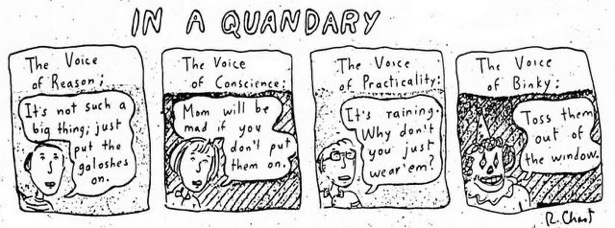
I don’t think I’m becoming a grumpy old man, but I am, I know, increasingly inclined to heed that voice inside me — let’s call it the Voice of Binky — that always asks “Why should you do this simply because it’s the kind of thing you’re expected to do?”
Professors give lectures, so why don’t you give lectures? Don’t want to. Look, this proliferation of administrative offices is just the way life is in the university today, so why don’t you adapt? Don’t want to. This country has a two-party political system, so quit complaining and just pick a side. Don’t want to.
You hand me all the defaults and say Do these. I say, “Toss them out of the window.”

credit, blame, and the unrewindable tape
Most political discourse is epideictic, which is to say, it’s about credit and blame. For instance, whenever we get an economic downturn in this country, the party not in the White House will blame the President, and the President and his supporters will blame his predecessor, whose bad policies have finally come home to roost, or a recalcitrant Congress, or bad judicial decisions, or whatever. If there’s an economic upturn, the President will take the credit, while his detractors will insist that he is merely benefitting from the wise decisions of his predecessor.
The problem with these disputes is that they are almost always irresolvable, and they’re irresolvable for two reasons. The first is that political and economic circumstances are so immensely complex, with so many forces mutually interacting, that it is simply impossible to know which ones have the greatest influence. And our inability to understand that complexity is related to a second factor: we can’t rewind the tape of history. We don’t know what would have happened if the former President had pursued policies similar to those of the current President, or if some particular judicial decision had gone the other way, or if Congress had passed the bill that the President wanted to have passed. Understanding how our ungoverned and ungovernable world works is not something we can do in laboratory conditions; controlled experiments are, and always will be, beyond our capabilities.
But political partisans don’t understand these factors, or refuse to consider them. They construct explanatory schemes that reinforce their political preferences, and then decry all alternative explanations as fake news. And this behavior will continue no matter what Facebook does to monitor the factual status of political statements on its platform.