
The Event
An eye-opening post from Douglas Rushkoff, describing what happened when he was asked to give a talk about “the future of technology” — and ended up instead being peppered with questions by five high-powered hedge-fund managers:
They had come with questions of their own. They started out innocuously enough. Ethereum or bitcoin? Is quantum computing a real thing? Slowly but surely, however, they edged into their real topics of concern.What a world we live in.Which region will be less impacted by the coming climate crisis: New Zealand or Alaska? Is Google really building Ray Kurzweil a home for his brain, and will his consciousness live through the transition, or will it die and be reborn as a whole new one? Finally, the CEO of a brokerage house explained that he had nearly completed building his own underground bunker system and asked, “How do I maintain authority over my security force after the event?”
The Event. That was their euphemism for the environmental collapse, social unrest, nuclear explosion, unstoppable virus, or Mr. Robot hack that takes everything down.
This single question occupied us for the rest of the hour. They knew armed guards would be required to protect their compounds from the angry mobs. But how would they pay the guards once money was worthless? What would stop the guards from choosing their own leader? The billionaires considered using special combination locks on the food supply that only they knew. Or making guards wear disciplinary collars of some kind in return for their survival. Or maybe building robots to serve as guards and workers — if that technology could be developed in time.
Trollope and Brexit
Trollope’s Phineas Redux, like the other Palliser novels, has a domestic plot and a political plot, and the political plot here spins out from the decision by Mr. Daubeny, the Prime Minister, to come up with a bill for the disestablishment of the Church of England. (Daubeny is a stand-in for Benjamin Disraeli, who never did anything quite like this. But we’ll set aside the real-life correspondences for this post.) This a curious, indeed a shocking, decision because Daubeny is a Conservative, and the Conservative Party in the Victorian era was very much the party of the Church. How could be betray the very heart of his constituency this way?
The answer is that in the recent election his party lost their majority, and in ordinary circumstances it would be incumbent on him to resign. So he creates extraordinary circumstances. His idea, it appears — we are not privileged to know his mind — is that most of his own party will stand with him as a matter of disciplinary obedience, while the many Liberals who have long wanted disestablishment will vote with him across party lines. Thus, on the basis of this single bill-to-come — he hasn’t produced it yet, only announced his plan to — Daubeny can remain in his place as P.M.
Some Liberals are willing to join Daubeny; some, following their leader Mr. Gresham (= Gladstone), are determined to oppose him; some are uncertain. Those uncertain ones want to see the Church disestablished — and, by the way, not necessarily because they dislike the Church: some of the most devoted churchmen in England have long wanted disestablishment in order to free the Church to preach and teach the Gospel without political interference — but they do not believe that Daubeny would do the job properly. They suspect that anyone capable of acting as cynically as Daubeny does cannot possibly carry through the process of disestablishment in a competent and appropriate way.
All of which puts me in mind of Brexit. As a strong proponent of subsidiarity, I am temperamentally disposed to welcome any effort at devolution. I’d love to see Britain freed from accountability to Brussels — and, for that matter, Scotland freed from accountability to England. (I’m even open to the restoration of the Republic of Texas — but that’s a story for another post.) I will always seek to move in the direction of localism and will always be suspicious of institutional cosmopolitanism. I am therefore supportive of Brexit in principle.
But a Brexit designed and managed by these people? I don’t think so. They are more cynical than Mr. Daubeny and less — far less — competent. It’s a feeling I often have with the Trump administration as well: even on those relatively rare occasions when I think they have a good policy in mind, I simply don’t believe that they can carry out that policy honestly, fairly, and successfully. In politics, principle is important; but good principles can produce political disasters when implemented by buffoons.
 Peter Tarka,
 the blog garden
My friend Dan Cohen recently wrote,
Think about the difference between a blog post and a book: one can be tossed off in an afternoon at a coffee shop, while the other generally requires years of thought and careful writing. Not all books are perfect — far from it — but at least authors have to wrestle with their subject matter more rigorously than in any other context, look at what others have written in their area, and situate their writing within that network of thought and research.
This is absolutely true — as I know from long experience with both genres. But what if there’s a more enlightening comparison? What if, instead of comparing a book to a blog post, you compared it to a blog? If a bog post is too small to compare to a book, a blog might be too big — keep on blogging long enough and you can have enough words to fill several books. If that’s the case, then one might find it interesting to compare a book to, say, a particular tag on a long-standing blog.
An example: For some time now I’ve been thinking of writing a book about John Ruskin. And I still might. But I’ve been led to consider such a book by gradually gathering drawings and quotes by Ruskin on this blog (there are also a few Ruskin entries at Text Patterns). Suppose that, instead of architecturally writing that book, I simply contented cultivating my Ruskin garden? (See this post for the architecture/gardening distinction.) More images and more quotations, more reflection on those images and quotations. What might emerge?
Well, certainly nothing that any scholar would cite. (How would that even be done? All the handbooks to scholarly documentation are still struggling with how to cite websites and individual articles — citing tags is not even on their radar, I suspect.) But I would certainly learn a lot about Ruskin; and perhaps the sympathetic reader would also.
In some ways this would be a return to what I did a few years ago with my Gospel of the Trees site, which arose because what I wanted to say about trees just couldn’t be made to fit into a book, in part because it refused to become a linear narrative or argument and in part because it was so image-dependent and book publishers don’t like the cost of that. But the advantage of a tag over a standalone site is that each post can have other tags as well, which lead down other paths of reflection and information, in a Zettelkasten sort of way.
My friend Robin Sloan tweeted the other day — I’m not linking to it because Robin always deletes his tweets after a few days — that, despite the many calls these days to return to the good old days of Weird Indie Blogging, there are still plenty of charmingly weird things being posted on the Big Media sites, especially YouTube. Point taken: no doubt this is true. But for my purposes the problem with the Big Media sites is the absolute control they have over association: you don’t decide what is related to your post/video/audio, they do. “If you liked this you may also like....” A well-thought-out tagging system on a single blog creates chains of associated ideas, with the logic of association governed by a single mind (or in the case of a group blog, a set of intentionally connected minds). And such chains are powerful generators of intellectual and aesthetic value.
I really do think that the Back to the Blog movement, if we can call it a movement, is so timely and so important not only because we need to, as I have put it, tend the digital commons, but also because we were just beginning to figure out what blogs could do when their development was pre-empted by the rise of the big social media platforms. Given the accelerated pace at which our digital platforms have been moving in recent years, blogs may best be seen as an old, established, and now neglected technology.
I think it was also Robin Sloan who recently directed my attention to this Wikipedia page on the late Nintendo designer Gunpei Yokoi, who promoted what he called "Lateral Thinking with Seasoned Technology”: finding new and unexpected uses for technologies that have been around for a while and therefore (a) have clear patterns of use that you can rely on even when deviating from them, and (b) have decreased in price. Nintendo’s Wii system is the classic example in the gaming world of this way of thinking: some of us will remember that when the Wii was introduced critics were flabbergasted by its reliance on previous-generation processors with their limited graphics capabilities, and were certain that the console would be a total flop. Instead, everyone loved it.
Blogging, I want to argue, is a seasoned technology that is ripe for lateral thinking. The question for me, as I suggested in my previous post, is whether I am willing to set aside the conventional standards and expectations of my profession in order to pursue that lateral thinking — in order, that is, to give up practicing architecture and going in for a good deal of gardening.
new uses for old blogs
More ideas about ideas: Given my current interest in intellectual gardening rather than architecture, in allowing ideas to emerge rather than trying to generate them by a brute-force attack, I am reconsidering the way I have historically used my blogs, and wondering whether there’s not a better path to intellectual substance than the one I’ve been following.
This has been my M.O. going back to the relatively early days of Text Patterns, when I was working on The Pleasure of Reading in an Age of Distraction: Use the blog to generate and try out ideas, get feedback from readers, develop the ideas a little further … and then put on the brakes. But why did I put on the brakes? Because I knew that I was getting close to the point at which there would be so much of the book’s contents online that a publisher wouldn’t want to buy it. And so the idea-generating stage of the project would effectively come to an end.
Not altogether, of course; I could still write in notebooks or sketch ideas or whatever. But two things were missing: the felt need in writing a public post to achieve at least some minimal level of coherence, and the feedback from readers. Moreover, when you’ve been generating ideas using a particular method and then are forced to switch to another one, you tend to lose momentum. So effectively I found myself working with the ideas that I had generated to that point in the project — even when I didn’t feel that I had explored my chosen topics as thoroughly as I would have liked. And this happened more than once, most recently with my idea for a book on what I called Anthropocene theology.
So in these situations the limits and boundaries of my projects are set, not by the inner logic and impetus of those projects, but by the preferences of the publishing industry. But that’s a superficial take. Why, after all, should I allow the publishing industry to set those boundaries? Because in my line of work the highest-denomination currency is the book. I have my current job because of publishing books — Baylor simply would not have sought me out and hired me had I not been able to list several books on my CV.
Put it this way: If I had never blogged a single word I would have precisely the same job I have now; if I had blogged millions of words without publishing books I would not have a job.
But, you may say, at this point in my career why don’t I just do what I want? I have tenure; I have no administrative ambitions (indeed, just the reverse); I am a Distinguished Professor and there’s no such thing as an Extremely Distinguished Professor or Sun-God Professor. If I am feeling the demands of the publishing world as a heavy yoke why not just throw it off?
Well, I might. But I hesitate for two reasons, or maybe it’s one reason with two parts.
- My profession has never figured out what to do with online writing, except for a few peer-reviewed online journals. It is still devoted to finished products — and vetted products too, despite the manifest problems with peer review. Scholars will cite a dozen mediocre peer-reviewed published papers before they’ll cite even the most brilliant blog post.
- And working to the established standards of my profession is, as I have noted, what got me my current position, so that I can’t help feeling that if I were to strike out into unfamiliar writing territory I wouldn’t be keeping the implicit contract I made when I took this job.
But what if, by following SOP for my profession, I limit my ability to think? What if I curtail the development of ideas and end up fitting them into familiar boxes rather than following them to surprising and new and fascinating places? Isn’t that a heavy price to pay for professional adequacy?
More on all this in the next post.

control and surrender, architecture and gardening

Tom Phillips, Brian Eno oil on canvas 35.6 x 25.4 cm 1984-85 collection: the artist
Tom Phillips writes:I once devised a television project whose abbreviated ghost now forms, not inappropriately, an introduction to the film I worked on with Jake Auerbach (Artist's Eye: Tom Phillips, BBC2 1989). The title was to be Raphael to Eno: it traced the lineage of pupil and teacher back through Frank Auerbach, Bomberg, Sickert etc. until, after an obscure group of French Peintres du Roy, it emerged via Primaticcio into the light of Raphael. Thus I find that at only twenty removes I am a pupil of Raphael. Brian Eno as a student of mine (initially at Ipswich in the early sixties) therefore continues that strange genealogy of influence as the twenty-first.I cite that simply because it’s awesome.
The relationship between Phillips — one of whose most famous works is A Humument, an ongoing-for-decades collage/manipulation/adaptation of a Victorian book — and Eno is a fascinating one in the history of aleatory or, as I prefer, emergent art.
I’ve been talking about all this with Austin Kleon — whose newspaper blackout poems are descendants or cousins of A Humument — who not only knows way more about all this than I do but who also has been posting some great stuff lately on the themes of patience, waiting, and what I recently called “re-setting your mental clock.” See for instance this post on Dave Chappelle’s willingness to wait for the ideas to show up at his door.
And of course that post circles back to Eno — so many useful thoughts about being a maker of something circle back to Eno — quoting from this article:
“Control and surrender have to be kept in balance. That’s what surfers do – take control of the situation, then be carried, then take control. In the last few thousand years, we’ve become incredibly adept technically. We’ve treasured the controlling part of ourselves and neglected the surrendering part.” Eno considers all his recent art to be a rebuttal to this attitude. “I want to rethink surrender as an active verb,” he says. “It’s not just you being escapist; it’s an active choice. I’m not saying we’ve got to stop being such controlling beings. I’m not saying we’ve got to be back-to-the-earth hippies. I’m saying something more complex.”In another talk, one in which he also spoke of control and surrender, he developed another contrast, between creativity-as-architecture and creativity-as-gardening:
And essentially the idea there is that one is making a kind of music in the way that one might make a garden. One is carefully constructing seeds, or finding seeds, carefully planting them and then letting them have their life. And that life isn't necessarily exactly what you'd envisaged for them. It's characteristic of the kind of work that I do that I'm really not aware of how the final result is going to look or sound. So in fact, I'm deliberately constructing systems that will put me in the same position as any other member of the audience. I want to be surprised by it as well. And indeed, I often am.I was texting with Austin about all this earlier today:What this means, really, is a rethinking of one’s own position as a creator. You stop thinking of yourself as me, the controller, you the audience, and you start thinking of all of us as the audience, all of us as people enjoying the garden together. Gardener included. So there’s something in the notes to this thing that says something about the difference between order and disorder. It’s in the preface to the little catalog we have. Which I take issue with, actually, because I think it isn’t the difference between order and disorder, it’s the difference between one understanding of order and how it comes into being, and a newer understanding of how order comes into being.

This is all good for me to reflect on right now, in this season of heat and uncertainty.
also
Just one more quick thought about yesterday’s post: I’ve done this kind of thing before, but usually by trying to delete Twitter altogether. This time I’m continuing to use Twitter to share links, but I am making it very difficult to look at Twitter. And that seems to work much better for me.
victory paper
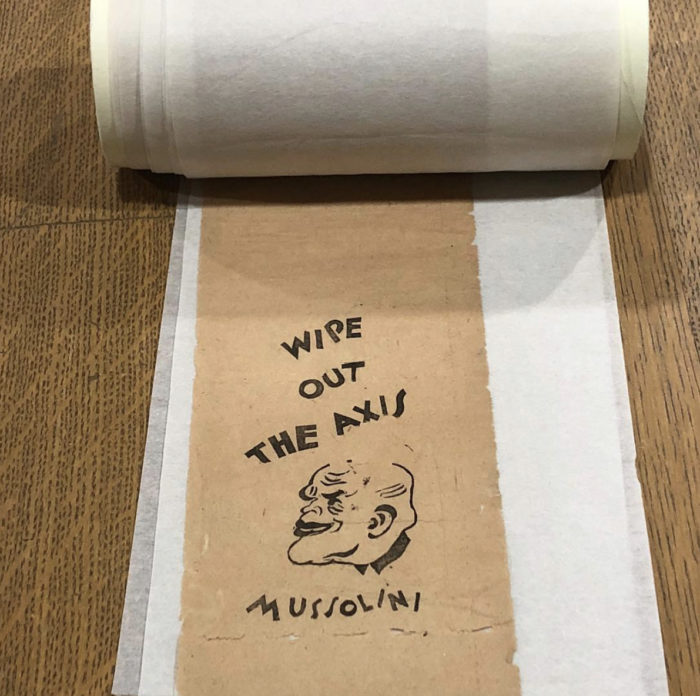
Made by the Randolph Novelty Company in Chicago during World War II; via the Newberry Library’s Instagram

