
Sir Gawain and the Green Knight: 2

All the visitor wants is to play a little “Christmas game” — but it appears that no one at Arthur’s court wants to play with him. Perhaps that’s because he is enormous and green.
a fearful form appeared, framed in the door: a mountain of a man, immeasurably high, a hulk of a human from head to hips, so long and thick in his loins and his limbs I should genuinely judge him to be a half giant, or a most massive man, the mightiest of mortals. But handsome, too, like any horseman worth his horse, for despite the bulk and brawn of his body his stomach and waist were slender and sleek. In fact in all features he was finely formed, it seemed. Amazement seized their minds, no soul had ever seen a knight of such a kind — entirely emerald green.
(It’s hard to get the “bob and wheel” — the short lines that end each stanza of the poem — to render accurately in HTML. In general, HTML is not made for the presentation of verse. Sorry.)
The knight clearly resembles the Green Man of European folklore, a kind of vegetation deity whose attitude towards humanity is ambiguous — he can be generous, he can be threatening. It is interesting, and perhaps relevant to this poem, that the Green Man is often represented in medieval churches, often as a stone carving, and sometimes in quite colorful form, as in this roof boss from Rochester Cathedral:

Or maybe it’s the particular game he offers that’s the problem: for he carries with him a massive axe, a “gigantic cleaver,” and he suggests that one of Arthur’s knights should take it and chop his, the Green Knight’s, head clean off — and then, he says, in a year and a day he’ll return the favor.
No one steps up to volunteer — until, in the embarrassed silence, King Arthur himself does. This event could be read as a token of Arthur’s courtesy and courage, and surely there’s an element of that; but aren’t the knights sworn to protect and serve their liege lord? Should they not be interposing themselves between their king and this terrifying stranger?
Only when Arthur offers himself does one knight, Gawain, acknowledge that the whole situation is rapidly becoming humiliating:
For I find it unfitting, as my fellow knights would, when a deed of such daring is dangled before us that you take on this trial — tempted as you are — when brave, bold men are seated on these benches, men never matched in the mettle of their minds, never beaten or bettered in the field of battle. I am weakest of your warriors and feeblest of wit; loss of my life would be grieved the least. Were I not your nephew my life would mean nothing; to be born of your blood is my body’s only claim. Such a foolish affair is unfitting for a king, so, being first to come forward, it should fall to me.This is throwing some serious shade on all the other knights, who (if he speaks true) are all more powerful and/or wiser than he. But none of them moves a muscle. So forward Gawain steps and takes the axe.
The Green Knight tells Gawain to search him out in a year — to seek a place called the Green Chapel, where he will wait for Gawain. However, Arthur whispers to Gawain that if he gives the fellow’s neck a truly serious whack, he won’t have to worry about what might happen in a year. Sage counsel; so Gawain lifts the “gigantic cleaver” high and lops the visitor’s head clean off. Problem solved!
Except …
The handsome head tumbles onto the earth and the king’s men kick it as it clatters past. Blood gutters brightly against his green gown, yet the man doesn’t shudder or stagger or sink but trudges towards them on those tree-trunk legs and rummages around, reaches at their feet and cops hold of his head and hoists it high, and strides to his steed, snatches the bridle, steps into the stirrup and swings into the saddle still gripping his head by a handful of hair. Then he settles himself in his seat with the ease of a man unmarked, never mind being minus his head!He then reminds Gawain of his obligations, bids everyone farewell, and rides away, leaving them to contemplate the great feast that’s growing cold on their plates.
Merry Christmas to all, and to all a good night!
To be continued…
A Child is Born
[caption id="" align=“aligncenter” width=“837”]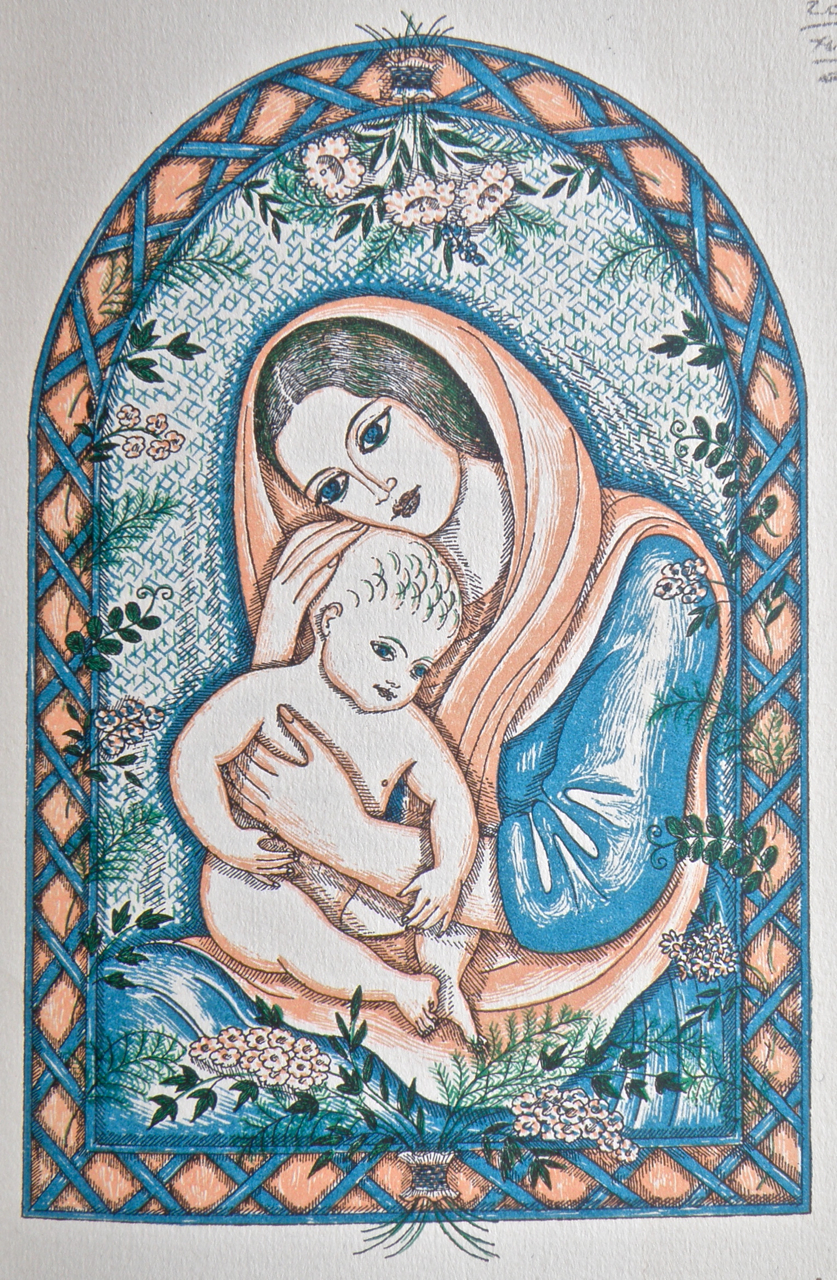 Althea Willoughby, illustration for A Child Is Born by Henry Newbolt[/caption]
Sir Gawain Is Rising
The estimable Robert Macfarlane has helped to organize a group reading on Twitter of Susan Cooper’s The Dark Is Rising. The choice makes sense: it’s the most-loved entry in a much-loved series of books, and its action begins on Christmas Eve and continues to the end of the Christmas season.
And yet the book really has nothing to do with Christmas. It takes narrative advantage of the warm associations people have with Christmas, but Cooper makes a point early in the novel of emphasizing the falsity and ineffectuality of Christianity. Now, of course, I wouldn’t say that the book should therefore be avoided — I have spent my entire adult life studying and teaching books by people who are indifferent towards Christianity, or who despise it, or who know nothing about it at all — but as a Christian I think I might want to make a different choice for reading this season.
So here’s my suggestion: Sir Gawain and the Green Knight, the 14th century poem by an unknown writer from England’s West Midlands — where J. R. R. Tolkien, who translated the poem, is also from. Not only do we know nothing about the author, but the poem itself, along with three others apparently by the same person, survived in a single manuscript, thanks to the antiquarian Sir Robert Cotton. The poem is written in alliterative verse, which most translations attempt to replicate at least to some degree.
By far the best of those translations, I believe, is the one by Simon Armitage.
It was Christmas at Camelot — King Arthur’s court, where the great and the good of the land had gathered, all the righteous lords of the ranks of the Round Table quite properly carousing and reveling in pleasure. Time after time, in tournaments of joust, they had lunged at each other with leveled lances then returned to the castle to carry on their caroling, for the feasting lasted a full fortnight and one day, with more food and drink than a fellow could dream of. The hubbub of their humor was heavenly to hear: pleasant dialogue by day and dancing after dusk, so the house and its hall were lit with happiness and lords and ladies were luminous with joy. Such a coming together of the gracious and the glad: the most chivalrous and courteous knights known to Christendom…And then a strange and utterly unexpected guest appeared — to propose a “Christmas game."
To be continued…


Les Murray, "Animal Nativity"
The Iliad of peace began when this girl agreed. Now goats in trees, fish in the valley suddenly feel vivid.
Swallows flit in the stable as if a hatching of their kind, turned human, cried in the manger showing the hunger-diamond.
Cattle are content that this calf must come in human form. Spiders discern a water-walker. Even humans will sense the lamb,
He who frees from the old poem turtle-dove and snake, who gets death forgiven who puts the apple back.
Dogs, less enslaved but as starving as the poorest human there, crouch, agog at a crux of presence remembered as a star.
Pirate and Traveler
[caption id=“attachment_34924” align=“aligncenter” width=“700”] Pirate and Traveler geographical board game (1906), from the Bodleian Library[/caption]
over the bluff and not-so-far away
I’ve been spending a few days of retreat and reflection at the amazing Laity Lodge, whose ministry of hospitality to writers, musicians, artists, and lovers of the arts is one of the best things in Texas — which is to say, one of the best things in the whole world.
On my way down here I decided to stop at a place I hadn’t visited before, Lost Maples State Natural Area — not for the autumn color, which has passed, but just to take a look around. And even post-bright-foliage, it’s a beautiful place:

And a river (the Sabinal) runs through it:
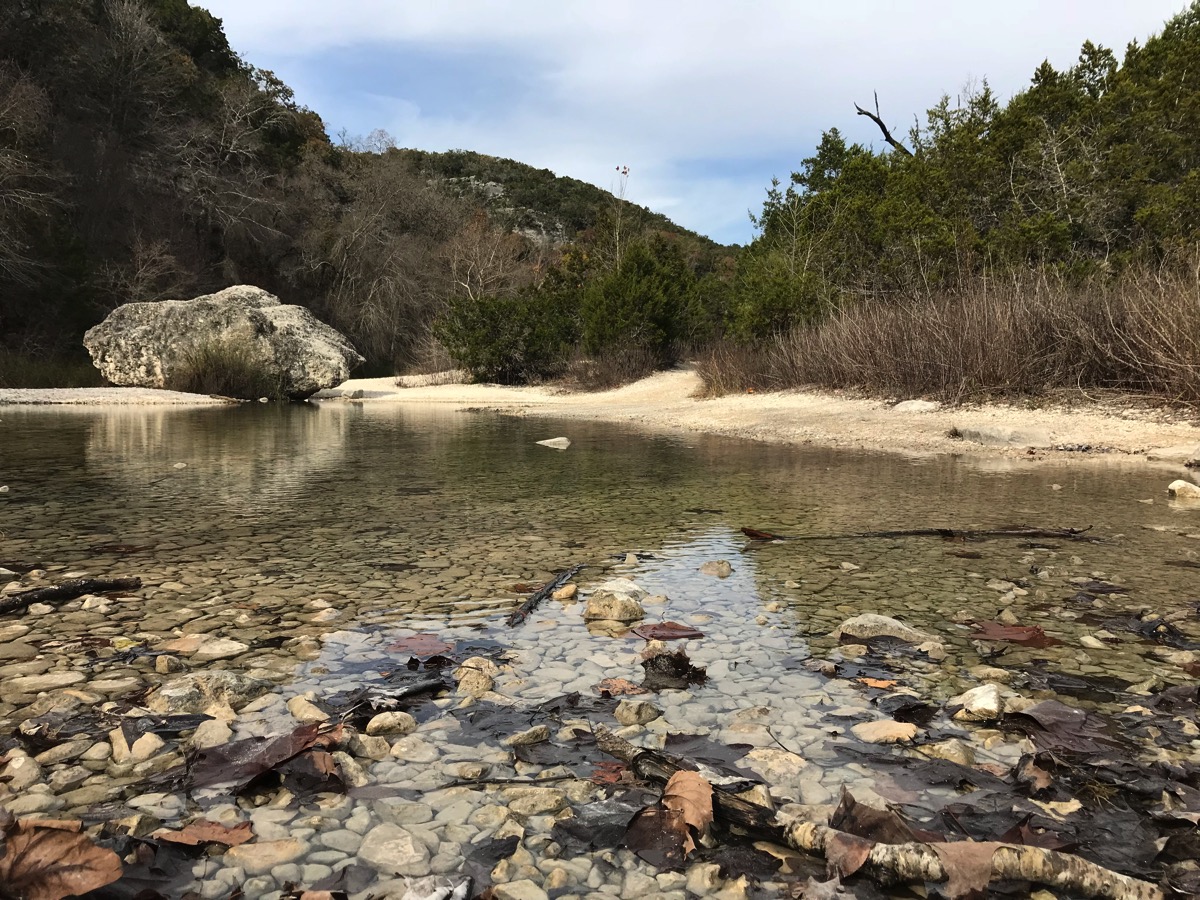
After hiking around a while, I headed down the road a bit and took State Road 337 over the hill towards Leakey — and it’s a pretty serious hill. Here’s the view from one of the higher places on the road:

Then on to Leakey, and up Highway 83 to Laity Lodge, which you can only get to by driving through the Frio River:

I never get tired of that. While there, I did some hiking around up above the lodge and the river:

And here’s something I never realized until this visit. If I were to hike up that bluff you see a glimpse of on the other side of the river, probably bushwhacking some of the time, but still hiking for only 45 minutes or so, and got to the top and started descending the other side, you know where I would be? Lost Maples.
Gate
[caption id="" align=“aligncenter” width=“510”] 門 (Mon, Gate), 2014, 140 cm by 100 cm., by Kanazawa Shōko[/caption]