
Sir Gawain and the Green Knight: 7
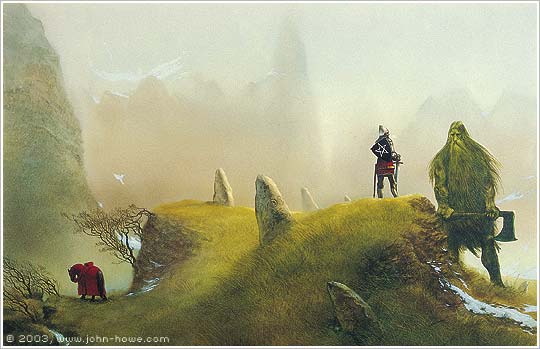
If you look closely at the picture above (by John Howe, the famous Tolkien illustrator) of Gawain’s confrontation with the Green Knight, you’ll see the pentangle on his shield. That is described much earlier in the poem:
First he was deemed flawless in his five senses; and secondly his five fingers were never at fault; and thirdly his faith was founded in the five wounds Christ received on the cross, as the creed recalls. And fourthly, if that soldier struggled in skirmish one thought pulled him through above all other things: the fortitude he found in the five joys which Mary had conceived in her son, our Savior. For precisely that reason the princely rider had the shape of her image inside his shield, so by catching her eye his courage would not crack. The fifth set of five which I heard the knight followed included friendship and fraternity with fellow men, purity and politeness that impressed at all times, and pity, which surpassed all pointedness. Five things which meant more to Gawain than to most other men. So these five sets of five were fixed in this knight, each linked to the last through the endless line, a five-pointed form which never failed, never stronger to one side or slack at the other, but unbroken in its being from beginning to end.
Sir Five-by-Five his friends called him, though probably not. In any case, here early in the story the poet is describing the images that represent what Gawain trusts in — above all, “the fortitude he found in the five joys / which Mary had conceived in her son, our Savior.”
And yet when faced with the prospect of meeting the Green Knight again, Gawain gives no thought to Mary or her Son. He trusts rather in the garter a certain lascivious lady gave him. (Isn’t he a little too old to believe in magical garters?) So how’s that going to turn out for him?
In the end: not so badly, because the Green Knight (Bertilak in disguise, we learn) really was playing a Christmas game after all. He never intended to chop Gawain’s head off; he just wanted to teach him, and the whole court of Arthur, a lesson. And the lesson is that they are guilty of pride — which is to say, it is a specifically Christian lesson that the the Knight wishes to teach.
Arthur’s court is a very self-satisfied place. They believe that they are the very flower of chivalry — and chivalry, as I mentioned in an earlier post, is comprised of courtesy and courage. But Gawain, by declining to keep his promise to his host, by hiding from him what he had received, failed in courtesy; and he did it because he was terrified of losing his life (a lack of courage he demonstrated once again at the moment of confrontation with the Knight). Yet Gawain is morally the best of all Arthur’s knights.
Now, you might respond that shitting your silken hose when faced with a an enormous green man threatening your neck with a “gigantic cleaver” is a pretty understandable human response. But Gawain, like other members of the Arthurian court, doesn’t think of himself as an ordinary human. Thus the Green Knight: “‘Call yourself good Sir Gawain?’ he goaded, / ‘who faced down every foe in the field of battle / but now flinches with fear at the foretaste of harm.’” In the end Gawain, who is supposedly the most chivalrous of Arthur’s knights, turns out to be a poor weak sinner like the rest of us. This is to him an intolerable revelation:
“Dread of the death blow and cowardly doubts meant I gave in to greed, and in doing so forgot the fidelity and kindness which every knight knows. As I feared, I am found to be flawed and false, through treachery and untruth I have totally failed.”
(Again, as I mentioned in an earlier post, this is a culture that takes the sin of “treachery” very seriously indeed.) Bertilak the Green doesn’t deny Gawain’s account — he implicitly accepts it — but rather plays the role of a priest pronouncing absolution:
“By confessing your failings you are free from fault and have openly paid penance at the point of my axe. I declare you purged, as polished and as pure as the day you were born, without blemish or blame.”
As much as to say: “Of course you failed, just like everyone else. What matters is that you confessed your sins and may thus be forgiven.” But if even the noble Sir Gawain collapses under pressure, then what becomes of Camelotian Exceptionalism? And this is the lesson that Morgan le Fay — not here the enemy of Camelot but its moral instructor, playing the same role that Nathan plays to King David as the revealer of a true but previous hidden moral state — wants the Arthurian court to learn. Thus Bertilak: “She guided me in this guise to your great hall / to put pride on trial, and to test with this trick / what distinction and trust the Round Table deserves.” The answer to that test: it deserves not nearly as much distinction as its members think.
To be continued...
Sir Gawain and the Green Knight: 6
As I noted in my previous post, Gawain’s deal with Bertilak is simple: What each takes during the course of the day he must exchange with the other. So Bertilak gives to Gawain the beasts he has killed, and Gawain gives to Bertilak ... kisses, because those he exchanged with the lady. But what would Gawain have done if he had succumbed to temptation and bedded Bertilak’s wife? (“Who whom?” as Lenin asked.) I can’t help believing that the comedy here is intentional.
But we can only speculate about what might have happened, because Gawain does not bed the lady, despite her eagerness and persistence. Strangely, on that third day she gives up her pursuit of Mary’s knight. She merely asks him to wear, in her honor, a garter — a garter which, she explains, oh by the way, protects its wearer from any harm.
I’m reminded here of a story. A young accountant for a big company has been quietly embezzling for some time, and a co-worker has just tipped him off that he’s been found out, and will be called into the boss’s office the next morning to be (a) fired and (b) arrested. In despair, the accountant wanders for hours through the streets of the city, but clearly there is no way out for him — except one. He finds the highest point on the bridge over the river that rushes through the city, and prepares to leap to his death.
But at that very moment a wizened, wrinkled old woman wearing some peculiar kind of robe or cape steps forward and calls on him to stop. “I know what’s wrong with you,” she says. “I know what you’ve done. I know that all will be revealed in the morning, and your life will be ruined. But I can prevent it from happening.”
The accountant knows this is ridiculous, but he can’t stop himself from asking: “How?” And she explains to him that she knows what has happened because she is a witch — and her witchcraft gives her the power to replace all that stolen money in the company’s coffers, to make his crime as though it had never been, to cleanse him from all guilt. All he has to do, she adds, is one little thing: have sex with her that night.
He looks her over and reflects that the only things worse than having sex with her are suicide and prison. So he agrees. Later that night, at her apartment, he shudders a bit at what he’s just done but starts pulling his clothes back on and preparing for a new and better day. The old lady lifts herself a bit from the bed, pats him on the back, and says, “Thanks, dearie. But one more thing: Aren’t you a little old to believe in witches?”
Which brings us back to Sir Gawain, who certainly believes that the lady’s garter has magical power and that his return engagement with the Green Knight is going to be No Problem Atall. That evening he makes confession of his sins and “The priest declares him so clean and so pure / that the Day of Doom could dawn in the morning” and he’d be scot-free. All the people of Bertilak’s castle note how happy Gawain has become. Everything is looking up.
There’s just one problem: When he saw Bertilak earlier that evening and they exchanged gifts — Bertilak gave him a fox that had, unfortunately, been torn to pieces by dogs — all Gawain gave his host in return was another kiss. He kept the garter.
To be continued...
excerpt from my Sent folder: myth
I still think my analysis in that essay is useful, but I wrote it before what happened in Charlottesville, and long before Roy Moore’s Senate campaign, and if I were writing it now I’d write something rather different. I’d want to reckon with the counter-myths of covert or overt racism — in some cases plain old white supremacy — that affect life on campus even when the people involved don’t have any investment in university life and can, like Spencer, walk away after they’ve lit a few fires. My friend Chad Wellmon not only teaches at UVA but lives with his family on the Lawn, and when the neo-Klansmen stomped in with their tiki torches chanting their threats, you can imagine how his small children felt. But those people had no business on the grounds in the first place — they were supposed to be protesting the city of Charlottesville’s actions — they just wanted to intimidate, and since a public university is a public place, they could move freely into its space even when their only goal was to frighten.
Similarly, as I observed the Alabama Senate campaign I was struck by how completely Roy Moore’s supporters operated from within their own mythical core, how completely impervious they were to argument or debate (this is true of some of his opponents too, of course). My point is simply that these contests of competing myths happen throughout our society and the university can’t be isolated or protected from them. That is, we can’t fix the university-specific problems I pointed to without addressing some of the larger social issues. That people associated with a university would invite a hateful mythmonger like Richard Spencer to campus is a tragedy; but it’s a greater tragedy that someone like Spencer is a public figure at all. That’s not something that even the best university administration can fix.
(I might add that when people say that they want conservative ideas to be represented on campus and then invite Ann Coulter or Milo or Richard Spencer to speak, they have zero interest in ideas. They just want to spit in their neighbor’s soup.)
Sir Gawain and the Green Knight: 5
At several points in the poem Gawain is referred to as “Mary’s knight,” and it certainly seems that here she has been gracious in answering his prayers. For immediately after he ends his prayer with his threefold self-crossing he discerns a place of refuge: a castle, inhabited by a gracious man named Bertilak and his lovely wife. They are delighted to have the famous Sir Gawain as their guest, and much Christmas festivity (at the table of feasting and at prayer in their chapel) is had by all.
Bertilak is a hunter, and on each of the following theee days he goes out on a hunt, leaving Gawain to rest and recuperate at home before he must proceed to the Green Chapel — which, he learns, is quite nearby. (O joy.) Bertilak and Gawain make a little agreement: each will bring to the other whatever he acquires during the course of the day. It’s, you might say, a Christmas game — though Gawain doesn’t seem to notice that in this it resembles an agreement he made with another stranger a year earlier.
This extremely complex and marvelously artful poem is very concerned with tacit and explicit agreements — with, as it were, the social contract of the Age of Chivalry. Some such concern arises in every pre-modern society: for instance, an awareness that in an often threatening and only partly civilized world we are often in desperate need of hospitality, and therefore must also be willing to offer such hospitality to others. You can see this theme going all the way back to the Odyssey, in which the Cyclops shows his barbarity by eating those whom he should treat as his guests, while back in Ithaca the suitors of Penelope show their barbarity by abusing her hospitality to them. So guests and hosts owe certain decencies to one another, and failure of those decencies is taken very seriously indeed in the premodern world; look at where the betrayers of guests and hosts are in Dante’s Inferno: in the very deepest circle of Hell.
But the temporary relations of guest and host are no more strictly governed than those permanent ones between lord and liegeman, which the Gawain poet is also interested in, as we saw at the beginning when none of Arthur’s knights came to his aid until Arthur’s offer of himself shamed Gawain into stepping up. And then there are the obligations one owes to the bond of marriage: chaste faithfulness within it, and for those outside, respect for its covenant. Those are about to come into play in this poem, but again, let me stress how concerned this poem is with all the forms of tacit and explicit agreement — all the promises we, either silently or verbally, make to one another. Much that in our world is governed by law was then governed by such personal promises. One’s words and one acts, including the acts of giving and receiving hospitality, must be one’s bond.
So what is Gawain supposed to do when, as Bertilak is out on his jolly hunts, the lady of the house starts hitting on him? At first she is relatively subtle, but soon enough she, as the poet says, makes her meaning quite plain. And now Gawain is in a bind indeed. For to have sex with her would be a double betrayal of Bertilak, would be to offend against the man as host and as husband. And yet knights are also sworn defenders and servants of ladies: they take pride in doing a lady’s bidding. But what if the lady is bidding you to give her a bit of rumpy-bumpy on a cold winter’s afternoon? What we see here is a moment when an entire moral system — the system of Courtesy — seems to be broken, or rather to be breaking right before Gawain’s eyes. For whatever he does he will inevitably he uncourteous to someone — he, known not as the most powerful or eloquent of Arthur’s men but rather the most courteous. The place that looked to be a respite before a great challenge has proved to be itself a challenge. What is Mary’s knight to do now?
To be continued...
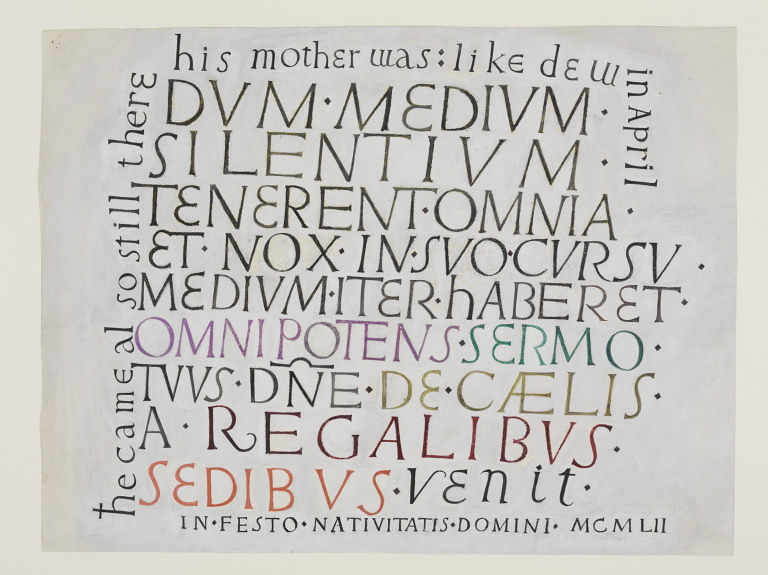
David Jones, <em>dum medium silentium</em>
[caption id="" align="aligncenter" width="1200"] David Jones, Nativity with Beasts and Shepherds (1927)[/caption]
Sir Gawain and the Green Knight: 4
At several points in the poem Gawain is referred to as “Mary’s knight,” and it certainly seems that here she has been gracious in answering his prayers. For immediately after he ends his prayer with his threefold self-crossing he discerns a place of refuge: a castle, inhabited by a gracious man named Bertilak and his lovely wife. They are delighted to have the famous Sir Gawain as their guest, and much Christmas festivity (at the table of feasting and at prayer in their chapel) is had by all.
Bertilak is a hunter, and on each of the following theee days he goes out on a hunt, leaving Gawain to rest and recuperate at home before he must proceed to the Green Chapel — which, he learns, is quite nearby. (O joy.) Bertilak and Gawain make a little agreement: each will bring to the other whatever he acquires during the course of the day. It’s, you might say, a Christmas game — though Gawain doesn’t seem to notice that in this it resembles an agreement he made with another stranger a year earlier.
This extremely complex and marvelously artful poem is very concerned, it seems, with tacit and explicit agreements — with, as it were, the social contract of the Age of Chivalry. Some of this arises in every pre-modern society: for instance, an awareness that in an often threatening and only partly civilized world we are often in desperate need of hospitality, and therefore must also be willing to offer such hospitality to others. You can see this theme going all the way back to the Odyssey, in which the Cyclops shows his barbarity by eating those whom he should treat as his guests, while back in Ithaca the suitors of Penelope show their barbarity by abusing her hospitality to them. So guests and hosts owe certain decencies to each other, and failure of those decencies is taken very seriously indeed in the premodern world: look at where the betrayers of guests and hosts are in Dante’s Inferno: in the very deepest circle of Hell.
But the temporary relations of guest and host are no more strictly governed than those permanent ones between lord and liegeman, which the Gawain poet is also interested in, as we saw at the beginning when none of Arthur’s knights came to his aid until Arthur’s offer of himself shamed Gawain into it. And then there are the obligations one owes to the bond of marriage: chaste faithfulness within it, and for those outside, respect for its covenant. Those are about to come into play in this poem, but again, let me stress how concerned this poem is with something that the medieval world in general seems to have cared about very deeply: all the forms of tacit and explicit agreement — all the promises we, either silently or verbally, make to one another. Much that in our world is governed by law was then governed by such personal promises. One’s words and one acts, including the acts of giving and receiving hospitality, must be one’s bond.
So what is Gawain supposed to do when, as Bertilak is out on his jolly hunts, the lady of the house starts hitting on him? At first she is relatively subtle, but soon enough she, as the poet says, makes her meaning quite plain. And now Gawain is in a bind indeed. For to have sex with her would be a double betrayal of Bertilak, would be to offend against the man as host and as husband. And yet knights are also sworn defenders and servants of ladies: they take pride in doing a lady’s bidding. But what if the lady is bidding you to give her a bit of rumpy-bumpy on a cold winter’s afternoon?
What we see here is a moment when an entire moral system — the system of Courtesy — seems to be broken, or rather to be breaking right before Gawain’s eyes. For whatever he does he is to someone uncourteous — he, known not as the most powerful or eloquent or Arthur’s men but rather the most courteous. The place that looked to be a respite before a great challenge has proved to be itself a challenge. What is Mary’s knight to do now?
To be continued…


Sir Gawain and the Green Knight: 3
Once the voice has quietly spoken, every knight must ride alone On the quest appointed him into the unknown: One to seek the healing waters, one the Dark Tower to assail, One to find the Lost Princess, one to find the Grail.Through the wood of Evil Counsel, through the Desert of Dismay, Past the Pools of Pestilence he must find the Way. Hemmed between the Haunted Marshes and the Mountains of the Dead, To the Valley of Regret and the Bridge of Dread.
— W. H. Auden, “Song of the Quest”
Gawain postpones his journey as long as he possibly can, for he can imagine no happy ending to the Quest laid upon him: to find the Green Chapel and receive from the Green Knight the promised reciprocation.In this section of the poem, the passing of the year is marked by the calendar of the Church. It is on the Feast of St. Michael and All Angels (September 29) that Gawain thinks he should leave Camelot and begin his search. But he does not leave; he tarries. A month later, on All Saints’ Day (November 1) he realizes that he may tarry no longer, and on the next day he sets out.
That next day, as it happens, is the Feast of All Souls. The brilliant, eccentric, maverick scholar Eugen Rosenstock-Huessy believed that the creation of All Souls’ Day was a great revolution in Western culture, because it added to the existing cult of the saints — those holy ones who intercede for us at the throne of God — a salutary reminder of all of us, all the souls, who are on our pilgrimage and need one another’s prayers. All Souls’ Day reminds us that everyone still on the way, whether in this world or in Purgatory, needs the prayers of the faithful. It marks, Rosenstock-Huessy said, “the universal democracy of sinners under judgment.” And that, as we shall see later, is a democracy that matters very much to this poem.
In any case, once Gawain is on his way time ceases to be marked by the sacred calendar: instead, the poet describes for us an increasingly wintry landscape: bare trees and swirling winds in the wild wood, a wilderness — and in the Middle Ages “wilderness” was a word to conjure fear — in which the knight cannot confidently make his way. He does not know where to look he does not know what he is looking for.
Now through England’s realm he rides and rides, Sir Gawain, God’s servant, on his grim quest, passing long dark nights unloved and alone, foraging to feed, finding little to call food, with no friend but his horse through forests and hills and only our Lord in heaven to hear him.Finally he pauses to pray: “Father, hear me, / and Lady Mary, our mother most mild.” What he wants above all is a place “where mass may be heard, / and matins in the morning.” He ends his prayer and crosses himself three times. It is Christmas Eve.
To be continued…