
Jeremy Begbie on Roger Lundin
He cared about words – or better put, he cared for people through words: his students, colleagues and readers. That was why he labored so hard to find the right ones. That was why – with that memorable sidelong glance – he paused so often in conversation. That is why he spent hours and hours revising and re-editing his essays and books. In all the years I knew Roger I can honestly say I never remember him using words carelessly. He knew that careless words could hurt, maim and wound. In a culture deluged with half-thought out words, sloppy, hollowed-out language, he saw it as his calling to hone words full of care for others, full of the winsome generosity of God. And in the corridors of the academy, few things are needed more today. We academics revel in large words – to impress, to intimidate. He inspired us to use words with largesse. And that is a legacy beyond measure.
— Jeremy Begbie. I know it is a stone-dead cliché, but I still can't in any way truly believe that Roger is gone.
Holocaust
[caption id="" align=“aligncenter” width=“1704”] proposal for a Holocaust Memorial in London, by Anish Kapoor and Zaha Hadid Architects[/caption]
Krazy Kat
[caption id=“attachment_29851” align=“aligncenter” width=“545”]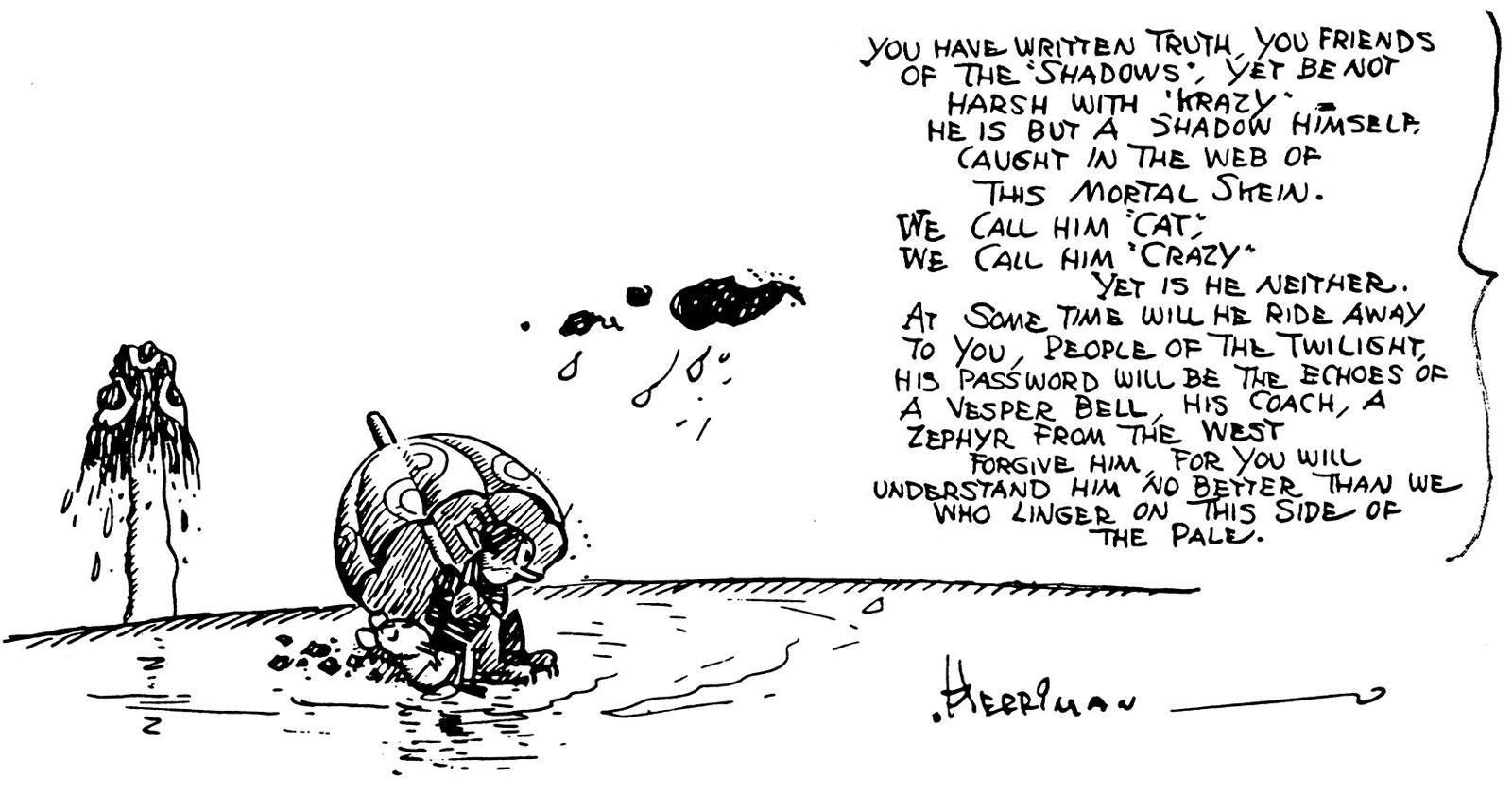 Chris Ware on George Herriman[/caption]
Pope Francis and Donald Trump: the same man?
There’s a very unfortunate moment in Jason Horowitz’s account of the conflict between Pope Francis and the Knights of Malta:
Now, suddenly, [Francis] is more politically isolated. The election of President Trump and the rise of far-right populists in Europe have ushered in an angrier era — and emboldened traditionalists inside the Vatican who sense that the once-impregnable pope could be vulnerable.
This is, quite simply, an utterly unwarranted slur on Catholic traditionalists. It’s not Francis’s opponents who resemble the “far-right populists in Europe” and the rather less politically consistent populist in the White House — it’s Francis himself.
Like Donald Trump, Francis makes dramatic and apparently extreme pronouncements which send the world into interpretative tizzies. When he says things like “Who am I to judge?” Catholics who support him effectively say that he should be taken “seriously but not literally” — just as Trump supporters say about their man. Both men generate massive, thick fogs of uncertainty.
Like Donald Trump, Francis cuts through political complications by issuing executive orders and blunt power grabs, as when he dismissed the Grand Master of the Knights of Malta and is seeking to replace him with a “papal delegate” under his own personal control, a move of questionable legality.
Like Donald Trump, Francis is an authoritarian populist: he bypasses institutional structures and governs by executive order, but believes that there can be nothing tyrannical about this because he is acting in the name of the people and is committed to “draining the swamp” of his institution’s internal corruption.
Francis and Trump may not agree about much else, but they agree about how to govern. A few years ago David Lebedoff wrote a book in which he argued that for all their political and religious differences, George Orwell and Evelyn Waugh were in effect “the same man.” This is equally, and far more troublingly, true of Pope Francis and Donald Trump.
"Where would we go?"
I look at them and I see us, sitting in that strangely-lit room with the Immigration and Naturalization Service officers who processed us and to whom, I’m sure, we were an abstraction, and who didn’t tell us that the way we transliterated our last name was stupid and that people would forever after think it began with lower-case L and not an upper-case I. But I think about that room and the refugee cards they filled out, cards we still have to this day, and what would have happened if we too had been turned back.Where would we have gone? We were people without a home, without a country. We had been stripped of our Soviet citizenship, we had sold everything to pay the four steep fines for having four citizenships stripped from us, and we certainly didn’t have enough money left over for four plane tickets back, back to a country we no longer belonged to and wouldn’t have us. After all that paperwork and waiting, where would we go?
you know who you are
It is high time for me to put an end to your sitting in this place, which you have dishonored by your contempt of all virtue, and defiled by your practice of every vice. Ye are a factious crew, and enemies to all good government. Ye are a pack of mercenary wretches, and would like Esau sell your country for a mess of pottage, and like Judas betray your God for a few pieces of money.Is there a single virtue now remaining amongst you? Is there one vice you do not possess? Ye have no more religion than my horse. Gold is your God. Which of you have not bartered your conscience for bribes? Is there a man amongst you that has the least care for the good of the Commonwealth? …
Ye are grown intolerably odious to the whole nation. You were deputed here by the people to get grievances redressed, are yourselves become the greatest grievance. Your country therefore calls upon me to cleanse this Augean stable, by putting a final period to your iniquitous proceedings in this House; and which by God’s help, and the strength he has given me, I am now come to do.
I command ye therefore, upon the peril of your lives, to depart immediately out of this place. Go, get you out! Make haste! Ye venal slaves be gone! So! Take away that shining bauble there, and lock up the doors.
In the name of God, go!
— Oliver Cromwell, speech dissolving Parliament, 20 April 1653
a lesson from France
Not content to expose [Eric Zemmour's] exaggerations and fabrications, their instinct — a deep one on the French left since the days of the Popular Front — is to denounce anything someone on the right says, so as not to give comfort to the enemy. Their thinking is: if it is four o’clock, and Éric Zemmour says it is four o’clock, it is our duty to say it is three o’clock. Which guarantees that twice a day he will be able to look at his sympathizers and say, “You see what I mean?”
idolatry
Christians have a word to describe the worship of that which is not God: idolatry. Idolatry, of course, can be a quite impressive form of devotion. The only difficulty is idolaters usually end up killing someone for calling into question their “god.”Trump’s inauguration address counts as a stunning example of idolatry. His statement — “At the bedrock of our politics will be a total allegiance to the United States of America and through our loyalty to our country we will recover loyalty to each other” — is clearly a theological claim that offers a kind of salvation.
Christians believe that only God demands “total allegiance.” Otherwise we run the risk, as Trump exemplifies, of making an idol out of some human enterprise.
Doomsdumb
Doomsday Clock Moves Closer to Midnight, Signaling Concern Among Scientists - The New York Times. It moves! All by itself! (I wrote about this little piece of ridiculousness last year.)
UPDATE: Here’s another example:
The Doomsday Clock now reads two and a half minutes to midnight https://t.co/OOcF2snLmr
— The Economist (@TheEconomist) January 27, 2017
The way journalists try to get us to take this ridiculous ongoing superannuated publicity stunt seriously is by attributing agency to a wholly metaphorical clock: It moves closer to midnight; it now reads 2.5 minutes to midnight. As though it is operating in complete independence of human judgment and merely bears witness to the horrible truth. As I wrote last year, “no actual science goes into the decision of where to place the hands of the clock. The scientists who make the decision have no particular expertise in geopolitical strategy, military and political risk assessment, or even climatology (relevant since they incorporate climate change into their assessment). They just read a bunch of stuff and take their own emotional temperature.”

