
a dialogue on punching
Frankly, I’m glad Richard Spencer got punched in the face, and I hope that happens to people like him every. single. day.
Seriously? You’re okay with Americans using violence against their political opponents?
Absolutely not! But Spencer isn’t just a “political opponent,” he’s a guy spreading a message of hatred and exclusion.
But don’t you believe that freedom of speech should be allowed even for people who hold repulsive opinions?
The Constitution doesn’t protect hate speech!
Actually, it does.
Okay, fine. But even if such speech is Constitutionally protected, that doesn’t mean that we have to accept it. If we have to practice civil disobedience, as protestors did during the Civil Rights era, then we’ll do that and pay the legal price.
Well, the protestors who followed Dr. King practiced passive resistance. It was the followers of Malcolm X who pursued the “by any means necessary” strategy.
We need to think pretty seriously about what Malcolm had to say.
You realize, I hope, that many people, especially on the alt-right, will see acts like the punching of Spencer as justification for their taking the same kind of actions against people you like?
I don’t care what those freaks do.
Maybe you ought to care.
They would be totally unjustified in using violence against those of us who are just standing up for the rights of the marginalized. That ought to be obvious.
Okay. On a different topic, what do you think about Trump’s trade war? His push for protectionist laws and policies, like tariffs on foreign imports?
It’s absurd! Doesn’t he realize that if he does that those other nations will retaliate against us?
Exactly.
the Pevensies and puberty
A comment on “the problem of Susan” and more particularly this post by Adam Roberts:
My thesis: None of the Pevensies goes through puberty in Narnia. Remember, while we are told that they “grow and change,” we don’t learn the specifics of that change — or, more tellingly, the ways in which they don’t change. It is perhaps the environment of a planet alien to the one on which they were born that afflicts them all with a rare acquired variant of Kallmann Syndrome. This is why none of them ever marries: though “all princes in those parts desire [Lucy] to be their Queen,” she refuses them because she knows that her condition makes her infertile, and knows that it is best for each of those princes to marry a woman who can bear him heirs. My thesis also explains why the Pevensies so unhesitatingly leave Narnia rulerless: they know that some plan for the succession has to be devised, but also that no Narnian (unacquainted as that land is with modern Terran medicine) would understand their condition or accept that it cannot be cured or remediated. In these circumstances, the responsibility for self-rule is the best gift they could give to their people. Otherwise their abandonment of Narnia would be inexcusable. It is only when they return to our world that they enter puberty for the first time — and puberty is something, I think you’ll agree, that no number of years ruling a country or fighting frost giants could possibly prepare one for.
The London Necropolis
[caption id="" align=“aligncenter” width=“1000”]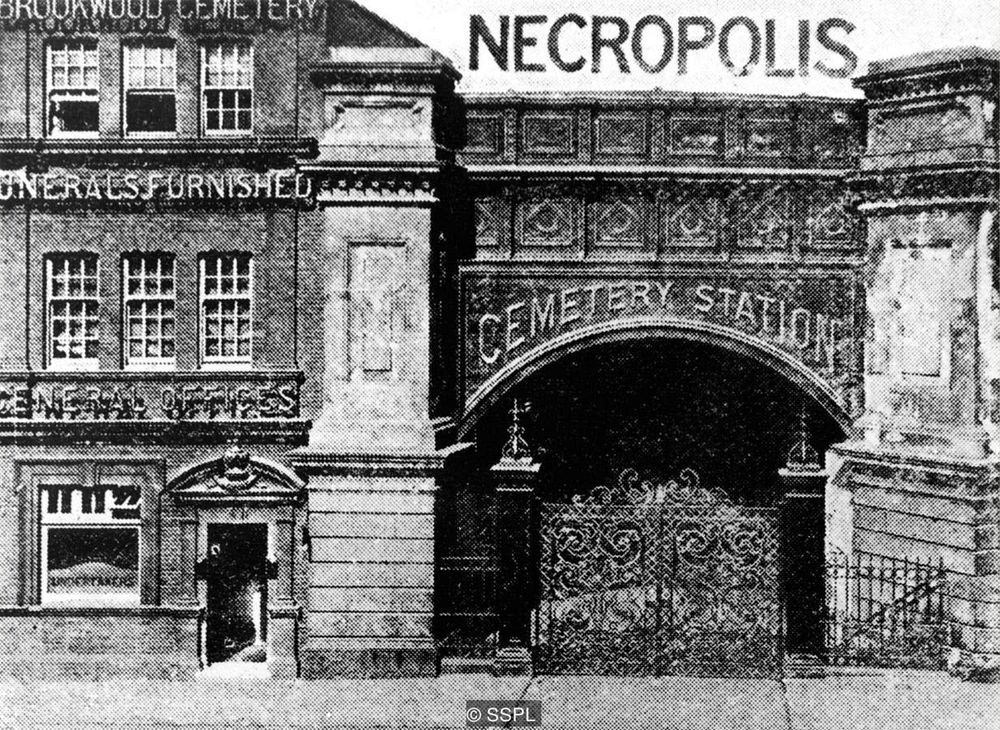 The London Necropolis[/caption]
want to know what "begging the question" means?
Here you go:
So most likely when Trump refers to “the media” as the most dishonest people on the planet, he refers only to professional journalists. This is a contradiction in terms, because modern journalism is a profession predicated on conveying truth. Journalists’ currency is credibility. To quibble with a particular journalist’s motives is to quibble with their identity: Are they journalists? Or entertainers, ideologues, or advocates?— James Hamblin. I’ve never seen such a laboratory-pure case. To the charge that journalists care more about pursuing political ends than telling the truth, Hamblin replies that that’s not possible because journalists are intrinsically and necessarily people who care about telling the truth more than political ends. Quod est demonstrandum.The goal in journalism is to be the best at identifying and conveying said truth. The entire concept of the profession is antithetical to lying. So it’s difficult to imagine objecting to the idea of journalism, in principle: To have people whose job is to act as dispassionate arbiters who discern truth. People who are fair, who are trustworthy, who do not slander, who are not beholden to any particular interest but seek transparency, to highlight injustice, and to hold people in power accountable.

everybody got some
The black bloc guy got a moment he’ll treasure for life. Richard Spencer got an aching jaw, but he also got some more Twitter followers, his name in the paper, the chance to pose as a martyr for his cause. Click farmers got clicks. Facebook got shares. Teens got memes. And everybody, everybody drew their tribe a little closer around them. None of these different groups agreed on what it all meant, mind you, but because they don’t interact, it didn’t matter. Maybe this is a vision of that national unity centrists are always calling for, so maybe even they win out, too. Everybody got served.In an unrelated note, the Trump administration demonstrated the continuity of our foreign policy yesterday by launching a drone attack in Yemen. Three people died.
youth and age
Among other pleasing errours of young minds, is the opinion of their own importance. He that has not yet remarked, how little attention his contemporaries can spare from their own affairs, conceives all eyes turned upon himself, and imagines every one that approaches him to be an enemy or a follower, an admirer or a spy. He therefore considers his fame as involved in the event of every action. Many of the virtues and vices of youth proceed from this quick sense of reputation. This it is that gives firmness and constancy, fidelity, and disinterestedness, and it is this that kindles resentment for slight injuries, and dictates all the principles of sanguinary honour.But as time brings him forward into the world, he soon discovers that he only shares fame or reproach with innumerable partners; that he is left unmarked in the obscurity of the crowd; and that what he does, whether good or bad, soon gives way to new objects of regard. He then easily sets himself free from the anxieties of reputation, and considers praise or censure as a transient breath, which, while he hears it, is passing away, without any lasting mischief or advantage.
In youth, it is common to measure right and wrong by the opinion of the world, and, in age, to act without any measure but interest, and to lose shame without substituting virtue.
Such is the condition of life, that something is always wanting to happiness. In youth, we have warm hopes, which are soon blasted by rashness and negligence, and great designs, which are defeated by inexperience. In age, we have knowledge and prudence without spirit to exert, or motives to prompt them; we are able to plan schemes and regulate measures, but have not time remaining to bring them to completion.
— Samuel Johnson’s Rambler No. 196. Saturday, February 1, 1752
interviewing Eno
“I just don’t want to talk about history. All that shit! You can find all this in other interviews I’ve done. I’ve been 40 years talking about other people I’ve worked with. No, sorry. I’m just not interested.”Doesn’t he think the idea that the interview should be entirely about the present and what he may do in the future is a bit unreasonable?
“But you can do research,” he says. And calm, measured Eno has turned into irascible Eno. “That’s your job! Research! You can look through thousands of interviews I’ve done where I’ve talked about all of this. That’s your job! You get paid for it. I don’t get paid for this, by the way!”
I get paid to ask people questions, I say.
“OK, well, you’ve asked me and I’ve said I don’t want to answer them. That’s a fair deal, isn’t it? I know what you were after,” he says, “and I don’t want to go there. I don’t want to go into a historical gloss on my career because that is not where my thoughts are right now. I’m thinking about something as we’re talking that we’re not talking about and I don’t want to lose it.”
— Brian Eno: ‘We’ve been in decline for 40 years – Trump is a chance to rethink’. I’m 100% on Eno’s side here.