
<em>The Hobbit</em> as prequel
Prequels (and reboots) also threaten to over-explain: learning just how Anakin Skywalker turned to the Dark Side of the Force or how Bilbo ended up with the One Ring are compelling ideas for a film.
— You have to hope that this is just an infelicity, that Andrew Liptak doesn’t really think that Peter Jackson (or Tolkien?) came up with the idea of The Hobbit as a LOTR “prequel.” But if indeed he knows better it’s hard to see what the point of the sentence is.
Light Masonry
[caption id=“attachment_29602” align=“aligncenter” width=“700”] Jason Bruges, Light Masonry[/caption]
fences and funnels
I haven’t said anything about American politics since the election, largely because I don’t think there’s much to say. I am simply waiting to see what a Trump administration will actually do, and how Congress and the judiciary will respond. Now that our President is a narcissistic ignoramus whose leadership team is comprised largely of people who share his belligerence and ignorance, plus a leaven of the most reflexively hawkish leftovers of the Bush era, I am hoping for fences and funnels: that is, the exercise by other branches of the government of their legal powers in ways that will limit Trump’s extravagances, and the gentle and subtle guidance of his administration towards constructive action. The creation and maintenance of such fences and funnels will require intelligence and subtlety on the part of the Republican Congressional leadership, which is why I am not hopeful.
Essentially, I am praying that people in our government who hold some power power and possess at least a little intelligence will impede Trump, will place enough obstacles in his way that he will be able to do minimal damage to the body politic, the national economy, and the international order during his time in office. Impede, delay, fence, funnel — these are the imperatives. And, please God, may this situation last no more than four years.
But I can’t imagine a situation in which political commentary could be less useful or relevant.
bad soccer
I’ve read a number of stories this morning about last night’s MLS Cup final between Seattle and Toronto, but none of them have said the the most obvious thing, which is that it was an appallingly bad game of soccer, “won” by a team that did not manage a single shot on goal in one hundred and twenty minutes of play. The nearly complete absence of technique, creativity, and imagination on both sides was something soporific to behold. (The only player who manifested any of those virtues, Giovinco, was of course withdrawn by his manager in extra time.) It’s hard to imagine a worse advertisement for MLS than that match.
Dash Shaw, map
[caption id="" align=“aligncenter” width=“534”] Dash Shaw, Boney Borough Map from “Body World,” 2007, pencil and ink on paper[/caption]
Perry Steindel, map
[caption id="" align=“aligncenter” width=“864”] Perry Steindel, Untitled, 1965, pen and pencil on paper[/caption]
The Feast of St. Nicholas
[caption id="" align=“aligncenter” width=“480”]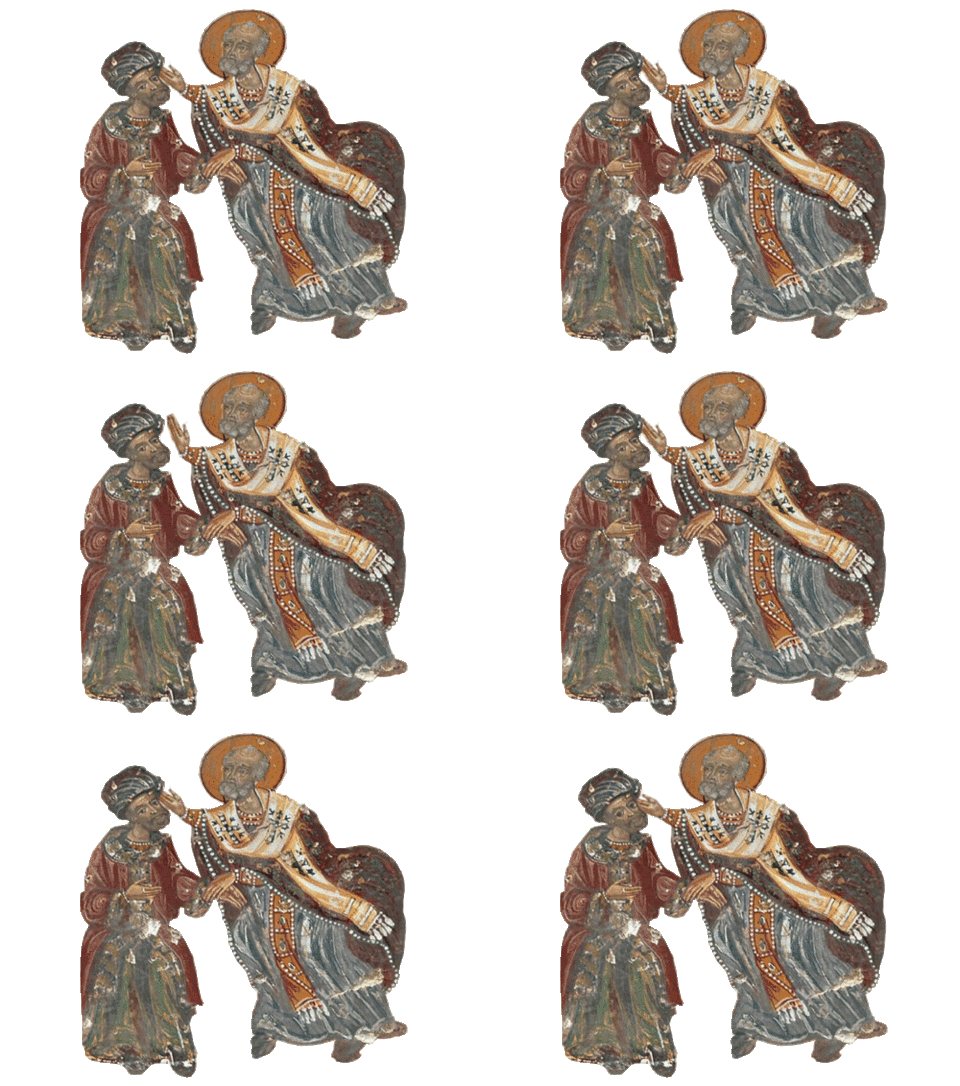 Via Rod Dreher[/caption]
why it matters
I’m sure I haven’t read all the responses to my recent ecclesiastic posts, but of the ones that I have read, (a) all of them have been critical, and (b) none of them, and I mean none, has addressed the actual argument I was making. “Didn’t Jesus denounce false teaching?”” He sure did, but that’s not relevant to my argument. “We can’t abandon church discipline.” We sure can’t. Etc., etc., etc. I won’t go off on a “social media have killed reading” rant, but you know, social media really have killed reading.
Anyway, my argument is simply this: The determination of who is and is not a Christian is above your pay grade, and expressly forbidden to you by Jesus. Again we must return to the parable of the wheat and the weeds, which, like all the parables, is about the Kingdom of God. When Jesus explains the parable, he says that “the good seed is the sons of the kingdom,” while “the weeds are the sons of the evil one.” But when “the servants of the master of the house” want to gather up the weeds, the master forbids them, “lest in gathering the weeds you root up the wheat along with them.” Note what the master’s verdict is here: he is not concerned that the servants will leave too many weeds; he is, rather, concerned that in their over-exuberance, their hypertrophied zeal for justice, they will mistake wheat for weeds: they will see “sons of the evil one” where they ought to be seeing “sons of the kingdom.” And apparently this tendency is so entrenched in the servants that they are not merely warned to be careful, they are forbidden the task altogether. They are not allowed to identify “sons of the evil one.” Note that the explanation of the parable says that there are indeed sons of the evil one, and merely points out that the servants of the master of the house cannot reliably identify them.
Why does all of this matter? It matters because when someone in my church, or within the Christian fold more generally, says or does things that I believe terribly wrong, or terribly mistaken, I have many options available to me but among them is not the declaration that “You are not a child of the kingdom, you are a child of the evil one.“ That is, if I am going to obey the teaching of this parable, I have to treat this person as a brother or sister, as one of my fellow children of the kingdom — and they have to do the same to me.
And see, once you acknowledge those you passionately disagree with as brothers and sisters in Christ, as fellow members of “the household of faith,” a great many obligations kick in. The letters of the New Testament are full of instruction for how we brothers and sisters are to interact with one another, and almost all of that instruction is sobering in its rigor: We must be patient, humble, gentle, not quarrelsome, encouraging and upbuilding — and must exhibit all those traits even when we believe people are wrong and are striving to correct them. It’s hard work, and I stink at it. But that’s what we’re all called to.
a response to replies to responses to ...
Thanks to an email from a friend, I just discovered that I am part of an ongoing controversy in ways that I knew nothing about. I’m tempted just to say “I would very much like to be excluded from this narrative, one that I have never asked to be part of” — except I kind of asked for it, so I guess I can’t complain. Anyway:
First of all, as I say in my Twitter bio and on my home page and in a blog post I link to from that home page, I don’t read Twitter any more. I use it just for linking to things I’ve posted or read. So if you write something in response to me and post that on Twitter, or reply to me on Twitter, I will not see it. I just now read a bunch of replies because of the tweet by Andrew Wilson my friend pointed me to, but otherwise I would never have been aware of responses. And I’m not changing my practice in this matter. Twitter is the worst possible platform for having discussions about anything of substance, and I am trying to emancipate myself from it altogether, though my publishers don’t like the idea of my deleting my account. (Of course, I don’t expect everyone to read my Twitter bio etc. before replying to me, but it’s a good general rule not to assume that other people use Twitter the same way you do.)
Anyway, my post was not written in reaction to anything other than the things I had read when I first responded to Andrew Wilson last week. I’ve just continued to mull over the same questions.
Now: it appears that Andrew and several others believe that I am — or Helmut Thielicke is, or both of us are — denying the possibility of church discipline. I cannot even imagine what tortured chain of illogic might lead people to think that You shouldn’t say that other people who claim to be Christians aren’t Christians at all is equivalent to You may not practice church discipline. There is simply no line that leads from the one to the other. In Catholic practice, for instance, even the most severe form of discipline, excommunication, does not in itself lead to damnation: In the Purgatorio Dante dramatizes the extended period of waiting that those who have been excommunicated must undergo before beginning their purgation, but they will eventually begin it because they are saved. Of course, excommunicated people can indeed be damned, but that’s neither the result nor the intention of excommunication in any church that I know of. To think that you can determine someone’s salvation or damnation by their inclusion in or exclusion from a given church community would be the very highest level of hubris. But surely — surely — it goes without saying that churches must have order, conditions for membership, discipline for wrongdoing, etc.
So anyone who thinks that I have denied the validity of church discipline is simply not reading what I wrote. And even in the brief excerpts from Thielicke that I quote he says, “Of course we should ‘distinguish between spirits.’ Of course we must call what is godly godly and what is satanic satanic. The Lord Christ himself did this.” This is I suppose an inevitable consequence of living in interesting times: people react rather than read; they get spooked by potential implications rather than taking the time to attend to what is actually said. I would just, as politely as possible, ask everyone to read the lines that I’ve actually written rather than try to read between them.
Three more brief comments and then I have to get back to my day job.
- If you want me to read something you’ve written, you’re gonna have to send me an email, because otherwise I’m not going to see it (unless your site happens to be in my RSS feed, as Andrew Wilson’s is).
- I think it’s vital to look at the profound and necessary instruction in church discipline given throughout the NT epistles within the context of the straightforward teaching of the Lord Jesus. It would be unfortunate indeed if the two bodies of teaching were seen to be in conflict with each other, or if one were designated as ruling the other.
- Several people responding to me talk about what “we” do to discipline those who go astray or teach wrongly. What do you mean “we,” kemosabe? It’s worth noting that most of the people responding to me are pastors or teachers of the church, whereas I am neither: I am a person in the pew and no more (and within the Anglican tradition of church polity, which means that my role is confined to safeguarding the material, as opposed to the spiritual, health of the parish). Which is perhaps why they tend to speak from the position of power and want to justify the legitimate exercise of that power, while I tend instinctively to sympathize with those against whom the power is wielded. That doesn't in any way mean that they're wrong and I'm right; I note it only to suggest that that difference may help to explain and situate some of the disagreement.
on wheat and weeds
In the early 1950s Helmut Thielicke preached a series of sermons at St. Michael’s Church in Hamburg on the parables of Jesus. They have been collected in this book and I recommend them to you in the strongest possible terms.
One of the most powerful of the sermons is on the parable of the wheat and the tares — and before I go any further I want to note that the great unspoken context of this sermon (and indeed the whole series) is the de-Nazification of Germany in the postwar years and the desire to start over from scratch, at Stunde Null. I should add also that the whole sermon is far more powerful than the summary account I will give here.
Thielicke begins by admitting that the parable poses a great and puzzling question:
We understand the angry reaction of the servants, who want to go out immediately and rip out the weeds, even though, from a farmer’s point of view, this is almost impossible. Nor does the Lord permit this. Rather, he says, “Let both grow together until the harvest. You can’t change things. Leave the decision, leave the separation of the weeds from the wheat to the judgment day of God. This is not your affair. God will take this thing in hand in his good time.” What is it that causes our Lord, so strangely, it seems, to stifle the holy zeal of his people and to say to them, “Hands off! You cannot change the field of the world as it is anyhow”?
He suggests that there are three reasons why Jesus dissuades his disciples from separating the wheat (the real disciples, those who will inherit the Kingdom of Heaven) from the tares, the weeds (those who are not truly Christians and will ultimately be cast out).
“First, he is saying: Please do not think that you can exterminate the evil in the world by your activity and your own personal exertions. After all, that evil is within you yourselves.” Even those who are true believers are not free from the sins that they denounce in others, which is why, Thielicke believes, we tend to distrust those who become obsessive about social reform. “The fanatical reformers do precisely what the servants in our parable wanted to do. They want to exterminate the tares with force and will power, failing to remember that their own wills are filled with weeds. Not to see this is their Pharisaical error; and to see this is the royal realism of Jesus Christ.”
The second reason Jesus forbids the uprooting of the weeds is
the same reason that Jesus forbade his disciples to call down fire from heaven to consume the hostile Samaritans (Luke 9: 52 ff.). On that occasion he cried out in anger to his people, “You do not know what manner of spirit you are of: for the Son of man came not to destroy men’s lives but to save them.” We would therefore be spoiling God’s plan of salvation if we were to organize a great “Operation Throw-them-out,” if we were to cast out of the temple the hangers-on, the hypocrites, the “borderliners,” and all the other wobblers in Christendom, in order to keep a small elite of saints. For this would mean that we would rob these people of the chance at least to hear the Word and take it to heart…. But the very reason why Jesus died was to open the Father’s house to everybody, including the superficial, the indifferent, the mockers and revilers. The bells of invitation which sound over market place, fields, and alleys would be silenced, and the comforting promise, “Everybody can come, just as you are,” would be turned into a questionnaire in which everybody would have to list his accomplishments and merits. And finally somebody else would add them up and evaluate them and give the verdict: “You passed” or “You failed.”
This, I think, requires no commentary; just reflection.
And now the third reason: “the householder in the parable explicitly points out that the servants are completely incapable of carrying out any proper separation of grain and weeds because they look so much alike and therefore in their zeal for weeding out the tares they would also root out the wheat.” Here Thielicke is quick to insist that he is not counseling either indifference or a reluctance to make moral judgments: “Of course we should ‘distinguish between spirits.’ Of course we must call what is godly godly and what is satanic satanic. The Lord Christ himself did this.” But the casting out of people is a different thing, a different order of action.
When we examine the weed patch more closely and try, on the basis of what we know about sin, blasphemy, and nihilism, to determine clearly just who is a sinner, a blasphemer, a nihilist, we encounter a strange difficulty. We find that nobody is merely a blasphemer or merely a nihilist, but always at the same time an unhappy, misguided child of God. The soldiers who drove the nails into Jesus’ hands and then mocked him were not only blasphemers and functionaries of Satan. On the contrary, the Father in heaven grieved over them, because they really belonged to him and, tragically, they seemed to be completely unaware of this and went on heeding the prompting of another, dark, power. I venture to ask this question: Have we ever in our life met a person, no matter how depraved, unbelieving, or vicious he may have been, even some malicious, quarreling, clacking neighbor or a slippery, scheming fellow worker— I ask you, have we ever met a person of whom we dared to say, “This person is really a weed and nothing but a weed”?Or were we not at the same time brought up short and challenged to see that Jesus died for him too, and that none of us can know whether God may not still have something in mind for him, whether some altogether different seed may yet spring up in him? Would not our hand wither if we were to root him out as a weed? Must not this hand draw back and perhaps open in a gesture of blessing and prayer that God may yet bestow his mercy upon this seemingly lost and condemned failure?
Those who have ears to hear, let them hear.