
theatrical memories
Recently, Teri and I have been watching both Victoria and The Crown — an interesting pair of experiences which I may say something about in a future post — and one of the pleasures of both series has been Alex Jennings, who in The Crown plays the oleaginous and embittered Duke of Windsor (i.e., the abdicated Edward VIII), and in Victoria plays the oleaginous and manipulative King Leopold of Belgium.
All of which reminds me that I first saw Jennings in 1990, at the Phoenix Theatre in London, playing Hjalmar Ekdal in Ibsen’s The Wild Duck alongside David Threlfall’s Gregers Werle. It was a magnificent production, and one of the reasons I remember it is that Teri and I had an extremely intense argument about it on our walk back to our hotel in Bloomsbury. All I can remember about the debate is that she thought the production was weighted towards the perspective of one character and I thought it was weighted towards the perspective of the other — which suggests that it was actually an ideal theatrical endeavor, capable of producing very different reactions in equally intelligent and attentive viewers. Even now I remember with great vividness the set, and a handful of crucial scenes.
I had already seen Threlfall on TV, in his amazing performance as Leslie Titmuss in John Mortimer’s Paradise Postponed — I can still see him in my mind’s eye, a working-class boy listening with passionate intensity to the radio and trying to mimic the BBC announcers’ intonations (in the days before the BBC thought it should represent the varieties of British speech patterns) — but Jennings was new to me, and was simply electric as Hjalmar. It’s so good to see him still at work.
The Christians of Nigeria
A terrifying and tragic story from the Spectator:
Nigerians have their own view as to what is really going on: a suspicion fuelled again as I leave one IDP camp at sunset and news comes in that another camp to the east has just been bombed by the Nigerian military, killing and maiming scores of people.The army later apologises for this ‘error’.But the bigger picture is not about error. If the international community meant anything by its promises such as the UN’s ‘responsibility to protect’ doctrine, then what is happening could not go on. But the international community is uninterested. Governments like ours are uninterested. The world’s media is uninterested.
At morning service in the city of Jos, the congregation sing and pray using the 19th-century hymnals and prayer books by which their faith was delivered. When we reach the plea to ‘Deliver us from the hands of our enemies’, the closely packed room hums with the literalness of the words. The Christians of Nigeria are alone. Even if we do not care about this, we ought to know.
A great many of the Christians so suffering are Anglicans. (There are more baptized Anglicans in Nigeria than anywhere in the world except England, and a far smaller percentage of those in England actually attend church.) I would like for my Catholic and Reformed friends who specialize in mocking and snickering at Anglicans to remember this.
judging judges
It has long been frustrating to me that the only criterion by which Americans — almost without exception — evaluate judges is: Did he or she make decisions that produce results I’d like to see? Virtually no one asks whether the judge has rightly interpreted existing law, which is of course what the judge is formally required to do. Americans — again, almost without exception — want judges to be politicians and advocates. The idea that a judge should strive to interpret existing law regardless of whether it does or doesn’t promote politically desirable ends never crosses anyone’s mind, and if by some strange chance it did, the person whose mind was so crossed would reject the proposal indignantly. Americans in this respect resemble toddlers and their own President: they evaluate everything in terms of whether it helps or hinders them in getting what they want.
This devaluation of interpretation amounts to a dismissal of the task of understanding: everything that matters is already understood, so the person who would strive to understand is not only useless, but an impediment to the realization of my political vision. To the partisan, the absence of partisanship is always a sin, and perhaps the gravest of sins.
Henri Nouwen’s Weakness Was His Strength
Initially Nouwen looks like a poster boy for activism. Climbing the ladder to the highest echelons of the ivy-covered ivory tower, jetting around the world as a conference speaker and lecturer, publishing books with prestigious New York houses, Nouwen was a high achiever. He relished the stage and often fell prey to its attendant trials of loneliness and overly sensitive self-awareness. But the arc of Nouwen’s whole life paints a different picture. Disillusioned with his successes, he sought what one evangelical pastor has described as the “liberation of ministry from the success syndrome.” For Nouwen, “the true task of life might be the task to live our life faithfully in communion with the Lord [rather] than to change it.”After withdrawing from his teaching post at Harvard and moving to the Daybreak community in Toronto, Nouwen was given the task of caring for a 25-year-old epileptic patient named Adam Arnett, about whom Nouwen wrote his final book. In it, he describes what Adam taught him about the limits of activism. Caring for Adam, Nouwen had to slow down, to realize the futility of pushing Adam beyond his limits, to accept the inability of Adam to achieve anything. “I found myself beginning to understand a new language,” Nouwen wrote. It was the language of stillness, the language of simply being present to another. Nouwen learned what he had so often tried to teach others: that offering one’s wounded self to a needy other is achievement enough. It’s a lesson evangelicals might continue to learn from Nouwen too.
a necessary coinage
Drumpfengeworfenheit: The condition of finding oneself “thrown” into Donald Trump’s America.
Jeremy Begbie on Roger Lundin
He cared about words – or better put, he cared for people through words: his students, colleagues and readers. That was why he labored so hard to find the right ones. That was why – with that memorable sidelong glance – he paused so often in conversation. That is why he spent hours and hours revising and re-editing his essays and books. In all the years I knew Roger I can honestly say I never remember him using words carelessly. He knew that careless words could hurt, maim and wound. In a culture deluged with half-thought out words, sloppy, hollowed-out language, he saw it as his calling to hone words full of care for others, full of the winsome generosity of God. And in the corridors of the academy, few things are needed more today. We academics revel in large words – to impress, to intimidate. He inspired us to use words with largesse. And that is a legacy beyond measure.
— Jeremy Begbie. I know it is a stone-dead cliché, but I still can't in any way truly believe that Roger is gone.
Holocaust
[caption id="" align=“aligncenter” width=“1704”] proposal for a Holocaust Memorial in London, by Anish Kapoor and Zaha Hadid Architects[/caption]
Krazy Kat
[caption id=“attachment_29851” align=“aligncenter” width=“545”]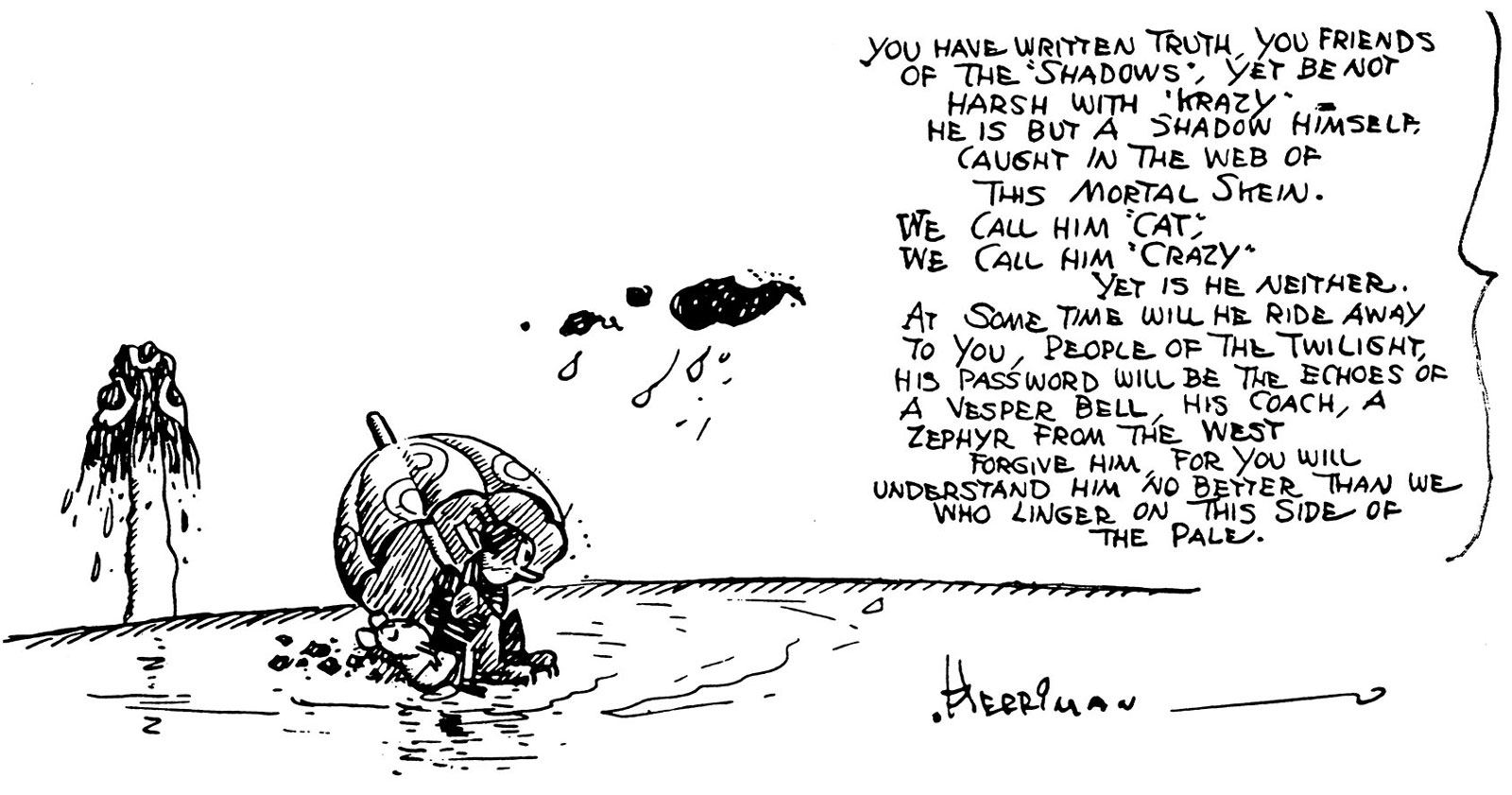 Chris Ware on George Herriman[/caption]
Pope Francis and Donald Trump: the same man?
There’s a very unfortunate moment in Jason Horowitz’s account of the conflict between Pope Francis and the Knights of Malta:
Now, suddenly, [Francis] is more politically isolated. The election of President Trump and the rise of far-right populists in Europe have ushered in an angrier era — and emboldened traditionalists inside the Vatican who sense that the once-impregnable pope could be vulnerable.
This is, quite simply, an utterly unwarranted slur on Catholic traditionalists. It’s not Francis’s opponents who resemble the “far-right populists in Europe” and the rather less politically consistent populist in the White House — it’s Francis himself.
Like Donald Trump, Francis makes dramatic and apparently extreme pronouncements which send the world into interpretative tizzies. When he says things like “Who am I to judge?” Catholics who support him effectively say that he should be taken “seriously but not literally” — just as Trump supporters say about their man. Both men generate massive, thick fogs of uncertainty.
Like Donald Trump, Francis cuts through political complications by issuing executive orders and blunt power grabs, as when he dismissed the Grand Master of the Knights of Malta and is seeking to replace him with a “papal delegate” under his own personal control, a move of questionable legality.
Like Donald Trump, Francis is an authoritarian populist: he bypasses institutional structures and governs by executive order, but believes that there can be nothing tyrannical about this because he is acting in the name of the people and is committed to “draining the swamp” of his institution’s internal corruption.
Francis and Trump may not agree about much else, but they agree about how to govern. A few years ago David Lebedoff wrote a book in which he argued that for all their political and religious differences, George Orwell and Evelyn Waugh were in effect “the same man.” This is equally, and far more troublingly, true of Pope Francis and Donald Trump.
"Where would we go?"
I look at them and I see us, sitting in that strangely-lit room with the Immigration and Naturalization Service officers who processed us and to whom, I’m sure, we were an abstraction, and who didn’t tell us that the way we transliterated our last name was stupid and that people would forever after think it began with lower-case L and not an upper-case I. But I think about that room and the refugee cards they filled out, cards we still have to this day, and what would have happened if we too had been turned back.Where would we have gone? We were people without a home, without a country. We had been stripped of our Soviet citizenship, we had sold everything to pay the four steep fines for having four citizenships stripped from us, and we certainly didn’t have enough money left over for four plane tickets back, back to a country we no longer belonged to and wouldn’t have us. After all that paperwork and waiting, where would we go?