[gallery]
Yesterday morning at 8:00 a.m. local time, in five cities around the U.S., the anarchist collective INDECLINE erected five copies of a nude polychrome statue of Donald Trump. The New York City copy went up in Union Square, but was removed after about two hours by the Parks Department, whose spokesman Sam Biederman explained that “NYC Parks stands firmly against any unpermitted erection in city parks, no matter how small”.
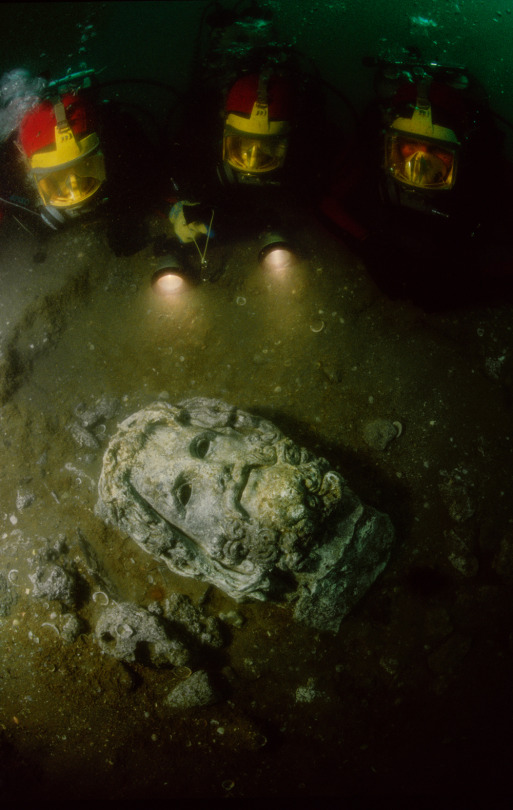
This head depicting the Greco-Egyptian god Serapis is from a colossal statue that stood over 4 metres tall. The statue is thought to be from the Temple of Serapis, a huge sanctuary measuring 101 metres by 78 metres, which once stood in the ancient Egyptian city of Canopus. The impressive remains of this sanctuary were recently discovered by underwater archaeologists led by Franck Goddio.
In this statue, Serapis wears his characteristic headdress, a corn measure known as a kalathos, symbolising abundance and fertility. Alongside his funerary and royal roles, Serapis was worshipped for his healing powers, which according to ancient historians were particularly potent in Canopus. People came from afar to sleep within the temple complex in order to be healed by ‘incubation’, when miraculous cures were delivered in a dream.
The god Serapis is said to have been introduced to Egypt by the ancient Greek ruler Ptolemy I. Serapis was aimed at Greeks living in Egypt and his worship developed where Greek presence was prevailing, notably in Alexandria and Canopus. The popularity of this universal god also flourished outside Egypt in the Greek Mediterranean world, then later in the Roman Empire.
I was going into town one day and had gotten as far as the gate when I realized that I had odd shoes on, and one of them clean and the other dirty. There was no time to go back. As it was impossible to clean the dirty one, I decided that the only way of making myself look less ridiculous was to dirty the clean one. Now would you have believed that this is an impossible operation? You can of course get some mud on it but it remains obviously a clean shoe that has had an accident and won’t look in the least like a shoe that you have been for a walk in. One discovers new catches and snags in life every day.
I am truly grateful for all the responses my essay in Harper’s is receiving, and I’ve been doing my best to give a fuller account of my thinking when asked to do so … but it’s getting harder! For me, this is an avalanche of inquiry.
First of all, let me encourage you to read this post by my friend Bryan McGraw, which raises some vital issues about our current technological regime and its dramatic alteration of the conditions of being “public.” For one thing, there’s the temptation to think of the public world as something to be manipulated by technique; for another, everything is accessible to everybody else. You may be a Christian tweeting to other Christians, but if a hostile person wants to listen in and then denounce you to the world, that’s always possible.
This gets back to the question I explore in my essay about the rise, starting in the 1940s — maybe the creation of the National Association of Evangelicals in 1942 could be a convenient starting date, though the story belongs to Catholics and mainline Protestants too —, of Christian “subaltern counterpublics.” Such counterpubliics create a double bind for their participants. On the one hand, a certain independence from the strongest currents of public opinion is necessary for Christians to undergo a seriously Christian formation; on the other hand, the longer you stay within that formative counterpublic the more unfamiliar and uncomfortable you become with the language of the larger public world. It appears that when Jesus commanded us to be “in the world but not of it” he was making a demand no less challenging than “Go and sin no more.”
One way I describe this difficulty in my essay is to say that the Christian intellectual wants to be both audible and free. But often we have to choose one or the other. I have retained much of my freedom as a Christian intellectual by working for Christian institutions, and have tried to become more audible by writing for mainstream magazines and book publishers. But it involves constantly sacrificing some good thing in order to get another good thing. I don’t say anything in that Harper’s essay that I don’t believe, but many things I do believe and are immensely relevant to the questions I raise didn’t make their way into the essay, and couldn’t have.
Francis Schaeffer — whom Jake Meador invokes in his response to my essay — chose freedom above audibility. As Jake points out, for a brief time he was also somewhat audible in the culture at large, but that didn’t last. The same forces (primarily the sexual revolution) that changed the direction of Richard John Neuhaus’s career also deprived Schaeffer of his larger audience. But Schaeffer was almost the opposite of the Christian public intellectual I describe: he was more of a Christian private intellectual. He always insisted on occupying his own turf, quite literally: if you wanted to interact with him, generally speaking, you had to come to L’Abri, or hear him lecture. Interacting directly with his peers, or with actual scholars, was not his thing. He wrote books, of course, but always for Christian presses, and most of the people who were most deeply influenced by him met him in person or saw him on video. His appeal to the Sixties counterculture was that of the guru — he was a readily recognizable example of that type — but his influence, like that of most gurus, was dependent on his personal charisma. Billy Zeoli shrewdly saw this and so turned How We Should Then Live? into a film series.
If all this sounds like I don’t have a lot of respect for Schaeffer, that’s because I don’t. His one merit — and it’s a significant merit — lay in convincing conservative Christians to be less afraid of art and ideas. But his actual readings of art and ideas were extremely simplistic and uninformed, and early in my career at Wheaton College I found it difficult to talk with students who had taken up Schaeffer’s line and were reluctant to think thoughts he had not thought before them. But that was long ago, and as far as I can tell Schaeffer’s influence has dwindled to almost nothing.
One more (possibly nitpicky?) thing: Jake speaks of Christian “intellectualism,” and several other people who have responded to me have used the same word, but I don’t use that term and I honestly don’t even know what people mean by it. My essay was about the intellectual, a type of person, a social type (as defined by Karl Mannheim) “whose special task is to provide an interpretation of the world,” to “play the part of watchmen in what otherwise would be a pitch-black night.”
Beyond that, Jake gets into questions of the general cultural place of Christianity in America today, all of which are great questions, but far beyond the scope of my essay.
I will try to respond to others who are responding to me — well, except for the people writing to tell me that I’m not a Christian, and that sort of thing — as best I can, but as I have said, it’s getting rather overwhelming. (And I’m staying away from Twitter for now.)
I have to say, I liked Strachan’s first effort better than his second, because in the second he attributes to me thoughts I do not think and statements I did not make. To wit:
It is [Jacobs’s] contention that evangelicals do not do good enough work to merit inclusion in the big bad secular academy, and that the neo-evangelicals whom I referenced were not themselves trying after all to enter the secular citadel, but sought to build staging grounds by which future generations would do so. To complete the narrative, in Jacobs’s view we have by and large failed to make good on these hopes. We are isolated, without much cultural influence, and we have no one but ourselves to blame.
Mostly wrong (right about the “staging grounds,” though). In my original essay I said that the disappearance of the generally audible Christian intellectual was “not wholly elective,” and I spent some time describing the forces that pushed us further into “subaltern counterpublics.” In my post I said often the work of my fellow Christian scholars who complain about exclusion isn’t good enough. I then said “Sometimes the work of Christians is rejected for ideological reasons, and I think there are also forces at work that prevent thoughtful Christians from entering the academy in the first place.”
So no, I never said that “we have no one but ourselves to blame.” I said that (a) some of the blame belongs to us, and (b) I think it’s spiritually and intellectually healthier to focus on our own shortcomings, “even if there really is a mean old secular world and it really does want our marginalization.”
I would also say that there are some important distinctions to be made between the place of the Christian public intellectual (which was the subject of my essay) and the place of the Christian scholar (which is what we’re discussing now).
One more thing: Strachan writes, “Perhaps he and I are both working from biography,” and I think that’s true, though in a slightly different way than his account of his time at Bowdoin indicates. I think — and here let me call attention to the “UPDATE” of my earlier response — the larger and more important difference between my experience and his is that I’m a literature guy and he’s a theologian. So I can work on W. H. Auden, who was a great poet and a tremendously theologically literate thinker, and say, “Hey, it doesn’t really matter what I think, I’m just telling you what Auden thought.” I have some cover, in other words.
Now, that’s not the whole explanation. You can be a serious Christian theologian and teach in the secular academy: Kevin Hector is the first example who comes to mind, and yes, I’m going to say that the University of Chicago Divinity School is “the secular academy,” because mostly it is. But it depends on what you work on, and it’s never going to be easy. I’ve had the luxury of deciding just how theological I want to be, or don’t want to be, which is a luxury no reputable theologian has.
Now, that said: I have chosen to be pretty theological, and as I’ve written before, I believe I’ve paid a price for that. I am simply unemployable outside the small world of religious colleges and universities. But the academic publishing world, in my experience, offers more possibilities.
So the story for almost all of us is a mixed one, with doors closing here, opening there. I just want to give as complete a picture as I can — but err on the side of emphasizing what we Christian scholars need to do to live up to our calling as fully as we possibly can.