


[gallery] robsheridan:
Selected stills from Phase IV, a gorgeously filmed sci-fi movie from 1974, directed by Saul Bass (sadly his only feature film). Cinematography by Dick Bush. Highly recommended. (Amazon link)


A response to Owen Strachan
I’m very grateful to Owen Strachan for his thoughtful response to my recent essay on Christian intellectuals. Let me go straight to what I believe to be the heart of the matter: Strachan writes, “I do wonder if [Jacobs] overplays the self-deselecting element of his public influence argument, and underplays the marginalization element.” Wonder no more, Professor Strachan! Not only did I overplay the self-deselecting element, that was precisely what I meant to do.
Here’s why: for about thirty years now I have listened to my fellow Christian scholars lament their marginalization in the academy. I have heard them complain that the leading journals of their fields and leading scholarly presses routinely reject their work, and I have heard them attribute such rejection to anti-Christian prejudice. But often when they have shown me that work, I have read it and thought: This isn’t very good. You’re not making a strong argument. You seem only to have read what your fellow Christians have to say on the subject, and are unaware of the larger scholarly conversation. Had I been the editor of that journal, I would have rejected this too.
After several experiences of this kind, I came to the conclusion that one of the best services I could provide to my fellow Christian scholars was to get them to repeat to themselves as a kind of mantra: When my work is rejected, that’s because it’s not good enough. Now, to be sure, this isn’t always true. Sometimes the work of Christians is rejected for ideological reasons, and I think there are also forces at work that prevent thoughtful Christians from entering the academy in the first place. But it is never good for you as a scholar, or as a follower of Jesus, to jump immediately to blaming others for your disappointments. It is much healthier to go back to the drawing board and redouble your efforts, reading scholars you don’t like and don’t approve of and trying to articulate thoughtful responses to them. That kind of discipline can only make your work better, and harder to reject. You won’t thereby escape the consequences of anti-Christian bias, but you’ll have a better chance of limiting its force, and in the meantime you will become a better thinker and better scholarly craftsman.
That attitude has been my watchword for decades now, and I think it has served me well, and I hope it has been helpful to others also. Insofar as my essay was written for non-Christians, I wanted them to hear a Christian voice that doesn’t just complain about marginalization, and insofar as I meant to be heard by my fellow Christians, I wanted to reinforce this message of blaming yourself first.
All that said, even if I stressed the self-deselecting element more then I believe is objectively warranted, I do believe that that self-deselection has played a major role in getting us to where we are now. But the problem is more subtle than is usually recognized — considerably more subtle than I was able to indicate in the limited space available to me in Harper’s.
Let me explain what I mean by turning to another passage from Strachan’s response:
Look, Carl Henry should have had the corner office at Yale University. E. J. Carnell should have had a 1–1 load at Princeton. George Eldon Ladd should have been famous the world over for his studies of the kingdom of God. Ockenga should have had a weekly broadcast on NBC. On and on it could go. These were fantastically gifted individuals, but their beliefs consigned them to the margins, and that was that.I agree with Strachan that these were all first-rate intellects whose abilities deserved the kind of stature that he imagines for them in an alternate and better universe. But I also think that they had intellectual priorities that made them poor candidates for playing the role of the broadly public Christian intellectual, or for holding the top-tier university post. My thinking about this is shaped primarily by George Marsden’s great book Reforming Fundamentalism, and I think Marsden’s title gets at what these men were up to. They looked around at their fellow evangelicals and they saw people who were simply not prepared to engage with the larger world of ideas, and so they took it upon themselves to educate their fellow evangelicals in these matters. A book like Henry’s The Uneasy Conscience of Modern Fundamentalism — and this is true of most of Henry’s work — is not meant for a general audience, it is meant for an audience of evangelical and fundamentalist Christians. And I think all of the figures Strachan cites were basically pastoral and pedagogical in their vocational orientation. They were less concerned to engage directly with the culture at large than to provide the intellectual foundations that would allow later generations of evangelical Christians so to engage.
It is of course perfectly possible, indeed likely, that the orthodoxy of their theological views would have made them unwelcome at the nation’s elite institutions. But I don’t think they ever tested that hypothesis, because they had other concerns that seemed to them more important to attend to. They wanted to build up their own Christian community, largely through the development of that community’s institutions, and that just didn’t leave them time for publishing articles in Harper’s.
I honor those men greatly, and I think much of my own intellectual journey has been made possible by the foundations they laid. But now it’s time to see whether my generation, and the generations following mine, are prepared to live up to the hopes that Carl Henry and Harold Ockenga and others of their kind had for us. And that’s definitely not going to happen as long as we are blaming a mean old secular world for our marginalization: even if there really is a mean old secular world and it really does want our marginalization.
UPDATE: I should also add that it’s hard to say anything very specific about these matters that applies across the disciplines: The challenges for me as a literature professor are different than those of theologians, which are in turn very different than those of scientists. Even within the humanities there are major differences: for instance, Christian scholars play a much larger role in history and philosophy than they do in literary study, for complicated reasons.
In my recent essay on Christian intellectuals, I say that one way to measure the influence of such figures is by noting their presense on Time magazine covers, and I briefly mention the shift of cultural authority that happened in the Fifties that led to scientists like John von Neumann having the kind of sage-like status than Reinhold Niebuhr and C. S. Lewis had had somewhat earlier. Maybe this celebration of Vannevar Bush is an early example of that transition. This brilliant essay by Daniel Sarewitz tells the story of how Bush created a scientific culture that has been enormously productive and yet also has become deeply dysfunctional. I can’t recommend the essay too strongly.

An estimated 10 billion people will inhabit that warmer world. Some will become climate refugees—moving away from areas where unbearable temperatures are the norm and where rising water has claimed homes. In most cases, however, policy experts foresee relatively small movement within a country’s borders. Most people—and communities, cities and nations—will adapt in place. We have highlighted roughly a dozen hotspots where climate change will disrupt humanity’s living conditions and livelihoods, along with the strategies those communities are adopting to prepare for such a future.
— What Life Will Be Like on a Much Warmer Planet - Scientific American. This article + infographic from SciAm (paywalled, I think, and if so, sorry) is pretty good, but I’d love to see another post on places that will benefit from climate change.
Now, before I go any further: I think anthropogenic climate change is real and is going to be, overall, enormously destructive. I favor serious global governmental intervention to head off, if possible, the worst of it.
But it’s not going to be bad for everyone, and it would be fascinating to learn who will benefit and how. But few journalists or scientists want to tell those stories, for fear that they’ll reduce public concern.
[gallery]

if I could...
If I could edit my essay on Christian intellectuals as I saw fit, I’d make it a lot longer, of course. But in light of the responses I’ve been getting for the past few days, I’d be especially eager to add something to this early section:
In the last years of the Weimar Republic, Karl Mannheim, an influential sociologist, argued that a new type of person had recently arisen in the Western world: the intellectual. These were people “whose special task is to provide an interpretation of the world,” to “play the part of watchmen in what otherwise would be a pitch-black night.” ... [watchmen] not [in the sense of] Juvenal’s guardians (Quis custodiet ipsos custodes?), or for that matter Alan Moore’s comic-book version, but interested observers whose first job was not to act but to interpret.
Here’s what I would now add:
Though Mannheim refers to this social type as the “intellectual,” making it quite clear that he is using this term in a technical sense rather than in its everyday meaning, I will not follow his example. The everyday sense of the word “intellectual” — basically, “really smart person” — is so deeply ingrained in the minds of readers that it would be impossible to convince them that by declining to identify certain figures as intellectuals you are not in any way demeaning those figures' intelligence. You could point readers to Mannheim’s definition, explain it, put it in different words, provide context ... nothing would work. Trust me on this one, it would be backing a sure loser. So instead of “intellectuals” I will henceforth refer to “interpreters.”
excerpt from my Sent folder: singing the Lord's song in a strange land
… I would say that openly Christian writers are often welcome at the WSJ, as long as they don’t say anything that contradicts the foundational beliefs of the WSJ (primarily free marketism). But then the same is true, mutatis mutandis, of the NYRB, at least for Marilynne Robinson: she can speak as a Christian because she pronounces her devotion to secularism. And my treatment of these issues in Harper’s is historical and social: if I tried to make a theologically grounded case for the political value of Christian intellectuals, Harper’s wouldn’t even look at it. I don’t in any way blame them for that; but it’s a factor that creates certain strategic challenges for me.
The problem for Christians, as I see it, is being “audible and free” as Christians without having to swear fealty to, or at least refrain from all criticism of, political and social positions that ground their legitimacy altogether elsewhere than in the Christian understanding of the world. Christians are welcome in many choirs as long as they agree to sing the songs written by non-Christians. If they want to sing their own songs, then they’ll probably have to do that in their own venues.
Again, that’s no tragedy, and I don’t know that it’s anyone’s fault, and I’m not even sure that it deserves my lamentation.* But I would love to have more opportunities to speak in distinctively Christian ways to people who don’t know much about Christianity, or who know all that they think they want to know.
*As my friend and colleague Scott Moore said to me the other day, in the time of Christian intellectuals like Reinhold Niebuhr and John Courtney Murray and the like American society had an unspoken agreement to pretend to listen to what Christians have to say, and now they don’t pretend any more. Maybe that’s an advance.

from “The Critic’s Art”; “Windows of the Fifth Order,” drawing by John Ruskin from his Modern Painters
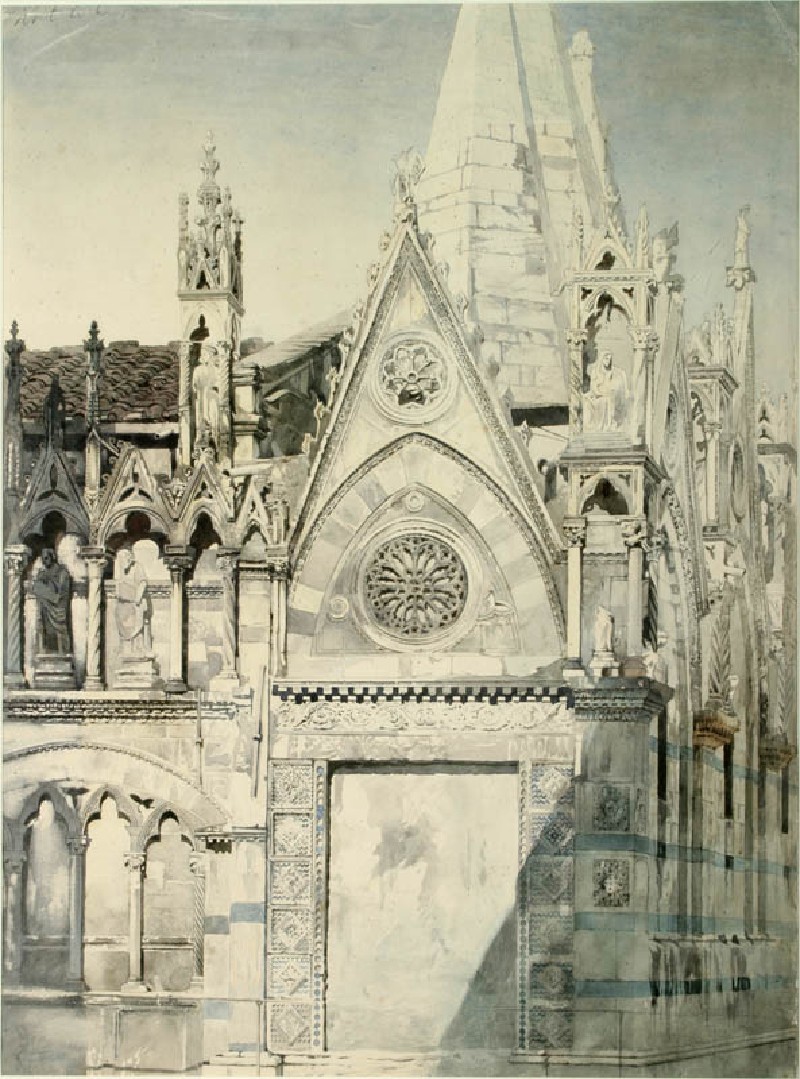
Drawing from a Photograph of Part of Santa Maria della Spina, Pisa, John Ruskin