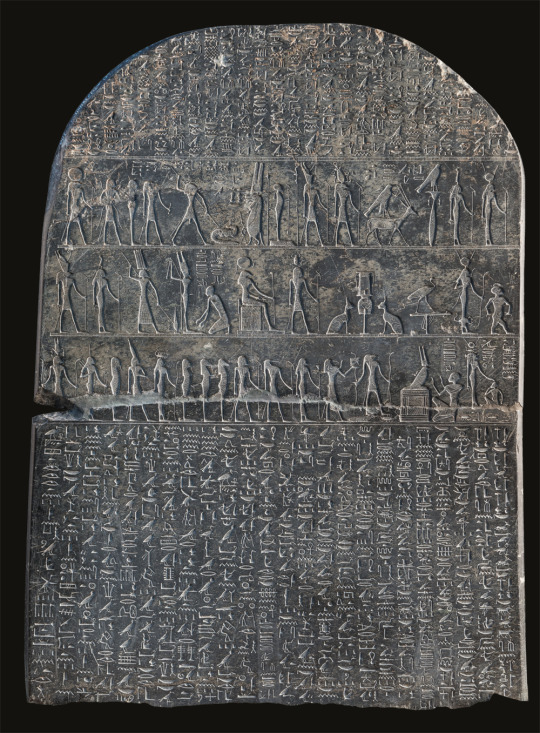
This
so-called ‘magical stela of Horus’ (a stela is a large tablet, usually made of stone) depicts the god Horus in the conventional Egyptian form for a youth: nude and wearing his hair in a side lock. He is portrayed here as Harpokrates, the Greek version of Horus-the-Child. The story told on this stela refers to the episode in Horus’ life when he grew up hiding from his evil uncle Seth in the marshes of the Nile delta. Protected by the magical powers of his mother, Isis, he was saved from a venomous animal’s mortal bite.
This slab shows the infant god as a conqueror of dangerous beasts. He is standing on a crocodile, holding a snake, a lion, a scorpion and a gazelle. These kinds of stelae were inscribed with magical spells and were thought to possess healing properties and used to protect people from dangerous animals. Water was poured over the stela to charge it with magic, the water was collected in the basin and the victim drank it.
This particular stela shows the popularity of ancient Egyptian gods even among people from elsewhere. It features a Phoenician inscription of the person who dedicated it – Paal-Astarte, son of Chemrebi, a man of Phoenician origin who believed in ancient Egyptian magic!
The good news is that both libertarianism and the LP have roughly arrived at places where that kind of two-way tolerance is the rule, not the exception. America is a weird place. It’s filled with weird people who increasingly don’t fit into the traditionally dominant political cultures. Those people should know that there’s a big tent around the corner, waiting to welcome them in all their glorious individuality.
Matthew was a charismatic man who could lead without being bossy and was ruthless without cruelty. He had glamour, charm and class. Careless and virtuous, he knew how to behave with everyone. He loved restaurants, booze, gossip, fast cars, good talk, politics and filth. He was louche, moody, good-looking and he wore fine shoes and suits, and with a fetching naivety was always keen to open his jacket and show you the label. He played cricket and was sexy like a movie star, with a shy side and great body, which is something you won’t hear said about many publishers. People in the office, and all over London, were in love with him, and wanted to sleep with him, though some of them were disappointed.
— Hanif Kureishi. Everything about this memorial is wonderful, but “some of them were disappointed” is writerly perfection.
A Department of Justice study revealed that a whopping 84 percent of police officers report that they’ve seen colleagues use excessive force on civilians, and 61 percent admit they don’t always report “even serious criminal violations that involve abuse of authority by fellow officers.”
This self-reporting moves us well beyond anecdote into the realm of data: Police brutality is a pervasive problem, exacerbated by systemic failures to curb it. That’s not to say that every officer is ill-intentioned or abusive, but it is to suggest that the common assumption that police are generally using their authority in a trustworthy manner merits serious reconsideration. As John Adams wrote to Jefferson, “Power always thinks it has a great soul,” and it cannot be trusted if left unchecked.





 Thanks for everything, Timmy. May you enjoy the decades of Dungeons and Dragons and paintball that you have so richly earned.
 designer and illustrator Travis Bone[/caption]