
my contribution to The American Conservative 2015 books symposium
Beyond any question, the four volumes by Elena Ferrante commonly called the Neapolitan Quartet constituted the most powerful and memorable reading experience I had in 2015. That’s an opinion shared by many, it seems, but I have yet to see a review of, or essay on, the story — and it is a single story: Ferrante herself thinks of it as one novel in four volumes — that captures its depth and richness. Most critics assimilate the story to pre-existing categories: it gets called a portrait of female friendship, an exploration of the costs of a rigidly sexist culture, and the like. But no standard political or social framework is adequate to the subtlety of Ferrante’s portrayal of human lives, both in their day-to-dayness and in extremis; and one character in particular, Raffaella Cerullo, known to the narrator as Lila, a girl and then a woman by turns open and hidden, confident and fearful, brilliant and defeated, generous and cruel, completely evades any attempt at comprehension. (But since that narrator—Elena Greco, or Lenù—reveals Lila to us, and Lila’s life is always entangled with hers, it may be best to say that they make an unforgettable pair.) What, fundamentally, is the story about? Loves that are indistinguishable from hatreds; the compelling power and appalling narrowness of a intensely localized upbringing, and the disruption of both the power and the narrowness by technological modernity; the many paths and meanings of womanhood; the profound corruption of a society clinging to the merest shreds of religious habit when the living force of Christianity has departed. Or: life.
— here
Abdelhamid Abaaoud, Man of the Year 2015
Abaaoud is the Man of the Year for personalizing the terror. He is Man of the Year for symbolizing Western impotence and indifference in the battle against ISIS. And he is Man of the Year for being the new thing. He is not like the old terrorists of the Middle East who were battle hardened against Soviet- or American-sponsored enemies at home. He is the monster creation of Western alienation and Middle Eastern religious radicalism. He is a terrorist well-fitted for the age of ambitious startups. And he is Man of the Year because he is the unwelcome reminder that even people who know the Western way of life intimately are capable of despising it.
Barth and Israel
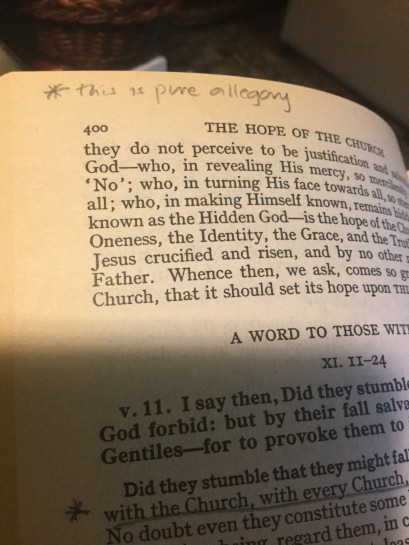
Above is one of several quite similar comments that I wrote in my copy of The Epistle to the Romans as I read Barth’s exegesis of Romans 9-11. So I was somewhat pleased and somewhat disconcerted to see how my friend Wesley Hill — unlike me, a professional in these matters — addresses Barth’s curious method here. In a thoughtful 2012 article, he acknowledges that Barth in exploring Romans 9-11 does not talk about Israel in any straightforward way, but Wesley then explores “metaphorical extensions” in Barth’s writing that “lead to the conclusion that Barth is doing more than simply reading a text about Israel as an allegory or parable for the life of the Christian church. They suggest, rather, that ‘Israel,’ ’the Church,’ and ’the world of religion’ are functioning within his commentary as ciphers for some reality inclusive of them all.”
This may be correct. But even if it is, and Barth is using a whole constellation of historical realities “as ciphers for some reality inclusive of them all,” that would just mean that he’s engaged in a even more abstract and comprehensive allegory than one that replaces “Israel” with “Church.” The key problem of Barth’s approach would in that case be simply intensified: his reading remains ahistorical and de-Judaizing — and it’s not clear to me whether he accepts the ahistorical in order to get the de-Judaizing, or vice versa.
I said in an earlier post that Barth’s commentary seems to be on the other side of some kind of divide, and I think that’s especially true of his reading of chapters 9-11. Remember that Barth insists that his project is to think with Paul, not mere comment on his letter. (That’s why Barth’s book has the same title as the text he’s commenting on.) So with that in mind, when Barth makes the historical Israel simply disappear from his commentary on 9-11, that can only be because he assumes that Paul isn’t really writing about Israel as such, but about some kind of universal “religious experience” of which Israel is merely an instance.
And I think this fits with Barth’s theology of krisis, a krisis which, he says over and over again, does not happen in history, at some particular moment in time, but is lifted out of the historical and into the eternal. “The eternal” always has a positive valence in this commentary, “history” a negative. And this is where Barth differs from us, who have learned to see the transcendent as expressing itself in and through the historical, and who have learned to doubt “religious experience” — and even “the world of religion” itself — as a useful category. In all these ways Barth is alien to us; and, I think, is simply and massively mistaken in his approach to Paul. Paul is clearly concerned, to the point of obsession, with the place of Israel in the Kingdom that has come in Jesus, given that (a) his fellow Jews have largely rejected the one Paul believes to be the Messiah of Israel as well as the world’s Savior and (b) “the gifts and the calling of God are irrevocable.” You simply cannot think with Paul unless you pursue this question, a question so intractable that Paul ends his meditation by confessing that it is wholly beyond his powers of understanding: “Oh, the depth of the riches and wisdom and knowledge of God! How unsearchable are his judgments and how inscrutable his ways!”
But in other respects Barth still provides an important model. I said in one of those earlier posts that Barth seems to be taking the dialectical character of Romans 7 as the model for his own theological rhetoric, and perhaps ignoring the other rhetorical modes of Paul’s letter, but in 9-11 we see Paul being just as thoroughly, passionately dialectical as in 7. Perhaps that back-and-forth, this-and-yet-also-that movement of Paul’s mind really is normative for him, or at least for this letter, and really should be imitated by the commenter who wants to “think with Paul.” I was too quick to say that Barth is over-relying on chapter 7.
More reflections to come later. And please remember that these are the unprofessional reactions of a mere reader.
Manger: sermon by Jessica Martin
There is no creature more needy than a human baby. For those first months, even years, all the nourishment apparently comes from adult to child. (What comes the other way is more profoundly difficult to quantify, but one name for it is love.) Luke is offering this child to us – yes, as needy, but even more as a sign of nourishment, newborn to adult. He lies in a manger; from birth, he offers himself to the world as heavenly food.Grown-up, and facing his death, this same Jesus breaks bread and offers wine – the staple food of that time and that place – and says ‘This is myself, offered to you for your hunger and your need. I will fill you, because I am fulfilment.’ It will not be long before his body, broken and bloody, is wrapped in strips of cloth and laid in a rock tomb. Death and birth echo each other, for the nourishment comes through death as well as through birth; the swaddling strips of cloth speak of Jesus’s shroud as well as his new body of love; the wise men’s gifts – gold, frankincense and myrrh – worship that needy, insecure newborn as an immortal God who must also die and be mourned.
Jesus is born to die, and born to bring life; he comes into the world desperately needy, and he is the world’s nourishment; he is defeated, and in that defeat he brings God’s victory over all that destroys body and soul. That is the sign of the swaddled baby in the manger: his need feeds us in our deepest hunger; his death brings to us abundant life; in all things, his poverty is our riches. Thanks be to God.
— via Unapologetic
Oliver Sacks remembered by his nephew, Jonathan Sacks
Source: The GuardianSome years on, after a long, chilly swim off Long Island, we sat on the beach and discussed life. Oliver, by now sporting a beard fit for an Assyrian king, said that he saw himself like a comet, hurtling through the neurological heavens, observing things as he went speeding by, constantly in motion and not bound to a home. Some time later, he described himself as a Victorian diarist, probably the most apt description and a role of which he was justifiably proud. He observed and listened, recording and writing millions of words by hand over the course of 70 years.
While striving for recognition, Oliver was of modest means. When my father asked him why he earned one-tenth of what his colleagues did, Oliver admitted to never charging patients for visits. As my father reeled in amazement at this declaration, Oliver continued, saying that after seeing patients for an hour or two, he felt he had learned so much from them that he could not possibly conceive of charging anything at all; indeed, he thought that he should pay them instead!
future Lagos
[caption id="" align=“aligncenter” width=“800”] Idumota Market, Lagos 2081 A.D. by Ikire Jones, Olalekan Jeyfous & Wale Oyejide / Courtesy of Guggenheim Museum Bilbao[/caption]
pane e vino
[caption id="" align=“aligncenter” width=“600”] The men and women of the Bose monastic community gathered in prayer[/caption]
Il Monastero di Bose was founded fifty years ago by a Catholic layman named Enzo Bianchi. The community describes itself thus: “Bose is a community of monks and nuns belonging to different Christian Churches, seeking God in obedience to the Gospel and living in fraternal communion and celibacy. We live in fellowship with men and women and at their service.”
Recently I saw a series of tweets from the Italian publisher Einaudi Editore describing a talk given by Enzo Bianchi. In one of them he’s quoted as saying — and I do not know the specific context — “Il pane è il bisogno, il vino è la gratuità.” My Italian is Dantean and formal, not contemporary and idiomatic, but when I read that I see: The bread is the need, the wine is the grace. Bread fills the hungry belly; wine gladdens the heart. What a glorious description of the Eucharistic meal, which is given both to feed us and to delight us.
type
[caption id="" align=“aligncenter” width=“1200”] a Christmas card from Cartlidge Levene, via Creative Review[/caption]
in memory

Teri and I tonight lifted a glass of Prosecco in memory of our so dear and so-greatly-lamented friend Brett Foster — who loved all things Italian, and Prosecco not least among them. There he is above, holding a glass of it at our house in Wheaton in April 2011: we hosted a party in celebration of the publication of his first book of poems, and made sure that we had a few cases of that underrated bubbly to keep the evening festive. Festive it was, and memorable. May we all lift our glasses someday in another and far better place.
a Byzantine Gospel of Luke
[caption id="" align=“aligncenter” width=“1576”]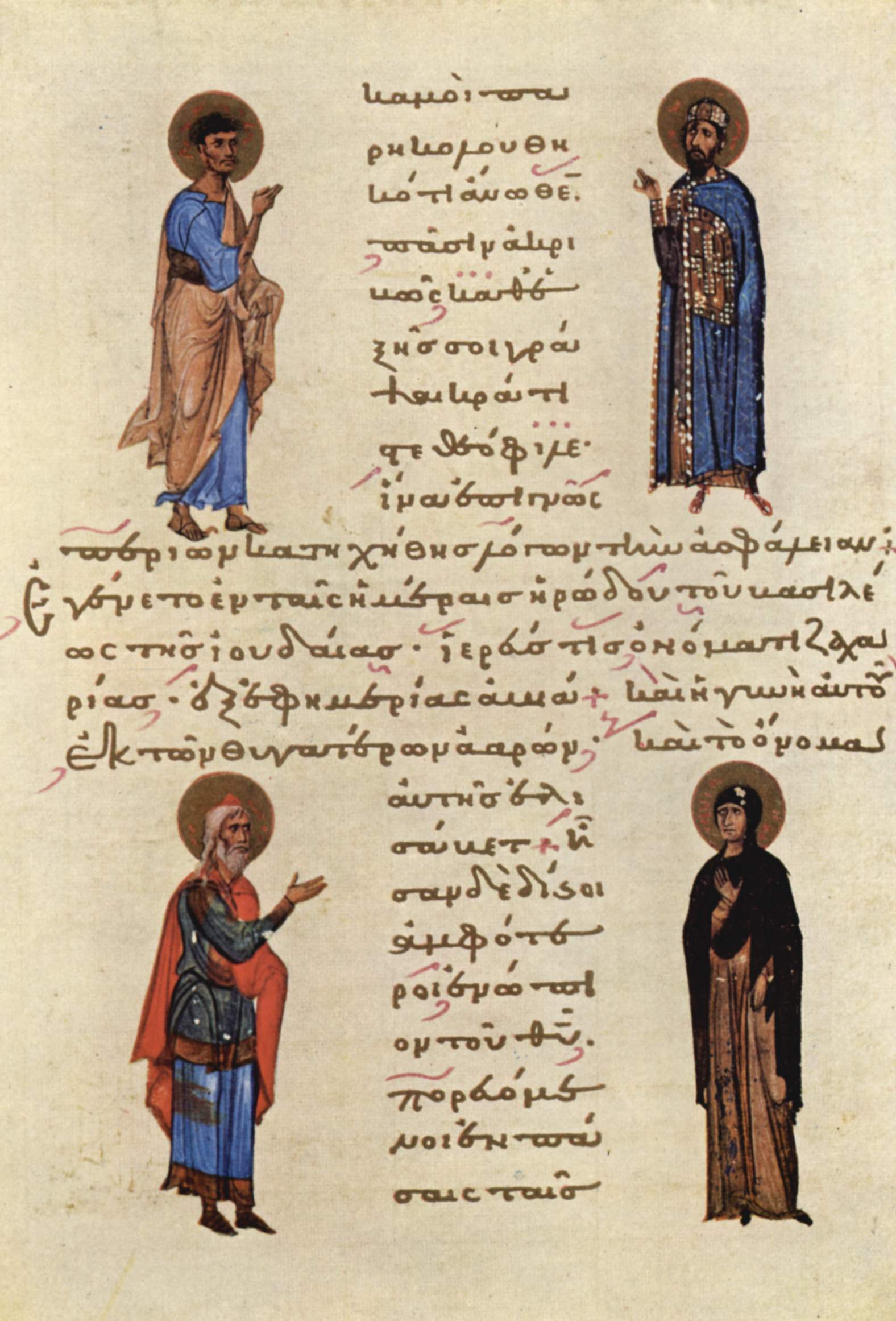 11th century; Biblioteque Nationale, Paris[/caption]
