

what Christianity is (and is not) for
As a believing Christian, I have come to a point where I find articles like Scruton’s increasingly frustrating. That large numbers of Europeans no longer embrace the Christian faith is obvious. But in this article, Scruton neither explains, nor defends, nor advocates the Christian faith other than as an instrumentality to buttress a select group of nation states, or as an instrumentality to inform elements of a culture he would like to see preserved. At least as described, Scruton’s is not a Christianity of radical practices of self-giving love that animated the early communities of the time of Acts of the Apostles. It is a Christianity from the top down. a bureaucratized belief system in which the value proposition lies not in the transformation of individual lives, but in providing some sort of ethical coherence to societies. Now, it may be a good thing for societies to possess ethical coherence – but that is a consequence far, far down the causal chain, and a long distance from the mission and purpose of Christian belief. Starting the discussion where Scruton does, he makes Christian belief the servant of state and culture (whatever he may think he is saying) rather than a set of beliefs that precedes and is therefore independent of state and culture. The error of that highly compromised version of Christian belief was exposed for all to see in The Great War, when it failed to speak truth to power, when its chief utility was to provide an endless series of benedictions to soldiers who died in the mud of that war in service to various regimes claiming the banner of Christianity in order to wage destruction on their neighbors. European Christianity has never recovered. Scruton cherry picks fragments of Christian moral teaching to fashion a belief system with which he is comfortable, and because it provides a rationale for safeguarding works of prior centuries whose aesthetics he finds appealing. His Christianity amounts to little more than prayer books for bare, ruined choirs. It’s an elegy, not evangelism, and it can neither transform, nor redeem. So no wonder it cannot compete with the ideals of the present age, whether in Europe or in this country. It has no Christmas, nor Easter. It’s just an endless series of 18th Sundays after Pentecost.
— A brilliant comment by one of Rod Dreher's readers. I love much of Scruton's writing and have learned a great deal from him, but he does sometimes talk as though the chief function of Christianity is to provide liturgical support for fox hunting.
Karl Barth and The Thing Itself
In speaking of God, human logic characteristically ignores both His nature and the fact that, when the reference is to Him, the argument from operation to cause is inapplicable, since He is not a known thing in a series of things.— Karl Barth, making a point that he makes often. In so doing he almost always means to show the necessary absurdity of Christian apologetics, but it’s worth noting that it’s a point equally relevant to the New Atheists, as David Bentley Hart points out in his powerful book The Experience of God: “Suffice it to say that the demiurge is a maker, but not a creator in the theological sense: he is an imposer of order, but not the infinite ocean of being that gives existence to all reality ex nihilo. And he is a god who made the universe 'back then,' at some specific point in time, as a discrete event within the course of cosmic events, rather than the God whose creative act is an eternal gift of being to the whole of space and time, sustaining all things in existence in every moment. It is certainly the demiurge about whom Stenger and Dawkins write; neither has actually ever written a word about God.”
But then many proponents of Intelligent Design don’t either. Here’s a long but vital passage in which Hart shows what the two sides have in common:
[Stephen] Hawking’s dismissal of God as an otiose explanatory hypothesis, for instance, is a splendid example of a false conclusion drawn from a confused question. He clearly thinks that talk of God’s creation of the universe concerns some event that occurred at some particular point in the past, prosecuted by some being who appears to occupy the shadowy juncture between a larger quantum landscape and the specific conditions of our current cosmic order; by “God,” that is to say, he means only a demiurge, coming after the law of gravity but before the present universe, whose job was to nail together all the boards and firmly mortar all the bricks of our current cosmic edifice. So Hawking naturally concludes that such a being would be unnecessary if there were some prior set of laws — just out there, so to speak, happily floating along on the wave-functions of the quantum vacuum — that would permit the spontaneous generation of any and all universes. It never crosses his mind that the question of creation might concern the very possibility of existence as such, not only of this universe but of all the laws and physical conditions that produced it, or that the concept of God might concern a reality not temporally prior to this or that world, but logically and necessarily prior to all worlds, all physical laws, all quantum events, and even all possibilities of laws and events. From the perspective of classical metaphysics, Hawking misses the whole point of talk of creation: God would be just as necessary even if all that existed were a collection of physical laws and quantum states, from which no ordered universe had ever arisen; for neither those laws nor those states could exist of themselves. But — and here is the crucial issue — those who argue for the existence of God principally from some feature or other of apparent cosmic design are guilty of the same conceptual confusion; they make a claim like Hawking’s seem solvent, or at least relevant, because they themselves have not advanced beyond the demiurgic picture of God. By giving the name “God” to whatever as yet unknown agent or property or quality might account for this or that particular appearance of design, they have produced a picture of God that it is conceivable the sciences could some day genuinely make obsolete, because it really is a kind of rival explanation to the explanations the sciences seek. This has never been true of the God described in the great traditional metaphysical systems. The true philosophical question of God has always been posed at a far simpler but far more primordial and comprehensive level; it concerns existence as such: the logical possibility of the universe, not its mere physical probability. God, properly conceived, is not a force or cause within nature, and certainly not a kind of supreme natural explanation.Reading this passage, I find myself thinking of Hart’s title and asking: What might it be like, then, to have an encounter with the real God, the God beyond categories and logic, the God who is “experience as such,” whom we encounter as sat, chit, ananda? It’s a question Adam Roberts asks too.
The Thing Itself is all kinds of amazing, and very hard to describe: if you imagine a mashup of The Thing, Lewis’s That Hideous Strength, The Thirty-Nine Steps, and Kant’s metaphysics, you’ll … not quite get it. Just read it, please. 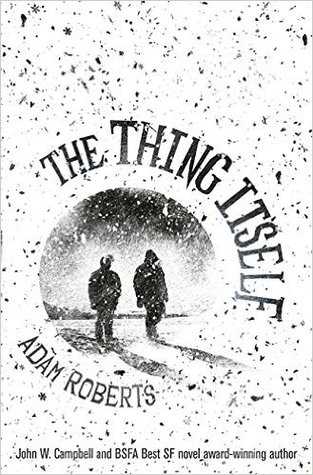 Among the many things that Roberts does here, one of the most intriguing is to ask whether Kant’s antinomies — which attempt to address some of the same limitations in our language and thought that Barth and Hart also point to — might be a key to unlocking, even in computational as well as experiential terms, the mysteries of the universe.
Adam and I have been corresponding a bit about these matters, and lo, as I am trying to wrap up this post I see that he has just put up a post of his own about Karl Barth! Wonder of wonders! But he the atheist and I the Christian are finding some significant points of common interest here, points that I hope we will find ways to explore further.
For now I’ll leave you with these questions, which have been turning and turning in my head since I read Adam’s book: What if we thought of our current debates about God, our current confrontations between theists and atheists, as the inevitably sorry by-products of a failure to grasp what Hart argues, what Barth argues, what Kant says when he presents us with his Fourth Antinomy? And what would happen to our conversations if we took seriously the possibility that we don’t have any real idea what we have been arguing about?
And with that, Merry Christmas to all, and to all a good night!
an educational Dark Age?
In response to this post on a lament by David Gelernter, one of Rod Dreher’s commenters cites, as evidence of cultural decline, an episode of MAS*H in which the characters all sing “Dona Nobis Pacem.” I think the idea is that people in the 1970s thought that people in the 1950s all knew that ancient hymn, so therefore … I’m not sure. Can’t quite follow it. I can tell you this, though: absolutely none of my Alabama Baptist redneck family, whether sixty or forty or twenty years ago or right now, could tell you whether “Dona Nobis Pacem” is a man or a horse. Though some of the elders might have a story or two to tell about Tommy Nobis.
When you’re arguing that what Hollywood TV scriptwriters in the 1970s put into their show about the 1950s is a reliable guide to the cultural capital possessed by that long-ago era, your narrative of decline needs some serious work. But Gelernter doesn’t provide it either. For instance, he says:
The problem is – the incredible richness of American civilization in the years after the Second World War, the generation after the Second World War. When we were creating such extraordinary art and painting, such extraordinary science and mathematics and engineering. Such extraordinary music. Gershwin – we were still in the Tin Pan Alley generation of Gershwin and Kern, and Cole Porter. Leonard Bernstein was the first American born maestro, and his young people’s concerts were broadcast by CBS, coast to coast. We were – people were excited about novelists. When Hemingway did something, shoot himself, it was front-page news. People knew and cared. They knew who Picasso was. He was a celebrity. They knew who Matisse had been. They heard of Jacometti [sic], they cared about Chagall. Chagall was a big celebrity in the United States.Who knew who Mastisse had been? Who had heard of Giacometti? Not me, when I was growing up. Not my parents or aunts or uncles or cousins or friends. (Also, not the person who transcribed the conversation, but never mind.) Gelernter again:
Music appreciation was never taken seriously. But what we used to do was, at least, expose students to things that they might be excited about, that their own minds would propel them into. So they would know nothing about Beethoven in any deep sense but they would have heard a phrase from the Fifth Symphony, they would have heard a phrase from the Ninth Symphony or the Moonlight Sonata. Doesn’t mean they know Beethoven, but it means if they love music, the door is open, they have some concept of what culture is.Again, not me, not anyone I knew, in my generation or the previous ones. In my music appreciation class we never got beyond “Reuben and Rachel.” So which educational model was closer to the American norm, that of my world or that of Gelernter’s? Where’s the evidence? (I’ve looked at his book America Lite and I don't see any.)
Now, there are some changes that are easy to discern. For instance, in 1947 Time had cover stories on C. S. Lewis and Reinhold Niebuhr, and reviewed W. H. Auden’s book-length poem The Age of Anxiety. Not something that would happen today, to put it mildly. The television networks felt that they had some responsibility to bring culture to the masses, thus, to take just one example, the creation of a classical music celebrity in Van Cliburn. But about education we seem to have nothing but anecdotes, and anecdotes that fail to come to grips with massive demographic changes especially in American university education.
So we end up getting rants like this one from a professor who seems to hate his job and have contempt for his students, who insists that students aren’t interested in learning and “no one [is] being educated” in universities today and parents are “allowing [their] children to become steadily less intelligent” — and all with the implication that once upon a time thing were better in higher education.
But were they? When? Back in the day when a tiny fraction of Americans attended college? In the days of the “Gentleman’s C,” when the smug sons of robber barons got such grades because, though they loved learning for its very own sweet sake, their professors were so intellectually rigorous that a C was the best they could do? Please. I’ve been saying this for years: Narratives of educational decline need data. My experience as a teacher doesn’t match these stories. Students always vary in their interests and abilities, but I have not seen any decline in either since I started teaching in 1982. Maybe my experience is an outlier; but without the data I don’t know. And even with data we need to reckon with the fact that college education now has a radically different place in American society than it had before the 1944 G.I. Bill, one of the most momentous legislative acts in American history.
P.S. At least some of the data is out there, for people who’d actually like to know. It’s not easy to find, and it’s not complete, and it’s always aiming at a moving target, given those huge demographic changes I’ve mentioned. But we can do a lot better in comparing eras, and regions, than even enormously smart people like David Gelernter typically do.
reading Barth on Romans (2)
No other possibility is open to me except the possibility of being a man of the earth – O wretched man that I am! We have seen at last the reality of religion; we have recognized what men are. How vast a gulf separates the nineteenth-century conquering-hero attitude to religion from that disgust of men at themselves, which is the characteristic mark of true religion! – But Jesus Christ is the new man, standing beyond all piety, beyond all human possibility. He is the dissolution of the man of this world in his totality. He is the man who has passed from death to life. He is – what I am not – my existential I – I – the I which in God, in the freedom of God – I am! Thanks be to God: through Jesus Christ our Lord I am not the wretched man that I am.— Karl Barth, from the magnificent peroration of his commentary on the seventh chapter of Paul’s letter to the Romans. Before I go any further with these reflections, let me just note that I am not a theologian, not a biblical scholar, not a Barth scholar. I’m just a reader (though I admit that I am going to be teaching this book, very unprofessionally, in a Great Texts class next term). I have no doubt that professional Barthians have already said everything I’ll be saying here. I’m just posting about this extraordinary book in order to force myself to think more clearly about what I’m reading.
The passage quoted above is about as perfect an example as you could find of Barth’s dialectical method, in which every affirmation gets followed by a counter-affirmation and the tension between the two is (usually!) left to stand as a witness to … well, various things, including the human incapacity to comprehend the things of God, the inevitable constrictions of theological language, and sinners’ relentlessly clever determination to twist every affirmation (even the affirmation of their own profound corruption) to their advantage. Scholars usually speak of Barth’s “dialectical theology,” but what’s going on here is dialectical exegesis — and Barth exegetes in this way not simply because he has a preference for it but because, as he insists repeatedly in the prefaces to this book, he does not mean to comment on Paul but to read and think with Paul. “True apprehension can be achieved only by a strict determination to face, as far as possible without rigidity of mind, a tension displayed more or less clearly in the ideas written in the text.” In this sense Barth, though in so many ways a critic of the theology of Schleiermacher, strives to live out Schleiermacher’s insistence that the interpreter should strive to understand an author better than the author understood himself.
So in reading Romans 7 Barth strives to mimic in his commentary what he perceives to be the dialectical character of the text. But it strikes me that chapter 7 is by far the most dialectical part of the letter; other passages do not have this back-and-forth, this yes-and-yet-also-no character, at least not nearly so pronouncedly. So it seems that Barth has taken chapter 7 as the hermeneutical key to the whole letter, the part that expresses the character of Paul’s argument most fully, and then deployed that method in commenting on the rest of the letter as well. This strategy reminds me of the usual way that the doctrine of the perspicuity of Scripture is defended: the obscure parts are to be interpreted in light of the clear parts. Barth seems to be saying: The rhetorically mixed parts of this letter are to be interpreted in the style of the most rhetorically pure part.
Which is defensible. But it makes me wonder what a commentary would look like that took the eighth chapter as its methodological model.
my year in tech
I’m not doing a “my year in reading” post — because I never do a “my year in reading” post — but in its stead here’s an account of my year in technology. I’ve made some significant changes and I’m really pleased with all of them.
Escaping Twitter. More than a year ago I described my problems with public Twitter, and things have gotten worse since then. I decided soon after writing that post that quitting Big Twitter cold-turkey would probably not work; I needed to reduce my involvement gradually. That proved to be more difficult than I had expected — it turned out that there were always conversations that tempted me back in — but my activity trended gradually downward until I finally ended it altogether. The key was unfollowing everyone, and I mean everyone; you can’t be tempted to join conversations you can’t see.
I still use my public account to post links to things I have written, but this is done wholly through IFTTT and the built-in sharing functions on OS X and iOS; I quite literally never see my public Twitter account. (So if you have replied to me there and didn’t get an answer, now you know why.)
I don’t know when I’ve been happier with a decision. Escaping the incessant Twitter tsunamis has been an unmitigated blessing, an enrichment-by-subtraction of my quality of life, and I wish I had done it a long time ago.
Owning My Turf. This too is something I endorsed long before living up to my endorsement. I have both slowed down and simplified my life by dropping Tumblr and Instagram, as well as Twitter; if I want to share any casual comments or reflections or links or images, I now share them here and only here. (By the way, here’s reminder number 10,000 that social media sites will do whatever the hell they want with your data.)
Writing By Hand. I have always kept a notebook around for jotting down the occasional idea, but in the past year I have learned to rely on paper for sketching and drafting almost all of my writing, and for managing my tasks. After years of oscillating among a wide range of task-management apps and systems on my computer, I now handle all planning and to-doing in my notebook, using a variation on the Bullet Journal method. This change is another one I wish I had made years ago: my thinking is clearer, my writing stronger and more precise.
Slower Listening. When I’m writing in my notebook, and thereby avoiding the distractions of the online world, I don’t really want to have to go online to get music — and we’re all being pushed to keep our music online. (Just try to get iTunes to download all your music to your own hard drive.) But the demise of Rdio should be a reminder of how fragile this new musical ecosystem is; it’s yet another reason to “own your turf,” your turf in this case being your music. So I have had multiple reasons for retreating to the ancient technology of … CDs. And it turns out that that has its own pleasures too: it may not be quite as artisanal as putting vinyl on the turntable, but there’s something really nice about selecting a record you want to listen to all the way through, putting it on, and taking the liner notes back to your chair to consult as needed. I’ve been spending much of my musical time the past month with Bach’s keyboard music, which is inexhaustible; and with Monteverdi’s L’Orfeo, which I had never before listened to all the way through (it’s amazing).
Dumbing Down the Phone. Perhaps the biggest change of all: after seven years or so of having an iPhone, I have retreated to a dumb, dumb phone. It makes calls and texts. That is all it does. And it turns out that that’s wonderful. The only thing I have missed at all is the camera — but first, it turns out that I don’t really need to document every trivial curiosity of the day with a snapshot, and second, I have a decent, if by today’s standards somewhat elderly, camera that I’m now using far more than I had been, and enjoying enormously. I keep it in my backpack now.
But often when I go out I don’t bring my backpack. I head for the coffee shop with my dumb phone, my notebook, and a pen. I sip coffee and think and write. If my mind wanders and I wonder what’s in my RSS feed, I can’t check, so I have to go back to writing. Sometimes I bring a book too, and read it. If I get tired of it, I don’t have anything else to read, so I either keep going anyway or get the notebook back out. Or just sit there and drink my coffee and watch the unphotographed world go by.
obligatory Star Wars post
Just for the record:
- My view of the prequels is precisely that of every rational person, even though I only saw one of them.
- I saw each of the first three movies when they came out, and found them sometimes entertaining but mostly kinda boring, and to this day I fail to understand the loyalty and affection they inspire.
- I think J. J. Abrams movies tend to be clever but soulless.
- So I came to The Force Awakens with extremely low expectations, which it met.
So Rey finds Luke’s lightsaber in Maz Kanata’s basement, and the second she touches it she receives a series of visions from its past. And as soon as I saw that I thought: Priori Incantatem. Not exactly, of course, but the principle seems to be similar: the weapon contains memories of its former owners, the way that wands in Harry Potter’s world contain memories of the spells cast with them.
And sure enough, the rest of the story strongly implies that Rey is in some sense the rightful custodian of that lightsaber. That she is able to wrest control of it from Emo Kylo Ren — the world’s first weepy millennial I-just-don’t-know-my-true-calling supervillan — could be attributed to her superior strength in the Force, but more likely to its belonging to her and not to him. So are lightsabers in this rebooted universe like wands in the Potterverse? Do they in some sense choose the wizard — um, I mean, the Jedi? Do have some kind of special bond with their rightful owners?
Or is that true of just this particular weapon? If so, maybe we have a different analogue. I imagine a line cut from the movie in which Maz Kanata says to Rey, “This lightsaber wanted to be found … and by you.”
reading Barth on Romans
The judgment of God is the end of history, not the beginning of a new, a second, epoch. The difference between that which lies beyond the judgment and that which lies on this side of it is not relative but absolute: the two are separated absolutely. God speaks: and He is recognized as the Judge. By His speech and by His judgment a transformation is effected so radical that time and eternity, here and there, the righteousness of men and the righteousness of God, are indissolubly linked together. The end is also the goal; the Redeemer is also the Creator; he that judgeth is also he that restoreth all things. The disclosure of non-sense is the revelation of sense. What is new is also the deepest truth of what was old. The most radical ending of history, the negation under which all flesh stands, the absolute judgment, which is the meaning of God for the world of men and time and things, is also the crimson thread which runs through the whole course of the world in its inevitability.— Kark Barth beginning to exposit Romans 3, in his The Epistle to the Romans. I am reading this book for the first time in at least a quarter-century, and in the intervening decades a great deal has happened in New Testament scholarship. I have only read a tiny fraction of that scholarship, but enough that the positions Barth takes throughout this famous commentary now seem utterly archaic, on the other side of some kind of intellectual and exegetical divide. I keep thinking how existential Barth is, how abstract his arguments seem in comparison to — to take only the best-known example relevant to the passage I’ve just quoted — N. T. Wright’s work on the New Creation and how that New Creation is complexly rooted in visions and arguments articulated in the Hebrew Bible (e.g. Deuteronomy 29, Ezekiel 34-37, Jeremiah 31, Daniel 9).
And yet how radical Barth seems in comparison to many more recent exegetes — and their followers. Three cheers for our new emphasis on history and the material world and all, but you can sometimes get the sense that if we’re just a little greener or rather more communal-minded God will be greatly pleased with us. Reading Barth makes me wonder whether, in the eyes of our green communitarians, the Second Coming is only required for some touch-up work on the worthy labors we’ve already performed….
Untrue and unfair, I know. Still, there’s something wonderfully bracing about Barth’s relentless insistence on the otherness of God, the force with which he reminds us that “the fear of the Lord is the beginning of wisdom.” Paul’s statement that to God “our righteousness is as filthy rags” seems to strike Barth as far too kind: in his vision the most glancing encounter with God would vaporize those rags and the unfortunate one who happened to be wearing them. And then there’s the equally relentless dialectical method, the refusal (seen clearly above) to let no statement stand without its counter-statement immediately appearing, fiercely juxtaposed.
Since eventually everything old is eventually new again, I wonder if it is yet time for our history-minded, embodiment-minded, worldly-minded exegetes and disciples to find value in Barth — to accept his radical Krisis hermeneutic as something that we might profitably encounter not just in our statements of general theology but in our very encounters with Scripture … and with one another.
(More reflections on Barth may be coming, as I read my way through this holiday season.)
old disciplines, new people
The practices of the ancient Church were forged in eras of the porous self and were responsive to its fears and vulnerabilities. Can they be nearly as meaningful to us, surrounded by our protective buffers, as they were to our ancestors? Does their evident power suggest to us that we have paid too high a price for our buffers, that we may need to be more exposed? The self that can pursue the via illuminativa — that can be illuminated by God — may open itself to the demonic as well as the divine. The disciplines and practices of our Christian ancestors are not toys or tools; they are the hope of life to those who are perishing. This is what Alasdair MacIntyre had in mind when he said that, here among the ruins of our old civilization, what we may be waiting for is a new St. Benedict: someone who can articulate a whole way of life and call us to it.— Do-It-Yourself Tradition by Alan Jacobs. From 2009, when the Benedict Option was scarcely a gleam in Rod Dreher’s eye.The turn to the Christian past is indeed welcome, but it may demand more of us than we are prepared to give. In contemplating the witness and practices of our ancestors, we may discover that we’d rather remain within our buffers — if we can. But can we? Current electronic technologies, from blogs to texting to online banking to customer-specific Google ads, may be drawing us into a new age of porousness, with new exposures, new vulnerabilities. And in such a new age the hard-earned wisdom of our distant ancestors in the faith may be not just a set of interesting ideas and recommendations but an indispensable source of hope. Those who have ears to hear, let them hear.
excerpt from my Sent folder (2)
… I’ve written a couple of angry things in defense of Wheaton, since I left, but I think my having left made it possible for me to get away with the anger. It’s harder to make that work from the inside.
Moreover, what’s really needed here is not anything that could be construed as a defense of particular administrative actions — and even if you deny that you’re doing that, in the residual heat of last week’s news that’s how such a piece will be perceived — but rather an explanation of why places like Wheaton deserve to exist within the widely varied landscape of American higher education. And by “deserve to exist,” I mean on an equal footing with other institutions. You say that Wheaton isn’t going anywhere, and that’s probably true, but a great many other Christian colleges may well, in the coming decade or two, have to close their doors because they lack the financial resources and reputational stature to respond effectively to legal challenges, denial of federal student-loan funding, and de-accreditation. At the very least, religious schools will be threatened with constant demands that they bow to Caesar; even if they can get legal verdicts in their favor that will only be after great expense; and I find it impossible to imagine a future in which religious institutions won’t always be dealing with discrimination suits.
If we who teach at religiously-based institutions have any chance of maintaining the status quo, we’ll need to articulate that more general account of what schools like Wheaton do and why even those who have no religious belief, or even sympathy with religious belief, should value that work.