
∞
Many advocates of assisted suicide try to redefine it as something else—indeed, to redefine human dignity and human life itself. [Brittany] Maynard has become a sort of secular saint for the cause, and the media have provided her hagiography. Maynard herself wrote: “If I’m leaving a legacy, it’s to change this health-care policy or be a part of this change of this health-care policy so it becomes available to all Americans. That would be an enormous contribution to make, even if I’m just a piece of it.” CNN named Maynard one of its “11 Extraordinary People of 2014” for her decision to define death “on her own terms.” Another columnist wrote that Maynard in her choice for self-inflicted death employed her “own definitions of life and dignity.”
This echoes the famous “mystery clause” of Supreme Court justice Anthony Kennedy: “At the heart of liberty is the right to define one’s own concept of existence, of meaning, of the universe, and of the mystery of human life.” Such a notion of liberty and human dignity can only lead to incoherence and absurdity; life and death are not ours to define, but are objective realities to which we must adapt. There is a great irony in all of this empty talk about controlling the timing and circumstances of our death, since death is the singular event that finally and completely announces our lack of complete mastery and control.
∞
I found myself recalling the story of the T’ang Dynasty artist Wu Tao-Tzu, who is said one day to have gathered his friends to show them his most recent painting. The friends huddled round it in admiration: it was a vertical scroll painting of a mountainous landscape with a footpath that led along the bank of a stream, and then through a grove of trees to a small cottage or hut. But when the friends turned to congratulate Wu Tao-Tzu, they realized he had vanished. Then they saw that he had stepped into the landscape of the painting, and was walking along the path and through the grove. He reached the entrance to the hut, and on its threshold he paused, turned, smiled, and then passed through the narrow doorway.
∞

[gallery] lawrenceleemagnuson:
Christopher Richard Wynne Nevinson (UK 1889-1946)
The Arrival (c.1913)
oil on canvas 76.2 x 63.5 cm
∞
When I cook, I like people to be able to identify the food. I like people to feel comfortable. I want people to look at my food and start salivating and starting thinking of marriage of that food with a certain type of wine, and so forth. But in molecular cuisine — this is fine, I mean, up to a certain extent, a meal or two this way — but after a while I just want to go out and have a taco and a beer.
∞
We always have to improve just a little, just as everything has to be “growth-based”, a little bigger next year than last year. It’s never good enough to maintain ground, to defend a center, to sustain a tradition, to keep a body healthy happy and well. Nor is it ever good enough to be different next year. Not a bit bigger, not a bit better, but different. New. Strange. We are neither to be new nor are we to maintain. We are to incrementally approach a preset vision of a slightly better but never perfect world. We are never to change or become different, only to be disrupted. Never to commune or collaborate, always to be architected and built.
<a href=“[blogs.swarthmore.edu/burke/blo...](http://blogs.swarthmore.edu/burke/blog/2015/10/02/inchworm/)”>Tim Burke on assessment
∞

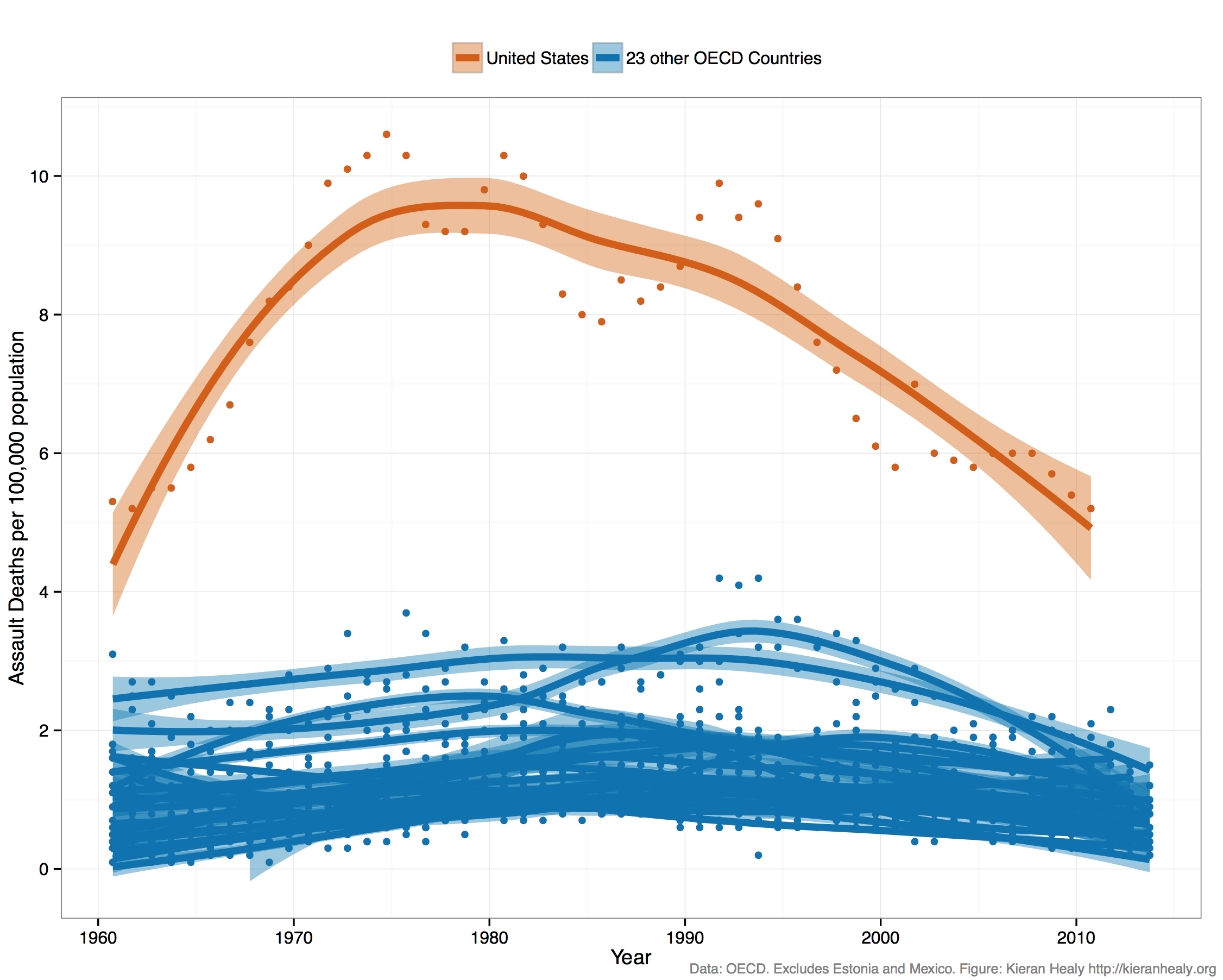
[gallery] Assault death rates, 1960-2013
∞
[youtube https://www.youtube.com/watch?v=96LUAaaPqRc?feature=oembed&enablejsapi=1&origin=http://safe.txmblr.com&wmode=opaque&w=250&h=141]
Michael Phillips channeling William Blake
(Source: https://www.youtube.com/)
∞
[gallery] Michael Phillips has recreated the techniques by which William Blake made his illustrated books. Here he is choosing and mixing colors as Blake did.


∞
Nothing to see here, folks. Just a vulgar woman who was snuck in. The Holy Spirit is definitely not afoot. It was practically an accident, really. Or perhaps it was some dastardly conservative bishop who allowed the cool pope to embrace someone universally despised by the great and good. She’s been married four times. Believe me, if he knew, he’d throw her into the well.
The scribes and the Jesuits are right on a very limited point. Based on the evidence, we cannot know what the pope’s gesture meant in an explicit way. We cannot know what was in his heart. But unlike the scribes and Jesuits, those with a mind habituated to liturgy know that the words and gestures prescribed by the hour and the office carry more meaning than can fit into the head of a single priest. They can express the divine intention even when the priest’s mind runs away to something trivial. Some might see mere routine in the pope’s encouragement, but the eyes of faith see something more: an act of humility, imposed by his lofty office. Even an act of trust and love. The world hates you. I do not.
∞
For 20 years I taught James Joyce’s Ulysses every year, but I don’t get to anymore—new university, new job description. I miss it terribly, even though my opinion of its quality wavered from semester to semester. Ezra Pound said of its successor, Finnegans Wake, “Nothing short of a divine vision or a new cure for the clap can possibly be worth all the circumambient peripherization.” I sometimes felt that way about the complications of Ulysses. But most of the time I believed it was a masterpiece, and I always thought that at the very least it contained extended passages of unsurpassed brilliance. Above all, I delighted in the challenge of taking undergraduates through it.
When they first looked at Ulysses their eyes grew round as saucers—“You’re expecting us to read this?”—but I strove for a constant tone of avuncular encouragement. I also had elaborate handouts outlining the book’s structure and offering advice, the first line of which was: “Try to read this when you’re fresh and rested. It is difficult at any time, but almost impossible when you’re tired or distracted.” We took it slow. Eventually I could see people, one by one, figuring things out—it was like lights going on in a city at dusk. The more that lights went on, the more I tended to feel that the book is a marvel after all. And surprisingly often, at the end of a semester people would say to me, “I’m so glad you made us read Ulysses.”