
In the end, the show of force looked more like a show of fear – a case where American exceptionalism was merely our exceptional paranoid obsession with security. The troop buildup was a giant money suck, taking dollars away from the common good, and it was absolutely a restriction on one of the freedoms that Americans have come to cherish the most – freedom of movement. I can’t help but think the whole experience made us look like a weak nation to vistors from other lands.Of course, while 9/11 will always be cited as the justification for this over-the-top protection of “the homeland,” the only possible real justification for checkpoints is not so much al-Qaeda as the fact that America is a nation awash in guns, the bulk of them legal. Personally, I prefer the right to move freely from place to place over the right to pack heat. Because this weekend made it clear that the United States is a place that can’t easily handle both at the same time.
The most memorable encounter between Day and Auden took place in 1956. By then, the Catholic Worker Movement, with its network of shelters and communal farms, was established as a national manger for the homeless. Because Day’s pacifism and compassion for striking workers was deemed subversive, J. Edgar Hoover of the FBI tried to nail her for sedition, but failed. Then, Day got a notice from the New York City fire department stating that unless she paid $250 to repair her “fire-trap” of a hospitality house, it would be closed. When she stepped out of the shelter to hurry to court, she saw a shabby group of men outside and assumed they were interested in the old-clothes bin. But one of them pressed something into her hands muttering, “Here’s two-fifty.” Only on the subway did she discover she’d been handed a cheque, not for $2.50 but $250, and that the hobo was the pre-eminent poet of the age.Auden had read about Day’s situation in the New York Times and shambled over from his famously unkempt apartment to do his bit, probably dressed in a rumpled, ash-smeared suit and carpet slippers. It wasn’t that he was rich. Scarcely a few days earlier he had written to his friend Stephen Spender, “How am I to live?” Still, he made his handsome donation. When he later examined his motivations, he concluded that he had been unconsciously selfish: it was to allay his conscience. He hated the camera, but he was good at taking moral selfies. For Day, the Catholic Church had a similar problem: “plenty of charity but too little justice.”
Day paid Auden back in the finest way possible. She told him that while in prison for refusing to participate in an air-raid drill, her co-inmate, a whore, had marched off to the weekly shower quoting the last line from a poem Auden had just published in the New Yorker: “Thousands have lived without love, not one without water.” For the rest of his life, Auden maintained it was the “nicest poetical compliment” he had ever received. “My God,” he thought, “I haven’t written in vain.” This from the poet who wrote, “Poetry makes nothing happen,” and never stopped repeating, especially after a few martinis, that all his revolutionary verse of the 1930s had not saved a single Jew from the ovens.
[gallery] Handmade embroidered notebooks, via thisiscolossal


[gallery columns=“1” size=“full” ids=“17687”]
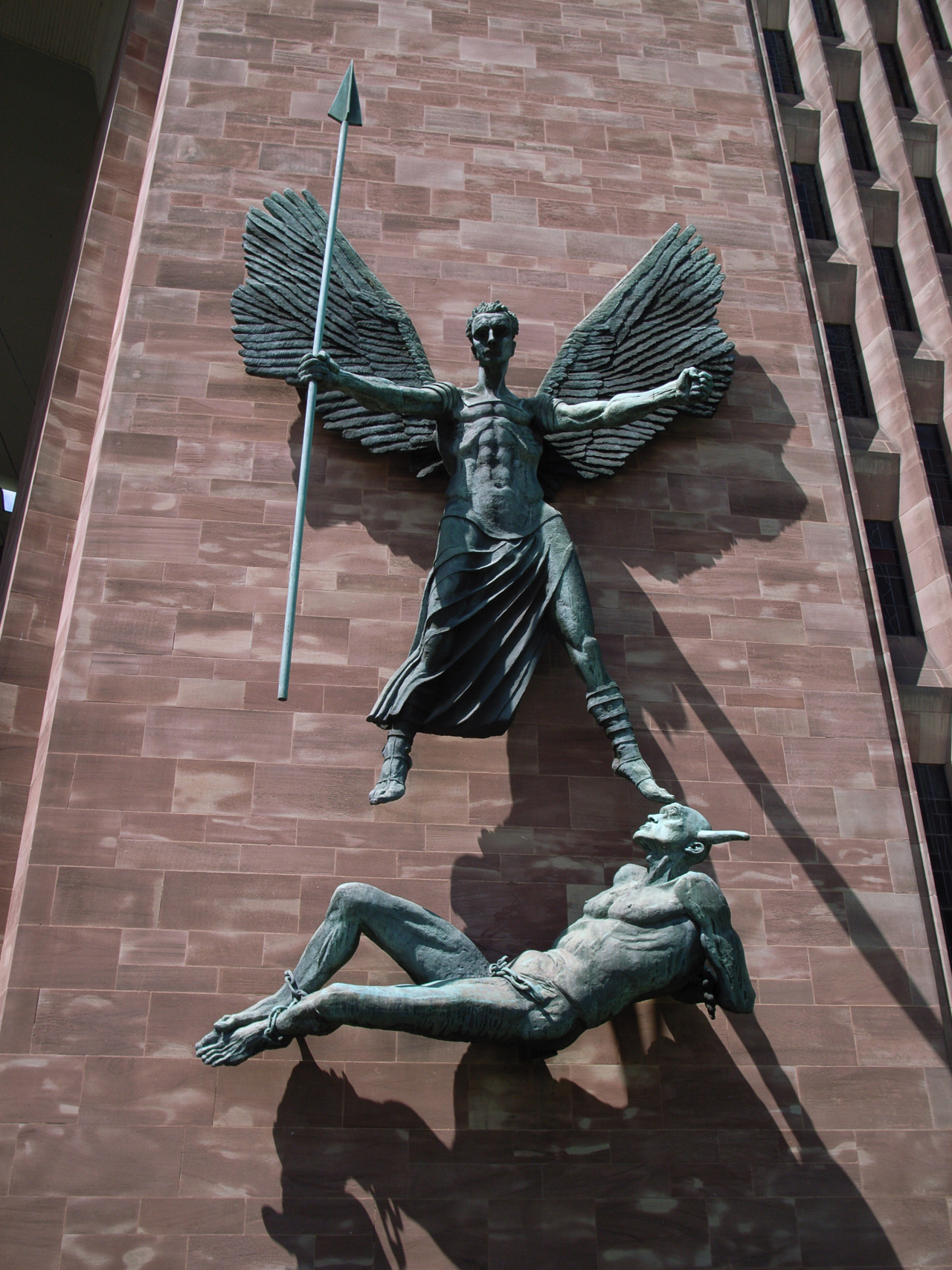
For Michaelmas: Jacob Epstein, St Michael’s Victory over the Devil (1958), Coventry Cathedral
[gallery columns=“1” size=“full” ids=“17690”]
eastmanhouse: Main Street, Saratoga Springs, Original photographer: Walker Evans, 1931
gelatin silver print Image: 20.6 x 16.4 cm Overall: 25 x 20.1 cm National Origin: United States

But for her words to rise to the level of an extraordinary ‘big lie,’ a vicious slander of abortion providers everywhere, it seems to me that something more than this kind of misdescription would need to be in play. If the scene in question literally did not exist, which is what the language of her critics consistently suggests — if Fiorina had conjured up a vision of an intact fetus with a working heart and twitching limbs having its brains harvested out of her hyperactive pro-life imagination — well, that would merit liberal shock and outrage. But she didn’t conjure or invent it: It’s very easy to figure out what scene she’s talking about, and the discrepancies between what’s in the documentary and her description aren’t wild or incredible or weird. There’s no fabrication here, in other words, and what Lithwick calls ‘the big lie about the kicking fetus and the brain harvesting’ is a basically-accurate summary of what the film actually shows. (A twitching, dying fetus? Check. A firsthand description of harvesting a brain from an intact fetus? Check again.)— Ross Douthat. This kerfuffle has done more than anything ever has to convince me that many supporters of unrestricted abortion are simply and genuinely incapable of acknowledging what happens in an abortion.
Once upon a time, Wesleyan students would have responded through grassroots organizing, not through supplicating at the feet of administrators and committees, asking them to do their protesting for them. The radical students I remember from Wesleyan’s past had a do-it-yourself ethos, understanding that they could not expect to change structures by working within them. Today’s Wesleyan students could have reacted to the piece in question by writing a response in the Argus. They could have started their own radical newspaper. They could have leafleted, or invited speakers, or used any other means to respond with better, more enlightened speech. By going straight to authority, they have instead embraced establishment power and asked it to be part of a liberatory struggle. That is folly. Institutions like Wesleyan may be made up of radicals, but they are by their nature conservative entities; that’s the nature of self-protective institutions. I’m sure many Wesleyan activists are familiar with Audre Lorde’s wise advice that we will never tear down the master’s house with the master’s tools.
[gallery] houghtonlib:
The future Queen Elizabeth, age 19, writes to her half-brother King Edward VI shortly before his death in 1553. The power struggle following the death of the 15-year-old King would lead to the 9-day reign of Lady Jane Grey and her eventual beheading.Houghton Library, Harvard University

Some, or even all, of these challenges may be misguided, silly, or narrow-minded. But even if you’re firmly opposed to “banning books”—and I am!—it’s hard to argue that parents should have no right to weigh in on what their children read at school. There’s an enormous difference between parents saying a book shouldn’t appear on their kid’s required reading list and a citizen demanding that adults should have no access to a book at a public library. And it should shock no one that in a country of 300 million people, there are a few hundred cases each year in which someone objects to a particular book’s availability, especially to children.
And in the clear majority of cases, the challenge ends the way that Jackie Sims’ objection to The Immortal Life of Henrietta Lacks ended. The school board already had a policy in place regarding sensitive instructional materials, and Sims’ son was provided with an alternate text. In media interviews, district officials seemed unmoved by Sims’ demands that no other students should have access to the book, either. (Sims has said she’ll keep appealing.) So in one corner were the media, the masses, the author, and the school board. In the other, one woman in East Tennessee. This Banned Books Week, instead of hand-wringing about a nonexistent wave of censorship, let’s celebrate the obvious: The books won.