
Kurzweilian Whiggery
The movie Back to the Future came out in 1985, and “the past” took place in 1955. In the movie, when Michael J. Fox went back to 1955, he was caught off-guard by the newness of TVs, the prices of soda, the lack of love for shrill electric guitar, and the variation in slang. It was a different world, yes — but if the movie were made today and the past took place in 1985, the movie could have had much more fun with much bigger differences. The character would be in a time before personal computers, internet, or cell phones — today’s Marty McFly, a teenager born in the late 90s, would be much more out of place in 1985 than the movie’s Marty McFly was in 1955.See, Accelerating Returns is a law. A LAW. That’s how we know progress happens faster and faster, because LAWS do that.This is for the same reason we just discussed — the Law of Accelerating Returns. The average rate of advancement between 1985 and 2015 was higher than the rate between 1955 and 1985 — because the former was a more advanced world — so much more change happened in the most recent 30 years than in the prior 30.
Still … the facts are pretty thin on the ground here, aren’t they? And then there’s Urban’s assumption that 1985 was “a time before personal computers,” which suggests that he hasn’t really thought about this. As it happens, around this time in 1985 I was typing on my Macintosh while listening to a recent U2 record and pausing from time to time to find out what Chris Berman has to say about the Super Bowl. So from some points of view nothing has changed in the past three decades.
But let’s not be quite so anecdotal. We could try a thought experiment, in the form of a few questions.
- Did automobiles change more from 1955 to 1985, or from 1985 to 2015?
- Did television change more from 1955 to 1985, or from 1985 to 2015?
- Did household appliances change more from 1955 to 1985, or from 1985 to 2015? (Think for instance about the prevalence of air conditioning.)
- Did space exploration change more from 1955 to 1985, or from 1985 to 2015?
- Did military weaponry change more from 1955 to 1985, or from 1985 to 2015?
- Did cancer treatment change more from 1955 to 1985, or from 1985 to 2015?
Auden and the Dream of Public Poetry
This essay was originally published in this book. I’m posting it here because I think fairly well of it — though I would write it very differently today — and wish it had had more readers. (Nothing makes an essay disappear as thoroughly as publishing it in an edited collection on a scholarly press.)
1.
The first of “Two Songs for Hedli Andersen,” written by W. H. Auden in 1936 and never considered one of his major works, found new and unexpected life in 1994 when it was featured in the movie Four Weddings and a Funeral. A young man asked to speak at the funeral of his beloved finds that the words of ‘another splendid bugger’ speak for him, and reads the poem, in a cracking voice, to the assembled mourners.Much of the credit for the strong response to this poem must go to John Hannah, the actor who plays the bereaved lover and whose recitation of the poem is indeed affecting; moreover, one should not discount the appeal of the film’s portrayal of a devoted gay couple whose relationship is the envy of all their straight friends; but clearly Auden’s poem itself struck something of a chord in many viewers. Within months of the film’s release one could purchase a recording of Hannah reading ‘Funeral Blues’ — as Auden called the poem in his 1940 collection Another Time, and as it is called on the recording, though as we shall see it was given different titles both before and after — and several other poems by Auden. A small chapbook-like edition of a dozen or so love poems by Auden was released, to be followed within the year by a substantial collection of Auden’s songs and occasional poems; both of these included, and prominently featured, ‘Funeral Blues’.
Those of us who love and celebrate poetry, especially modern poetry, must of course be gratified by this unexpected burst of attention. But we may also ask ourselves why it happened to this particular poem, especially since it is not one of Auden’s acknowledged masterpieces. I do not know of an anthology in which it appears, and Edward Mendelson did not include it among the hundred poems he chose for the second edition of Auden’s Selected Poems (though Auden himself selected it for the first edition, which he compiled in 1958). And one does not have to read the poem very closely before noting that it is in some ways peculiar: for instance, the way it juxtaposes distinctive and even bizarre metaphors with shamelessly deployed clichés. The ‘black cotton gloves’ of the traffic policemen seem faintly comic, and the presence of such an image in a funeral lament is rather suspicious. Still more dubious is the skywritten news bulletin: ‘He is dead’ instead of, say, ‘Eat at Joe’s’. But even if the reader feels the dissonance between what I. A. Richards would call tenor and vehicle in these metaphors, they are at least new, something which cannot be said for a line such as ‘I thought that love would last for ever: I was wrong’. The poem seems to hover, or to cause its reader to hover, uneasily among sentimentality, parody and (especially in the final stanza) deep pathos.
It is clear, then, that a traditional new-critical close reading of ‘Funeral Blues’ (the kind of reading I have just sketched an outline of) is bound to discover features of the poem which by the criteria of that theory can only be called faults. Close readers tend to value irony and paradox, but not tonal inconsistency, and cannot abide the use of cliché. But these ‘faults’ come into view, are identifiable as faults, primarily because close reading is just that, a way of reading, and this poem was not, at least at first, made to be read. It is not evident that a good poem-for-reading will possess the same characteristics of a good poem-for-singing, and Auden makes it clear that ‘Funeral Blues’ is primarily a song, intended for public and aural, rather than private and visual, appropriation. It is a ‘Blues’, that is, among other things, a song in a popular idiom. In the last edition of his Collected Poems that he oversaw Auden placed it in a group of ‘Twelve Songs’.[1] In the 1958 Selected Poems it is identified as one of ‘Two Songs for Hedli Anderson’,[2] Hedli Anderson being an actress and singer whom Auden first met in the thirties, when both of them were working with the Group Theatre. And indeed, the first version of the song appeared in The Ascent of F6, the play that Auden and Christopher Isherwood wrote for the Group Theatre in 1936 (and which was performed for the first time in early 1937).[3] Only in 1938 did the poem we now have emerge from this song: it was published in an anthology called Poems for To-day (Third Series) under the title ‘Blues’.[4]
In light of this complicated textual history one could argue that Four Weddings and a Funeral has rescued ‘Funeral Blues’ from a context — that of private, solitary reading — essentially foreign to its means and purposes, and placed it within a more congenial environment, thereby releasing its power and making evident its virtues. (The cinema in no sense identical to the stage — as we will later have cause to reflect — but approximates it more closely than does the printed word.) When read aloud or sung ‘Funeral Blues’ works in a way that it may not on the page, and shows itself a significant and powerful work of art. The human voice, as John Hannah has demonstrated, gives resonance to the assortment of strange tropes and flat clichés; the utterance of the poem by a person knits up these heterogenous linguistic threads into a tightly woven garment of grief. We understand, hearing that utterance, that clichés and strained metaphors alike are resources called upon in the disarray of bereavement.
Or so I contend, by way of explaining the poem’s sudden popularity. But that Auden would write such a song only to have it disappear into the great jumble of his Collected Poems — this is a fragment of literary history worthy of a little attention. The immediate origins of this phenomenon lie, not in Auden’s work, but in a brief and relatively little-known essay by T. S. Eliot. For the early Auden inherits from Eliot a great dream, one in which both poetry and English society are restored to some imagined earlier state of wholeness and integration. ‘Stop all the clocks,’ in each of its forms, is a tentative but hopeful step toward the realization of that dream; but the story I want to tell describes the dream’s abandonment.
2.
Consider: Auden is known to students and teachers of literature almost exclusively through the poems he wrote for the page, while his dramatic poetry — though it fills approximately a thousand pages in the edition of his Complete Works which Edward Mendelson is in the process of editing — remains almost completely unknown. The case of T. S. Eliot is quite similar in this respect: critics often speak of Four Quartets as Eliot’s ‘farewell to poetry’ even though he wrote verse plays for another two decades; and the fame of The Waste Land could never console Eliot for his failure to complete what he often considered his most important project, the ‘Aristophanic melodrama’ Sweeney Agonistes.[5]What is particularly ironic about these case studies in poetic reputation is that for Auden and Eliot dramatic poetry was absolutely central to a vision they (with many other modern artists) shared: the vision of a culture of unified sensibility. That term, of course, derives from Eliot’s famous historical thesis about a European ‘dissociation of sensibility’ that ‘set in’ in the seventeenth century, and ‘from which we have never recovered’.[6] As Eliot’s thoughts on this subject developed, it became more and more clear to him that individual sensibilities could only be unified and integrated if civil society were reunified and reintegrated. In short, Eliot came more and more to believe that only a fully functioning public sphere could rescue us from our long agony — and to hope that a ‘reconstruction’ or ‘restoration’ of the English tradition of poetic drama could serve in the building of that public sphere.
Eliot’s first significant, if tentative, move to articulate his hopes for the drama comes in an essay first published in 1919 and called ‘The Possibility of a Poetic Drama.’ Eliot’s speculations are animated by a conviction quite prominent in his criticism of those years:
The Elizabethan Age in England was able to absorb a great quantity of new thoughts and new images, almost dispensing with tradition, because it had this great form of its own [i.e., the drama] which imposed itself on everything that came to it. Consequently, the blank verse of their plays accomplished a subtlety and consciousness, even an intellectual power, that no blank verse since has developed or even repeated; elsewhere this age is crude, pedantic, or loutish in comparison with its contemporary France or Italy.[7]Eliot here attributes to Elizabethan society as a whole something very like what he attributes to certain individual writers in his articulation of the difference between a unified and dissociated sensibility: ‘The poets of the seventeenth century, the successors of the dramatists of the sixteenth, possessed a mechanism of sensibility which could devour any kind of experience’.[8] But note that in the first passage social integration is the consequence of the possession of integrated minds by the society’s poets, especially its dramatic poets. He admits that ‘the drama is only one among several poetic forms,’ but contends that it ‘is capable of greater variation and of expressing more varied types of society, than any other,’ and further claims that ‘when one day it was discovered lifeless, subsequent forms which had enjoyed a transitory life were dead too’.[9] And not just literary forms, but also, presumably, forms of social life were lost with the demise of poetic drama.
This social integration, according to Eliot, was not the achievement of heroic figures like Marlowe or Shakespeare: rather, such poets were the beneficiaries of a general development. When he makes this point Eliot fairly drools with envy: ‘To have, given into one’s hands, a crude form, capable of indefinite refinement, and to be the person to see the possibilities — Shakespeare was very fortunate. And it is perhaps the craving for some such donnée which draws us on to the present mirage of poetic drama’.[10] For if we were to understand just how much is given to the dramatic poet in such an age ‘we should see then just how little each poet had to do; only so much as would make a play his, only what was really essential to make it different from anyone else’s. When there is this economy of effort it is possible to have several, even many good poets at once. The great ages did not perhaps produce much more talent than ours; but less talent was wasted’.[11]
Eliot’s account suggests that an age which lacks such a donnée, such a preexisting dramatic form, will be not just artistically but politically impoverished and imperiled. But Eliot’s little cultural history is thoroughly anti-heroic: it offers no hope that a single poet, or even a collection of gifted poets, will be able simply to create the needful form if it is missing. So he looks again at his contemporary scene: is anything appropriate ‘given’ to us? In the last paragraph of his essay, as (it appears) an afterthought, Eliot tosses out a suggestion:
The Elizabethan drama was aimed at a public which wanted entertainment of a crude sort, but would stand a good deal of poetry; our problem should be to take a form of entertainment, and subject it to the process which would leave it a form of art. Perhaps the music-hall comedian is the best material. I am aware that this is a dangerous suggestion to make… [12]Then follow three ambiguous sentences that distinguish, in a vague way, treating art seriously, treating it solemnly, and treating it as a joke. End of essay.
But having fled unceremoniously from his own notion, Eliot found himself unable to ignore it, and when Marie Lloyd died in 1922 he discovered an occasion to return to the idea and give some hint of its potential importance. Lloyd was, for Eliot as for many others, the greatest of the music-hall entertainers. And what made her great, says Eliot, was her ability to use her art to forge a temporary but powerful union with her audiences. While other performers could ‘amuse their audiences as much [as] and sometimes more than Marie Lloyd, no other comedian succeeded so well in giving expression to the life of that audience, in raising it to a kind of art’.[13] ‘The working man who went to the music-hall and saw Marie Lloyd and joined in the chorus was himself performing part of the act; he was engaged in that collaboration of the audience with the artist which is necessary in all art and most obviously in dramatic art’.[14]
Throughout this brief eulogy Eliot hints at, though he never specifically mentions, ancient Athenian drama. In the sentence just quoted one might think of the ending of Aeschylus’ Eumenidies, when the audience quite literally ‘joins in the chorus’ and marches with the actors out of the Theater of Dionysus to celebrate the past, present, and future of Athens. And when Eliot says that Marie Lloyd’s audiences were ‘not so much hilarious as happy’ he seems to be invoking that complex Greek word commonly if inadequately translated as ‘happiness,’ eudaimonia — eudaimonia for the citizens of Athens being the ultimate goal of Athenian drama (and philosophy too, for that matter).
But if Marie Lloyd’s music-hall is the closest equivalent in postwar London to the Theater of Dionysus, the parallel is not after all as close as Eliot would like. For the music-hall is a class-specific phenomenon — it is, in Habermasian terms, a ‘partial’ rather than a ‘universal’ public sphere, or (more specifically) in Nancy Fraser’s language a ‘subaltern counterpublic’: Marie Lloyd, says Eliot, is ‘the expressive figure of the lower classes.’ In her music and comedy, working people ‘find the expression and dignity of their own lives.’ Such a gift is not available to either the aristocracy, who ‘are subordinate to the middle class, which is gradually absorbing and destroying them,’ or to the middle classes (Eliot shifts to the plural here) themselves, who ‘have no such idol’ as Marie Lloyd because they ‘are morally corrupt.’ And even the lower classes, who have tragically just lost their ‘idol’ and ‘expressive figure,’ may not last much longer, since their representative dramatic form is being replaced by the ‘cheap and rapid-breeding cinema’ which threatens to reduce the lower classes to ‘the same state of protoplasm as the bourgeoisie’.[15]
This is strong language for the Eliot of 1922, though it would become pretty characteristic of him when another dozen years had passed. His frustration was no doubt intensified by the fact that he was not and could never be a member of the lower classes; Athenian drama was in its own way a class-specific phenomenon too, but it was at least the product of a class with whom Eliot could identify. What is needed, one may clearly infer from the essays I have been citing, is a modern form that in some way combines the energies and resources of the music-hall with the energies and resources of Athenian drama. This combination is represented in the very title of Eliot’s great theatrical project, which he started working on soon after the completion of The Waste Land [16] and only a few months after the death of Marie Lloyd: Sweeney Agonistes. But, as I have noted, he never finished the play; perhaps his theory of the sociological origins and development of great dramatic traditions, or rather of their failure to originate and develop, found empirical confirmation in his own work. ‘When he was engaged on Sweeney Agonistes,’ writes Peter Ackroyd, ‘he complained to Virginia Woolf that, in the absence of illustrious models, the contemporary writer was compelled to work on his own and that was, perhaps, the essential problem’.[17]
3.
For Auden and the other Left writers of the Thirties — that is, almost every writer in England among that ‘second generation,’ the younger siblings as it were of Eliot, Pound, Woolf, Yeats, and Joyce — a primary attention to the public and political was not laboriously pursued, it was simply given. From the start of Auden’s career the drama held itself forth to him as a genre in which public dreams could be realised (thus paving the way for private satisfactions to follow): his first collection, Poems (1930), begins with his dramatic ‘charade’ Paid on Both Sides, and his criticism in the Thirties frequently recurs to the question of how a meaningful public role for poetry can be achieved. Thus the avowedly Leftist Auden, and the Eliot who in the preface to his 1928 collection of essays For Lancelot Andrewes deemed himself ‘classicist in literature, royalist in politics, and anglo-catholic in religion,’ alike focused a remarkable amount of their time and energy in the Thirties on the construction of a poetic drama (with an accompanying dramatic theory) oriented toward the reconstitution of the public sphere. In one of the most interestingly condensed ironies of modern literary history, when the Group Theatre inaugurated its first public season in the autumn of 1935, it featured a double bill: Auden’s medievalist masque The Dance of Death and Eliot’s still fragmentary Sweeney Agonistes.To understand how odd this juxtaposition is, one needs to compare, however briefly and inadequately, Eliot’s argument about the European ‘dissociation of sensibility’ with Habermas’s account of The Structural Transformation of the Public Sphere. The two arguments have the same form, in that they describe how cultural and historical circumstances first enabled and then disabled a vibrant public sphere (to which vibrancy literature made a major contribution); but the differences are enormous. For Eliot, the European mind began to disintegrate in the seventeenth century, just about the time at which Habermas sees the ‘bourgeois public sphere’ beginning to assemble itself. Moreover, Eliot’s understanding of ‘unified sensibility’ depends upon a certain valorization of poetry, especially dramatic poetry, while for Habermas the literary genre that played the greatest role in establishing the ‘literary public sphere’ (literarische Öffentlichkeit) is the novel. Eliot has nothing to say about the novel, but one can readily infer that for him it is a debased genre. It is only a slight oversimplification to say that Habermas’s understanding of a workable public sphere is social-democratic, Eliot’s aristocratic: while Habermas thinks that ‘a robust civil society can develop only in the context of a liberal political culture,’ Eliot would surely reply that that’s just the kind of culture in which a ‘robust civil society’ is impossible. (Indeed, he makes such a case pretty explicitly in his suppressed 1934 volume After Strange Gods and, in a different way, in The Idea of a Christian Society.) This contrast is worth noting because Auden, whose politics were much closer to Habermas’s than Eliot’s, had to work with the only strong model of literary ‘publicness’ (again, Öffentlichkeit) available to him, and this meant that he had to engage in a long process of revising the Eliotic understanding of the potential public role of poetic drama.
Thus, as the young Auden worked through his understanding of what drama and poetry should be, Eliot could provide, if not a model for dramatic composition, a (contestable) model for dramatic theory; and indeed Auden often responds, usually covertly, to Eliot’s pronouncements. In a 1934 review, for instance, though he never mentions Eliot’s name he extends and meditates upon Eliot’s suggestion about the music-hall as a potential model for modern poetic drama — and pauses for an ironic echo of a sentence from ‘The Possibility of a Poetic Drama’:
If the would-be poetic dramatist demands extremely high-brow music and unfamiliar traditions of dancing, he will, of course, fail; but if he is willing to be humble and sympathetic, to accept what he finds to his hand and develop its latent possibilities, he may be agreeably surprised to find that after all the public will stand, nay even enjoy, a good deal of poetry.[18]A year later, in writing a kind of manifesto for the Group Theatre, Auden seems to adapt ideas from Eliot’s essay on Marie Lloyd: ‘Drama began as the act of a whole community. Ideally there would be no spectators. In practice every member of the audience should feel like an understudy’.[19]
So it seems that Eliot provided Auden with certain coordinates to help him fix his proper artistic tasks. But, in what may be an example of the anxiety of influence — I have already spoken of a kind of revisionary swerving — Auden seems to have gone out of his way to avoid the literary models which Eliot tended to favor. If he was influenced by Athenian or Elizabethan tragedy, he preferred not to acknowledge it. He had moved to America before he could reckon directly with Shakespeare, in what may be his greatest poem, The Sea and the Mirror; in the Thirties he was determined to find medieval models. He told a friend that for anyone wanting to understand Paid on Both Sides — the title of which is taken from a line in Beowulf — ’literary knowledge of the Mummers’ play with its Old-New year symbolism is necessary’.[20] Similarly, his Dance of Death is an adaptation of both the medieval danse macabre and the English mystery plays — one of which, The Deluge from the Chester cycle, was, at Auden’s bidding, coupled with The Dance of Death in two private performances by the Group Theatre in 1934.
But if this was to some degree a swerving from Eliotic influence, it was surely also an illustration of the common tendency to idealize medieval society, to understand it as having had a unity of purpose and (as Eliot would say) sensibility that the modern world so noticeably lacks. If Eliot fixed on the last years of Elizabeth I as his Golden Age, Auden usually looked further back.[21] And above all what he found in that earlier time was a significant public role for poets, and for artists more generally. It was largely in hopes of restoring or recovering such a role for poets that he wrote plays and served as ‘secretary of ideas’ for the Group Theatre.[22]
But Auden was aware of the temptations of nostalgia, and understood that it could quickly render inauthentic any would-be appropriation of the poetic or cultural past. From the start of his career he had been determined to write poetry of the world he actually lived in, and his propensity for working industrial equipment, power stations, airplanes, and (especially) pylons into his verse was so immediately noticeable that it quickly became a focus for parody. All of his plays have contemporary settings. For Auden medieval drama exemplified a public poetry rooted in its lifeworld, but for that very reason its protocols and techniques could not simply be transferred to another and radically different time. The example of the medieval dramatists had to be followed, rather than their productions imitated. And Auden devoted a great deal of his poetic energies in the decade of the Thirties to following that example, especially in the plays he wrote with Christopher Isherwood.
But even as Auden worked so hard in and for the theater (as theorist, as manifesto writer, as ‘secretary of ideas,’ as solitary and collaborative playwright), he was simultaneously working at the development of another kind of public poetry — as though he were preparing for the possible failure of his projects in drama. Auden throughout the Thirties sought to develop a public poetry that did not require for its sustenance the apparatus of the theater. Almost from the beginning of his career, Auden understood that public poetry comes in more than one variety. In a journal entry from 1929, he asked: ‘Do I want poetry in a play, or is Cocteau right: ‘There is a poetry of the theatre, but not in it’?’[23] The different versions of ‘Stop all the clocks’ indicate that several years later he had not decided whether his poetry should live inside or outside the theater — or rather, that he was seeking to maintain a double poetic presence, patrolling a boundary that demarcated genres and social institutions alike. ‘Stop all the clocks’ stands at the juncture of these two related but different attempts to reassociate the poetic sensibility and reinvigorate the public sphere.
4.
The Modernist emphasis on the dramatic as the impersonal — Pound’s personae, Yeats’s masks, Joyce’s (or Stephen Dedalus’s) deus absconditus paring his fingernails — is well known. What is less well known is the history that we have seen a bit of in the preceding pages: the transformation of that emphasis in the next generation of British writers, especially in Auden. (Following the example of Paul Fussell, I will call Auden and his contemporaries the Moderns as opposed to the Modernists.[24]) The dramatic is important to Auden not because it is impersonal and hence a repudiation of the Romantic cult of personality: his immediate poetic predecessors had worked that line of argument about as thoroughly as it could be worked. Instead, the drama for him represented the public and the communal. In this respect Eliot, as his comments on poetic drama and the music hall indicate, serves as a kind of bridge between the two generations. (Imagine Yeats saying such things about Marie Lloyd! She utterly lacked the cachet of the Galway peasant.)The Modernists and the Moderns alike write plays. But when they employ other poetic genres in which there is the possibility of retaining at least some of the characteristics of drama they make very different choices. As Carol Christ has so effectively argued, the Modernists prove themselves to be the true heirs — not, after all, the enemies — of the Victorian poets by making the dramatic monologue their normative genre (see especially her second chapter). This supports their anti-Romanticism, because it allows for the creation of a poetic persona clearly marked as different from that of the author. But Auden — who was followed in this practice by others, but led the way in this as in so much else — wrote almost no dramatic monologues: instead he wrote songs.
The speaker, or rather the singer, of a song is not necessarily, and in some cases demonstrably not, the poet. The singer-songwriter is a creation of the 1960’s, and as a cultural standard owes almost everything to Bob Dylan — who had inherited it from bluesmen like Robert Johnson and folk singers like Woody Guthrie. But the pre–1960’s popular song invested very little energy in creating a distinctive personality for its singer: the character expressed in a song lyric is attenuated and stylized, typical rather than idiosyncratic. ‘Stop all the clocks’ features a bereaved lover, not J. Alfred Prufrock or Hugh Selwyn Mauberly. And in this it shows itself to be truly derived from the songs of the music hall or the cabaret.
This heritage is nicely limned in Richard Hoggart’s famous account of working-class life in early twentieth-century England, The Uses of Literacy. In the sections devoted to music, he describes the semi-professional singers who performed at ‘working-men’s clubs,’ clubs that retained the characteristics of an ‘older environment,’ that of the music halls (in Hoggart’s childhood the music hall had been displaced by the cinema). Hoggart contrasts the singing style favored in such clubs with the more idiosyncratic approach of American ‘crooners’:
The manner of singing is traditional and has fixed characteristics. It is meant to embody intense personal feeling, but is much less egocentrically personal and soft-in-the-middle than the crooning styles; it aims to suggest a deeply felt emotion (for the treachery of a loved one, for example), but the emotion has not the ingrown quality shown by the crooners. With the crooners, … one is in the world of the private nightmare; here [in the clubs], it is still assumed that deep emotions about personal experiences are something all experience and in a certain sense share.[25]Moreover, when Hoggart notes the unpopularity in England of certain well-known American songs, he attributes that failure to ‘the lack of sufficiently generalised emotion’[26]: they are insufficiently typical, one might say too much like the dramatic monologue. Few of us are inclined to sing along with ‘The Love Song of J. Alfred Prufrock.’ But in ‘Stop all the clocks,’ the rich profusion of tropes makes the simply direct last line, which calls attention to itself by the measured tread of its six stresses (‘For nothing now can ever come to any good’), exceptionally potent: it can be readily echoed by bereaved lovers, or lovers who can imagine bereavement. Its emotion is ‘sufficiently generalised.’
Hoggart’s description of the musical preferences of the working-class English is relevant to Auden’s songs in another way as well. Earlier I mentioned, briefly, the way that ‘Stop all the clocks’ seems to hover between pathos and parody, and this is true of many of Auden’s songs. In the 1958 Selected Poems, for instance, the second of the ‘Two Songs for Hedli Anderson’ also combines the stunningly new and the banal in a way that can almost make a reader queasy:
O the valley in the summer where I and my John Beside the deep river would walk on and on While the flowers at our feet and the birds up above Argued so sweetly on reciprocal love, And I leaned on his shoulder; ‘O Johnny, let’s play’: But he frowned like thunder and he went away. [27]That’s the first stanza; by the last the effect is surreal:
O last night I dreamed of you, Johnny, my lover, You’d the sun on one arm and the moon on the other, The sea it was blue and the grass it was green, Every star rattled a round tambourine; Ten thousand miles deep in a pit there I lay: But you frowned like thunder and you went away.Hoggart makes it clear that the working-class people who listened raptly to sentimental songs knew perfectly well that the songs were sentimental, and that some kind of corrective was sometimes called for, perhaps in the form of parody. ‘But,’ he goes on, ‘the limits of this are intuitively defined: I once heard a young man deliver his own mocking version of a popular sentimental song, and not only fail to make the company laugh, but raise in them the strong, though unexpressed, sense that he had been guilty of a lapse of taste. He … had not so much laughed affectionately at the emotions as destroyed them’.[28] What is remarkable and disorienting about Auden’s practice is that he combines the direct expression of emotion and its parody in a single song in such a way that it becomes hard to distinguish affectionate laughter from destructive contempt.
This technique places a great responsibility on the reader, who must find her way through this passional maze or accept being lost in it. For the actual listener of the song the problem can be (though it is not always) simplified by the music written for the poet’s words. In the case of ‘Stop all the clocks,’ Benjamin Britten decided to play it straight in the tune he wrote for its Ascent of F6 version, for, though those lyrics are still stranger and apparently more parodic than the ones the appear in Auden’s collections (see note 4 above), listeners seem to have been deeply moved by the song: Christopher Isherwood refers to it as an ‘overwhelming funeral dirge’, while Michael Sidnell calls it a ‘magnificent blues number’.[29]
Without the music, though, the reader is on her own, and judgments about Auden’s songs can be diverse indeed. For instance, ‘Miss Gee,’ one of the ballads Auden was so fond of writing in this period, describes the illness and death, from cancer, of a repressed spinster. To me, and to a number of other critics, this is a sober and sobering poem; but Valentine Cunningham refers to it as one of Auden’s ‘savagely jaunty sick-joke lyrics’,[30] and when Christopher Isherwood found out that Auden wanted to write a ballad about Isherwood and his boyfriend Heinz, he ‘objected absolutely’ to having his experiences depicted in the ‘heartless comic style’ of ‘Miss Gee’.[31]
One can imagine several motives for Auden’s writing this ambiguous kind of song. For Michael Sidnell — describing similar tendencies in the verse of Auden’s plays — ‘in such verse Auden seems to be working both sides of the stylistic street. If it was taken at face value as the language of poetic tragedy (as it often was) well and good; if not, the bolt hole of burlesque had been prepared’.[32] There is probably something to this view; Auden was not above playing games with his audience (especially in political matters, about which, throughout the Thirties, he was more ambivalent than he felt he could acknowledge himself to be). But whatever he was up to in his plays, it may well be that in his songs Auden was taking the public and dialogical dimensions of such verse seriously — seriously enough to encourage the reader/listener to become a co-maker with him, a participant in the establishment and elaboration of poetic meaning. In the absence of the complex context of the theater, Auden in poems like ‘Stop all the clocks’ may have been violating the singularity typically associated with the lyric voice in order to build a kind of community of voices: song becomes the means by which a ‘partial’ (and quite temporary) public sphere is established.
In ‘Stop all the clocks’ a number of voices may be discerned. We have, of course, the modern inventive poet with his ‘original’ tropes (e.g., the white ‘public doves’ whose necks bear funereal bows); but there is also, especially in the third stanza, the exaggeration conventional to popular love poems and poetic elegies alike; and the methodical deconstruction of the cosmos depicted in the final stanza reads like a parodic inversion of creation myths, or nursery rhymes. Are these competing or complementary ways of representing loss? If one understands the lyric voice to be essentially singular — as is common in post-Romantic reflection upon the genre of lyric — then the song must be convicted of vocal incoherence. But this is to neglect an ancient tradition of lyric poetry, one which despite its great lineage is so little understood that it has no agreed-upon name. Nietzsche, who is responsible more than anyone else for calling this tradition to the modern attention (in The Birth of Tragedy), uses its old Greek name and names it the dithyrambic; W. R. Johnson in his admirable The Idea of Lyric seeks a somewhat broader designation and calls it the choral.
Johnson, who mentions Auden but rarely, seems to be invoking the Auden we have been investigating when he writes that, ‘if the name of choral has almost disappeared from our literary vocabulary, the choral imagination and the choral act have, so far from disappearing, made an extraordinary comeback in modern times.’ The choral lyric is necessary, contends Johnson, because ‘Human beings have, after all, not only private emotions and selves but also public emotions and selves.’ The role of the ‘solo lyric’ may be, in part, to ‘clarify the limits and the nature of the private self’; but ‘the choral poet imagines those emotions which lead us to want to understand both the possibility of our communion with each other and the possibility of our communion with the world… . [T]he modern choralists, in their different ways, attempt to countervail [the characteristically modern] process of alienation by reaffirming our kinship with each other and with the world that begets us and nourishes us’.[33]
This is the specifically literary tradition on which Auden draws as he writes his songs and ballads of the Thirties. It dovetails neatly, I think, with the tradition of popular music discussed earlier, especially in its need for a properly typical and stylised representation of emotion: the energies of ‘Stop all the clocks’ derive from Pindar and Marie Lloyd alike. Such emotive representation draws explicitly on readily identifiable artistic models in order to emphasize its continuity with other utterances, other people, a continuity which yields at least a momentary sense of community.
But is this ‘sense of community’ in any way authentic? Can the solitary reader of a poem ever experience what Hoggart’s (perhaps idealised) participants in the culture of the working-men’s clubs knew? Can she even feel what the audience at The Ascent of F6 felt?[34] These are questions that take on ever greater significance as the music halls, and the working-class culture described by Hoggart, retire further into the recesses of the past; and, as Faber allows The Ascent of F6 to go out of print while collections and selections of Auden’s poems succeed one another with impressive regularity. The community in the reader’s mind may be the only one which poets can now hope to cultivate.
5.
I have said that Auden resisted nostalgia. But as the Thirties drew to a close, along with his theatrical partnership with Christopher Isherwood — and as the doubts I have enumerated grew stronger in his mind — the nostalgic note began to creep into his critical writings, and as it did so the Eliotic influence which Auden had earlier tried to suppress found its outlet.The great project of the Group Theatre was failing, as perhaps it had to. Its hope to become a place of meeting and reconciliation for the classes of Britain never was realised. Though it repeatedly announced its solidarity with working people, the reality was rather different, as Valentine Cunningham explains (citing a 1935 article in the New Statesman):
Group’s handful of Sunday nighters were scarcely the masses: ‘small Sabbatical assemblies’ of bourgeois Lefties in ‘juvenile beards, dark-blue shirts, and horn-rimmed spectacles, which are not the representative insignia of the working class,’ was how Ivor Brown saw them… . Brown couldn’t ‘see much point’ in audiences who ‘either see the point of the propaganda already or see the point of nothing but their own importance.’ The amateurism of the Group’s acting was often criticised; more damagingly, [Stephen] Spender found Auden and Isherwood’s plays ‘undergraduate smoker’ (he meant Oxford and Cambridge) stuff. Group was run, in fact, very like an undergraduate society, with its programme cards, bottle parties, and its intimate revues before invited audiences. A comparison Auden cannot have found welcome.[35]The comparison would certainly have been unwelcome: Auden’s hopes for the Group Theatre, and for English poetic drama more generally, involved their bringing him and people like him out of the narrow world of the intellectual cadres and into the society from which they had been exiled not only by the persistence of the British class system but also by (as we shall see) the advent of Romantic aesthetic isolationism. Auden had no interest in a very partial public sphere which deceived itself into believing that it was the universal one. As it became clear that his theatrical work was not succeeding in its integrating mission, he turned more and more to the choral or dithyrambic traditions which I have just outlined — but could not see them as offering the social salvation which he had earlier hoped to find in the theater.
In 1938 Auden edited The Oxford Book of Light Verse and, strange to say, did so in such a way that the task came to illuminate the questions with which this essay is occupied. In Auden’s utterly idiosyncratic definition, light verse is written ‘when the things in which the poet is interested, the things which he sees about him, are much the same as those of his audience, and that audience is a fairly general one.’ In such a case the poet ‘will not be conscious of himself as an unusual person, and his language will be straightforward and close to ordinary speech’.[36] Auden is at pains to insist that ‘light verse can be serious,’ and that it is only because we still live ‘under the social conditions which produced’ Romanticism that we fail to understand this. Since the Romantics, ‘it has been only in trivial matters that poets have felt in sufficient intimacy with their audience to be able to forget themselves and their singing-robes’.[37]
Romanticism is in this view the Fall of Poetry, or more specifically an especially tragic consequence of the Fall of Society. Auden explicitly invokes what Raymond Williams calls the myth of the ‘organic community of Old England’[38]: ‘As the old social community broke up, artists were driven to the examination of their own feelings and to the company of other artists. They became introspective, obscure, and highbrow’.[39] The ‘interests and perceptions’ of the post-Romantic poet ‘are not readily acceptable to his society’; he is, therefore, ‘acutely aware of himself as the poet, and his method of expression may depart very widely from the normal social language’.[40] As it happens, this is a pretty good description of Auden’s early lyric poetry, so famous for its obscurity; but it is just what he sought to avoid in the plays he wrote alone or with Isherwood.
One might infer from the passages just quoted that Auden like Eliot longs for an unselfconscious absorption in the rituals and practices of an organic community, but this is not quite so. ‘The more homogeneous a society, the closer the artist is to the everyday life of his time, the easier it is for him to communicate what he perceives, but the harder for him to see honestly and truthfully, unbiased by the conventional responses of his time. The more unstable a society, and the more detached from it the artist, the clearer he can see, but the harder it is for him to convey it to others.’ Either extreme, absorption or detachment, disables the artist from productive engagement with society. What is called for, Auden posits, is a productive tension, in which the poet is ‘still sufficiently rooted in the life of his age to feel in common with his audience,’ but the society as a whole is ‘in a sufficient state of flux for the age-long beliefs and attitudes to be no longer compulsive on the artist’s vision.’ Was there a time in the history of English literature when this balance was best achieved, when the tension was most productive? Yes: it was the Elizabethan age.[41]
Here the young lion of English poetry unexpectedly rejoins Old Possum; the hero of the intellectual Left meets the voice of classicism, royalism, anglo-Catholicism. But let us also note that Auden’s picture of Elizabethan requires less unanimity than Eliot’s; it is actually closer to the Habermasian claim (noted in the Introduction to this volume) that ‘a lifeworld in which cultural traditions are open to criticism’ is the medium in which civil society can best flourish. Moreover, at the end of this odd introduction Auden seeks once more to keep Eliot at arm’s length. He does so by reminding himself of the larger socio-political context in which nostalgia is unacceptable:
The old pre-industrial community and culture are gone and cannot be brought back. Nor is it desirable that they should be. They were too unjust, too squalid, and too custom-bound. Virtues which were once nursed unconsciously by the forces of nature must now be recovered and fostered by a deliberate effort of the will and the intelligence. In the future, societies will not grow of themselves. They will be either made consciously or decay.[42]Or, as Eliot had written twenty years earlier, ‘Tradition … cannot be inherited, and if you want it you must obtain it by great labour’.[43] But Auden is arguing for neither royalism nor aristocracy, but ‘a democracy in which each citizen is as fully conscious and capable of making a rational choice, as in the past has been possible only for the wealthier few.’ Only ‘in such a society will it be possible for the poet, without sacrificing any of his subtleties of sensibility or his integrity,’ to write what Auden calls light verse: ‘For poetry which is at the same time light and adult can only be written in a society which is both integrated and free’.[44]
This is indeed a compelling vision, as far as it goes. But on the obviously vital question of how such a society may be achieved, Auden is silent. There is no hint from him that the drama, or any other form of art, could contribute to the formation of a genuine public sphere. In this sense he repudiates the dream Eliot first formulated in ‘The Possibility of a Poetic Drama,’ and seems covertly to employ the Marxist distinction between base and superstructure: the whole introduction implies that art, as a superstructural phenomenon, is utterly dependent for its health and its character on the health and character of the economic base. Socio-political conditions determine poetry, not the other way around; and the social conditions which produced Romanticism may not be reversible.[45]
Already in 1936 Auden had written in The Highway (the magazine of the Workers’ Educational Association), ‘personally the kind of poetry I should like to write but can’t is ‘the thoughts of a wise man in the speech of the common people’’ (English 360); but by the end of the decade he was wondering if anyone could write that kind of truly choral or dithyrambic poetry, and, if they could, whether it would make any difference. Less than a year after writing the introduction to The Oxford Book of Light Verse Auden would sound a note for which he would later become notorious. This is from the defense counsel’s speech in ‘The Public v. the Late Mr. William Butler Yeats’ (an essay, in the guise of courtroom arguments, which takes up the vexed question of Yeats’s politics):
Art is a product of history, not a cause. Unlike some other products, technical inventions for example, it does not re-enter history as an effective agent, so that the question whether art should or should not be propaganda is unreal. The case for the prosecution rests on the fallacious belief that art ever makes anything happen, whereas the honest truth, gentlemen, is that, if not a poem had been written, not a picture painted, nor a bar of music composed, the history of man would be materially unchanged. (393)Many experiences led Auden to this disillusionment about the public role of art — not least the history of the Group Theatre — but one, perhaps, was crucial. Like many European and American artists he had gone to Spain during the Civil War there and tried to serve the Republican side; but he was frustrated not only by his own inability to make a difference (and that of almost all his fellow artists, whom he came to see as playing a self-gratifying and ultimately self-deceptive game) but also by his discovery that the Spanish war was not as morally unambiguous as the artistic partisans of the Republicans were leading everyone to think. Among the many atrocities committed by Republican supporters, one in particular stood out for Auden in a way that, at the time, he could not understand:
On arriving in Barcelona [in January 1937], I found as I walked through the city that all the churches were closed and there was not a priest to be seen. To my astonishment, this discovery left me profoundly shocked and disturbed. The feeling was far too intense to be the result of a mere liberal dislike of intolerance, the notion that it is wrong to stop people from doing what they like, even if it is something silly like going to church. I could not escape acknowledging that, however I had consciously ignored and rejected the Church for sixteen years, the existence of churches and what went on in them had all the time been very important to me. If that was the case, what then? (Pike 41)Thus even as he was writing what many thought the great poetic anthem of the Spanish Civil War, ‘Spain’ (with its refrain ‘But to-day the struggle’), he knew he was telling only a small portion of what he knew to be true, and was therefore for all practical purposes lying. Which is why ‘Spain’ and political poems like it — most notably the famous ‘September 1, 1939’ — were later condemned by Auden and excluded from his Collected Poems.
It was perhaps inevitable, then, that Auden’s loss of faith not just in the politically transformative power of art (in which he never had full confidence) but in any social role for art would lead him to search for another faith — the one represented by the closed and shuttered churches of Barcelona.
When Auden came to America, he retained his interest in and commitment to poetic drama; but he had shed the political imperatives which which shaped the projects he and Isherwood pursued in the Thirties. His first poetic drama in America was a collaboration with Benjamin Britten on the operetta Paul Bunyan — a distinctively American subject to match Auden’s new country; a subject indebted to the folk sources of American culture (just as The Dance of Death had drawn on English folk sources like the Mummers’ Play); but a work with no pretense whatever to political relevance or social leadership. From this beginning Auden went on, with Chester Kallmann, to the rarefied air of opera proper. It is not likely that the masses would have much interest in a libretto about the hubris of a modern artist (Elegy for Young Lovers) or an adaptation of a play by Euripides (The Bassarids), especially when the words are accompanied by the dissonant tonalities and strange orchestrations of Hans Werner Henze. Auden was free to pursue such projects precisely because he was a Christian: if God had saved the world, the artist didn’t have to, and the project of reconstituting the public sphere only made sense if it were conducted within the context of Christian theology. To such hopes and dreams poetry (whether private or public, dramatic or lyric) is utterly irrelevant, which is why Auden makes this request in one of his greatest poems, ‘At the Grave of Henry James’:
All will be judged. Master of nuance and scruple, Pray for me and for all writers living or dead; Because there are many whose works Are in better taste than their lives; because there is no end To the vanity of our calling: make intercession For the treason of all clerks. (Collected 312)Eliot too seems to have lost his hopes for public poetry, as he abandoned the experimental Sweeney Agonistes and the explicitly, insistently communal lyrics he wrote for The Rock (a church pageant, of all things) in favor of a set of rather conventional Shaftesbury Avenue plays, starting with The Family Reunion in 1939. It is noteworthy that as Eliot strove to learn the craft of theatrical writing he was also developing, in The Idea of a Christian Society (which was delivered as a series of lectures in the very month that The Family Reunion debuted in London) and Notes toward the Definition of Culture (1948), a theology of culture — a project in which Eliot retains his old preoccupation with cultural unity but in which literature has no evident place.
As for Auden, it is no accident that one of his closest friends and deepest influences in his first years in America was Reinhold Niebuhr, the great theologian of the public realm, who never for a moment would have taken seriously any claims by poetry to orient and give structure to society. That is theology’s job. So perhaps it is not surprising that, just as Auden’s quest for a theater of social integration metamorphosed into a desire to write words in service of music — Auden always insisted on the subordinate role of the librettist (see, e.g., Dyer’s 473) — his dithyrambic or choral songs were replaced by a fascination with occasional poetry and a virtual compulsion to dedicate poems to friends. Auden became a proponent of local culture — the chief locality being the page on which a poem is printed. The poet as liberator became the poet as servant, the poet as friend. As Lucy McDiarmid has argued, much of Auden’s later poetry takes the form of a retractio: an oft-repeated act of penitence for his former and long-standing poetic arrogance. In Auden’s Christian understanding this change in tone and restriction of ambition represent moral and spiritual progress; but those with a higher view of the potential social value of art have not always been so complimentary.[46]
6.
In some respects it is clear why things fell out this way for Auden and Eliot. Neither man had a particular gift for dramatic composition. Eliot understood and admitted this deficiency, yet determined to overcome it;[47] Auden, as far as I know, never admitted his limitations directly, but acknowledged them by recruiting collaborators — Christopher Isherwood in the Thirties and Chester Kallman after his move to America — who could provide him with narrational and structural forms upon which he could poetically elaborate. The critical consensus is that neither poet ever wrote a wholly successful play, and on a more general level it is intriguing that the great English modernists (particularly Eliot, Joyce, and Yeats) tended to celebrate the drama, or the dramatic, in ways that later critics would take careful note of without ever bothering to pay much attention to the plays those modernist titans wrote. Few courses in modern British literature include Exiles or The Countess Cathleen.It is conceivable that larger cultural forces are at work here, that, for instance, as literacy and the habit of literary reading increased people became less comfortable with, or felt less need for, the public experience of going to the theater; or (more likely) that they ceased to think of the theater as a place where their more refined tastes could find satisfaction. Middlebrow drama — from J. M. Barrie and Arthur Pinero to J. B. Priestly and Terence Rattigan — dominated the London stage in the first half of this century, but surely this is the usual state of affairs wherever the drama flourishes. Even acknowledged masters of their craft like Brecht, Pirandello, and Beckett are perennially unlikely candidates for boffo box-office; what then can the less practiced and accomplished highbrow dramatist hope for?
To take a still longer and broader perspective, we have Michael Sidnell’s sobering contention, in his excellent history of the Group Theatre, that attempts to reclaim legitimate public space by means of the theater will inevitably fail:
The attempt to create a theatre in which actors, dancers, singers, musicians, designers, poets, and a ‘participating audience’ would engage in collaborative creation informed the European theatre at its very beginnings and has eluded it ever since. If such a ‘total theatre’ is impossible to achieve it may be because — as theorists from Aristotle to Brecht have explained — the consuming reality of ritual actions is incompatible with a thoroughly self-conscious art.[48]If, as some of the Romantics dreamed, the Fall into Self-Consciousness can be reversed, this incompatibility is not eternal; there is hope for reconciliation of dramatic art and the community. But in any case the ‘total theatre’ must happen, it cannot be willed into existence; a viable public culture will create the ‘total theatre’, not the other way around.
This seems to be, as I have argued, the conclusion reached not just by Auden but also by Eliot; and it is hard not to think that Christianity had a great deal to do with their reaching this conclusion. In Eliot’s case the conversion to Christianity came first, and skepticism about the cultural power of art developed gradually. But Auden’s experience was differently ordered: because he lacked religious faith he struggled mightily for several years to maintain faith in art. When he could not succeed in that work of maintenance — when his experiments in poetic drama failed and his choral songs were absorbed by the silent world of printed verse — he left his native England for an America where he hoped to start from zero. It didn’t work out that way: the Old World followed him to the New. But the nightmarish persistence of that Old World which he had fled was, ironically, instrumental in his reclamation of Christian faith and practice and in the solidification of his conviction that ‘poetry makes nothing happen.’
In November of 1939, less than two months after the Nazis completed their staggeringly rapid conquest of Poland, their own cinematic record of the victory (called Sieg in Polen) was being shown in a theater in Yorkville, a neighborhood in Manhattan then predominantly German. Not surprisingly, especially since the United States was not yet involved in the war, the moviegoers were quite sympathetic to the Nazi cause; they knew what Hitler had done to restore German pride and economic and cultural stability; many of them had come to the U. S. during the economic crises that debilitated Germany in the 1920’s.
But Auden, when he saw Sieg im Polen, was not prepared for the extremity of the viewers’ reactions to this film. Whenever the Poles appeared on the screen — always as prisoners, of course, in the hands of the Wehrmacht — the audience would shout, ‘Kill them! Kill them!’ Auden was stunned. ‘There was no hypocrisy,’ he recalled many years later: these people were unashamed of their feelings and attempted to put no ‘civilized’ face upon them. ‘I wondered, then, why I reacted as I did against this denial of every humanistic value’.[49] On what grounds did he have a right to demand, or even a reason to expect, a more humane response? Not only was the kind of culture that supports poetry unable to shape the public sphere, unable to make anything happen; it was unable to sustain or defend itself before those who preferred evil and brutality. Late in his life Auden often said, as he did in this interview, that his inability to account for, much less justify, his own horror ‘brought [him] back to the Church.’
NOTES
- Auden, Collected Poems (rev. ed.), ed. Edward Mendelson (London: Faber, 1991), pp. 116–21. ↩
- Auden, Selected Poems (New York: Random/Modern Library, 1958), pp. 31–3. ↩
- In The Ascent of F6 the first two stanzas of the poem are the same, but the last two stanzas of the poem as it appears at the beginning of this essay did not appear and were apparently the result of a later revision. Here is how the song concludes in F6, where it is sung by Lord Stagmantle and Lady Isabel Welwyn over the body of James Ransom (the names in this song are those of characters in the play): ↩
- For an excellent survey of Auden’s work in popular poetic genres during this period of his career, see Nicholas Jenkins’s ‘Introduction’ to some of Auden’s ‘Uncollected Songs and Lighter Poems, 1936–40’, in W. H. Auden: ‘The Language of Learning and the Language of Love’: Uncollected Writings, New Interpretations (Auden Studies 2), ed. Katherine Bucknell and Nicholas Jenkins (Oxford: Clarendon Press, 1994), pp. 49–59. ↩
- See Eliot, The Use of Poetry and the Use of Criticism (London: Faber, 1933), p. 153. ↩
- Eliot, Selected Essays (New York: Harcourt, 1951), p. 247. ↩
- Eliot, The Sacred Wood: Essays on Poetry and Criticism, 2nd ed. (London: Methuen, 1928), p. 62. ↩
- Eliot, Selected Essays, p. 247. ↩
- Eliot, The Sacred Wood, p. 61. ↩
- Eliot, The Sacred Wood, p. 63. ↩
- Eliot, The Sacred Wood, p. 64. ↩
- Eliot, The Sacred Wood, p. 70. ↩
- Eliot, Selected Essays, p. 406. ↩
- Eliot, Selected Essays, p. 407. ↩
- Eliot, Selected Essays, p. 407. Raymond Williams has provided a shrewd and precise account of the commonly used contrast in modern British thought between the ‘organic’ and the ‘mechanical’ in a given culture (see Culture and Society: 1780–1950 [New York: Columbia UP, 1983], p. 138): the music-hall represents the former, the cinema the latter. The easy and potentially infinite reproducibility of a film is for Eliot part of the problem. (Clearly, Walter Benjamin’s famous essay on ‘The Work of Art in the Age of Mechanical Reproduction’ remains utterly germane to these issues.) ↩
- Peter Ackroyd, T. S. Eliot: A Life (New York: Simon and Schuster, 1984), p. 135. ↩
- Ackroyd, T. S. Eliot, p. 147. ↩
- Auden, Complete Works, Volume I, p. xxii. ↩
- The English Auden, p. 273. ↩
- Auden, Complete Works, I:xvi. The validity of this claim is borne out by Mendelson’s analysis in Early Auden (Cambridge: Harvard UP, 1983), pp. 50–51. Incidentally, Auden may have first come across the Mummers’ play — an ancient but long-lived Christmas pantomime — in his beloved Hardy’s The Return of the Native, where a performance of it plays a key role in the developing relationship of Bathsheba Everdene and Clym Yeobright. ↩
- But not as far back as Yeats with his celebration of ‘Byzantium in the age of Justinian’ or Pound with his praise for the Troubadours and Trouveres; the High Middle Ages were more to Auden’s taste, even if he tended to identify with populist figures like Langland. This particular kind of idealization of the past, with its emphasis on social harmony and religious and intellectual unity, is neatly skewered by Raymond Williams in the famous second chapter of his The Country and the City (New York: Oxford UP, 1977). ↩
- So Rupert Doone, the artistic director of the Group, called him. See Michael Sidnell, Dances of Death: the Group Theatre of London in the Thirties (London: Faber, 1984), p. 24. ↩
- The English Auden, p. 301. ↩
- Paul Fussell, ‘Modernism, Adversary Culture, and Edmund Blunden’, in Thank God for the Atom Bomb and Other Essays (New York: Ballantine, 1988), p. 211. ↩
- Richard Hoggart, The Uses of Literacy (New Brunswick, NJ: Transaction, 1992), p. 113. ↩
- Hoggart, The Uses of Literacy, p. 118. ↩
- Auden, Selected Poems (1958), p. 32, and The English Auden, p. 213. ↩
- Hoggart, The Uses of Literacy, p. 123. ↩
- Isherwood, Christopher and His Kind (New York: Farrar, 1976), p. 268; Sidnell, Dances of Death, p. 197. Sometimes, though, even music is insufficient to direct the stubborn audience. Auden’s The Dance of Death, which purports to describe the decline and fall of the bourgeoisie, ends with Karl Marx appearing on the stage to announce, ‘The instruments of production have been too much for him. He is liquidated’ (Complete Works I:107). But Marx’s arrival is heralded by a chorus singing these words to the tune of Mendelson’s wedding march (!): ↩
- Valentine Cunningham, British Writers of the Thirties, p. 97. ↩
- Christopher Isherwood, Christopher and His Kind, p. 288. ‘A year or so later, Christopher withdrew his veto, fearing that he might have aborted a masterpiece. Wystan, however, said he had now forgotten all his ideas for it’. ↩
- Sidnell, Dances of Death, p. 204. ↩
- W. R. Johnson, The Idea of Lyric: Lyric Modes in Ancient and Modern Poetry (Berkeley: U of California P, 1982), p. 177. ↩
- Walter Ong has made the following sobering claim: ‘There is no collective noun or concept for readers corresponding to “audience”. The collective “readership” — this magazine has a readership of two million — is a far-gone abstraction. To think of readers as a united group, we have to fall back on calling them an ‘audience,’ as though they were in fact listeners’. Orality and Literacy: the Technologizing of the Word (London: Methuen, 1982), p. 74. ↩
- Valentine Cunningham, British Writers of the Thirties, p. 323. ↩
- The English Auden, p. 363. ↩
- The English Auden, p. 364. ↩
- Williams, The Country and the City, p. 11. ↩
- The English Auden, p. 365. ↩
- The English Auden, p. 363. ↩
- The English Auden, p. 364. ↩
- The English Auden, p. 368. ↩
- Eliot, Selected Essays, p. 4. ↩
- The English Auden, p. 368. ↩
- In December of 1938 Auden delivered a lecture at the Sorbonne on ‘The Future of English Poetic Drama,’ the text of which has not survived (perhaps because there was no text and the lecture was extemporaneous). But something purporting to be a transcription of Auden’s remarks has survived, and it is interesting to note that Auden apparently concluded his lecture by echoing his Light Verse introduction and connecting those ideas specifically to the question of poetic drama: ‘Now, what will happen to the stage, I do not know, but I do know this: that the search for a dramatic form is very closely bound up with something much wider and much more important, which is the search for a society which is both free and unified’. Then, hinting at the possibility of European war and the danger such war would pose to France: ‘If we sometimes, at this moment, look towards France in apprehension mingled with hope, it is because we realise that while these values have disappeared in one country after another, we know that unless they are safeguarded here, in our country liberty, culture, drama are made impossible’ (Complete Works, I:522). Here too the future of art is dependent upon the strength of the political fabric; art is not seen as a contributor to that strength. ↩
- I have discussed some of these issues at length in Chapter 4 of my book, What Became of Wystan: Change and Continuity in Auden’s Poetry (Fayetteville: University of Arkansas Press, 1998). ↩
- See Ackroyd, T. S. Eliot, p. 285. ↩
- Sidnell, Dances of Death, p. 257. ↩
- A. Levy, ‘On Audenstrasse: In the Autumn of the Age of Anxiety’. The New York Times Magazine, 8 August (1971), pp. 10–12, 42. ↩
Two kinds of critics in the world....
I’m very interested in Andrew Piper’s new work on the “conversional novel”:
My approach consisted of creating measures that tried to identify the degree of lexical binariness within a given text across two different, yet related dimensions. Drawing on the archetype of narrative conversion in Augustine’s Confessions, my belief was that “conversion” was something performed through lexical change — profound personal transformation required new ways of speaking. So my first measure looks at the degree of difference between the language of the first and second halves of a text and the second looks at the relative difference within those halves to each other (how much more heterogenous one half is than another). As I show, this does very well at accounting for Augustine’s source text and it interestingly also highlights the ways in which novels appear to be far more binarily structured than autobiographies over the same time period. Counter to my initial assumptions, the ostensibly true narrative of a life exhibits a greater degree of narrative continuity than its fictional counterpart (even when we take into account factors such as point of view, length, time period, and gender).Now — and here’s the really noteworthy part — Piper defines “conversional” largely in terms of lexical binaries. So a novel in which a religious conversion takes place — e.g., Heidi — is no more conversional than a novel whose pivot is not religious but rather involves a move from nature to culture or vice versa — e.g., White Fang.
As I say, I’m interested, but I wonder whether Piper isn’t operating here at a level of generality too high to be genuinely useful. Computational humanities in this vein strikes me as a continuation — a very close continuation — of the Russian formalist tradition: Vladimir Propp’s Morphology of the Folk Tale — especially the section on the 31 “functions” of the folk tale — seems to be a clear predecessor here, though perhaps the more radical simplifications of Greimas’s semiotic square are even more direct a model.

Two thoughts come to my mind at this point:
- I would love to see what would happen if some intrepid computational humanists got to work on filtering some large existing of corpus of texts through the categories posited by Propp, Greimas, et al. Were the ideas that emerged from that tradition arbitrary and factitious, or did they draw on genuine, though empirically unsupported, insights into how stories tend to work?
- A good many people these days emphasize the differences between traditional and computational humanists, but the linkage I have just traced between 20th-century formalists and Piper’s current work makes me wonder if the more important distinction isn’t Darwin’s opposition of lumpers and splitters — those who, like Piper in this project, are primarily interested in what links many works to one another versus those who prefer to emphasize the haecceity of an individual thing … which of course takes us back to the ancient universals/particulars debate, but still….
[caption id=“attachment_14599” align=“aligncenter” width=“1000”] Eu Jin[/caption]
Many wonderful images on the site of Eu Jin (via Matt Frost on Twitter)
Coleridge on the Reading of Fairy Tales
My Father (who had so little of parental ambition in him, that he had destined his children to be Blacksmiths &c, & had accomplished his intention but for my Mother’s pride & spirit of aggrandizing her family) my father had however resolved, that I should be a Parson. I read every book that came in my way without distinction — and my father was fond of me, & used to take me on his knee, and hold long conversations with me. I remember, that at eight years old I walked with him one winter evening from a farmer’s house, a mile from Ottery — & he told me the names of the stars — and how Jupiter was a thousand times larger than our world — and that the other twinkling stars were Suns that had worlds rolling round them — & when I came home, he shewed me how they rolled round —. I heard him with a profound delight & admiration; but without the least mixture of wonder or incredulity. For from my early reading of Faery Tales, & Genii &c &c — my mind had been habituated to the Vast — & I never regarded my senses in any way as the criteria of my belief. I regulated all my creeds by my conceptions not by my sight — even at that age. Should children be permitted to read Romances, & Relations of Giants & Magicians, & Genii? — I know all that has been said against it; but I have formed my faith in the affirmative. — I know no other way of giving the mind a love of ‘the Great’, & ‘the Whole’. — Those who have been led to the same truths step by step thro’ the constant testimony of their senses, seem to me to want a sense which I possess — They contemplate nothing but parts — and all parts are necessarily little — and the Universe to them is but a mass of little things. — It is true, that the mind may become credulous & prone to superstition by the former method — but are not the Experimentalists credulous even to madness in believing any absurdity, rather than believe the grandest truths, if they have not the testimony of their own senses in their favor? — I have known some who have been rationally educated, as it is styled. They were marked by a microscopic acuteness; but when they looked at great things, all became a blank & they saw nothing — and denied (very illogically) that any thing could be seen; and uniformly put the negation of a power for the possession of a power — & called the want of imagination Judgment, & the never being moved to Rapture Philosophy!
(letter to Tom Poole, October 1797)
Repeatedly (but not often enough)
Zoe Corbyn in the Guardian on Nick Carr’s The Glass Cage:
Not everyone buys Carr’s gloomy argument. People have always lamented the loss of skills due to technology: think about the calculator displacing the slide rule, says Andrew McAfee, a researcher at the MIT Sloan School of Management. But on balance, he says, the world is better off because of automation.
Ah, the perils of writing about a book you clearly haven’t read – either that, or the perils of a journalistic model that requires you to set up simplistic oppositions. By contrast, from my review of The Glass Cage:
It cannot be stressed too strongly that resistance does not entail rejection. Carr makes this point repeatedly. “Computer automation makes our lives easier, our chores less burdensome. We’re often able to accomplish more in less time—or to do things we simply couldn’t do before.” And: “Automation and its precursor, mechanization, have been marching forward for centuries, and by and large our circumstances have improved greatly as a result. Deployed wisely, automation can relieve us of drudge work and spur us on to more challenging and fulfilling endeavors.”
Carr could have said something like that on every single page of his book and people would still say, “I don’t agree with Carr that we should eliminate automation.”
BUT
“I condemn those heinous killings, but…”
“First i condemn the brutal killing. But…”
“No, journalists are not legitimate targets for killing. But…”
“Liberty was indeed under attack — as a writer, I cherish the right to offend, and I support that right in other writers — but…”
“The victims of this crime did not ‘have it coming’. They did not deserve their fate. But…”
“Killing in response to insult, no matter how gross, must be unequivocally condemned. That is why what happened in Paris cannot be tolerated. But…”
It’s an interesting rhetorical quirk, I think, and one I could have illustrated by a hundred other quotations. How should it be read?
The first thing I note, at any rate, is a tone of exasperation: I can’t believe I have to say this. But why do you have to say it? Obviously: because if you didn’t, people would think, from the rest of your post or essay, that you don’t have a big problem with the murder of the people who worked at Charlie Hebdo.
And why would people get that impression? Because you’re not interested in saying anything that would indicate compassion for the murder victims. Now, you may well have compassion for the murder victims — I have no way of knowing — but it’s not a topic you want to indulge in.
And it’s not a topic you want to indulge in because such compassion would not further your preferred political narrative. In fact, the deaths of these particular people impede the success of your narrative: the people who worked for Charlie Hebdo are definitely not on your side, and once they become victims the risk increases of their becoming personally sympathetic, which could in turn lead to sympathy for their views and actions. The heightened emotions that inevitably follow a massacre threaten to send the narrative spiraling out of control — and that can’t be allowed. You’ve got to get the conversation back on point, you’ve got to make sure that you restore the status quo ante bellum. Sympathy must be pointed in the proper direction, as must judgment, blame, commendation … and right now human responses are weaving all over the place. This is a freakin’ rhetorical emergency, is what this is.
But you can’t seem callous; you can’t seem to be tolerating, much less enjoying, murder. That wouldn’t help the cause. So you say the right thing. You say it briefly, you say it exasperatedly, you say it impatiently. Nevertheless, you say it. Then: “BUT….”
Random thoughts on <em>Charlie Hebdo</em>
-
I don’t think the most important question about what happened is “Do we support Charlie Hebdo?” I think the most important question is, “Do we support, and are we willing to fight for, a society in which people who make things like Charlie Hebdo can work in peace and sleep in their beds each night without fear?”
Peter Beinart and Ross Douthat and Jon Chait and hundreds more will take the time in the week to come to beat their chests and declare themselves firmly committed to brave ideas like “murder is bad” and “free speech is good.” None of them, if pressed, would pretend that we are at risk of abandoning our commitment against murder or in favor of free speech. None of them think that, in response to this attack, we or France or any other industrialized nation is going to pass a bill declaring criticism of Islam illegal.That last sentence is true enough, as far as it goes. But it doesn’t go nearly far enough. The measure of freedom of speech in a society is not simply a matter of what laws are or are not passed. We must also ask which existing laws are or are not enforced; and what self-censorship people perform out of fear that their societies will not or cannot protect them. Freddie writes as though freedom of speech can be adequately evaluated only by reference to the situation de jure; but there are de facto issues that must also be considered.
- One of the more interesting comments on this whole affair is that of Giles Fraser:
In one sense an iconoclast is someone who refuses the established view of things, who kicks out against cherished beliefs and institutions. Which sounds pretty much like Charlie Hebdo. But the word iconoclast also describes those religious people who refuse and smash representational images, especially of the divine. The second of the Ten Commandments prohibits graven images – which is why there are no pictures of God in Judaism or Islam. And theologically speaking, the reason they are deeply suspicious of divine representation is because they fear that such representations of God might get confused for the real thing. The danger, they believe, is that we might end up overinvesting in a bad copy, something that looks a lot like what we might think of as god, but which, in reality, is just a human projection. So much better then to smash all representations of the divine.I would love to agree with this, but can’t quite. All iconoclasm is not alike. Reading Fraser’s essay I found myself remembering Mikhail Bakhtin’s great essay “From the Prehistory of Novelistic Discourse,” in which he compares ancient and medieval parody with its modern equivalent.And yet this, of course, is exactly what Charlie Hebdo was doing. In the bluntest, rudest, most scatological and offensive of terms, Charlie Hebdo has been insisting that the images people worship are just human creations – bad and dangerous human creations. And in taking the piss out of such images, they actually exist in a tradition of religious iconoclasts going back as far as Abraham taking a hammer to his father’s statues. Both are attacks on representations of the divine. Which is why the terrorists, as well as being murderers, are theologically mistaken in thinking Charlie Hebdo is the enemy. For if God is fundamentally unrepresentable, then any representation of God is necessarily less than God and thus deserves to be fully and fearlessly attacked. And what better way of doing this than through satire, like scribbling a little moustache on a grand statue of God.
Ancient parody was free of any nihilistic denial. It was not, after all, the heroes who were parodied, nor the Trojan War and its participants; what was parodied was only its epic heroization; not Hercules and his exploits but their tragic heroization. The genre itself, the style, the language are all put in cheerfully irreverent quotation marks, and they are perceived against a backdrop of contradictory reality that cannot be confined within their narrow frames. The direct and serious word was revealed, in all its limitations and insufficiency, only after it had become the laughing image of that word — but it was by no means discredited in the process.By contrast, “in modern times the functions of parody are narrow and unproductive. Parody has grown sickly, its place in modem literature is insignificant. We live, write and speak today in a world of free and democratized language: the complex and multi-leveled hierarchy of discourses, forms, images, styles that used to permeate the entire system of official language and linguistic consciousness was swept away by the linguistic revolution of the Renaissance.” Parody for us is too often merely iconoclastic, breaking images out of juvenile delight in breaking, not out of commitment to a reality too heteroglot (Bakhtin’s term) to fit within the confines of standardized religious practices. I think Charlie Hebdo is juvenile in this way.
But feel free agree with that judgment or not — it’s not germane. As I said, the truly vital question here is not whether the magazine’s satire is worthwhile. The truly vital question is how badly — if at all — we want to live in a society where people who make such magazines can live without fear of losing their lives.
More About My New Writing Assignment
When, a few days ago, I posted the details of my radically subversive new writing assignment, I got a number of replies from my friends on Twitter. They fell into three categories:
- This sounds great!
- Um … let me know how it goes.
- I’d feel better about something like this if my students were skilled at writing conventional thesis essays.
Here I want to address that third response.
Some of my students are quite skilled at writing “conventional thesis essays” — the kind that have an introductory paragraph announcing the thesis to be supported, followed by evidence for that thesis taken from the primary source under consideration plus relevant secondary sources, and a conclusion that wraps things up nicely. Some of my students are not so skilled at working in that genre. By eschewing it I am definitely passing up the opportunity to give my students detailed instruction in how to write that kind of text.
Which leads me to a series of questions: How much does that matter? How important is it that my students get better at writing thesis essays? After all, the thesis essay is just one of many genres of writing: how did it become so utterly dominant in the academic study of the humanities? Does it deserve such dominance? Presumably we assign thesis essays not because we think that genre uniquely valuable in itself, but because we think it inculcates certain valuable skills (how to research and sift one’s research, how to defend an arguable position, etc.) — but what if those skills can be taught through assigning different kinds of writing? What if there are other equally valuable skills that can’t readily be taught through the assigning of thesis essays?
Yes, students who are going on to graduate school in the humanities will need to become quite skilled at writing thesis essays — but why should we craft our assignments in order to meet the needs of a small percentage of our students? Moreover, especially if those students get practice writing thesis essays in other classes, why shouldn’t I use my class to teach them some skills and intellectual virtues that could later set them apart from peers?
Questions like those.
One of the primary things I’m hoping to achieve through this assignment is to bring reading and writing into closer and more constructively interanimating relation. In the traditional model, students read and discuss a text and then, at some point later in the term, write about it. Reading is generally done on an almost daily basis, while writing (serious, in-depth writing anyway) is done infrequently and in intense bursts of activity, probably over little more than 48 hours.
I want to see what happens if students have to write, and write seriously, in more-or-less the same rhythm as they read: read a section of a text, write about it, read some more, see what others (scholars and classmates) have said about it, revisit your earlier thoughts to extend or correct them, etc. I feel quite confident that this will make students more incisive and reflective readers; what it will do for their writing skills I am not certain. But it’s worth an experiment.
(P.S. The assignment is neither radical nor subversive, but I thought that might be a cool thing to say.)
The Dance of Death
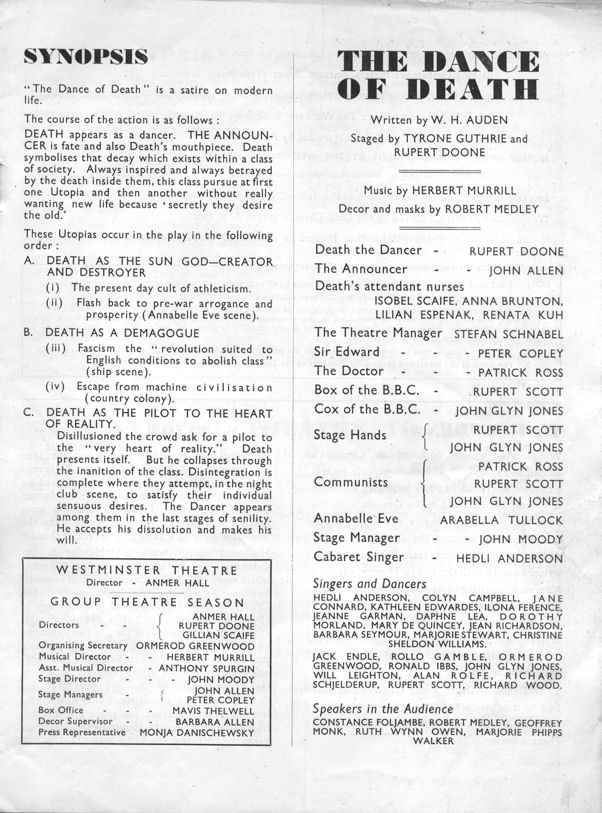
The programme from the Group Theatre’s production of Auden’s verse drama The Dance of Death (1933) contains a synopsis written by Auden himself. In retrospect it seems pretty clear that the “satire on modern life” included satire on the earnest Marxists who populated the Group Theatre productions. After all, one passage near the end includes these lines, sung to the tune of Mendelssohn’s Wedding March:
Oh, Mr Marx you've gatheredHowever, at the time this seems not to have been noted as irony.All the material facts;
You know the economic
Reasons for our acts.
(Image courtesy of the exceptionally well-prepared Wikipedia page on Auden.)