[caption id=“attachment_14574” align=“aligncenter” width=“500”] Strouzas[/caption]
[caption id=“attachment_14572” align=“aligncenter” width=“600”] Lucille Clerc[/caption]
[caption id=“attachment_14567” align=“aligncenter” width=“643”] Cover for a (second!) Chinese edition of my book The Pleasures of Reading in an Age of Distraction[/caption]
[caption id=“attachment_14564” align=“aligncenter” width=“520”] David Jones, Madonna and Child in the Landscape (1924)[/caption]
Good News for Mac Users
Cabel Sasser, writing about how 2014 went at Panic Software, breaks down November sales by unit sold:

And then by revenue:

Cabel isn’t totally sure what to make of these numbers, but he says that Panic is “less likely to tackle any huge new iOS projects until we get this figured out.”
For me, a Mac user who merely dabbles (almost always grumpily) in iOS, this is great news. For the past few years my fear has been that Mac developers would be seduced by the hope of getting the iOS App Store to promote their app, leading to a Flappy Bird-like killing, and in that hope would neglect to make cool and/or useful Mac apps. But it seems that, for the really classy developers anyway, the Mac is likely to remain the better option for a steady revenue stream.
On the iOS App Store quite dramatically, and to a lesser but still significant extent on the Mac App Store, Apple has a tendency to feature some pretty crappy apps: flashy, ugly, likely to have a short shelf life. See Marco Arment’s second point here:

Moreover, the Mac App Store has been a source of great frustration to some of Apple’s most creative and loyal developers. In the same post I’ve been quoting from, Cabel writes about the decision to pull Panic’s web-development multitool Coda from the App Store:
To be honest, I was pretty nervous to be pulling Coda from the Mac App Store. But when we finally did it, I felt an incredible, almost indescribable sense of relief — mostly because as we began to wrap up bug fix releases, we were able to immediately post them to our customers within minutes of qualifying them. My god. That’s how it should be. There’s just no other way to put it — that’s how you treat your customers well, by reacting quickly and having total control over your destiny. To not be beholden to someone else to do our job feels just fantastic. (Also to not pay someone 30% in exchange for frequent stress is a fine deal.)One of the very oldest Mac apps, and my favorite app in the whole world, BBEdit, will also be yanked from the App Store, for very similar reasons.
So it seems that we have a strange situation here: brilliant developers, makers of extraordinarily useful and innovative software, remain deeply devoted to the Mac as a platform, but feel forced to distance themselves from Apple as a company — because that company seems determined to make it harder for them to sell their best products and serve their customers properly. What a crazy world.
Bonhoeffer and the Song of Songs
This is the text of a lecture I gave several years ago at an American Academy of Religion meeting. I’ve never known what to do with it. Its a purely amateurish effort, and probably not worthy of being published anywhere reputable. But I have often over the years returned to some of the ideas in it, wishing I had the skills and knowledge to develop them further. So I’m posting it here, with a few links in lieu of proper footnotes, just in case anyone finds it interesting.
The most famous of all statements about the Song of Songs was uttered by Rabbi Akiba. It occurs in the Mishnah, in tractate Yadayim, which is concerned with the washing of hands and therefore with what is holy and defiles the hands, so that they must be washed. This leads, curiously but inevitably, into a discussion of the canon of Scripture. Says one rabbi,
All the holy writings defile the hands. Shir ha-Shirim and Qoheleth [Ecclesiastes] defile the hands. Rabbi Yudah said, “Shir ha-Shirim defiles the hands, but Qoheleth was in dispute.” Rabbi Yose said, “Qoheleth does not render unclean the hands, but there is a dispute about the Song of Songs.” … But Rabbi Akiba said, “God forbid! No one in Israel disputed the fact that Shir ha-Shirim defiles the hands, for the entire world does not compare with the day that Shir ha-Shirim was given to Israel. All the writings are holy, but Shir ha-Shirim is holiest of all.” (Midrash Yadayim 3:5)The “writings” to which Akiba refers are, of course, the kethuvim, the Biblical texts other than the Torah and the Prophets. So Akiba is giving the Song of Songs a higher place than, for instance, the Psalms. But his celebration of the Song is contingent upon the understanding that it be interpreted as a poem about the love between Israel and its God. Thus the Tractate Sanhedrin says, “Our Rabbis taught: He who recites a verse of the Song of Songs and treats it as an air [that is, a secular poem], and one who recites a verse at the banqueting table unseasonably, brings evil upon the world. Because the Torah girds itself in sackcloth, and stands before the Holy One, blessed be He, and laments before Him, ‘Sovereign of the Universe! Thy children have made me as a harp upon which they frivolously play.’” This passage suggests that one who treats the Song of Songs as an erotic poem not only insults it, but insults Torah — since in this little story, Torah identifies with the Song: “thy children have made me as a harp.” The relationship between the Song of Songs and Torah is developed both in further rabbinical commentary that associates the Song with the Exodus — one tradition has it that the Song is a transcription of words that passed between Yahweh and Israel at the Red Sea — and in Jewish worship, since the Song is read at Passover. It is within such a context that Akiba and like-minded teachers celebrate the Song; to treat it as something other than a part of the covenant history is to “bring evil upon the world.”
In a June 1944 letter to Eberhard Bethge, Dietrich Bonhoeffer wrote, “While you’re in Italy I shall write to you about the Song of Songs. I must say I should prefer to read it as an ordinary love song, and that is probably the best ‘Christological’ exposition.” This intriguing comment comes right in the middle of the most famous sequence in the letters, in which Bonhoeffer explores the possible avenues for Christian faith in a “world come of age” and in which he so forcefully repudiates a “God of the gaps” and a Christ who comes to “solve our problems.” But it appears that he never wrote the promised letter, so we have to guess what he meant. I want to suggest, first, that we can make a pretty good guess; second, that that guess leads us into productive theological territory; and third, that Bonhoeffer’s provocative idea leads us back to the Song, and to Akiba’s deep concern that it be rightly read.
In short, I am trying to see what happens when I put Akiba and Bonhoeffer in conversation with each other. I think that conversation will lead to the awareness that we are not confined to a simple choice between a literal and an allegorical meaning, and will enable a way of seeing erotic love as a benefit of the Covenant itself.
As I have noted, the immediate context of Bonhoeffer’s comment about the Song of Songs is the great letters of May and June 1944, when he finds opening up before him wholly new possibilities of theology, and indeed of the Christian life — possibilities that emerge from “the question of what Christianity really is, or indeed who Christ really is, for us today” (279). But there is another level of context that matters here just as much, one that leads us back to the Advent season of 1943. At this point Bonhoeffer was still hoping that his release from prison would come soon, perhaps even before Christmas; but that hope was beginning to fade, and in a long letter to Bethge (dated December 18th) he confesses his “homesickness” and “longing” — longing especially (though he does not say so explicitly) for his fiancée Maria. He wishes “above all” to avoid self-pity, but as he thinks of one of the most common Christian ideas used to counsel those who suffer in this world — the Pauline reminder that “this world is not our home” — he has some doubts, not about the truthfulness of the claim (“That is indeed essential”) but about the ways in which we use it. And quickly what emerges is the unfortunate effect such a reminder can have, not so much on the one who suffers, but on the one who (like Bethge) is blessed with freedom and the presence of loved ones.
I believe that we ought so to love and trust God in our lives, and > in all the good things that he sends us, that when the time comes (but > not before!) we may go to him with love, trust, and joy. But, to put > it plainly, for a man in his wife’s arms to be hankering after the > other world is, in mild terms, a piece of bad taste, and not God’s > will. We ought to find and love God in what he actually gives us; if > it pleases him to allow us to enjoy some overwhelming earthly > happiness, we mustn’t try to be more pious than God himself and allow > our happiness to be corrupted by presumption and arrogance, and by > unbridled religious fantasy which is never satisfied with what God > gives… . Everything has its time, and the main thing is that we > keep step with God, and do not keep pressing on a few steps ahead — > nor keep dawdling a step behind. It’s presumptuous to want to have > everything at once — matrimonial bliss, the cross, and the heavenly > Jerusalem, where they neither marry not are given in marriage. “To > everything there is a season.” (168f)This is a fascinating adumbration of an idea that would become his obsession six months later. Its most famous expression goes like this:
Christianity puts us into many different dimensions of life at the > same time; we make room in ourselves, to some extent, for God and the > whole world. We rejoice with those who rejoice, and weep with those > who weep; we are anxious ( — I was again interrupted just then by the > alert, and am now sitting out of doors enjoying the sun —) about our > life, but at the same time we must think about things much more > important to us than life itself… . We have to get people out of > their one-track minds; that is a kind of preparation for faith, or > something that makes faith possible, although really it’s only faith > itself that can make possible a multi-dimensional life, and so enable > us to keep this Whitsuntide, too, in spite of the alarms… . God is > no stop-gap; he must be recognized at the centre of life, not when we > are at the end of our resources; it is his will to be recognised in > life, and not only when death comes; in health and vigour, and not > only in suffering; in our activities, and not only in sin.But now we get to the heart of the matter, for the very next sentences Bonhoeffer writes are these: “The ground for this lies in the revelation of God in Jesus Christ. He is the centre of life, and he certainly didn’t ‘come’ to answer our unsolved problems. From the centre of life certain questions, and their answers, are seen to be wholly irrelevant… . In Christ there are no ‘Christian problems.’ That is, only in the encompassing and all-illuminating light of the Christ-event does this embrace of all life make sense. It is, strangely enough, the death and resurrection of Jesus Christ that make it “bad taste” for a man to long for the transcendent when in his wife’s arms. And this gives us a strong indication of why Bonhoeffer thinks the literal interpretation of the Song of Songs is the most Christological one. But of course the logic here is not obvious — at least not to me — so let’s back up a bit and look at the more specifically theological context in which Bonhoeffer makes these claims.
This whole section of the letters is scattered with references to two theologians, Bultmann and Barth, both of whom he sees as deficient. Bultmann’s problem is that his theology is liberal rather than radical: he merely “abridges the Gospel,” to which Bonhoeffer contrasts his own project: “I’m trying to think theologically” (285). There is just too much of life — and indeed of theology itself — which Bultmann gives up on having anything theological to say about. Barth, by contrast — and it’s significant that Bonhoeffer doesn’t seem, here at least, to think any more highly of Barth than of Bultmann — stresses a “like it or lump it” “positivism of revelation” (286), in which the doctrines of Christian theology are simply to be received rather than integrated with the world of human thought and experience. Charles Marsh, in his book Reclaiming Dietrich Bonhoeffer, gets to the heart of the matter — at least as it affects my argument here — by noting that, in Bonhoeffer’s account, “for Barth the world is ultimately depleted by revelation” (21).
This “depletion” of the world by revelation is something that can be seen in Barth’s treatment of Agape and Eros in the Church Dogmatics (IV/2). Though Barth is willing to say that “this other love” — that is, eros — “can claim some of the greatest figures in the history of the human spirit,” he makes this acknowledgment only in order to deny it any theological significance whatsoever. When he writes, “Nor can Christian love be fused with this other to form a higher synthesis,” he is referring to Anders Nygren’s book Agape and Eros, which explores the “caritas synthesis” which medieval thinkers and poets achieved — often by means of a version of the Platonic scala amoris, which one can see a refined, subtle form of in Dante and a coarse, simplistic form of in the “romantic theology” of C. S. Lewis’s friend Charles Williams. Whether refined or coarse, Barth is having none of it. “Man loves either in one way or the other, and he has to choose whether it is to be in the one way or the other. If in fact he loves in both ways at the same time, as is often the case even with the Christian, this can only be with … disruption, [a] “falling out”… . There can be only conflict and not compromise between Christian love and this other.” Indeed, Barth goes so far as to say that “erotic love is a denial of humanity.”
Now, to a certain extent Barth and Bonhoeffer — who were of course not talking to each other, about this issue anyway — are talking at cross purposes here. Barth can condemn eros so thoroughly because of the way he has chosen to define it: as either a needy, possessive, grasping desire or an idolatry of the beloved (Barth gets positively Platonic here, in an excursus on the way that eros makes eidola). For Barth, the only genuine alternative to such sinful practices is agape’s “regard for the other.” As Barth so often tells us, on such a wide range of subjects, one must simply make one’s choice. But Bonhoeffer does not define erotic love in Barth’s way — or rather, Bonhoeffer is willing to consider a wider range of possible choice. No doubt he would reject eros as defined by Barth as firmly as Barth himself does. But is the embrace of a loving couple — especially a Christian loving couple — an illustration of that eros? No doubt it can be, but is it necessarily so? And if not, is it then simply an example of agape’s “regard for the other”? If so, it is a very peculiar kind of “regard,” and one which (so Church and Scripture teach us) it is inadvisable to practice indiscriminately. For Bonhoeffer, then, Barth’s position is oddly similar to Bultmann’s, in that he too was, however inadvertently, giving up on having anything theological to say about something, that something being married love. As a Tom Stoppard character says, “It is the third thing when you thought there were only two.” By insisting on there just being two, Barth depletes the world.
But it is important to insist that in his comments on sexual or romantic love Bonhoeffer is clearly not trying to resurrect the old “caritas synthesis,” or to construct a ladder by which we may ascend from erotic love to holy love. Nor is he seeking general approval for sexual desire and experience. Instead, he is trying to imagine a more radical possibility: that through Christ and in Christ erotic love is justified as itself, not requiring a transformation into something “holy.” On the other hand, neither is such love immune from the need to be justified. The canonical place of the Song of Songs would, on this account, be as a witness to the power of God in Christ to dwell “at the centre of life.” Bonhoeffer later says that “the difference between the Christian hope of the resurrection and the mythological hope is that the former sends a man back to his life on earth in a wholly new way… . he must drink the earthly cup to the dregs, and only in his doing so is the crucified and risen Lord with him, and he crucified and risen with Christ” (337). This is true — and here is Bonhoeffer at his most radical and provocative — even when “the earthly cup” is sweet to the taste. “The world must not be prematurely written off,” he writes, and to write it off while in the midst of great pleasure is not only in bad taste, not only an attempt to be “more pious than God himself,” but a deep perversity.
Just how it happens that the Christ-event justifies marital love as itself — and therefore how, precisely, the literal interpretation of the Song of Songs is the most Christological one — Bonhoeffer never got the chance to explain. I do not think I can explain it either; but the heart of it must lie in focusing on Christ’s death and resurrection not primarily as the means by which sinners are justified, but rather as the beginning of the redemption of the whole of Creation from its bondage, the beginning of its reclaiming of its original glory.
(In his Ethics Bonhoeffer protests against the insistence in Catholic teaching that when it is inadvisable for a married couple to have children, they must abstain from sex altogether rather than use artificial means of birth control. Bonhoeffer’s concern is that this takes away the “bodily union” which is one of the chief features and purposes of marriage. This teaching avoids the “unnatural act of preventing conception” only by instituting the “unnatural state of a marriage without bodily union.” The invocation of the category of the “natural” is of particular interest here, since it invokes the possibility of a redeemed Creation operating within its sovereign sphere and according to its own self-governance. If unpacked this notion might be key to understanding his point about the Song.)
But I will leave that speculative line of thought and turn back, this time a little more attentively, to the Song of Songs itself. Because the logic of Bonhoeffer’s point in his letter, if I have discerned it rightly, enables us to see certain features of that text in a new way, and perhaps even enables us to offer some assistance (if we may be so bold) to Rabbi Akiba.
One thing that strikes the “literary” reader of the Song is that its images of beauty and excellence so often come from the local landscape — that is, the landscape specific to the land of Israel. I am not thinking of the frequent references to grapes, apples, gazelles and doves — it is hardly noteworthy that a poet’s images of the natural world would be taken largely from the flora and fauna he sees every day. It is the incessant geographical references that are noteworthy: the “tents of Kedar” (1:5), the “vineyards of Engedi” (1:14), the famous rose (or crocus) of Sharon (2:1), the “slopes of Gilead” (4:1), the “tower of David” (4:4), the mountains of Lebanon, Amana, Senir, Hermon (4:8). The beloved woman is “beautiful as Tirzah, … comely as Jerusalem” (6:4). In the most extended passage of this kind, in Chapter 7, we hear of this woman,
Your eyes are pools in Heshbon, by the gate of Bath-rabbim. Your nose is like a tower of Lebanon, overlooking Damascus. Your head crowns you like Carmel, and your flowing locks are like purple; a king is held captive in the tresses.As Francis Landy points out, this passage “is in fact a single extended metaphor of the Beloved as the kingdom… . The face evokes peripheries: Lebanon is in the north, Heshbon on the east, Carmel in the west. The landscapes complement one another: the mountain fastness matches the city on the edge of the desert and promontory overlooking the sea. Each suggests power and prosperity in its dealings with the outside world: the tower of Lebanon watches over Damascus; the ‘gate of the many’ in Heshbon is the focus of busy traffic; the sea is dominated by the Carmel, and from it is extracted the royal purple” (314–15).
This is the sort of passage that seems strongly to invite an allegorical reading: the beloved woman does not just remind us of Israel, she is Israel. It is as though the land itself has been animated, transformed into a beautiful reclining woman, so that every feature of the landscape becomes is given life as a part of her body. It is interesting in this context to note that, according to Elsie Stern, “the Song was a popular biblical text for the early Zionist movement” (introduction to the Tanakh translation). Look at 4:11: “honey and milk are under thy tongue,” a clear reminder of Palestine as the land of milk and honey. (A similar strategy is used by James Joyce in Finnegans Wake, where the sleeper whose dreaming thoughts comprise the book is also figured as a reclining giant who is the living cityscape of Dublin at night.) But despite the temptations to read the relentless geographical troping of the poem in this allegorical way, allegory is not the only way to take full cognizance of the phenomenon.
As Robert Alter notes, “the imagery of the Songs of Songs is a curious mixture of pastoral, urban, and regal allusions.” I want to suggest that this division of metaphorical labor is highly purposeful. The pastoral images indicate Israel as the land given to the people, the urban images the building-up of that land by the people (especially in Jerusalem), and the regal ones the rise of Israel to full nationhood under the kingship of David and his son Solomon, who is of course repeatedly invoked in the poem. This threefold edifice of tropes points us always to the assured beauty of the Promised Land, as given by Yahweh and as built up by the children of Israel; the beauty of the beloved is derivative of that. Or, to put it another way, the beauty of Israel is what enables the lovers to live in such a way that they can discern and enjoy each other’s beauty.
I find this idea appealing in part because it is so essential to another great work of antiquity, Homer’s Iliad. In the speeches of the Trojan warrior Hector and his wife Andromache a clear message emerges, one that is extended and confirmed by the detailed description in Book 18 of the great shield that the smith-god Hephaestos makes for Achilles. The message is that the safety and security of the city guarantee the blessings and pleasures of its citizens. Andromache laments her husband’s entry into the battle because she fears that the city is doomed and therefore if he defends it he too will be doomed; and Hector laments the imminent destruction of Troy chiefly because it means the end of the life he shares with his beloved wife. So in the Iliad — just as in the Song of Songs — there is an intimate connection between the public world of the city, or the homeland, and the familial and private loves of the people who live in it. In a world in which civilization is hard-earned and fragile, it is more greatly valued as the guarantor of an environment in which love can be cultivated.
The difference between the two poems, in this respect, is that for Hector and Andromache the value of Troy is purely instrumental — that is, it matters only insofar as it provides for the private joy of their marriage. Hektor says quite bluntly that it is not the destruction of Troy itself that grieves him nearly as much as the fate of Andromakhe, who he knows will be taken into slavery. In the Song of Songs, by contrast, though the security and power of Israel make the lovers’ wooing possible, the land is by no means merely instrumental to the realm of private joy. (“If I forget thee, O Jerusalem… .”) Instead, as I have already indicated, it is the greatness of Israel that is certain, and, because it is certain, provides the anchor of metaphorical value for the descriptions of the beloved.
It is clear that Rabbi Akiba’s praise of the Song as a celebration of the covenant love of Yahweh and Israel, and the Sanhedrin’s general opposition to a “literal” reading as a nearly blasphemous failure to acknowledge that meaning, assume a necessary opposition of the literal (which is, as St. Paul would later put it, “carnal”) and the allegorical or “spiritual.” But if we are right to see the health and strength of the nation of Israel as the guarantor of a social space in which erotic love can be safely pursued, then the literal reading can also be a covenantal and therefore “spiritual” one.
And this way of reading the poem would be, I think, still more potent in the context that Bonhoeffer points us towards, the Christian one in which not the land of Israel but the cross of Christ is the guarantor of value for the realm of erotic love as expressed in Christian marriage. In this account, the Song of Songs celebrates God’s power in Christ to restore relationship, to redeem Creation in such a way that the love which Adam and Eve shared in Eden can be continually imagined and made the object of human striving. In the Cross of Christ lies the power to restore the Edenic conditions of sexual, marital love, if not in full present actuality, at least in hopeful anticipation. The love celebrated in the Song of Songs is a memory of Eden and an implied teleology for every marriage, grounded in the transforming power of the Gospel. In contrast to Rabbi Akiba and the Sanhedrin, I think we must say that this is a “spiritual” meaning which is only liberated for our use by a “literal” reading. It is in this sense that Bonhoeffer was surely right to say that the literal interpretation of the Song of Songs is the most truly Christological one.
Selling Books
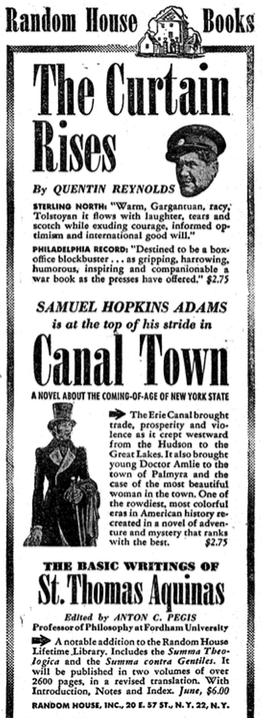
An interesting trio of books for Random House to be advertising in the April 24, 1944 issue of The New Republic — in the margin, by the way, of an extremely negative review of two C. S. Lewis books, written by Alistair Cooke, later of Masterpiece Theater fame. Also, I plan to find a use for the phrase “Tolstoyan it flows with laughter, tears and scotch.”
Changes
I don’t do New Year’s resolutions, but in between semesters I always take some time to re-evaluate how I’m spending my time, and over the last few weeks I’ve started implementing some fairly significant changes — especially in my online life.
Actually, I got a start on these changes a few months ago, when I said goodbye to Big Twitter. (I do visit from time to time but I don’t live there any more.) And then just in the past few days I set aside my Tumblr, which I had been faithfully updating for almost eight years. (My Gospel of the Trees site and my Book of Common Prayer tumblelog are effectively complete and have been for some time. I still like them, though.)
These two environments, Twitter and Tumblr, have something important in common, which they share with most social media sites: they invite you to measure people’s response to you. For many people this probably means nothing, but on me it has always had an effect. Over the years I developed a sense of how many RTs a tweet was likely to earn, how many reblogs or likes a Tumblr post would receive – and I couldn’t help checking to see if my guesses were right. I never really cared anything about numbers of followers, and for a long time I think I covertly prided myself on that; but eventually I came to understand that I wanted my followers, however many there happened to be, to notice what I was saying and to acknowledge my wit or wisdom in the currency of RTs and faves. And over time I believe that desire shaped what I said, what I thought – what I noticed. I think it dulled my brain. I think it distracted me from the pursuit of more difficult, challenging ideas that don’t readily fit into the molds of social media.
I started thinking seriously about these matters about a year ago, but after what was frankly a terrible 2014, marked by serious illness in my whole family and the death of my beloved father-in-law, I’m just now getting around to implementing what even then I knew I should do.
- I’ll use Big Twitter (i.e. my public account) primarily for links and announcements.
- I’ll use private Twitter to talk with my friends and family.
- Instead of using Tumblr to create a commonplace book of fun images and snappy quotes, I’ll keep track of everything that interests me online on Pinboard, and much of it will be public. (This relieves me of a decision that I have had to make several times a day for the past few years: Does this go on Tumblr or Pinboard?)
- Instead of using Tumblr to make brief and superficial commentary on whatever is current, I’ll use this space to write less frequently but at greater length on issues that have more lasting significance. I think often of a comment by the great computer scientist Donald Knuth about email: “Email is a wonderful thing for people whose role in life is to be on top of things. But not for me; my role is to be on the bottom of things.” Tumblr and Big Twitter were for me ways of staying on top of things, but while I am no Donald Knuth, I need to get closer to the bottom of things than I have been for the past few years. This here site is where I’ll be doing that online.
- I'll be reading some books along with select groups of people and discussing them either in-person or online. (Amazing how that kind of environment tends to produce both accountability and coherent conversations.)
- I will of course continue to work on my current book project, to write for Books & Culture, possibly to get back to writing for the Atlantic.
Assignment: Commentary and Anthology
Just in case anyone is interested, here’s a draft of something I’ll be handing out to my students in a couple of weeks.
In most of your courses in the humanities, you’re asked to write papers — probably thesis papers, in which you make an argument that you support with evidence from the text under consideration and from critical or contextual studies. It’s a reasonable task to ask students to perform; Lord knows I have asked it of enough students in my thirty-plus years of teaching. But it’s not the only appropriate assignment, and it has certain shortcomings.
Chief among those, I think, is its tendency to encourage people to get through the task of reading as quickly as possible in order to get on to the really important job of articulating and defending your own position. But reading is a task that deserves more care — especially when the texts involved are challenging, difficult, and major.
In a brilliant and important book, Religious Reading, Paul Griffiths demonstrates that in most of the great religious traditions — Hinduism, Buddhism, Islam, Judaism, Christianity — there are genres of reading, that is, kinds of texts in which one records one’s reading. The two major genres, according to Griffiths, are commentary and anthology. To people trained in the habits of mind associated with the thesis paper, these genres seem passive and deferential — especially when applied to non-religious texts. But those genres are not passive at all, and insofar as they are deferential that deference may be quite appropriate. After all, many non-religious texts, especially when they arise in cultures distant from us in time or space or both, pose great difficulties for the reader. Allusions will escape us, social and cultural contexts will be unknown to us, subtleties of argument or exposition or characterization or poetic language will leave us scratching our heads. To seek to identify and then resolve those difficulties — these are highly demanding intellectual tasks, and will not allow passivity, though, as they reveal the complexities that animate really significant works, they may promote deference.
In our class, we will be using a wonderful tool called CommentPress to create an online anthology of writings and to comment on those writings. You will not write papers in this class; instead, you will help to create the anthology, and you will comment on texts you bring to our attention and on the texts others bring. By the end of the term, we will have created a body of annotated readings that, taken as a whole, will significantly illuminate our subject.
So each week, you will do each of the following:
- Post one passage from one of our assigned texts (either copying and pasting from an online public-domain text, or typing in a passage from one of your books);
- Make a comment that offers some helpful contextual information about the passage (something about the text’s author, or the historical moment of its composition, or the culture within which it was produced, or a work that it echoes or responds to), preferably with a link to your source;
- Make a longer comment (perhaps 150-250 words or so) that offers an interpretation of a particular passage in the text, probably drawing on existing scholarly work;
- Respond to someone else’s comment by disagreeing with it, amplifying and extending it, or providing further relevant information.
You will also need to familiarize yourself with the CommentPress software, including the proper ways to format text and insert links. Don’t worry: I’ll show you in class how it’s done, and will be happy to answer questions later.
So this will be different than you’re used to. But different is good. Or at least, it can be!
signing off
A note to the few who read this tumblelog: I don’t expect to be posting here any more. It’s been fun — for almost eight years! — but it’s time for me to think longer and slower thoughts, and that will be easier to do if I get out of the habit of posting every little cute or funny or intriguing thing I come across online.
My hope is that in 2015 — in addition to working on my ever-expanding Big Research Project — I will write less often but at greater length, probably on my home blog, though possibly elsewhere if someone wants to pay me.
For updates on these emerging plans, check Twitter. Also, almost everything I read gets recorded on Pinboard.
Ciao!