

[gallery] architectural-review:
Architectural fantasy of the decaying building of the Cardiff Coal Exchange

[gallery columns=“1” size=“full” ids=“18852”]
drawingarchitecture: Nicole Marple, 2014, Mixed Media.

Yahoo shuts down ... Yahoo

It doesn’t look like much, but that little yellow icon … for several years in the early days of the Web, the sight of it would give me heart palpitations. They found something new! Whatever might it be?? Farewell, Yahoo Directory. We remember you with great affection.
Progress Report: Continued Product Focus
Progress Report: Continued Product Focus
By Jay Rossiter, SVP, Cloud Platform GroupAt Yahoo, focus is an important part of accomplishing our mission: to make the world’s daily habits more entertaining and inspiring. To achieve this focus, we have sunset more than 60 products and services over the past two years, and redirected those…
I am genuinely, not in the least ironically, nostalgic about the end of an internet era. I remember those first years on the Web when the Yahoo Directory was the only way to find out what was happening online. There were certain categories in the directory I knew so well that when I logged in and saw that yellow “New!” image next to a category I almost got heart palpitations.
Farewell, Yahoo Directory. Even though I have used you in fifteen years, you served us well in our hour of need. We will always remember you with great affection.
to know as I am known (by Apple)
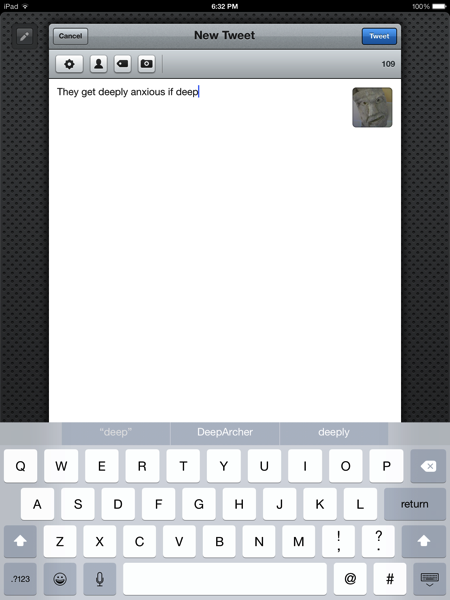
As you type, you’ll see choices of words or phrases you’d probably type next, based on your past conversations and writing style. iOS 8 takes into account the casual style you might use in Messages and the more formal language you probably use in Mail. It also adjusts based on the person you’re communicating with, because your choice of words is likely more laid back with your spouse than with your boss. Your conversation data is kept only on your device, so it’s always private.

The pundits who say that President Obama has failed to demonstrate leadership have never considered whether the public is capable of following him, or even their own train of thought. The American public is not even capable of not following him in any recognizable way. We might have been dropping bombs in Syria against Assad to the benefit of ISIS a year ago had it not been for the hearty “No” vote in the British Parliament that denied Obama the fig leaf of multilateralism. A democratic people should be bewildered that their president was urging them to join one side of a civil war a year ago, and now joins them to another. But the American people are as responsive to this stimulus as a cattle herd is to the conclusion of a Dostoyevsky novel.Among a people that flatter themselves as democratic, nothing is more gauche than the expectation of democratic exercise. To demand as much is to wander dirty in the streets with a sign saying “Wake up, Sheeple!” So, forget I mentioned it. Fifty more years? No way. But, whatever, sure.
Closely related is the sheer exhaustion of being constantly tapped into in the network. Every tweet I read or write elicits some small (or not so small) emotional reaction: anger, mirth, puzzlement, guilt, anxiety, frustration. I’ve tried to prune my following list so that when I do find myself engaging in a genuine way, it’s with a person I genuinely want to engage with. But there’s a limit to how much pruning can be done, when unfollowing a real-life friend is the online equivalent of punting his puppy across the room. So all day long, I’m in and out of the stream, always reacting to whatever’s coming next. Setting aside the question of how distracting this is when I’m trying to get work done, the fact is that I have a limited capacity for emotional engagement, and the code-switching that’s required when the character of my response is supposed to change every 140 characters only increases this overhead. A life spent on Twitter is a death by a thousand emotional microtransactions. I want to be pouring these energies into my family and my friends and my work.
Students in my history of architecture course are amused to discover that the final exam offers a choice of questions. Some are bone dry (“discuss the development of the monumental staircase from the Renaissance to the nineteenth century, citing examples”) and others deliberately open-ended (“General Meade overslept at Gettysburg and the South has won the Civil War; you are commissioner for the new national capital and must tell us which architects you will choose and what instructions you will give them.”) In offering this whimsical range of options, I do nothing original; my own professors at Haverford College did much the same in their day.But a peculiar thing has happened. When I began teaching twenty-five years ago, almost all students would answer the imaginative question but year in, year out, their numbers dwindled, until almost all now take the dry and dutiful one. Baffled, I tried varying the questions but still the pattern held: Given the choice, each successive cohort preferred to recite tangible facts rather than to arrange them in a speculative and potentially risky structure. In other respects, today’s students are stronger than their predecessors; they are conspicuously more socialized, more personally obliging, and considerably more self-disciplined. To teach them is a joy, but they will risk nothing, not even for one facetious question on a minor exam.