
All
- for 1850–1900: William Faulkner
- for 1900–1950: Ralph Ellison
- for 1950–2025: Albert Murray
The dek here is exactly right: “Tech companies believe in intellectual property, but not yours.” They’ll protect their own IP with every resource available to them and steal ours without a moment’s hesitation.

Today I was dicing a ham steak for risotto and dropped a few pieces on the floor, which Angus vacuumed up. Here he is a minute later, looking for all the world like Oliver Twist in the workhouse: “Please, sir, may I have more?”
Daring Fireball: ‘Your Frustration Is the Product’:
You read two paragraphs and there’s a box that interrupts you. You read another two paragraphs and there’s another interruption. All the way until the end of the article. We’re visiting their website to read a f***ing article. If we wanted to watch videos, we’d be on YouTube. It’s like going to restaurant, ordering a cheeseburger, and they send a marching band to your table to play trumpets right in your ear and squirt you with a water pistol.
No print publication on the planet does this. The print editions of the very same publications — The New York Times, The Guardian, The Wall Street Journal, The Atlantic, The New Yorker — don’t do anything like this. The print edition of The New Yorker could not possibly be more respectful of both the reader’s attention and the sanctity of the prose they publish. But read an article on their website and you get autoplaying videos interspersed between random paragraphs. And the videos have nothing to do with the article you’re reading. I mean, we should be so lucky if every website were as respectfully designed as The New Yorker’s, but even their website — comparatively speaking, one of the “good ones” — shows only a fraction of the respect for the reader that their print edition does.
This is why my primary use for chatbots is searching the web — getting the information I need without having to traverse ad after ad, video after video, popup after popup. The periodicals I value the most — the Economist, the London Review of Books, the Times Literary Supplement — I subscribe to in print. Print resists enshittification; the web embraces it.

Richard Beer, Tresham’s Triangular Lodge (1971)
The Last Quiet Thing | Terry Godier:
What if the exhaustion everybody feels isn't a moral failure but the completely rational response to being made responsible for an ecosystem of objects that never stop asking?
We concluded that the public has a deep interest in understanding the identity and career of a figure with his profound and enduring influence on culture, the art industry and international political discourse. In so doing, we applied the same principle Reuters uses everywhere. The people and institutions who seek to shape social and political discourse are subject to scrutiny, accountability, and, sometimes, unmasking. Banksy’s anonymity – a deliberate, public-facing, and profitable feature of his work – has enabled him to operate without such transparency.
The idea that an artist, like a government agency, cannot be allowed to “operate without transparency” is ludicrous. This is idle curiosity masquerading as social responsibility.
This is a worst-case scenario: you work faster and harder, but mainly on shallow, mentally taxing tasks (because of all the context shifting they require) that only indirectly help the bottom line compared to harder efforts.
It’s not quite clear why AI tools are having this impact. One tantalizing clue, however, comes from Berkeley professor Aruna Ranganathan, who is quoted in the article saying: “AI makes additional tasks feel easy and accessible, creating a sense of momentum.”
This points toward a pattern similar to what happened when email first arrived. It was undeniably true that sending emails was more efficient than wrangling fax machines and voicemail. But once workers gained access to low-friction communication, they transformed their days into a furious flurry of back-and-forth messaging that felt “productive” in the abstract, activity-centric sense of that term, but ultimately hurt almost every other aspect of their jobs and made everyone miserable.
I’m increasingly inclined to believe that we’ll soon see a Great Sorting with regard at AI at work: coders and scammers will love it, everyone else will hate it.
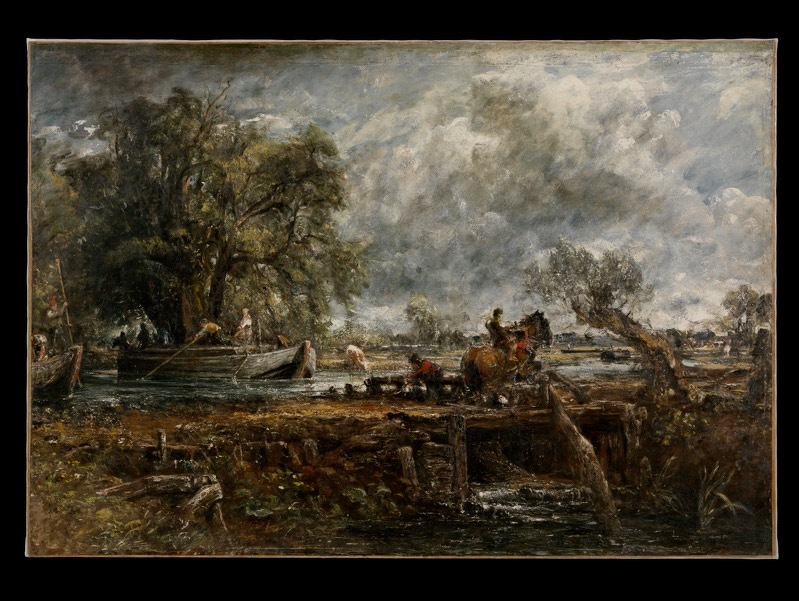
A wonderful essay on Constable’s The Leaping Horse and … other matters.
I’m in The Dispatch this morning on Christopher Beha’s new book on unbelief, belief, and skepticism. And, I am told, if you use the promo code JACOBS at checkout you can get 15% off an annual Dispatch subscription.
Novelists who help us think theologically about this country’s racial history:
These are people to read after you’ve read the ones I name in my previous post, to see what got left out.