
All
Mark Humphries: “To my mind, the traditional research paper as a tool of differential assessment is now dead. And I think it should be left to rest in peace.” I believe this judgment is correct.
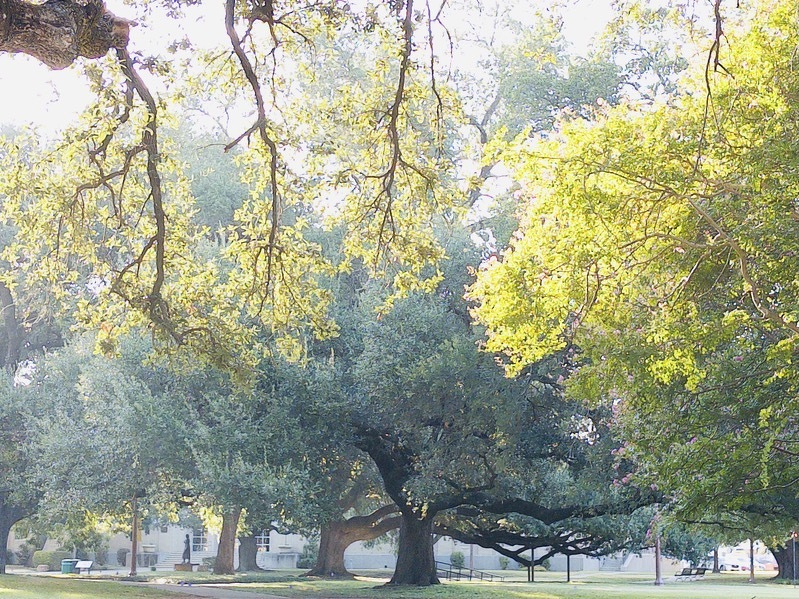
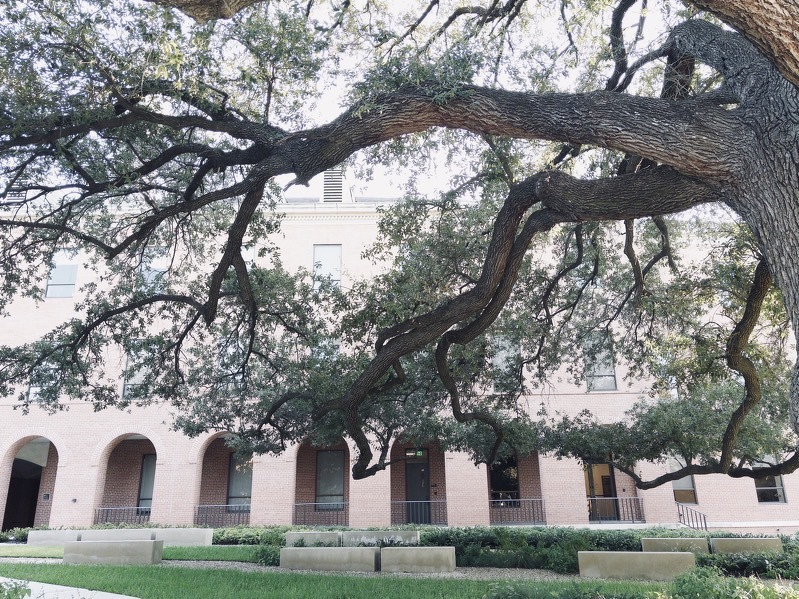
Morning on campus.
The corrected and slightly improved paperback version of my critical edition of Auden’s The Shield of Achilles is now available. I really do think it’s his masterpiece and highly recommend it to you. Back when the first edition came out I wrote a brief essay on it for the PUP website.
Currently listening: Count 'Em 88, by the Ahmad Jamal Trio. Can you dig it? I knew that you could. ♫
Oxford reprinted the anthology in hard covers until the mid-1960s, then issued it in paperback in 1973, a few weeks before Auden's death, under the title W.H. Auden's Oxford Book of Light Verse, as if to signal that it was more of a personal selection than one that came with the authority of its publisher. Oxford also commissioned Kingsley Amis to compile a New Oxford Book of Light Verse, which appeared in 1978. This collection of undemandingly amusing verse (about half the length of Auden's) was effectively the book that Auden's disappointed reviewers had hoped to see in 1938. In his introduction Amis approvingly echoed Charles Dibdin, who had written in a preface in 1825: "To raise a good-natured smile was the major part of this work written." Amis succeeded in this purpose, partly by devoting one of the largest sections of the anthology to Auden, who received as many pages as Lewis Carroll did, and whose share of the book was smaller only than Lord Byron's. Amis's anthology is consistently amusing, but Auden's, perhaps more than any other anthology of English poetry, manages to be amusing, moving, instructive, outrageous, and profound.
This is exactly right. It may be my favorite anthology of anything.
Currently listening: John Hiatt, Crossing Muddy Waters. Haven’t listened to this in years, and am glad to be reconnected with it. Almost every song a banger. ♫
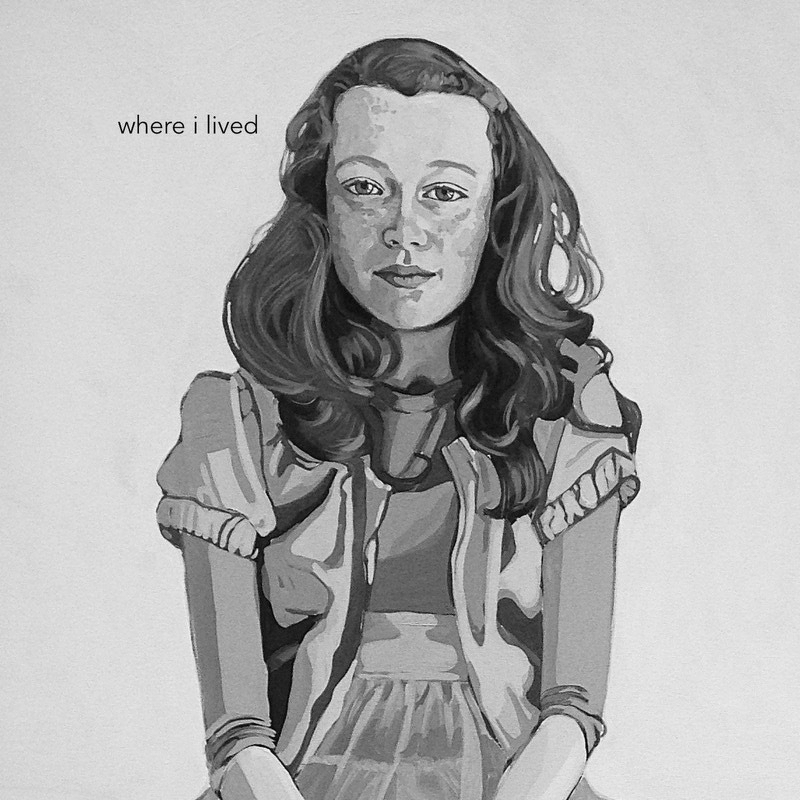
Currently listening: Claire Holley, Where I Lived. What a superb record. Now, Claire is an old friend, and I listened to this when it came out some months ago — but I didn’t really hear it. My recently chaotic life had to settle down a bit before there was enough silence inside me to let this music in. The songs are beautifully arranged and recorded, and the whole mood is meditative, reflective, evocative. But above all these are wonderful songs, songs that often go (lyrically and harmonically) in directions you don’t expect but that always in the end come sweetly home. ♫
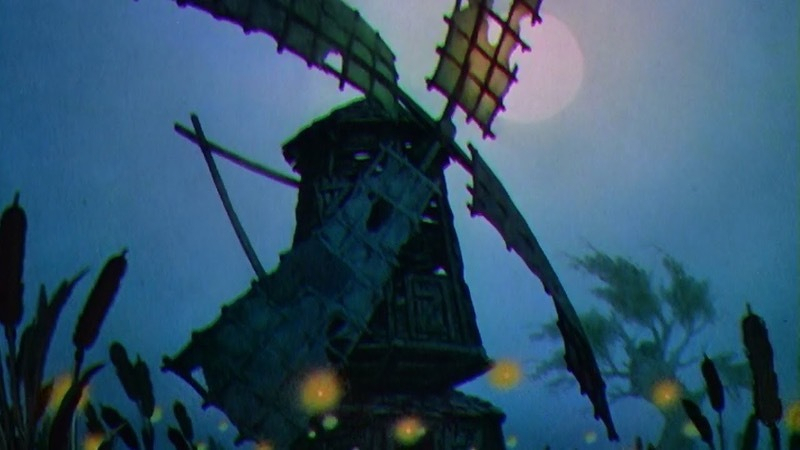
Disney was an early adopter of a then-struggling technology called Technicolor: you can see it in the landmark shorts “The Three Little Pigs” (1933) and “The Grasshopper and the Ants” (1935). But while the artwork and animation in those films are first-rate by the standards of the time, they haven’t aged very well. Contrast them to “The Old Mill” (1937) — which looks gorgeous even today. What happened? The animators were working on the first animated feature, Snow White and the Seven Dwarfs, and they were learning on the job at an astonishing rate. “The Old Mill” appeared just six weeks before Snow White; it was a harbinger.
I don’t know how many American colleges and universities will exist in ten years. Probably fewer than now, but then a little right-sizing has made sense for awhile, and would likely increase rather than decrease the health of the system. The ones that keep existing, which is to say most of them, will go on doing what they’ve always done, which is to supply the external scaffolding that the vast majority of human beings require in order to learn anything they don’t already want to learn: deadlines, grades, embarrassment in front of peers, the looming presence of a teacher who will notice…. That scaffolding is the product and always has been. The lectures are incidental, the textbooks are incidental, and the personalized AI tutor will turn out to be incidental too. What is not incidental is the social and institutional pressure that compels an ordinary late adolescent to sit in a room and slog through the Federalist Papers when every fiber of their being would rather be doing anything else. Maybe we can’t make young people feel that pressure in a meaningful way anymore. Maybe. But that just means that our whole society is doomed anyway, and ChatGPT is not going to be able to fix it.
A great post by Freddie, who is one of our best cultural critics: he writes excellent sentences and has a superbly well-tuned BS detector.
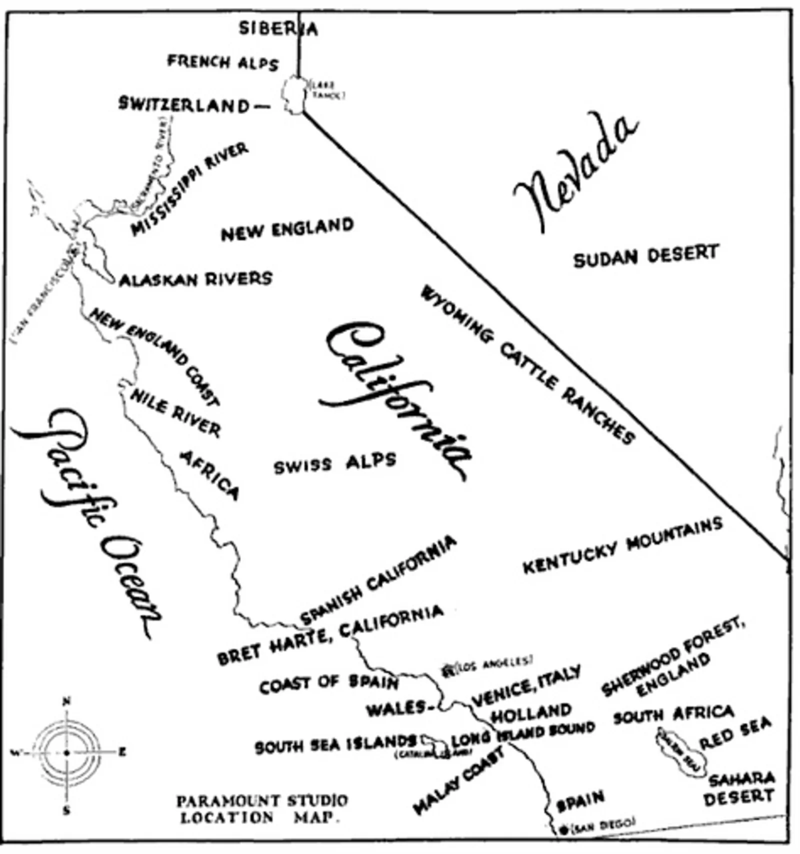
Via Peter Atwood, a map made by Paramount Studios in 1927 to show directors and producers that they didn’t need to film in exotic locations: California and Nevada offered all the necessary exoticism! (I’d like to get a closer look, though, at the parts of southeastern California that are supposed to stand in for Sherwood Forest. And at a number of other things, if I’m being honest.)