
All
- What the Norman Empire of Lower Italy and Sicily was
- Who Emperor Frederick II was
- What the Saracenic States were
- What struggle Frederick had with the Papacy
- What “measures” Frederick took, especially “after the year 1231”
- What “Mohammedan usages” are
- What the “cruel and vexatious methods” of Frederick’s tax-collecting were
- In what way the University of Naples “restrict[ed] the freedom of study”
- What Burckhardt means by “the East”
- What “Mohammedan rules” Frederick followed
- Who the Fatimite Caliphs were
- What their “esoteric unbelief” was
- What the nature of Frederick’s “religious inquisition” was
- What heresies he attempted to put down
- Who “the representatives of a free municipal life” were
Known Unknowns
When you’re writing a historical narrative, you can’t explain everything — you have to assume that your audience has a certain level of knowledge. But it’s tricky to establish just what that baseline should be. You don’t want to insult your readers’ intelligence by overexplaining, but you also don’t want to leave them confused.
And as a reader of historical narratives, you want to look for books that set that baseline appropriately for you. (Of course, the same general principle applies when you’re reading anything, from a cookbook to a treatise on mathematics, but I’m focusing on history here.) I find it helpful to have this issue in mind whenever I begin reading a work of history, because if I’m alert, I can know within a few pages whether a given book will work for me.
One of the most famous classics of historical writing is Jacob Burckhardt’s The Civilization of the Renaissance in Italy, first published in 1860. Here is a characteristic passage from the early pages of that book:
The internal condition of the despotically governed States had a memorable counterpart in the Norman Empire of Lower Italy and Sicily, after its transformation by the Emperor Frederick II. Bred amid treason and peril in the neighbourhood of the Saracens, Frederick, the first ruler of the modern type who sat upon a throne, had early accustomed himself to a thoroughly objective treatment of affairs. His acquaintance with the internal condition and administration of the Saracenic States was close and intimate; and the mortal struggle in which he was engaged with the Papacy compelled him, no less than his adversaries, to bring into the field all the resources at his command. Frederick’s measures (especially after the year 1231) are aimed at the complete destruction of the feudal State, at the transformation of the people into a multitude destitute of will and of the means of resistance, but profitable in the utmost degree to the exchequer. He centralized, in a manner hitherto unknown in the West, the whole judicial and political administration. No office was henceforth to be filled by popular election, under penalty of the devastation of the offending district and of the enslavement of its inhabitants. The taxes, based on a comprehensive assessment, and distributed in accordance with Mohammedan usages, were collected by those cruel and vexatious methods without which, it is true, it is impossible to obtain any money from Orientals. Here, in short, we find, not a people, but simply a disciplined multitude of subjects; who were forbidden, for example, to marry out of the country without special permission, and under no circumstances were allowed to study abroad. The University of Naples was the first we know of to restrict the freedom of study, while the East, in these respects at all events, left its youth unfettered. It was after the examples of Mohammedan rules that Frederick traded on his own account in all parts of the Mediterranean, reserving to himself the monopoly of many commodities, and restricting in various ways the commerce of his subjects. The Fatimite Caliphs, with all their esoteric unbelief, were, at least in their earlier history, tolerant of all the differences in the religious faith of their people; Frederick, on the other hand, crowned his system of government by a religious inquisition, which will seem the more reprehensible when we remember that in the persons of the heretics he was persecuting the representatives of a free municipal life.
That’s only part of a paragraph, by the way. Historians wrote long paragraphs in those days.
Here are some of the things that Burckhardt expects that you already know:
Now, I have firm knowledge about a couple of these things and an in-the-ballpark awareness of a few more, but beyond that … the less said, the better. So maybe this book is not for me.
But The Civilization of the Renaissance in Italy is a very important and influential book! Yes, it is. But that doesn’t mean that it’s something I need to read – not until I acquire the requisite knowledge, which, let’s face it, I am not especially likely to do.
To Daniel Moran's question about the reasons for the decline of The Simpsons, I have an answer: There are only so many stories you can tell and jokes you can make about characters who are forbidden to change.
One of the reasons why many historical cycles seem to recur every hundred years, more or less, is that the people who learned the lessons of this mostly forgotten past are dead and gone. We can’t hear their warnings, or benefit from their experience. So we are doomed to repeat their mistakes.
That’s why I’m always fascinated by things that happened almost exactly a century ago. They typically represent a comparable point in the cycle as the one we are currently living through. Yet those earlier events exist just beyond the horizon of our living memory — and thus tell us painful truths that we can only learn from history books.
How will encouraging students to use AI when writing papers in political theory, philosophy, literature, or history deepen learning? I have taught in UChicago’s social sciences core sequence, I have studied the linguistic and analytic capacities of LLMs, and I can say with confidence that there is no use of AI that can “deepen” students’ learning of Plato, Machiavelli, Nietzsche, Marx, and Du Bois over and above an unmediated engagement with the original works. If one wants to deepen students’ understanding of human beings’ most difficult, elevated and important intellectual and artistic achievements, one needs to give instructors the means of demanding that students spend time with the works, alone. Allow professors to require students to spend the time they are nominally already required to dedicate to the course outside the classroom in tech-free reading rooms; shut down the WiFi; scramble the cell signal; send them to weeklong retreats in the deep, dark woods. Whatever.
Failure to do so will mean giving up on mastery in the humanities and humanistic social sciences, and with it, the liberal-arts model of college education itself.
It really is that straightforward. And almost everyone in the American academy has already waved the white flag.
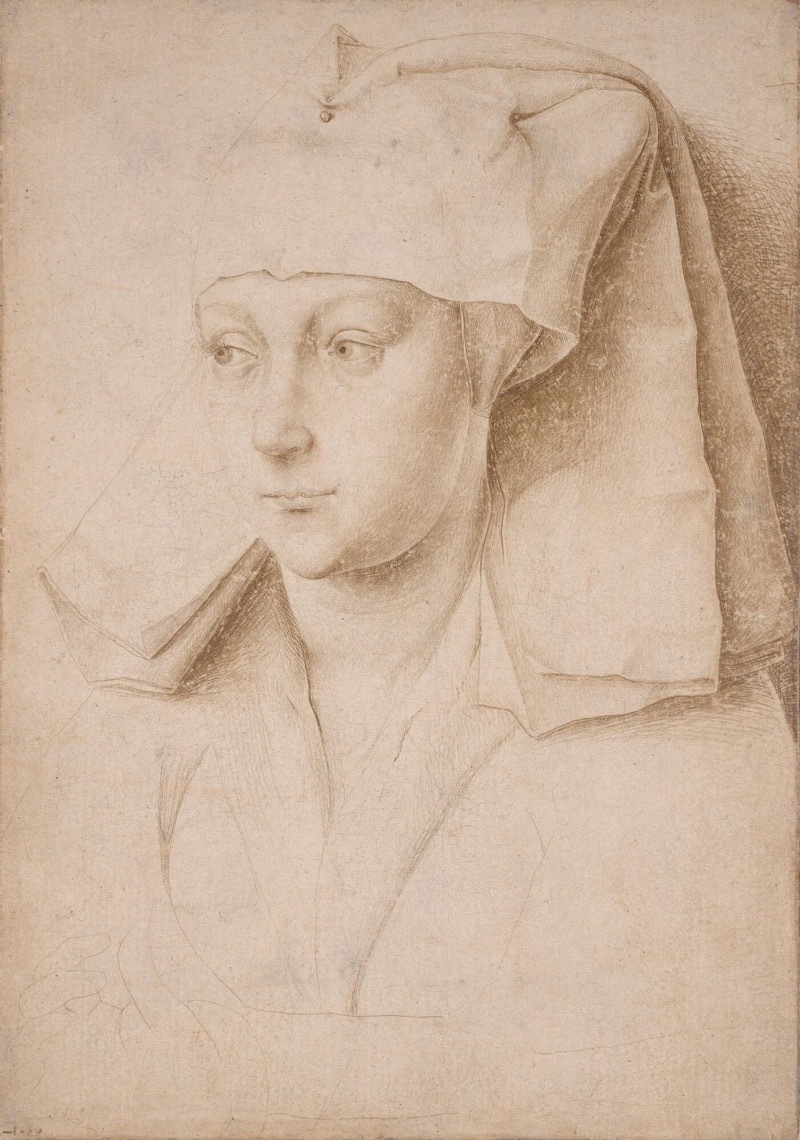
As Horbatsch notes in the catalogue, only a small fraction of 15th-century drawings, the earliest works in the show, survive and all extant examples were made as functional objects in the studio. Drawings were valuable workshop material, handed down from master to disciple. The sole surviving drawing by van der Weyden’s own hand, a silverpoint portrait of a young woman (c.1440), is thought to be a free copy after a lost portrait by Jan van Eyck, and it reveals not only van der Weyden’s practice of copying works by his most famous predecessor but also his subtle use of line and keen observation of texture and facial expression.
Saying goodbye to WordPress. I won’t stop writing longer posts, I’ll just be writing them here and at Cosmos Malick and at a new blog that I am calling, unimaginatively I suppose, Personal History. I’ve begun it by re-posting a few autobiographical pieces from the old WordPress blog, and I will be adding to those over time — largely for my own sake, as I’m trying to make sense of some of the odder things about my life. But since most of my readers are unlikely to be interested in all that, I’ll keep it siloed in its own blog.
It’s all part of the Ayjay Empire, though. As far as I can tell, most of my readers find out what I’m writing through the weekly newsletter/digest and don’t really care to what URL the links go. Nothing will change for you, if you’re one of those people, and little will change for anyone else.

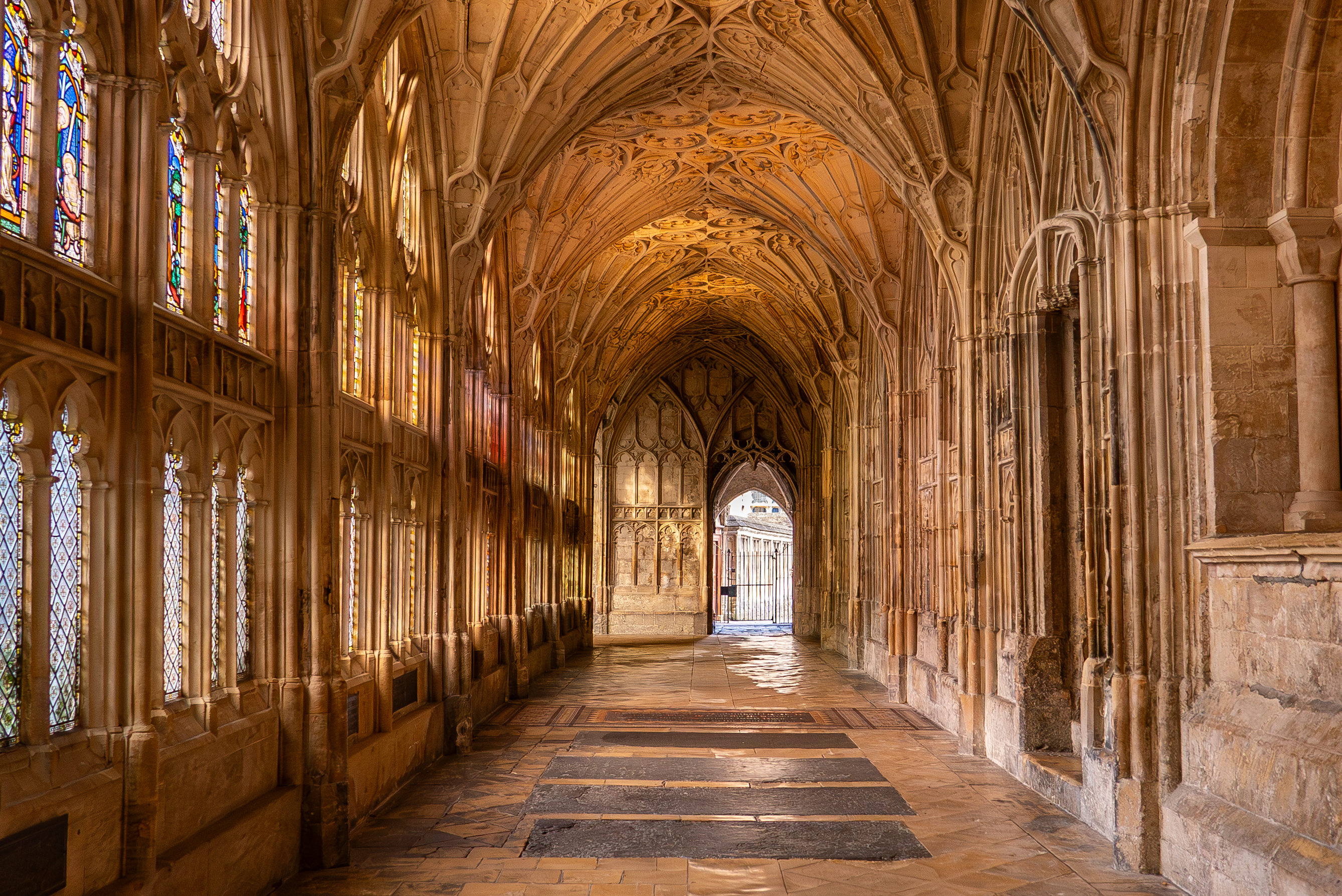
The famous East Cloister of Gloucester Cathedral, with the earliest known example of fan vaulting. Much larger version of the photo here.

In God’s mercy, this design for the rebuilt Coventry Cathedral was not chosen.
The weirdest thing about the current AI-may-kill-us-all stories is the tone of the people who work for the big AI companies. They’re all like, “Hey, our products may well destroy humanity 😂🤪🤷 okay gonna try this new coffee shop, ciao for now” — Still, just as I’ve been asking how AI is going to “cure cancer,” I’d also like to know how it will kill everybody. The promises and the threats are equally abstract.
UPDATE: I see that the WSJ is asking my question.
If I don't post much in the coming days and weeks this is why.