
All

Exotic Botany… (1804), by James Edward Smith
Sidney Lumet, from Making Movies:
The sound editor on Murder on the Orient Express hired the “world’s greatest authority” on train sounds. He brought me the authentic sounds of not only the Orient Express but the Flying Scotsman, the Twentieth Century Limited, every train that had ever achieved any reputation. He worked for six weeks on train sounds only. His greatest moment occurred when, at the beginning of the picture, the train left the station at Istanbul. We had the steam, the bell, the wheels, and he even included an almost inaudible click when the train’s headlight went on. He swore that all the effects were authentic. When we got to the mix (the point at which we put all the sound tracks together), he was bursting with anticipation. For the first time, I heard what an incredible job he’d done. But I had also heard Richard Rodney Bennett’s magnificent music score for the same scene. I knew one would have to go. They couldn’t work together. I turned to Simon. He knew. I said, “Simon, it’s a great job. But, finally, we’ve heard a train leave the station. We’ve never heard a train leave the station in three-quarter time.” He walked out, and we never saw him again.
I feel great sorrow for this man.


Whether or not one enjoys listening to the music of George Crumb, his scores are fabulous fun to read. ♫
One of the longstanding Christmas campaigns of my childhood was to forbid any reference to “Xmas.” Anyone attempting to remove Christ from Christmas was surely of the devil. And yet, Xmas comes from the Greek letter chi (X) which happens to be the first letter of Christos (Χριστός), meaning “Christ.” It turns out that Xmas is a way of honoring Jesus, not extracting him. Furthermore, doesn’t the letter “X” resemble something else? What if it’s a cross? Even if by accident, all signs point to Jesus.
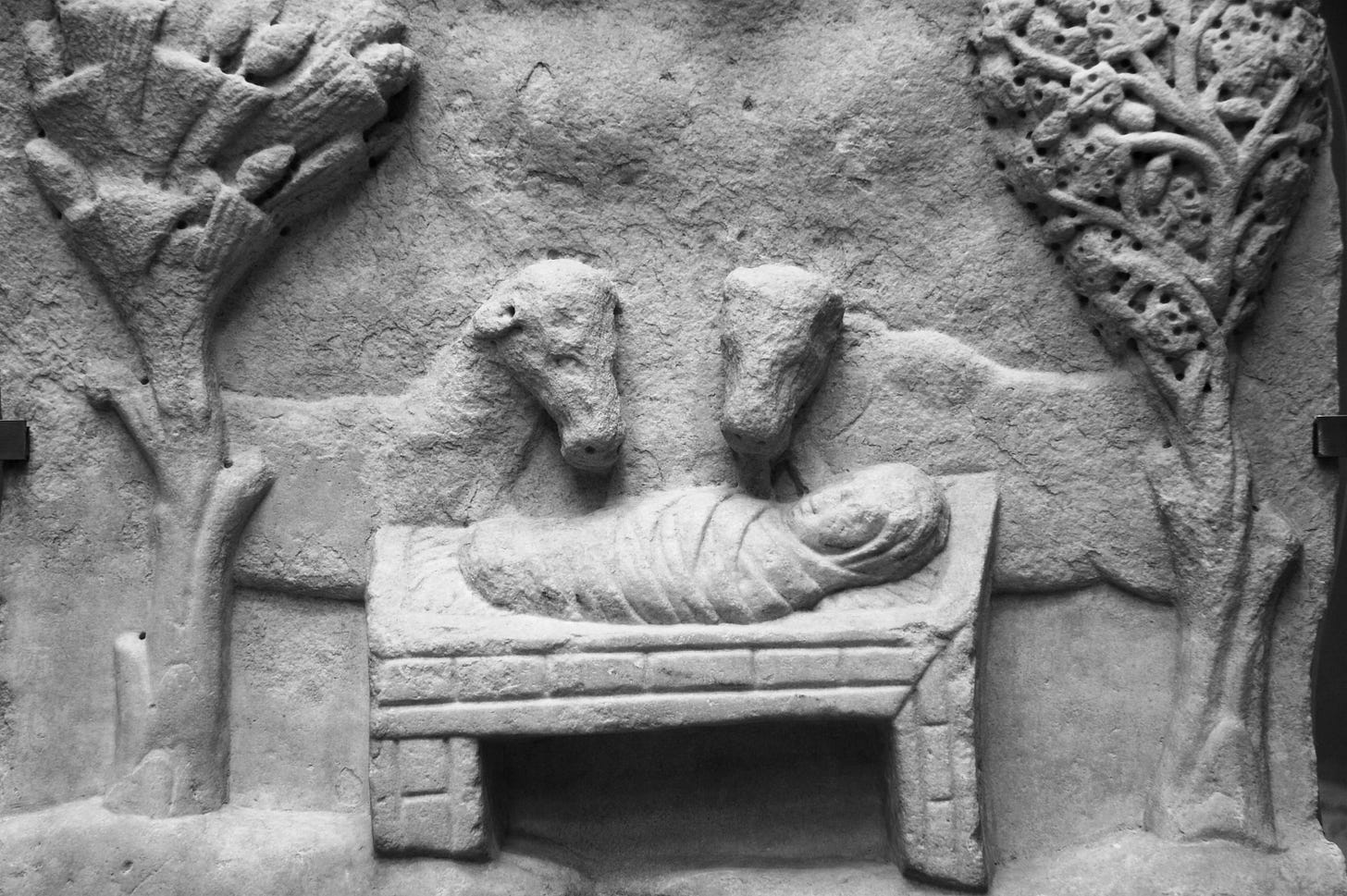
One of the earliest surviving depictions of the Nativity in art, in the Byzantine Museum in Athens, depicts Jesus lying in a manger with the ox and ass and omits any other human figures at all (in fact, there are several early depictions of the infant Christ like this). Christ is here the unmediated Lord of animals, who recognise and adore him. It is easy for us, in a culture that takes a very low view of animals, to dismiss the role of the animals in the Nativity story as sentimental pap; but animals in the Bible are repeatedly endowed with agency.... From Balaam’s ass to the penalties for ‘criminal’ animals laid down in Numbers and Leviticus, the ancient Hebrews clearly did not have a view of animals that sharply divided them from humans in the way we are inclined to do.
Biblical, medieval and folkloric views of animals are challenging to us because, under the influence of the mechanical philosophies of the 17th century and the Theory of Evolution in the 19th century we have convinced ourselves that humans and animals are unbridgeably different in kind. People in the more distant past did not see things this way; animals to them were far closer to being persons than they were to being automata. We have travelled so far in the other direction that any treatment of animals as persons, any suggestion that they too might reverence the Creator, takes on the status of sentimental anthropomorphisation in our culture. We see a depiction of animals kneeling at the crib or the repentance of the Wolf of Gubbio, and our minds leap to Disneyesque talking animals and childish fantasies. But people in ancient Israel and medieval Europe took completely seriously the idea that animals could be held responsible for their actions (at least to some extent) and that they had a duty of reverence to their Creator.
Mark Hurst: 2025 showed why to get off Big Tech. Co-sign.
[George] Herbert desires to comprehend the infinity and timelessness of God in a finite and temporal world. His poetry is a record of a striving after glimpses of the divine in the human sphere. No difficult question is avoided, no agony of mind is shirked, and his work documents every turn of thought and feeling, from exaltation and a sense of union, to anxiety, doubt, despair, revival and eventual resurrection. Despite the complexity of this pursuit, it is chronicled in language of startling clarity. Herbert is an outstanding example from the Anglican tradition of the fact that one can convey the authentic struggle of heart and mind for the presence of God in simple dress, without having to resort to the idiom of the primary school.
The movie’s final scene changes everything, of course, and lifts this darkness. Or so it would seem. I have an artist friend who adores the movie, watches it every year, and cannot watch the ending. I watch it and always cry, now harder than ever. At the age of 66, I can’t tell how much of this reaction comes from the joyous scene itself and how much from its close proximity to the darkness it breaks, from the miracle of reprieve.
Storytelling, with its tricks, its smoothing, cobbling and evading, may be our oldest hack. But if it gives us something we keep needing, it outlives the storyteller and all the décor. For me, the staying power of It’s a Wonderful Life comes from its two gifts. It keeps faith with human goodness and doesn’t pretend the world isn’t broken, that we don’t need help.