
writing time

on the edge
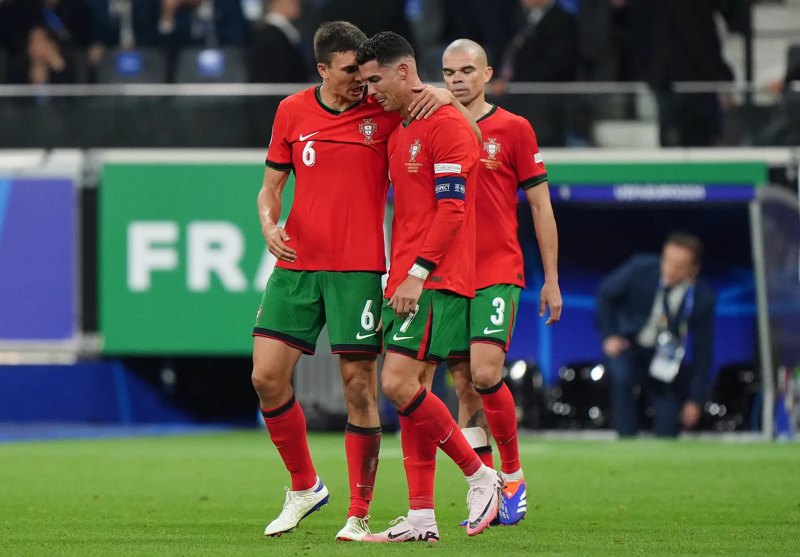
Above you see what I believe was the key moment in today’s match between Portugal and Slovenia. After having a penalty saved, astonishingly, by Jan Oblak, Cristiano Ronaldo collapsed in tears, and I mean collapsed: during the break between the two halves of extra time, his shoulders were shaking, he was inconsolable. Several teammates came up to hug him and pat him on the back, but only Palhinha gave him what he needed, which was a stern pull-up-your-socks talking-to.
Given the excessive deference Portuguese football exhibits towards Ronaldo — manifested today by allowing him to take several terrible free kicks which should have been taken by Bruno Fernandes, with Ronaldo in the box trying to get his head on the ball — Palhinha’s initiative was brave, and it may have saved the match. Without his intervention, would Ronaldo have been able to get himself together for the penalty shootout? Maybe. But I’m not sure.
Surely Ronaldo is the most unlikeable of the truly great footballers. He has always been petulant, whiny, preening, and selfish, and has often been on the edge of losing self-control altogether. As a starlet at Manchester United, he took more dives than Greg Louganis … but eventually he realized that his behavior was counterproductive — he was not getting calls that he deserved because the refs assumed that he was diving once again — and he stopped. Just stopped.
Ronaldo strikes me as a narcissistic asshole who wants so desperately to be great at football that he manages — with enormous difficulty — to control his bad disposition sufficiently that it doesn’t prevent greatness. His devotion to preparation is, I think, unparalleled. Consider for instance how good he is with his “off” leg — he’s scored around 175 left-footed goals in his career — and think about how many thousands of hours of practice enabled that success. His conditioning is likewise superlative: he’s 39 years old and just played 120 minutes, but of all the Portugal players he’s the one I’m least worried about being tired for the Friday match with France.
It would have been so easy for his own temperament to destroy his career, but it didn’t. I don’t like him, I don’t like him one bit, but I have to admire him for that. I’m talking here only about his play, not about the rest of his life, but: Whether his demons are inbuilt or whether he has indulged them, they’ve been afflicting him his entire career, and yet in every essential way he has throttled them. That’s remarkable.
All that said, I wish he’d have missed that second penalty as well, and that Slovenia had sent him home.
P.S. Palhinha’s full name is João Maria Lobo Alves Palhares Costa Palhinha Gonçalves.
UPDATE after the Portugal loss to France, from Jonathan Liew:
In a way, it’s hard not to feel resentful of him: resentful of the way this grand, galaxy-sized occasion is ultimately reduced to a function of one man’s ego. This could have been an all-time great quarter-final, and instead a part of it was stolen: stolen ball possession, stolen attention, stolen minutes from better players who actually deserve to be there, rather than a pure anachronism trotting out simply because no one has the clout to tell him not to.
Liew points out that Ronaldo was the only Portugal player on the pitch not to console Joao Felix after the kid missed his penalty. He just turned and walked away, even though he had received consolations in the previous match.

Siena Cathedral. (Test post.)
Very glad to see the NYT printing a lengthy obituary of the great Kinky Friedman, though they don’t emphasize the fact that his run for Governor of Texas featured the best campaign slogan ever: “How Hard Could It Be?”
I deleted my big-blog post on today’s big SCOTUS ruling. I think I have a useful point, but today’s not the time to make it. People will be too heated. I’ll save the post and publish it in 2034.
Just a gentle reminder of a point I’ve often made: if you read the actual text of Supreme Court opinions instead of journalists’ descriptions of them, you’ll see (a) the existing law which the court is interpreting, and is legally bound to respect; (b) the relevant precedents which they’re professionally bound to reckon with; (c) the reasoning — complete with clarifications, distinctions, and the setting of boundaries — which both majority and dissent employ to reach their decisions; and (d) the diversity of opinion even among justices who are on the same side of the question. You can’t fairly judge a decision simply on the basis of whether or not you like the outcome’s implications for the present moment.
“What lies have I ever told? There is no need for lying, seeing that mankind are such fools … tell them the truth and they will mislead themselves by their own vanities and save me the trouble of invention.” — Mephistopheles, in Dorothy L. Sayers’s The Devil to Pay
“Wonderful is the effect of impudent and persevering lying.” — Thomas Jefferson, letter from Paris to William Stephens Smith, 13 November 1787
supple and athletic minds
Walt Whitman, Democratic Vistas (1871):
A new theory of literary composition for imaginative works of the very first class, and especially for highest poems, is the sole course open to these States. Books are to be call’d for, and supplied, on the assumption that the process of reading is not a half sleep, but, in highest sense, an exercise, a gymnast’s struggle; that the reader is to do something for himself, must be on the alert, must himself or herself construct indeed the poem, argument, history, metaphysical essay — the text furnishing the hints, the clue, the start or frame-work. Not the book needs so much to be the complete thing, but the reader of the book does. That were to make a nation of supple and athletic minds, well-train’d, intuitive, used to depend on themselves, and not on a few coteries of writers.
A recommendation more important now than ever.