plurality and unity
In this essay from a couple of years ago and today’s post at the Hog Blog — the first for a Christian audience, the second for a general one — I’m trying to think through what I’m calling plurality without pluralism. I take it that pluralism is a preferential option for a diversity of human ends, as well as the means by which to pursue those ends. I also take it that Christians cannot affirm such pluralism. Christians believe that “the chief end of man is to glory God and enjoy him forever,” or, if they would not put it precisely that way, perhaps they would say, with St. Augustine in the final chapter of the City of God that our end is the Great Sabbath of God:
Suffice it to say that the seventh day will be our Sabbath, whose end will not be an evening, but the Lord’s Day, as an eighth and eternal day, consecrated by the resurrection of Christ, and prefiguring the eternal rest not only of the Spirit, but of the body also. There we shall rest and see, see and love, love and praise. Behold what will be, in the end to which there shall be no end! For what other end do we set for ourselves than to reach that kingdom of which there is no end?However we choose to put it, it is surely clear that there is no diffuse plurality of ends for human beings, but rather one great one. In Revelation 7, we see “a great multitude that no one could count, from every nation, from all tribes and peoples and languages,” but they are all “standing before the throne and before the Lamb, robed in white, with palm branches in their hands, and singing the same hymn: “Salvation belongs to our God who is seated on the throne, and to the Lamb!” Jesus commands us to be one as he and the Father are one.
There’s no need to belabor the point — nothing could be more foundational to the Christian faith. So why, then, do I think I have cause to give at least one cheer, maybe two, for plurality?
-
The diversity of callings in the church, and of charisms, which it seems we always struggle to acknowledge and accept, though Catholics do a much better job of it than Protestants, at least in my experience. These callings and charisms, when rightly exercised, all tend towards the one telos of Christians, but they often don’t look that way. The teacher leading students in conversation, the contemplative in ecstasy, the hospice worker cleaning the body of a dying woman, seem to be following wholly different models of the conduct of life, and indeed can themselves be tempted to think that way. People called to any active form of life always tend to suspect the contemplative of not really doing anything. Examples could be multiplied endlessly.
-
The double character, immediate and eschatological, of Jesus’s commandments. We are commanded to be One even as the Father and the Son are one, but this does not give us license to enforce a merely visible oneness — this is what Simone Weil calls “spiritual totalitarianism” and Charles Williams “the method of imposition of belief.” (In The Year of Our Lord 1943 I explore this theme in more detail.) Just as there is an idolatry of experience that drives us apart, there is also an idolatry of order that unwisely strives to force us together. The commandments must be pursued immediately but will only be fully realized eschatologically. “Be perfect, even as my Father in heaven is perfect” is not something I will do today.
-
The need, resulting from the former two points, for humility. We must be constantly aware of the self-blinding nature of sin, yes, and that should be enough to guarantee at least a measure of humility. But more than that, we need to remember the general character of revelation about both human and cosmic teleology. “No man knows the hour” and all that. And still more we must acknowledge the imperfect knowledge that comes from being simply finite creatures. Even the wisdom of the unfallen Adam was a human and thus a finite wisdom. I’m not a fan of Schleiermacher, but every Christian needs a theology of finitude.
A few years ago I would have said that the greatest danger facing the Christians I know was a kind of carelessness about the truth, a shrugging at difference and disagreement; now I think it’s the opposite, a kind of premature foreclosure, which is a way of immanentizing the eschaton. Obviously in any group of people we will find both intellectual flaccidity and intellectual rigidity present, but I do think that rigidity is now in the ascendent, simply because it is in the ascendent in our ambient culture and Christians, for the most part, behave as their ambient culture behaves.
In a recent conversation with Cherie Harder of the Trinity Forum, I recommended what I called — then half-jokingly, and now that I think about it more seriously — the Gandalf Option. I take that phrase from something Galdalf says to Denethor, the Steward of Gondor, who believes that Gandalf is plotting to rule that kingdom:
“The rule of no realm is mine, neither of Gondor nor any other, great or small. But all worthy things that are in peril as the world now stands, those are my care. And for my part, I shall not wholly fail of my task, though Gondor should perish, if anything passes through this night that can still grow fair or bear fruit and flower again in days to come. For I also am a steward. Did you not know?”I think we Christians today have become so exercised by the felt need to sniff out and banish disagreement and difference that we are forgetting to nurture the worthy things in this world that are now in peril. Thus I said, in a recent post, that “pure critique is a high-demand, low-reward kind of work. It can be helpful if you want to rally your base, but I find it more useful to celebrate what I believe to be true, and true, and beautiful, and embed critique in a larger, more constructive enterprise.” We are called to be gardeners, but it often seems that we prefer to be cops.
We need to remember that — to cite Gandalf again! — that “it is not our part to master all the tides of the world,” and that we are just a handful of people in the great procession of Christ’s saints. That’s why I think I can, with a bit of adaptation, be comforted by some words that Tom Stoppard gives to Alexander Herzen, which I discuss in today’s post — words that call us to work patiently towards oneness without demanding, or even expecting, that in this vale of tears we will come into the full inheritance of it: The Gospel of Jesus Christ “will not perish. What we let fall will be picked up by those behind. I can hear their childish voices on the hill.”
Remembering Jim Packer
I am grieved to hear today of the death of J. I. Packer, a great evangelical Christian and a great saint. He had been failing for some time but I did not know that the end was near.
Jim — whom I knew for about twenty years, though not intimately — was considerably more Reformed than I am and considerably “lower” in his worship preferences, but he is to me, and has been for many years, a model of how to combine firm conviction and graciousness. It is because of Jim and a handful of other public figures (setting aside the great saints who are known only to a few) that I can still be proud to call myself an evangelical. Moreover, I have always deeply admired the consistency with which Jim set the needs of Christ’s church ahead of his own scholarly reputation. He always knew how to put first things first.
The last time I saw Jim, some years ago, we ate fajitas and drank margaritas together at Joe T. Garcia’s in Forth Worth. (Service to the Lord can take a boy from Gloucester to some peculiar places.) The next time I’m there, I’ll lift a glass to you, Jim, in gratitude for all you did — and more, all you are. Well done, thou good and faithful servant. Very well done indeed.
return of the Dish
I’m really glad to learn that The Dish is returning — especially in a form that will allow Andrew to write fewer but longer pieces than he did in the old days, and, I trust, by such means to retain his sanity. The former Dish was pedal-to-the-metal every single day, and even Andrew, the hack than whom no sharper can be conceived, couldn’t over the long term flourish at that pace, either emotionally or intellectually.
A slower-paced Dish of his own is surely the best venue for Andrew, who is the most independent of thinkers and therefore a constant threat to the “safety” of any colleagues whose mental cabinets have just two pigeonholes, Correct people and Evil people. (Apparently at New York most of his colleagues were two-pigeonholers.) I subscribed instantly, and I know I won’t regret it.
But Andrew is not the only thoughtful and unclubbable journalist who’s going indie these days, and that poses a problem for me. In that introductory message I linked to above, Andrew mentions the similar Substack-based endeavors of Jesse Singal and Matt Taibbi, and while I think both of those guy as are superb journalists, if I were to subscribe to their work as well as Andrew’s that would cost me 150 bucks a year. I still might do it — but that’s a lot of coin for three voices.
There’s an economies-of-scale problem here. At a newspaper or magazine, writers share an editorial and technical infrastructure, so costs of production are distributed. Those who go it alone don’t get to benefit from that, and neither do their readers. So the cash outlay for those readers can escalate in a hurry.
On the other hand, it’s nice when the money you send to pay the writer actually pays the writer (minus Substack’s cut, of course). I have long wished that places like the New York Times and Washington Post had tip jars for the good writers — if I subscribed to the damned things I would have to subsidize the clueless, pompous, self-righteous, yappy-dog incompetents who dominate those once-distinguished institutions.
One hand, other hand, one hand, other hand. The work of the subscriber-supported solo practitioner doesn’t get seen by nearly as many people as something on the open web — but maybe that’s a feature rather than a bug! Fewer morons to insult you without reading what you write.
Given the hostility of our major media venues to anything that even resembles thinking, there’s no easy solution to this problem. Perhaps some kind of non-partisan, non-ideological journal of ideas will eventually emerge — Lord knows there are enough tech zillionaires to fund one — but in the meantime what does a reader do? This reader is gonna look for some fat to cut from his media budget and pay one or two more writers.
tolerating corruption, or not
Everyone knows that professional sports around the world are utterly and unfixably corrupt. Was there ever a chance that Manchester City’s ban from the Champions League would be upheld? I doubt that anyone in the whole wide world thought so. Corruption is baked into the system, and no reasonable person could think otherwise.
Last year, when Daryl Morey, the general manager of the Houston Rockets, expressed support for democracy in Hong Kong and thereby brought the wrath of the CCP down upon him, NBA Commissioner Adam Silver mumbled a bit about free speech — but since then, as far as I can tell, the only person associated with the NBA who has expressed support for Morey is Shaquille O’Neal — and even Shaq acknowledged the need to “tiptoe around things” when commerce is involved. What are the chances that anyone employed by the NBA says a critical word about China from now on?
Senator Josh Hawley’s suggestion that ESPN — as a theoretically journalistic enterprise, at least sometimes, though the “E” in ESPN stands for “entertainment” — ought to cover the NBA’s Chinese entanglements received a now-notorious two-word response from ESPN’s Adrian Wojnarowski. Which was interesting, if readily comprehensible. Woj gets paid by ESPN, ESPN gets paid by the NBA, the NBA gets paid by China; Woj was outraged by the merest hint that his own personal gravy train should be looked into. But the fact that he made that response using his ESPN email account suggests how invulnerable he thinks he is, and he has been proven correct. ESPN “suspended” him, which only means that they gave him a few days of vacation. Meanwhile, the league has decided that it’s better to disallow any custom text on the jerseys they sell rather than allow someone to have “FreeHongKong.”
As I said in the first paragraph of this post: this is all par for the course. And yet for some reason, some reason I can’t quite grasp, it has stuck in my craw, and I have decided — or rather, I haven’t decided, I just feel — that I don’t want to have anything to do with either ESPN or the NBA. Is it the brazenness of Woj’s contempt for elementary journalistic ethics? Is it Adam Silver’s jaw-droppingly hypocritical simultaneous embrace of (a) racial justice and (b) “mutual respect” with China? (As Garry Kasparov noted, “China has Uyghur concentration camps and is preparing to crush Hong Kong and he talks of ‘mutual respect’? What a joke.”) Could be either, or both. But is the NBA any more brazen or hypocritical than Manchester City’s petrodollar-laden ownership group and the system that enables them? I think not.
And yet I expect to keep watching the Premier League — even Manchester City. And I think the real reason for that decision is this: right now Premier League soccer is a better game than NBA basketball. It may be as simple as that.
In any case, I am writing this post not to complain about corruption but rather to point to this curious trait I have — one I am sure I share with you, dear reader: extreme moral inconsistency. Continuing to watch the Premier League while turning up my exquisitely sensitive olfactory organ at the NBA makes no moral sense. Yet it looks like that’s what I’m going to do. I suppose I should think of it this way: One step at a time. Make a tiny and mostly insignificant moral stand today, and maybe that will enable me to make another one next month. And then I’ll progress from strength to strength, and by the time I’m 275 years old I might be a decent person.
The Shield of Achilles
I’ve prepared two critical editions of long poems by Auden: The Age of Anxiety: A Baroque Eclogue (originally published in 1947) and For the Time Being: A Christmas Oratorio (originally published in 1944). I love this kind of job.
It requires patient and thorough archival work — Auden’s notebooks and manuscripts are scattered in several locations, but the work he did after his move to America is largely held in the Berg Collection of the New York Public Library and in the Harry Ransom Center at the University of Texas — and meticulous attentiveness to variations in published work. This latter is especially important for Auden, who was an inveterate reviser.
Then, once you have established the text, you have to annotate it carefully — not the easiest thing with a poet as learnedly allusive as Auden — and provide a synoptic introduction that will make difficult poetry comprehensible to its readers without inserting your own personality and preferences.
And maybe that’s what I like best about textual editing, and especially the preparation of a critical edition: Not one element of the job is about me. It’s completely focused on Auden, and on connecting him to his readers and potential readers. And then there’s this: Not one of the monographs I have written will last nearly as long as these editions will.
So I am extremely pleased to say that I am going to be editing another book of Auden’s — though this one will be a rather different enterprise. This time it’s not a long poem, but, in a first for the Auden Critical Editions series, a collection of lyric poems, The Shield of Achilles (1955). This is worth doing because of all Auden’s collections — counting them is complicated, but there are around ten — The Shield of Achilles is the most carefully organized and internally coherent. Individual lyrics, including the great title poem, sit in the middle of the collection, bookended by two magnificent sequences, “Bucolics” and “Horae Canonicae.” Teasing out the complex relations among these texts, and understanding the whole that they make, will be challenging but deeply enjoyable.
I am able to commence this task thanks to the invitation of Edward Mendelson, Auden’s best critic, literary executor, and editor of his complete works, and to the agreement of the fine folks at Princeton University Press. This will be my fourth time working with PUP, and the previous projects have been the best publishing experiences of my life, so I am looking forward to this more than I can easily say.

the emotional intelligence of long experience
Reading this for reasons unrelated to our current kerfuffles, I came across an interesting passage:
As it turns out, scientific research bears out this Confucian insight: “One thing is certain: Emotional intelligence increases with age.” Fredda Blanchard-Field’s research compares the way young adults and older adults respond to situations of stress and “her results show that older adults are more socially astute than younger people when it comes to sizing up an emotionally conflicting situation. They are better able to make decisions that preserve an interpersonal relationship…. And she has found that as we grow older, we grow more emotionally supple — we are able to adjust to changing situations on the basis of our emotional intelligence and prior experience, and therefore make better decisions (on average) than do young people.” Other research shows that older adults seem particularly good at quickly letting go of negative emotions because they value social relationships more than the ego satisfaction that comes from rupturing them. In short, we have good reason to empower elderly parents in the family context — to give them more voice, and let them decide in moments of emotional conflict — because they are more likely to have superior social skills.This may help to explain why cancel culture is driven by the young: perhaps they don’t have enough life experience to understand the long-term costs of “rupturing” relationships. Maybe not even the short-term costs either.
Samuel Johnson had a young friend named George Strahan, who at one point thought he had said something to offend Johnson. The older man’s reply is one of the most glorious things he ever wrote:
You are not to imagine that my friendship is light enough to be blown away by the first cross blast, or that my regard or kindness hangs by so slender a hair, as to be broken off by the unfelt weight of a petty offence. I love you, and hope to love you long. You have hitherto done nothing to diminish my goodwill, and though you had done much more than you have supposed imputed to you my goodwill would not have been diminished.Maybe something of this wisdom applies not just to friends, but to fellow citizens, co-workers — in short, our fellow human beings.I write thus largely on this suspicion which you have suffered to enter your mind, because in youth we are apt to be too rigorous in our expectations, and to suppose that the duties of life are to be performed with unfailing exactness and regularity, but in our progress through life we are forced to abate much of our demands, and to take friends such as we can find them, not as we would make them.
These concessions every wise man is more ready to make to others as he knows that he shall often want them for himself; and when he remembers how often he fails in the observance or cultivation of his best friends, is willing to suppose that his friends may in their turn neglect him without any intention to offend him.
When therefore it shall happen, as happen it will, that you or I have disappointed the expectation of the other, you are not to suppose that you have lost me or that I intended to lose you; nothing will remain but to repair the fault, and to go on as if it never had been committed.
Mindslaughter and the united front
Isaiah Berlin’s famous essay “Two Concepts of Liberty” (delivered as a lecture in 1958) begins with a meditation on political ends and means. “Where ends are agreed,” he writes, “the only questions left are those of means, and these are not political but technical, that is to say, capable of being settled by experts or machines, like arguments between engineers or doctors. That is why those who put their faith in some immense, world-transforming phenomenon, like the final triumph of reason or the proletarian revolution, must believe that all political and moral problems can thereby be turned into technological ones.” It is simply a matter of political engineering. This is of course what Oakeshott calls “rationalism in politics.”
Berlin then comments that if a stranger visited a British or American university, he would surely think that all the questions of ends has been settled, “for all the serious attention that is paid to fundamental problems of politics by professional philosophers.” That is, our professoriat act as though they believe that all the old debates about the social and political order, debates that go back in the West at least to Socrates and in the East at least to Confucius, have been decided. In Berlin’s view, this habit of mind “is both surprising and dangerous.”
Surprising because there has, perhaps, been no time in modern history when so large a number of human beings, in both the East and the West, have had their notions, and indeed their lives, so deeply altered, and in some cases violently upset, by fanatically held social and political doctrines. Dangerous, because when ideas are neglected by those who ought to attend to them – that is to say, those who have been trained to think critically about ideas – they sometimes acquire an unchecked momentum and an irresistible power over multitudes of men that may grow too violent to be affected by rational criticism.I think it was an awareness of just this danger that made the great historian Robert Conquest write, in one of his last books, Reflections on a Ravaged Century (2000), that in an age dominated by what he calls “mindslaughter” — the destruction of intellect by ideas that have “grown too violent to be affected by rational criticism” — Yeats’s description of the state of affairs just before the Second Coming might not be right. When Yeats wrote that “The best lack all conviction, while the worst / Are full of passionate intensity,” he implied that the best needed to acquire a “passionate intensity” of their own — but Conquest isn’t so sure. Maybe what the world needs is more people who are skeptical by temperament, inclined to suspect certainty, wary of passions and their resulting intensities.
Conquest says, citing Orwell, that he wants to resist “the lure of the profound.” I have not been able to find that Orwell ever wrote that, though perhaps he said it to Conquest — I believe they knew each other, and Conquest wrote an incisive poem about Orwell. Why resist profundity, or at least the quest for it? There’s a hint at the beginning of Christopher Hitchens’s book Why Orwell Matters, which is dedicated to Conquest with these words: “premature anti-fascist, premature anti-Stalinist, poet and mentor, and founder of ‘the united front against bullshit.’” What the desire for profundity lures us into is bullshit.
Maybe we don’t need any more passionate intensity for a while. Maybe we need to revivify the United Front Against Bullshit.
high time
It is high time for me to put an end to your sitting in this place, which you have dishonored by your contempt of all virtue, and defiled by your practice of every vice; ye are a factious crew, and enemies to all good government; ye are a pack of mercenary wretches, and would like Esau sell your country for a mess of pottage, and like Judas betray your God for a few pieces of money.
Is there a single virtue now remaining amongst you? Is there one vice you do not possess? Ye have no more religion than my horse; gold is your God; which of you have not barter’d your conscience for bribes? Is there a man amongst you that has the least care for the good of the Commonwealth?
Ye sordid prostitutes, have you not defil’d this sacred place, and turn’d the Lord’s temple into a den of thieves, by your immoral principles and wicked practices? Ye are grown intolerably odious to the whole nation; you were deputed here by the people to get grievances redress’d, are yourselves gone! So! Take away that shining bauble there, and lock up the doors.
In the name of God, go!
— Oliver Cromwell to Parliament (1653), also me to the GOP (2020)
dog whistles
A friend kindly explained to me that this post was quite badly written, so I have fixed it. Sort of.
Perhaps the most tiresome — not the worst, probably, but the most tiresome — feature of journalistic/social-media discourse today is its fervent belief in the near-universality of dog whistles. Consider, for example, the convulsive and dyspeptic responses to the letter on justice and open debate recently posted by Harper’s. No reasonable person could object to the letter’s actual statements, and so those who pretend to be reasonable don’t even try. They ignore what the letter says in order to focus on what it really and secretly means, its inner and essential nastiness and cruelty so carefully concealed by a thin veneer of decent common sense. As Sam Kriss says, this kind of exercise in the hermeneutics of suspicion is "a virulent form of paranoid signification.”
You adopt the ugliest possible interpretation of something, and then you convince yourself that it’s true. In fact, it’s not just true, it’s so shiningly, obviously true that anyone who doesn’t have your particular psychotic read on events is immediately suspect. Don’t believe Corbyn was activating secret Nazi programming implanted in people’s brains? Well, then you’re probably an antisemite yourself. Bad-faith positions are never cautious or provisional. You scream them loud to drown out the doubt inside your own head. And because the other side is screaming too, you have to pump up your agony to match their pitch. The thing spirals faster with every improvement in our communications infrastructure.
Everyone is furious and nobody really cares. Emphasis mine. Because if you really cared you’d understand that there are differences between good-faith disagreement and malicious hatred and you’d try to read carefully enough to discern those differences. I mean, there are certainly plenty of dog-whistly statements out there — POTUS specializes in them to a perhaps unprecedented degree — but there is something perverse about people who make it their default reading stance to presume hidden malice in any old text.
Reading these people puts me in mind of a sadly funny passage in C. S. Lewis’s autobiography Surprised by Joy in which he’s describing one of the strongest features of his father’s personality:
It was axiomatic to my father (in theory) that nothing was said or done from an obvious motive. Hence he who in his real life was the most honorable and impulsive of men, and the easiest victim that any knave or imposter could hope to meet, became a positive Machiavel when he knitted his brows and applied to the behavior of people he had never seen the spectral and labyrinthine operation which he called “reading between the lines.” Once embarked upon that, he might make his landfall anywhere in the wide world: and always with unshakable conviction. “I see it all” — “I understand it perfectly” — “It’s as plain as a pikestaff,” he would say; and then, as we soon learned, he would believe till his dying day in some deadly quarrel, some slight, some secret sorrow or some immensely complex machination, which was not only improbable but impossible. Dissent on our part was attributed, with kindly laughter, to our innocence, gullibility, and general ignorance of life.
We can only hope that the Machiavels of this moment are even a fraction as honorable as Lewis’s father was. Not much hope of that, I fear. Albert Lewis’s practice of “reading between the lines” wasn’t founded on an unshakeable faith in his own perfect righteousness.
The point of the reading-between-the-lines is usually to discover the hidden bad motives of the people who hold a particular position — but once you have done that … so? Let’s suppose that you are absolutely correct, that you, with your profound insight and utter purity of soul, have peered into the hearts of the people who hold Position X and have genuinely discerned impurities there. Now what? Every good thing in this world, without exception, is commended by at least some people of impure motive and gross sin. Love is celebrated by the cruel, justice by the misogynist, kindness by the rapacious. No virtue or good deed is exempt from this taint, not free inquiry or free speech or free beer. Only a dimwit would think that the patronage of Bad People discredits justice or kindness or free beer themselves.
So even on its own terms, presuming bad faith is a useless exercise that typically disables you from reflecting on the validity, or otherwise, of stated claims. It shits down your own intellectual equipment. So as for me, I’ll keep trying to respond to what people actually say as opposed to what reading between the lines, AKA listening for the dog whistles, might lead me to suspect. I mean, probably Salman Rushdie signed that Harper’s letter because he just wants to protect his great fame and privilege, but there’s the tiniest sliver of possibility that he signed it because he prefers living in a society that responds to offensive speech by argument to living in one that responds by offering a rich bounty to anyone who murders him.
out-wrathing
In 2017, I was interviewed by Emma Green of the Atlantic about my book How To Think. Here’s an excerpt:
Green: Ideologically speaking, people are often stuck in their own “truths” — they’re like circles in Venn diagrams that don’t necessarily overlap. Your proposal of generous listening and consideration is almost impossible to imagine.After re-reading this today, I have two thoughts. First, things have gotten worse. Second, the Left now our-wraths the Right.Jacobs: You’re right that it is hard to envision. What I’m trying to do is slow people down. One of the most important passages in the book is where the software developer Jason Fried is wanting to argue with a guy who is giving a talk, and the guy says, “Just give it five minutes.” If we could just give it five minutes — even five minutes — we might be able to cool down enough to say, “Maybe this is different than what I first thought,” or “Maybe there’s a point here. Maybe this isn’t completely insane.”
Green: Is the right or the left more to blame for this fracture?
Jacobs: They’re bad in different ways. There’s a smugness on both sides. But I am more worried about the condition of the right in America right now. I think the primary moral fault of the left is a kind of smug contemptuousness toward people who don’t agree. And I think that’s a bad fault. But the primary fault of the right at this moment in America is wrath. I worry about the consequences of wrath more than I worry about the consequences of contemptuous smugness.
Freddie is right
So how can someone object to an endorsement of free speech and open debate without being opposed to those things in and of themselves? You can’t. And people are objecting to it because social justice politics are plainly opposed to free speech. That is the most obvious political fact imaginable today. Of course Yelling Woke Twitter hates free speech! Of course social justice liberals would prevent expression they disagree with if they could! How could any honest person observe out political discourse for any length of time and come to any other conclusion?
You want to argue that free speech is bad, fine. You want to adopt a dominance politics that (you imagine) will result in you being the censor, fine. But just do that. Own that. Can we stop with this charade? Can we stop pretending? Can we just proceed by acknowledging what literally everyone quietly knows, which is that the dominant majority of progressive people simply don’t believe in the value of free speech anymore? Please. Let’s grow up and speak plainly, please. Let’s just grow up.
as essential as bread
People often talk about the death of the humanities, or hard times for the humanities, but when they do what they really mean is the death of or hard times for humanities departments in universities. But humanities departments in universities are not the humanities. There’s a really interesting passage in Leszek Kołakowski’s book Metaphysical Horror in which he discusses the many times that philosophers have made a “farewell to philosophy,” have declared philosophy dead or finished. Kołakowski says that when all of the “issues that once formed the kernel of philosophical reflection” have been dismissed by professional philosophers, that doesn’t actually silence the ancient questions that once defined philosophy.
But such things, although we may shunt them aside, ban them from acceptable discourse and declare them shameful, do not simply go away, for they are an ineradicable part of culture. Either they survive, temporarily silent, in the underground of civilization, or they find an outlet in distorted forms of expression.… Excommunications do not necessarily kill. Our sensibility to the traditional worries of philosophy has not weathered away; it survives subcutaneously, as it were, ready to reveal its presence at the slightest accidental provocation.I believe this to be true, and therefore, while I am concerned by the likely fate of our universities and by the ways that so many professors in the humanities have been stupidly complicit in their own demise, I don’t worry about the death of the humanities. Though I don’t agree with Philip Larkin’s view that people will eventually stop worshipping in churches, I think he’s right when he says, near the end of “Church Going,” that ”someone will forever be surprising / A hunger in himself to be more serious,” and when that happens such a person will gravitate towards all the great works of the past — and of the present too, though that will feel less necessary — even though the whole of society heaps scorn on all that our ancestors have done.
Here’s how we’ll know that things have gotten really bad in our society: People will start turning to Homer and Dante and Bach and Mozart. Czeslaw Milosz — like Kołakowski, a Pole, perhaps not a trivial correspondence — wrote that “when an entire community is struck by misfortune, for instance, the Nazi occupation of Poland, the ‘schism between the poet and the great human family’ disappears and poetry becomes as essential as bread.”
I think often, those days, of Emily St. John Mandel’s haunting novel Station Eleven, in which the great majority of human beings have been killed by a deadly plague, and those who remain live at a near-subsistence level. Even so, some musicians and actors have banded together to form an itinerant troupe, the Travelling Symphony.
The Symphony performed music — classical, jazz, orchestral arrangements of pre-collapse pop songs — and Shakespeare. They’d performed more modern plays sometimes in the first few years, but what was startling, what no one would have anticipated, was that audiences seemed to prefer Shakespeare to their other theatrical offerings.“People want what was best about the world,” Dieter said.
Mammon
Eugene McCarraher’s The Enchantments of Mammon is a remarkable book, beautifully written and narrated with great verve. However, I do not find its argument persuasive. You can only find the argument persuasive if you accept the book’s two key axioms, and I don’t. I say “axioms” because McCarraher doesn’t argue either of them, he takes them as … well, axiomatic.
The first axiom is that the Middle Ages in Europe, especially western Europe, constituted a great coherent sacramental order — McCarraher loves the word “sacramental” and uses it to designate pretty much everything he approves of — a “moral economy,” a “theological economy,” in which “preparation for [God’s] kingdom was the point of economic life.” Even the vast waves of rebellion and protest that occurred throughout the Middle Ages weren’t protests against that order as such, only complaints that the political and ecclesial authorities weren’t properly fulfilling their duties. McCarraher cites rebellions (e.g. Wat Tyler’s) of which this could plausibly be said as characteristic, and ignores all the more radical protests. (See Chapter 3 of Norman Cohn’s The Pursuit of the Millennium for examples.) Similarly, he presents the political-eschatological vision of Piers Plowman as though it’s typical of its age, when it isn’t typical at all, any more than William Blake’s poems are typical of England circa 1800. A fair look at what we know suggests that the Middle Ages was as governed by greed and lust and the libido dominandi as any other era, and if God had spoken to the rulers of that age he would have asked them, “What mean ye that ye beat my people to pieces, and grind the faces of the poor?” I think the great preponderance of the evidence suggests that McCarraher’s portrait of the Middle Ages is a pious fiction.
The second governing axiom of The Enchantments of Mammon is that modern capitalism, which was, he says, created by Protestantism, sacralizes wealth in a way that no previous system did. But I don’t think that’s true. In all times and all places that I know of, wealth is generally perceived as a sign of divine favor. The peculiarity of the Axial Age is that in that era there arise, in various places around the world, philosophical and theological traditions suggesting that human flourishing cannot be measured in money and possessions. (After all, one of the key features of the land that Yahweh promises to the wandering Israelites is that it flows with milk and honey, is a place in which the people can prosper economically. It’s only when we get to the book of Proverbs that we discern a serious ambivalence about all this. Proverbs 22:4: “The reward for humility and fear of the Lord is riches and honor and life.” But also Proverbs 11:4: “Riches do not profit in the day of wrath, but righteousness delivers from death.”)
At one point early on McCarraher writes, “Talking about consumerism is a way of not talking about capitalism.” This is true. However, it could equally well be said that talking about capitalism is a way of not talking about money. “The love of money is the root of all evil” was written long, long before the rise of the capitalist order that McCarraher denounces. Moreover, talking about money can be a way of not talking about human acquisitiveness, about the sin of greed. The tension between acquisitiveness and a dawning awareness that acquisitiveness isn’t everything goes as far back as the Odyssey, the great predecessor (or maybe great initiator) of the Axial Age sensibility, the first major work of art against greed, which suggests that only tragic suffering — like that of Odysseus, exiled and imprisoned far from his homeland, or Menelaus, whose family is destroyed as he gains godlike riches — is sufficient to break the hold of greed upon us. It seems to me that McCarraher is blaming capitalism for something that is a permanent feature of human life.
Anyway: If you believe that the Middle Ages were a veritable paradise of sacramental order and that the sacralizing of greed is an invention of modern capitalism — which is to say, if you believe that pretty much everything bad in the world is the result of Protestantism — then you may well find McCarraher’s case compelling. But even if you don’t accept those axioms, it’s a terrific read full of fascinating anecdotes. I’ll be thinking about it for a long time.
betwixt and between
My employer, Baylor University, graciously provides me with a computer, a MacBook Pro; but it also loads that computer with a whole bunch of enterprise software apps that from the perspective of an IT manager are useful but from the perspective of a user are sheer malware. The chief problem: these apps eat CPU cycles at a terrifying rate — consistently over 100%, sometimes spiking to 300% or more, which I didn’t even know was possible — which means that the computer’s fan runs full-speed all the time and the computer is still too hot to touch. As a result, I’ve had to turn the laptop into a desktop by hooking it up to an external monitor and keyboard, which works just fine … but I really need a machine I can carry around. So I started shopping for one.
If this had happened a year ago, I would have bought another MacBook straightaway; but the release of the new iPad Pro with Magic Keyboard complicated the choice for me. Not to prolong the suspense: I bought the iPad, and have been using it for a couple of months now; recently I’ve been using it full-time, because the MacBook Pro is in the shop to have its battery replaced.
How do I feel about my choice? It’s complicated.
On the plus side:
- Everything about the iPad is faster: It starts up, wakes from sleep, connects to Bluetooth devices faster, and connects to WiFi networks far more quickly than the Mac does.
- Its battery life is roughly three times that of my Mac. (No matter what Apple promises, my portable Macs always get 4–5 hours of battery life at most. If I get on a Zoom call that goes down to two hours.)
- The Magic Keyboard is fabulous to type on, better than any other keyboard I own (and I have several).
- Annotating PDFs with an Apple Pencil is an elegant experience (and using the Pencil is only going to get better with iPad OS 14). This matters because I read a lot of PDFs.
- Generally, the modularity of the iPad, its usability in a variety of configurations, is delightful.
On the minus side:
- The best software for the iPad is elegant, but rarely is it as powerful as its Mac equivalents. For instance, no text editor on the iPad has even a quarter of the functionality of BBEdit. There’s no blogging app remotely like MarsEdit.
- Because the iPad is so thoroughly sandboxed, it is impossible to create the kind of system-wide utilities that accelerate and simplify work on the Mac, especially repeated tasks. There are a number of individual apps on the iPad that support TextExpander, but on the Mac TextExpander works everywhere. You can’t have a Keyboard Maestro or a Hazel for the iPad. You can, of course, create Shortcuts that perform some of the tasks those utilities perform, but you have to run those shortcuts. Nothing happens automatically.
- For similar reasons, you can’t control the sound inputs and outputs on an iPad the way you can on the Mac: the magnificent audio software from Rogue Amoeba simply can’t be made for the iPad. (By the way, Apple’s App Store polices make it difficult for Rogue Amoeba even to make Mac apps, as they explain here.)
- While the Magic Keyboard’s trackpad works quite well most of the time, some apps don’t support it well, and it still behaves inconsistently at times. That should get better over time, though.
- The iPad has no Terminal.
What’s my overall verdict? Honestly, I just don’t know. I wrote this post for myself, as a way of trying to figure out whether I should have bought the iPad, but also as a way of figuring out what I should to in the future. Right now I don’t have much of a choice: I have to make the iPad work for me. But I have a feeling that as time goes by I’m going to be increasingly frustrated with its limitations.
the circle game
A year-and-a-half ago or thereabouts I deactivated my Twitter account and was very happy to escape the place. But I have a new book coming out, and one’s publisher always reminds one that social media are super-important for promoting books, and Twitter is the only mainstream social media platform I have ever used, so … earlier this year I re-activated the account. Round and round.
At first it didn’t go badly. Twitter created a new setting that allows users to hide replies from anyone they’re not following — an important and decade-overdue step. Also, when the lockdown started a good many people enjoyed using Twitter as a place to re-connect with people they had fallen out of touch with. There was a positive vibe.
For a while. It didn’t last long. The old habits of malice and ignorance soon reasserted themselves. And even the best-natured, gentlest people would regularly feel compelled to share some horrific news item or appalling celebrity/politician/journalist tweet. I could get Twitter’s filtering of my replies only by using its own apps — its API doesn’t provide that feature to third-party apps, naturellement — which regularly served me ads I didn’t want to see and promoted tweets I would’ve paid to avoid. (I have been asking for at least ten years why Twitter doesn’t create a paid level where that kind of shit can be escaped.) Frustrated by all that, I would return to a third-party app — I like Tweetbot best — only to be confronted by replies I was even more eager to avoid.
My feelings about replies from strangers, I realized some time ago, are largely a function of my Southern upbringing. For years, whenever I got some random question or comment from someone I didn’t know, I would feel honor-bound to reply. That’s what a gentleman does, isn’t it? I was certainly raised to believe that when someone addresses you you have an obligation to respond, and to do so politely. (I didn’t always manage the “politely,” though.) After some years of obeying the promptings of conscience, I finally understood that four out of five strangers who addressed me on Twitter were not seeking good-faith conversation but rather were angry or needy or some combination of the two. And yet my felt need for politeness had me answering them for far longer than was healthy for me. That’s why being able to hide replies from people I don’t follow relieved me of my burden: I can’t respond to tweets directed at me if I never see them.
However, that didn’t altogether solve my problem. I still felt an obligation to reply to the people I do follow, almost all of whom are friends or at least acquaintances. So if any of them addressed me or tagged me in a tweet I had to come onto the site at least to like the tweet, maybe to comment. But that always ended up exposing me to a whole bunch of stuff I didn’t want to see. And so I would fulfill my felt duty to my friends but go away frustrated by what I heard and saw. Round and round and round.
That’s why I was I was really content during that year or so my account was deactivated: my friends couldn’t tag me there, so if they wanted to get in touch with me they had to send me an email. I wasn’t failing them by not answering their tweets, because there were no tweets to answer. Perfect!
But when I returned to Twitter to promote my new book, I fell back into the same frustrations as before. If I just didn’t have this Southern training that makes me feel an obligation to anyone who asks anything of me, I probably wouldn’t be in this situation, but you can’t unlearn your rearing. Or I can’t anyway.
My friends make fun of me for my long-standing ambivalence about Twitter, but since the 2016 election season I haven’t been ambivalent. I have despised it wholly. I believe that Twitter and Facebook have done unprecedented and unhealable damage to our social fabric — I believe that they are evil, and that no morally sane person should be comfortable using either of them. I do not say that every morally sane person should refuse to be on them — for some people the decision to be on social media is wholly justifiable and maybe even admirable — but if you’re happy on social media then you need to reset your moral compass.
So I wrote to my peeps at Penguin Random House and asked if I would be betraying them if I deactivated my Twitter account again. My wonderful editor Ginny Smith wrote back reminding me that Twitter is a “useful tool” — “but it’s not worth your sanity.” Exactly. Thank you. I’m outta there.
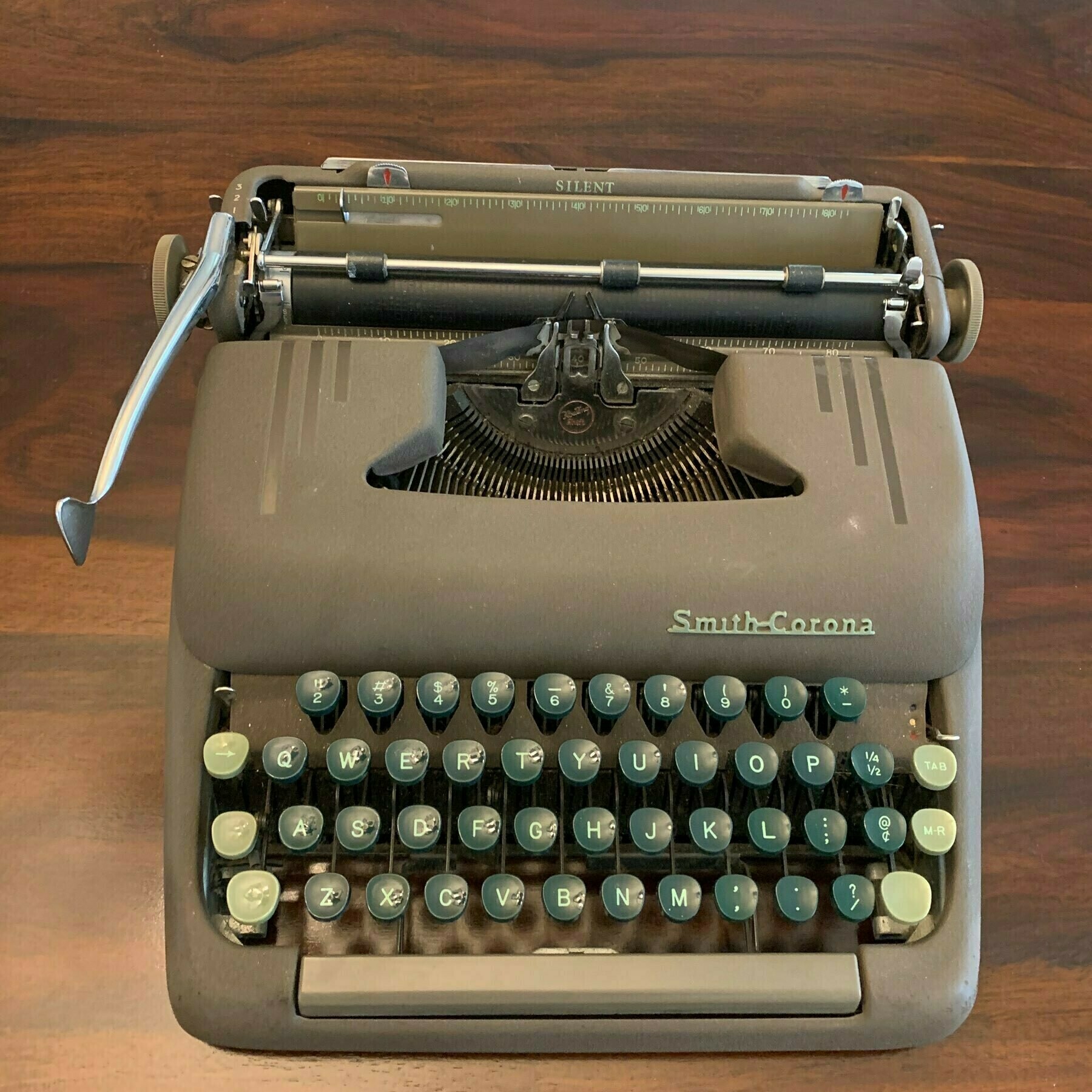
I wrote about sharing a typewriter (model) with Carl Reiner.
Carl Reiner and me
In a career spanning seventy years, Carl Reiner shaped the nation’s sense of humor through his writing, directing, and performances on stage and screen.
He used this typewriter to write "The Dick Van Dyke Show." pic.twitter.com/rafXr9hrh4— National Museum of American History (@amhistorymuseum) June 30, 2020
As it happens, I have the same model of typewriter, which I used to write all my papers from my junior year in high school through graduate school (only turning to a computer when I started my dissertation):


But I won’t do anything nearly as cool as writing The Dick Van Dyke Show.
learning from Rod Dreher
My buddy Rod Dreher has a book coming out soon called Live Not By Lies, and it’s about what American Christians can learn about living under an oppressive regime by studying what believers did under the old Soviet Union. I think this is a story that Christians ought to be interested in, whether they agree with Rod’s politics or not. Every thoughtful Christian I know thinks that the cause of Christ has powerful cultural and political enemies, that we are in various ways discouraged or impeded in our discipleship by forces external to the Church. Where we differ is in our assessment of what the chief opposing forces are.
Rod is primarily worried about the rise of a “soft totalitarianism” of the left, what James Poulos calls a “pink police state.” Other Christians I know are equally worried, but about the dangers to Christian life of white supremacy, or the international neoliberal order. For me the chief concern (I have many) is what I call “metaphysical capitalism.” But we all agree that the Church of Jesus Christ is under a kind of ongoing assault, sometimes direct and sometimes indirect, sometimes blunt and sometimes subtle, and that living faithfully under such circumstances is a constant challenge. Why wouldn’t we want to learn from people who faced even greater challenges than we do and who managed to sustain their faith through that experience? Isn’t that valuable to all of us?
I felt the same way about The Benedict Option, which was mostly not an argument but rather a job of reporting, reporting on various intentional Christian communities. I read the book with fascination, because I was and am convinced that the primary reason American Christians are so bent and broken is that we have neglected catechesis while living in a social order that catechizes us incessantly. What can I learn from those communities that would help me in my own catechesis, and that of my family, and that of my parish church? I read The Benedict Option with the same focus I brought to my reading of a marvelous book by another friend of mine, Charles Marsh’s The Beloved Community. Charles’s politics are miles away from Rod’s, but their books share an essential concern: How can the church of Jesus Christ, how can Christ’s followers, be formed in such a way that they can flourish in unpropitious conditions?
That’s exactly the right question, I think, and both The Benedict Option and Live Not By Lies introduce me to people who help me — even when I don’t agree with their strategies! — to think better about what its answers might be. (And The Beloved Community as well. Christians under Marxism and the Black church under Jim Crow offer remarkably similar kinds of help to us, a point that deserves a great deal more reflection than it is likely ever to get in our stupidly polarized time.)
Often when I make this argument people acknowledge the force of it but tell me that Rod is the “wrong messenger.” I understand what they mean. Rod is excitable, and temperamentally a catastrophist, as opposed to a declinist. (That’s Ross Douthat’s distinction.) Like the prophet of Richard Wilbur’s poem, he’s gotten himself “Mad-eyed from stating the obvious,” and I often think that if he writes the phrase “Wake up, people!” one more time I’m gonna drive to Baton Rouge and slap him upside the head.
Also, when Rod rails against “woke capitalism,” he clearly thinks that “woke” is the problem, without giving real assent to the fact that Christians are susceptible to woke capitalism because they were previously susceptible to other kinds. He perceives threats to the Church from the Right, from racism and crude nationalism and general cruelty to whoever isn’t One Of Us, and writes about them sometimes, but they don’t exercise his imagination the way that threats from the Left do. I can see why people whose politics differ from Rod’s don’t what to hear what he has to say.
But, you know, Jonah was definitely the wrong messenger for Ninevah — he even thought so himself — and yet the Ninevites did well to pay attention to him.
And if you think Rod has a potentially useful message but is the wrong conveyer of it, then get off your ass and become the messenger you want to see in the world. Lord knows we need more Christians, not fewer, paying attention to the challenges of deep Christian formation. Wake up, people!

Went down to the river today to make sure it’s still there. ✔️