a road not taken
Lately I have been reading some of the wartime letters of Dorothy Sayers — who, I have just learned, pronounced her name to rhyme with “stairs” — and have been constantly reminded of something that I wrote about a bit in my Year of Our Lord 1943: the complex network, centered of course in London, of Christians working outside of standard ecclesiastical channels to bring a vibrant Christian faith before the minds of the people of England in the midst of war. People like J. H. Oldham and Philip Mairet and, perhaps above all, James Welch of the BBC — who convinced Dorothy Sayers to write the radio plays that came to be called The Man Born to be King, recruited C. S. Lewis to give the broadcast talks that became Mere Christianity, and commissioned music from Ralph Vaughan Williams — ended up having an impact on the public face of English Christianity that was enormous but is now almost completely unknown.
At one point in researching my book I thought seriously about throwing out my plans and writing this story instead — but I couldn’t bear to let go of the fascinating interplay between ideas being articulated in England and their close siblings arising in the U.S., especially in New York City.
I can’t remember whether I’ve mentioned it here before — a quick search suggests not — but I have long dreamed of writing a book called Christian London: a history of the distinctive and often profoundly influential role that London has played in the history of Christianity. However, no one I have spoken to about this project — my agent, various editors, friends — has shared my enthusiasm. I might write it one day anyhow, and if I do, people like Oldham and Mairet and Welch will be major characters in one chapter.
And one of the desserts: corn mochi with blackberry sorbet and various delicious accessories.

A highlight from last night’s anniversary dinner at Barley Swine: fried buns (like a steamed bun except … fried) with shrimp dumplings.

39th anniversary dinner at the amazing Barley Swine in Austin. So, so grateful for my beloved.
here and there
As some of you may have noticed, I’m not posting here very frequently. I think for the foreseeable future I’m only going to be using this blog for longer reflections – long by internet standards, anyway.
From day to day you’ll find me posting to my micro.blog account – and if you haven’t checked out micro.blog, please do! People sometimes describe micro.blog as a “Twitter replacement,” but that’s not quite right. It may be better to think of it as what services like Twitter and Instagram could have been if they had been devoted to the open web and not subservient to the demands of venture capital. It’s a great place for low-key connection with others, and the best possible way to get started in blogging. It’s not free, but then Twitter and Instagram aren’t free either – those services just make you may in currencies other than money. Micro.blog serves no ads, respects your privacy, and allows you to own your turf. Try it!
I continue to post bookmarks – with useful excerpts! – at my Pinboard page, which I have been using for … [checks site] … ten years and two weeks.
Finally, I think my newsletter is pretty fun – a bit of a break from the incessant seriousness of our political moment.

Hose time

First the Eucharistic Feast, then the Breakfast Pizza at Moroso Feast.

the airless room
This is an interview with Kathryn Scanlan about her very peculiar new book, which is made up of selections from a person’s diary — read the interview to learn more, it’s really fascinating.
But I want to talk about a distraction from the real subject of the interview. Here’s a passage:
Etter: Now this is a question I have coming from a journalism background: what does it mean for fiction to take a real life and remix it, scramble it, and fine tune it into something that becomes non-real? What is it like to play with that?Scanlan: A little bit weird. From the beginning, I felt like it was a weird thing I was doing. I don’t necessarily think it’s any particular genre, I think it has elements of all genres. I think it can be called fiction and I would call it that because of the way it’s been selected. If you are only showing part of something, it’s fiction. If you’re omitting lots of things, or if you’re focusing on only something particular, it’s fiction in my mind.
Etter: I think most journalists would probably agree with that definition — maybe not our president.
I read that and thought: Is there any chance of my getting through a recent essay, an article, a story, an interview, without a reference to That Man? Is it really necessary for every member of The Cultured to signal their disdain for him in every single conversation?
I want to say: He’s not sucking the air out of the room, you are.
Yes, I know, it’s just a passing comment. But when “passing comments” of that kind show up twenty times a day, it wears on a fella.
This is why I make my newsletter. It’s a place that I can guarantee will be free from that kind of thing, that will allow me and my readers to spend time in a broader world than that of posted and tweeted and retweeted political vaporing, posturing, and rancor.
Many of you will know this famous letter from John Adams to his wife Abigail: “The Science of Government it is my Duty to study, more than all other Sciences: the Art of Legislation and Administration and Negotiation, ought to take Place, indeed to exclude in a manner all other Arts. I must study Politicks and War that my sons may have liberty to study Mathematicks and Philosophy. My sons ought to study Mathematicks and Philosophy, Geography, natural History, Naval Architecture, navigation, Commerce and Agriculture, in order to give their Children a right to study Painting, Poetry, Musick, Architecture, Statuary, Tapestry and Porcelaine.” Let not Adams have studied in vain.
on social acceleration
Recently I’ve read two of the most stimulating, provocative, generative books I’ve read in a long time. One of them is Bewilderments: Reflections on the Book of Numbers, by Avivah Gottlieb Zornberg. I hope to have something to say about that in the near future.
The other, and the one I want to talk about here, is Hartmut Rosa’s Social Acceleration. This one poses some real challenges to me, primarily because it bears so directly on the book I’m writing but is not the sort of thing — it gets deep into the weeds of social theory — that I can treat at length in a book for a general audience. So as relevant as it is to the argument of Breaking Bread with the Dead, I won’t say much about it there, though it will surely end up in the notes a few times. (One of the things I most want to do in my writing for general audiences is to translate complex work in theology, philosophy, and social, cultural, and literary theory into terms accessible to the common reader — and to do so without defacing the ideas by oversimplifying them.)
I’ll unpack a bit of Rosa’s argument here, then. Rosa looks at the phenomenon of acceleration in three dimensions:
- “technical acceleration, that is, the intentional acceleration of goal-directed processes”;
- “acceleration of social change, that is, the escalation of the rate of social change with respect to associational structures, knowledge (theoretical, practical, and moral), social practices, and action orientations”;
- “acceleration of the pace of life represents a reaction to the scarcity of (uncommitted) time resources. This is why, on the one hand, it is expressed in the experience of stress and a lack of time, and, on the other, it can be defined as an increase in the number of episodes of action and/or experience per unit of time."
The relationship between these three dimensions, Rosa shows, is complex: after all, when you have technical acceleration, especially in the form of what we call “labor-saving devices,” shouldn’t our pace of life slow down? And yet it often doesn’t — or, perhaps more accurately, we don’t feel that it does.
Rosa also discusses various “decelerating” forces or institutions, and it’s the last of those that I want to focus on here. Unlike the deceleration of a technologically backward society with scant or no access to the most current technologies — and also unlike the deliberate choice, long term or short, of technological limitation (the family living “off the grid” or the techbro vacationing in a monastery) — this final kind of deceleration is “the paradoxical flip side of social acceleration.” Many people in our time have “the experience of an uneventfulness and standstill that underlies the rapidly changing surface of social conditions and events, one that accompanies the modern perception of dynamization from the very beginning as a second fundamental experience of modernization.” Rosa often uses in the book a phrase by the cultural theorist Paul Virilio: “frenetic standstill” — the widespread sense that the world around us is in constant flux and yet nothing essential is happening — nothing essential can happen. (There’s a fascinating section of the book on the ways that depression is a natural response to this and therefore the characteristic disease of late modernity.)
This sense of “frenetic standstill” is especially common when the second dimension, acceleration of social change, crosses a certain threshold. Rosa looks at three social conditions, divided by two thresholds. In the first condition no obviously major change happens over several generations, or if it does happen it happens with imperceptible slowness, which lends to everyone in that society a feeling of stability, even permanence. Thus it was, thus it is, thus it shall ever be.
But when a major change occurs fast enough so that one generation of people can see that they’re living in a different form of life than their parents, or grandparents, did, then a threshold has been crossed. And Rosa argues that when this happens people tend to perceive that change as progressive: the world is going somewhere, it has a direction, and if I go with it my life can have a progressive direction too.
However: there’s another threshold to cross, as we have recently learned, and that’s when significant social change happens within a generation. Not only is your social world different than the one your parents experienced and came to count on, it’s different than the social world you experienced even a short time ago. When that happens, you see a couple getting a divorce because when they married they were “different people.” You get Farhad Manjoo feeling that the gender that he absolutely took for granted just a few years ago is now an “ubiquitous prison for the mind.” You get a Christian academic like David Gushee making a career of chastising people for holding views he himself held quite recently. And everyone thinks this kind of thing is normal: to look upon your very self of five years ago as a stranger, and presumably one for whose beliefs and actions your NowSelf cannot possibly be held responsible.
But, Rosa reminds us, we don’t really how what life on this side of that second threshold is going to do to us.
An intragenerational tempo of change thus undeniably raises the question of the temporally specific, so to speak, load-bearing capacity of cultural reproduction and social integration. The consequences of the growing intergenerational divide in lifeworld orientations and everyday practices as well as the ongoing devaluation of experience for the exchange between generations, for the passing on of cultural knowledge, and for the maintenance of intergenerational solidarity have hardly been studied at all.
It hasn’t been studied, but the consequences are going to be interesting (and, I think, not pleasant) to see unfold. For instance, here’s one aspect of the “ongoing devaluation of experience for the exchange between generations, for the passing on of cultural knowledge, and for the maintenance of intergenerational solidarity”: a currently small but increasing number of parents live in absolute terror of “assigning” gender to their children. Some decades from now there will surely be some powerfully embittered people who will despise their parents for having forced such choices on them when they were wholly unprepared to make them.
And yet many of those same parents don’t hesitate to forbid the eating of meat or Twinkies or Doritos to those same children, and will be deeply grieved when, as is inevitable, some of those kids end up as junk-food junkies. So I don’t think there will ever be a wholesale abandonment of “the passing on of cultural knowledge,” or of a desire for “the maintenance of intergenerational solidarity.” But what, specifically, people will want to pass down to their children will change. And there’s no doubt that as long as social change happens, or is felt to, at the current rate, parents will want to give their children free choices as often as they can possibly bear to. The “load-bearing capacity of cultural reproduction and social integration” will continue to decline, it seems likely.
And yet maybe not inevitable. There’s a passage from Adorno’s Minima Moralia that I think of often — and that Rosa refers briefly to at one point: “Perhaps the true society will grow tired of development and, out of freedom, leave possibilities unused, instead of storming under a confused compulsion to the conquest of strange stars.”
bookmaking
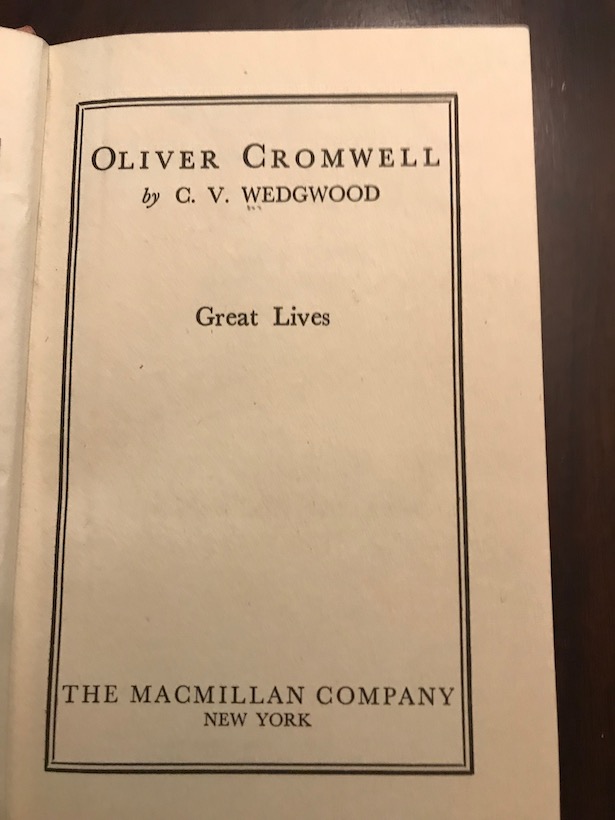
After writing my recent post on my enthusiasm for the writing of C. V. Wedgwood, I realized that I didn’t have a copy of her brief biography of Oliver Cromwell, so I ordered one from AbeBooks. It duly arrived, and I have just read it, and can report that it’s fine but by no means one of her best works. But I find myself thinking about the actual physical book, the codex.
It’s a discarded library book — from Stephens College in Missouri — and was acquired by that library in 1956. It’s a small book (4.5 x 7.5 inches) and has a basic, unadorned cover, and when I first opened the book I thought that the paper wasn’t great. But then I realized that the paper is sixty-three years old, and in that context it’s pretty darn good. It hasn’t yellowed much, and isn’t as brittle as paper that age often is. The binding is sewn, and the book easily lies flat.
Though the book, as you can see, was published by a New York house, it was actually printed in England.

The Jarrold Group sold their printing business around fifteen years ago, after which it seems to have closed, leaving only a small and rarely open museum of printing.
But in their day they knew their craft. It’s the typography that really struck me, even though it’s not unusual or obviously distinctive. Here’s a sample page:

As I say, not dramatic — but look at how lovely all the proportions are: the layout on the page, the spacing and kerning, the simple but elegant (and highly readable) typeface — Baskerville, I think — you can’t go wrong with Baskerville. It’s very rare for a book to get almost every element of typesetting and layout right the way this one does. (The kerning might be a tiny bit wide at times, but that’s because the book is small and the lines are therefore short. The compositors have done very well to make you forget about that.)
Consider this recent and nicely-designed book, Shoshana Zuboff’s The Age of Surveillance Capitalism:

Now that’s a lovely typeface — Minion, I think? I’m not expert in these things — and note the generous spacing between lines: important when a book is as big as this one (over 600 pages). But the margins are too narrow. Look how the ends of the lines disappear into the gutter. I think with slightly wider margins and slightly narrower spacing between the lines the book could have been more readable at the same length. (Though, as you can see, the paper is too thin. Compare the older book, in which nothing shows through from the other side.)
Obviously, every typesetting decision creates tradeoffs: you get a good feature in exchange for putting up with something a little less good. It’s like working with a stringed instrument: something is always out of tune, at least a little, thanks to the perversities of equal temperament. But those bookmaking people at Jarrold & Sons did the job about as well as it can be done. Hats off to them. I wish I could buy new books made by them, or by craftsmen who can do what they could do.
I’ve probably taken too many pictures of our huge oleander, but I think its combination of delicate pink bloom and spiky dark-green leaf is so, so striking.

Some of our container plants have been struggling a bit in the heat, but this little pairing has thrived madly.

Malcolm is relaxed but hopeful that there might be more play.

the most literary decade
Popular radio shows featured literary critics talking about recent poetry and fiction. The New Yorker’s book-review editor hosted one of the most popular radio shows in America, and his anthology, Reading I’ve Liked, ranked seventh on the bestseller list for nonfiction in 1941. At the Democratic Primary Convention in 1948, F. O. Matthiessen, a professor of American literature, delivered a nominating speech for Henry Wallace, the late FDR’s vice president. Writers were celebrities. Literature was popular. The 1940s was the most intensely literary decade in American history, perhaps in world history. Books symbolized freedom.Posters of 1942 quoted the president: “Books cannot be killed by fire. People die, but books never die. No man and no force can put thought in a concentration camp forever. No man and no force can take from the world the books that embody man’s eternal fight against tyranny. In this war, we know, books are weapons.” During the Blitz, Muriel Rukeyser recalled, “newspapers in America carried full-page advertisements for The Oxford Book of English Verse, announced as ‘all that is imperishable of England.’ ” For the first and only time in history, protecting books in war zones became an official aim of armed forces.
— George Hutchinson, Facing the Abyss: American Literature and Culture in the 1940s. Compare the argument I made in my essay “The Watchmen.”
neighbors
When I awoke I could barely move for the pain; I didn’t know where I was, and I didn’t know how I had gotten there. I could hear, from some nearby room, laughter and conversation. Eventually a woman came to my door and asked how I was doing.
“Who are you?” I managed to ask, though it hurt me to speak. I could feel with my tongue that I had lost teeth, and I could see through one eye only. Every breath made my ribs ache.
“My husband and I keep this inn,” she said, and then she told me about the man who had found me and brought me to safety. When I arrived, she said, the stranger had already washed me as best he could and bandaged the worst of my wounds. He gave them money to take care of me. “And we will do right by you,” she said. “He promised that when he comes this way again he’ll pay us for any added expense. So you just rest up, and I’ll bring you some soup. You won’t be going anywhere for a few days.” And then as she was leaving she looked back and said, “He was a Samaritan, you know.”
Now that’s odd, I thought as I lay back and tried to breathe without hurting myself. I didn’t, and don’t, remember the man at all — I didn’t, and don’t, remember anything after the moment the first blow from the robbers knocked me to the ground. They’re wicked men, of course, but I should’ve known better than to take that road at that time of night. I was trying to save time; I was in a hurry to get some business done. I was a fool.
But to think that a stranger passing by, and a Samaritan at that, stopped to care for me! — what an encouragement. It makes me think that all these years I’ve been too cynical about people. Sure, there are some bad ones in the world — don’t I know it! — but in the end, surely, human nature is essentially good. I must remember that.
the greatest of the Wedgwoods
 National Portrait Gallery
Cicely Veronica Wedgwood (1910–1997) was the most distinguished of the Wedgwoods — with the possible exception of her great-great-great grandfather Josiah. In the estimation of Anthony Grafton — himself one of the most distinguished historians of our time — she is “the greatest narrative historian of the twentieth century.” And that counts for a lot, in my book.
By the adjective “narrative” Grafton means to distinguish Wedgwood’s way of writing history from what has become the standard academic one, which is less concerned with telling a story than providing an analytical and often data-driven framework for understanding historical events and patterns. That model has become sufficiently dominant that most of us these days think of the writing of history as something very different than the writing of “literature,” but ’twas not always so. When Gibbon wrote his great Decline and Fall of the Roman Empire he was understood to be just as literary as Alexander Pope or Henry Fielding (probably more so than Fielding). In the next century Lord Macaulay’s History of England was every bit as literary as his Lays of Ancient Rome. George Steiner, writing decades ago, understood that Wedgwood was working in this tradition, and celebrates it even as he denounces what has replaced it:
The ambitions of scientific rigour and prophecy have seduced much historical writing from its veritable nature, which is art. Much of what passes for history at present is scarcely literate…. The illusion of science and the fashions of the academic tend to transform the young historian into a ferret gnawing at the minute fact or figure. He dwells in footnotes and writes monographs in as illiterate a style as possible to demonstrate the scientific bias of his craft. One of the few contemporary historians prepared to defend openly the poetic nature of all historical imagining is C. V. Wedgwood. She fully concedes that all style brings with it the possibility of distortion: ‘There is no literary style which may not at some point take away something from the ascertainable outline of truth, which it is the task of scholarship to excavate and re-establish.’ But where such excavation abandons style altogether, or harbours the illusion of impartial exactitude, it will light only on dust.
“The poetic nature of all historical imagining” — preach it, sir! But few historians today, even those rare birds who even make an effort to tell a good story, can hold a candle to Wedgwood. Peter Ackroyd, for instance, who has shifted from being primarily a novelist to being primarily a historian, presumably because of his skills at narration, is a mechanical plodder in comparison to Wedgwood. (And he’s getting worse. His ongoing history of England is coma-inducing.)
Wedgwood didn’t describe what she did as more literary or artful than the work of academic historians, even though, of course, it is. Here’s how she understood her work:
The application of modern methods of research, together with modern knowledge and prejudice, can make the past merely the subject of our own analytical ingenuity or our own illusions. With scholarly precision we can build up theories as to why and how things happened which are convincing to us, which may even be true, but which those who live through the epoch would neither recognize nor accept. It is legitimate for the historian to pierce the surface and bring to light to motives and influences not known at the time; but it is equally legitimate to accept the motives and explanations which satisfied contemporaries…. This book is not a defence of one side [in the English Civil War] or the other, not an economic analysis, not a social study; it is an attempt to understand how these men felt and why, in their own estimation, they acted as they did.
That from the Introduction to The King’s Peace, the first volume of her history of the fall of King Charles I. This interest in representing people and events by employing categories that they themselves would have recognized may be seen in this brilliant brief portrait of Charles:
He had never had the painful experience from which his father, as a young man, had learned so much; he had never confronted insolent opponents face-to-face and had the worst of the argument. No national danger had compelled him to go out among his people and share their perils. He was, at this time, not only the most formal but the most remote and sheltered of all European kings.Less virtuous monarchs escaped from formality in the arms of lowborn mistresses, but for the chaste Charles, no Nell Gwynne, prattling cockney anecdotes, opened a window into the lives of his humbler subjects. Like many shy, meticulous men, he was fond of aphorisms, and would write in the margins of books, in a delicate, beautiful, deliberate script, such maxims as “Few great talkers are great doers” or “None but cowards are cruel.” He trusted more to such distilled and bottled essence of other man’s wisdom than to his own experience, which was, in truth, limited; his daily contact with the world was confined within the artificial circle of his Court and the hunting field. He was to say, much later, in tragic circumstances, that he knew as much law as any gentleman in England. It was true; but he had little conception of what the laws meant to those who lived under them.
That last sentence is simply devastating. (Whenever Wedgood pauses in her narrative for a character sketch of one of her actors, you are always in for something superb.)
Wedgwood pauses from time to time in The King’s Peace, especially in its early pages, to sketch not personalities but social orders and patterns and beliefs, including the experiences of those very people whom Charles never knew. Here’s a sample:
In the wilds of Lochaber from time to time a green man could be seen, one that had been killed between daylight and starlight and belonged neither to earth nor heaven. Some thought these apparitions were only the unhappy dead but others thought them one of the many forms taken by the devil. The strong forces of nature, with the advent of Christianity, had become confused with the devil, and after the lapse of centuries witchcraft had become indivisibly compact of pagan and Christian beliefs. The devil, in many forms, bestrode the islands from end to end. Sometimes he was “a proper gentleman with a laced band,” as when he came to Elizabeth Clarke at Chelmsford; at other times you might know him, as Rebecca Jones of St. Osyth did, by his great glaring eyes. He was cold and sensual and rather mean: he offered Priscilla Collit of Dunwich only ten shillings for her immortal soul; she gave it to him and off he went without paying. Respectably dressed in “brown clothes and a little black hat,” he spoke in friendly terms to Margaret Duchill of Alloa in Scotland; “Maggie, will you be my servant?” he asked, and when she agreed he told her to call him John and gave her five shillings and powers of life and death over her neighbours.
I could quote paragraph after paragraph, page after page, of this kind of thing. And her ability to immerse you in a battle, or a court scene, or a back-room political argument, is unexcelled. Moreover, all this is based (as Grafton notes) on exceptionally thorough archival research, sometimes in multiple languages. I am writing a book that attempts to convince people that the past can be, and should be, a living world to us. That case would be much easier to make if there were more historians like C. V. Wedgwood.
She should be remembered as one of the best storytellers writing in English in the twentieth century. And yet her major works — with the sole exception of the early but masterful history of the Thirty Years War — are out of print. That is a travesty.
Editors! Publishers! Let’s redress this injustice. If you need someone to edit and/or write an introduction to a new edition of Wedgwood’s work, just call on me. I am here for you.
And readers! You can of course start with The Thirty Years War, which is as good as advertised. But I prefer her work on English history. For those, AbeBooks is your friend. If you’re not sure you want to commit to one of the big books, her third volume on the English Civil War, A Coffin for King Charles, works perfectly well as an independent story and comes in at around 250 pages. It is absolutely riveting.
this is your mind on presentism
As a person writing a book about the need to cultivate temporal bandwidth, I am so pleased when various prominent cultural outlets do advance publicity on my behalf. Consider for instance this piece in the New Yorker on the decline in the study of history:
“Yes, we have a responsibility to train for the world of employment, but are we educating for life, and without historical knowledge you are not ready for life,” Blight told me. As our political discourse is increasingly dominated by sources who care nothing for truth or credibility, we come closer and closer to the situation that Walter Lippmann warned about a century ago, in his seminal “Liberty and the News.” “Men who have lost their grip upon the relevant facts of their environment are the inevitable victims of agitation and propaganda. The quack, the charlatan, the jingo … can flourish only where the audience is deprived of independent access to information,” he wrote. A nation whose citizens have no knowledge of history is asking to be led by quacks, charlatans, and jingos. As he has proved ever since he rode to political prominence on the lie of Barack Obama’s birthplace, Trump is all three. And, without more history majors, we are doomed to repeat him.
I would give a big Amen to this but with one caveat: it’s not more history majors we need, it’s a more general, more widespread, acquaintance with history. Without that we are fully at the mercy of our now-habitual and increasingly tyrannical presentism.
Consider, as an exemplum, this Farhad Manjoo column, in which he deplores the “prison” of being referred to by gendered pronouns. Damon Linker’s response zeroes in on a key point:
But what is this freedom that Manjoo and so many others suddenly crave for themselves and their children? That’s more than a little mysterious. Slaves everywhere presumably know that they are unfree, even if they accept the legitimacy of the system and the master that keeps them enslaved. But what is this bondage we couldn’t even begin to perceive in 2009 that in under a decade has become a burden so onerous that it produces a demand for the overturning of well-settled rules and assumptions, some of which (“the gender binary”) go all the way back to the earliest origins of human civilization?
I think Linker could have, with equal appositeness, referred to 2014: If you got in a time machine and showed the Farhad Manjoo of 2014 a copy of his 2019 column, he almost certainly would not believe that he had written it. A stance that in 2014 was been so uncontroversial that it didn’t rise to the level of consciousness — that it’s okay for us to refer to ourselves by gendered pronouns — is now the unmistakable sign of “a ubiquitous prison for the mind.” And yet so thoroughly is Manjoo immersed in the imperatives of the moment that he’s not even aware of the discontinuity. That is the real prison for the mind.

Jamesian aphasia
I’m reading Henry James’s late unfinished novel The Sense of the Past for the book I’m writing, and while my opinion of Henry James as a writer is not relevant to my use of his story, I just want to go on record saying that there is no writer who frustrates me more than Henry James in his later period. I find Joyce’s Ulysses – dammit, Joyce’s Finnegan’s Wake – easier to read and to make sense of than the prose of Henry James in his later period. When I read one of James’s sentences I often feel that it was created by an algorithm that has been fed a list of English words classified by part of speech and an extensive set of grammatical rules — but has been given no information about what the words mean. Here is a representative — note: representative, not unusual, not exaggerated — sentence from The Sense of the Past: “Just these high considerations were in all probability the influence most active in his attitude toward the only approach to an adverse interest with which he was to perceive himself confronted.“ Just for fun, here’s another one: “He had even for this one of those rarest reaches of apprehension on which he had been living and soaring for the past hour and which represented the joy he had just reasseverated; impatience was surely one of her bright marks, but he saw that to live with her would be to find her often deny it in ways unforeseen and that seemed for the moment to show themselves as the most delightful things in nature.” I read sentences like these and think I’m developing some rare and deadly form of aphasia.
Biscuit.