
Inside the Bro-tastic Short-Term Rentals Upending an Austin Community:
Almost anywhere you find tourists in Texas, from waterfront neighborhoods on Galveston Island to the ghost towns in the western reaches of the state, locals are bemoaning the changes unleashed by short-term rentals and the visitors who temporarily inhabit them. In Dallas, where one neighborhood STR was turned into a raucous wedding venue, infuriating neighbors, the city council is weighing a plan to outlaw STRs from residential neighborhoods. In Fredericksburg, the popular Hill Country getaway, locals have blamed STRs for exacerbating a severe housing shortage. In Wimberley, about an hour southwest of Austin, they’ve been accused of encouraging debauchery. But when it comes to STRs in Texas, there is no place quite like Austin. The influx of STRs is inextricably linked to the city’s transformation, in just over a decade, from one of the most affordable cities in America to one of the least. Between 2000 and 2010, Austin was the only city in the U.S. experiencing double-digit growth that also saw a decline in the percentage of its Black population — a decline that continued over the next decade. No longer a countercultural haven for artists and independent thinkers, Austin has embraced a new role as the tourist-obsessed, bachelor party–dependent STR capital of Texas — a kind of Las Vegas with tacos in which it can feel as if the real world has been subsumed by the digital one being marketed on Instagram by newly-arrived influencers and real estate agents.
This is incredibly depressing but also utterly unsurprising.
Dominion might win its suit notwithstanding the general truth of what Kevin [Williamson] said in his piece, that “nothing short of a signed and notarized statement of intent to commit libel seems to satisfy judges or juries” in modern defamation litigation. What the company aimed to show in its nearly 200-page brief is that, by word and deed, Fox personnel from management on down did all but openly confess their intent to commit libel. They acknowledged privately that Trump’s conspiracy theories were false; they were warned repeatedly that those theories were false; they pressed ahead on the air with the big lie anyway.
But even if Dominion loses, it’ll have extracted a measure of moral compensation. Whatever else one might call programming that suppresses the truth if it might offend the audience, “news” ain’t it. (“Propaganda” sounds about right.) No one who reads Dominion’s pleading will ever look at Fox the same way. That’s why the company filed it.
I’ve been reading the pleading and … it’s something else. If Dominion doesn’t win this suit, then there is no law against defamation in this country, and “news” outlets can say anything they want about anyone at any time with absolute disregard for the truth. Which, come to think of it, is what they do already, I guess. Does anyone really believe that the NYT didn’t demonstrate “actual malice” against Sarah Palin when it repeatedly lied that she played a role in Gabby Giffords’ shooting? Of course not. It’s just that a lot of people believe that Palin is an official Bad Person and therefore deserves to be lied about.
Which is why Operation Diogenes must go on!
I want this (forthcoming) book just for its cover. Or the cover as a poster.

Cory Doctorow: “In its nearly 25-year history, Google has made one and a half successful products: a once-great search engine and a pretty good Hotmail clone. Everything else it built in-house has crashed and burned.” Ouch.
question and answer
Question: How bad would the whole AI/search/chat situation have to get — how much real-world harm have to be done — before any of the tech companies pulled their version from the market?
Answer: The publicly-held companies might pull theirs in response to a stock-market collapse, but the privately-held ones? I can’t imagine any circumstances short of legislative action that would cause them to pull back. They believe in the “move fast and break things” mantra, they think no publicity is bad publicity, and their technological justification is that the bots will improve only through iteration.
UPDATE: So Microsoft — one of the public companies in this racket — hasn’t taken down Bing Chat but has “lobotomized” it. Sydney, we hardly knew ye.
strings and bows
Making the Sausage - Freddie deBoer:
That said, I feel that the only value proposition I really offer is my writing, the writing itself. The fact of the matter is that anybody could come along and offer the exact same political perspective; it’s a weird lane, but one that could certainly be replicated. What’s not so easily replicated is my writing ability. I have worked very, very hard on my prose for a long time. It’s the only thing I’ve ever been good at. I became a fairly good guitar player, as a young man, but never good enough; I’m bad at almost all athletics and almost preternaturally shitty at team sports; I’m a disaster at most video games; I cook and cook and cook and never get any better; it takes me approximately seven hours to learn any given boardgame; my drawings and handwriting are genuinely indistinguishable from those of a 7-year-old; in the extremely unlikely event that you can get me to dance, kind witnesses will likely ask me if there’s someone they can call to come help me. I’m terribly clumsy even when I’m not on meds, and meds make it even worse. My bike was my primary means of transportation for four years and I still can’t look to my left or right while biking without turning in that direction. And after I got fired from Brooklyn College in 2020 nine months of applications in all kinds of fields got me nothing but a single offer for a $15/hour job. This is all I’ve got.
A terrific essay from Freddie.
I often wonder how I would do in Freddie’s situation. I am blessed in that I have two strings to my bow rather than one: My day job is teaching, and I’m past the publish-or-perish stage, so I could just teach if I wanted to. (And I love teaching.) Vital though my writing is to me, I haven’t pushed all my chips to the middle of the table the way Freddie has.
One of the topics of Freddie’s essay is the response to a recent essay of his on growing up in the Nineties. It was widely read and shared and admired, but there were of course some naysayers. And — also of course, even more of course — most of the naysayers hadn’t read the essay. Some of them, it seems, didn’t even manage to read the entire title.
There are millions and millions of people like this on social media, and especially on Twitter — I can’t count the number of times I saw people responding to the first half of a tweet, not having been able to make it all the way to the 200-character mark before blessing the world with their Opinion. (I think those people are pretty much the only ones left on Twitter now.) But that’s par for the social-media course; you can’t expect anything better.
What bothers me is the extension of these habits of mindlessness into longer-form writing and even into professional journalism. Genuine critique is a great gift to a writer — maybe the single most helpful response to How to Think that I received came from Jonathan Rauch, in a conversation at the Ethics and Public Policy Center, who was gracious and friendly but also quite critical. Made me want to run back home and write the Revised and Improved Edition. But criticism of that kind is relatively rare, because it depends on a careful reading of the work in question. You’re much more likely to get a review based on a more superficial reading, which is perhaps inevitable given the tyranny of deadlines.
But occasionally I have seen a review of a book of mine written by someone who quite evidently hasn’t read the book at all. I mean, maybe they’ve skimmed a few pages, but that’s it. And such reviews are not always negative! — some reviewers have been quite complimentary towards the book that they inaccurately assumed I probably wrote. That sort of thing annoys me in a weird way, but not as much, of course, as the review that attacks an argument I didn’t make — an argument I explicitly repudiated on page 49 — or that wags an admonitory finger at me for leaving something out of my book that in fact is right there on page 73 you dumbass.
This sort of thing annoys me enough that years ago I stopped reading reviews — though that doesn’t prevent people from writing to me to ask What do you think about the bad things so-and-so said about you? So I end up anyway hearing more than I want to about such responses. And it annoys me even though it can’t really hurt me — so imagine how strongly I would feel about such things if, like Freddie, I were depending on my writing to feed myself and my family.
I go on about this because it’s a recent theme of mine: the perils of a media culture that’s indifferent to truth. Thus my argument about truth as a commons; thus Operation Diogenes. I’m going to be mulling over these matters often in the weeks or months to come.
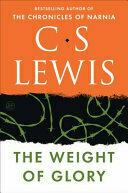
Finished reading: The Weight of Glory by C. S. Lewis. Delightful to come back to this and read it straight through, for the first time in … a long time. 📚


Continuing the recent reflections on fantasy, it me:
Like many other fantasy writers, [Hope] Mirrlees is interested in what happens if the power of Fairyland cannot be wholly excluded from our well-buffered society. In this case, we see what happens when magic begins to creep back into well-ordered and well-buffered lives. To figure this as essentially a drug war — an inevitably unsuccessful attempt to prevent the smuggling of what one character in the story significantly calls the “commodity” of fairy fruit — is a wonderful conceit and developed with delightful panache, tracing an elegantly oscillating line between the economic and the metaphysical. When one character tells a senator that he should be more aware of the high levels of consumption of fairy fruit among the poor, I find myself murmuring, Fairy fruit is the opiate of the masses.