
brief hiatus
This seems like a good time to go silent for a few days — to pray in silence. I’ll be back, probably next week.
When I grow up, I wanna be like Pop. And you should too.
For abuse to happen under any circumstances is gut-wrenching; when it happens in a church setting, and is perpetrated by people who are viewed as spiritual leaders, who are entrusted with the care and formation of the young, it’s that much worse. And when those in positions of leadership not only fail to step in to help victims of abuse, but actually attack them, it becomes even more wicked and grievous. Brown’s haunting phrase — soul murder — is what happened within the SBC, and it’s only the latest in a string of recent scandals that have rocked the evangelical world.
The other thing that makes the SBC scandal so twisted and ugly is how leaders of the denomination used the Bible and spiritual language as weapons against the innocent victims, as when Boto invoked Satan to discredit the survivors. That is yet another level of depravity.
We need a word worse than “depravity” for this. See also Russell Moore on this tragic situation. It’s time for pretty much everyone in the current and recent leadership of the SBC to take the Profumo Option.
Reformation in the Church of Science — The New Atlantis:
Fake news is not a perversion of the information society but a logical outgrowth of it, a symptom of the decades-long devolution of the traditional authority for governing knowledge and communicating information. That authority has long been held by a small number of institutions. When that kind of monopoly is no longer possible, truth itself must become contested.
This is treacherous terrain. The urge to insist on the integrity of the old order is widespread: Truth is truth, lies are lies, and established authorities must see to it that nobody blurs the two. But we also know from history that what seemed to be stable regimes of truth may collapse, and be replaced. If that is what is happening now, then the challenge is to manage the transition, not to cling to the old order as it dissolves around us.
The authors don’t attempt to say how this transition should be managed, which is probably wise. Their point, and I fear that it’s quite correct, is that the transition is happening: What counts as scientific truth is now contested in many of the same ways that what counts as religious truth was contested in the Reformation period.
normie wisdom: 1
First post in a series

When Hugh Trevor-Roper was a young historian he became friends with with the art connoisseur Bernard Berenson. Berenson was fifty years older than Trevor-Roper, and rarely left his home outside Florence, so Trevor-Roper enlivened his octogenarian friend’s dull days with maliciously gossipy letters, especially about his colleagues at Oxford. Here is what he had to say (on 18 January 1951) about C.S. Lewis:
Do you know C.S. Lewis? In case you don’t, let me offer a brief character-sketch. Envisage (if you can) a man who combines the face and figure of a hog-reever or earth-stopper with the mind and thought of a Desert Father of the fifth century, preoccupied with meditations of inelegant theological obscenity; a powerful mind warped by erudite philistinism, blackened by systematic bigotry, and directed by a positive detestation of such profane frivolities as art, literature, and, of course, poetry; a purple-faced bachelor and misogynist, living alone in rooms of inconceivable hideousness, secretly consuming vast quantities of his favorite dish, beefsteak-and-kidney pudding; periodically trembling at the mere apprehension of a feminine footfall; and all the while distilling his morbid and illiberal thoughts into volumes of best-selling prurient religiosity and such reactionary nihilism as is indicated by the gleeful title, The Abolition of Man.
The first thing to say about this is that it’s very funny. The second thing to say is that it makes no pretense to accuracy. I’m sure Trevor-Roper knew perfectly well that The Abolition of Man is not what Lewis hopes for but what he fears, and that he does not detest literature and poetry but rather adores them. Old Hughie’s having his bit of fun.
Still, there’s no doubt that the letter reflects Trevor-Roper’s actual attitude towards Lewis, and I want to zero in on the key phrase: “a powerful mind warped by erudite philistinism.” It’s a double judgment: he detests Lewis as a philistine – but he doesn’t hesitate to credit him with “a powerful mind.” I think that’s very important, not just for understanding how Trevor Roper thought but for understanding how the intelligentsia, especially within the academy, has been orienting itself to the world for the past hundred years or so.
For Trevor-Roper, the problem with Lewis isn’t that he stupid. Trevor-Roper is perfectly aware of Lewis’s exceptional intelligence, and if pressed he might even have acknowledged that Lewis was more intelligent than he himself – certainly more profoundly learned. What Trevor-Roper despises is Lewis’s aesthetic and emotional response to the world, his moral taste – in a word, his affections, in the Augustinian and Jonathan-Edwardsian sense. Trevor-Roper was appalled by Lewis because Lewis showed that a person could be prodigiously intelligent and nevertheless in other respects be – well, a normie.
I’m going to use that as a technical term here: a normie is someone whose responses to the world, whose affections, are close to those of the average person. This is not the only way it’s used, of course: in Angela Nagle’s 2017 book Kill All Normies normies are essentially political centrists, people who accept the status quo rather than embracing revolutionary change from the right or the left. But I think a more accurate sense of the word’s connotations is outlined in a post on the Merriam-Webster “Words We’re Watching” blog that wrestles with it: “The term normie has emerged as both a noun and an adjective referring to one whose tastes, lifestyle, habits, and attitude are mainstream and far from the cutting edge, or a person who is otherwise not notable or remarkable” – but then, at the end of the post, there’s an acknowledgment that “the word has lately flattened out and is now occasionally embraced as a term of ironic self-mockery. The emergence of the term normcore, which evokes a fashion style noted for being deliberately bland and unremarkable, might have helped to neutralize normie and bring the word back into the realm of cool — however that adds up.”
A rather hand-wavy conclusion. But in essence: “Normie” began as a term of disparagement but has been claimed by (a) the committed ironists and (b) the very people against which it was originally deployed – a relatively common event in the history of disparagement, as illustrated by the history of such words as “Methodist” and “Quaker.”
But whether you use the word in a pejorative or a commendatory sense, it’s important to recognize that normieness is a matter of “tastes, lifestyle, habits, and attitude” – or, as I prefer, affections – rather than intelligence. It is hard for people who disparage normies to keep this in mind, and maybe even for the rest of us. To stick with the Inklings for a moment: early in his wonderful book about Tolkien, The Road to Middle-Earth, Tom Shippey makes the offhand comment that “Tolkien’s mind was one of unmatchable subtlety, not without a streak of deliberate guile.” When I first read those words I was somewhat taken aback, because I was not accustomed to thinking of Tolkien’s mind as a subtle one. But the more I reflected on it the more convinced I became that Shippey is correct: Tolkien’s mind is exceptionally subtle, though his tastes and affections are simple – hobbitlike, as he himself often said: he once wrote in a letter, “I am in fact a Hobbit (in all but size).”
My initial reflexive skepticism about Shippey’s claim suggests a deeply-buried sense that the normie is unreflective in comparison to the person who takes a more adversarial attitude towards the conventional; an unfortunate assumption for me to be making, since I am pretty much a normie myself – but perhaps an understandable one, since I am a scholar of modernism, and modernism is essentially, as Paul Fussell pointed out many years ago, adversarial to the norm. So all the more credit to Hugh Trevor-Roper for managing to despise Lewis as a normie while crediting him with a powerful mind.
But the specific term that Trevor-Roper uses to describe Lewis’s orientation is not “normie” but rather “philistinism.” We’ll get into that in the next post in this series (whenever that may be).

A festive harvest in the mail today. Listening to Wood Works right now and it’s utterly enchanting.
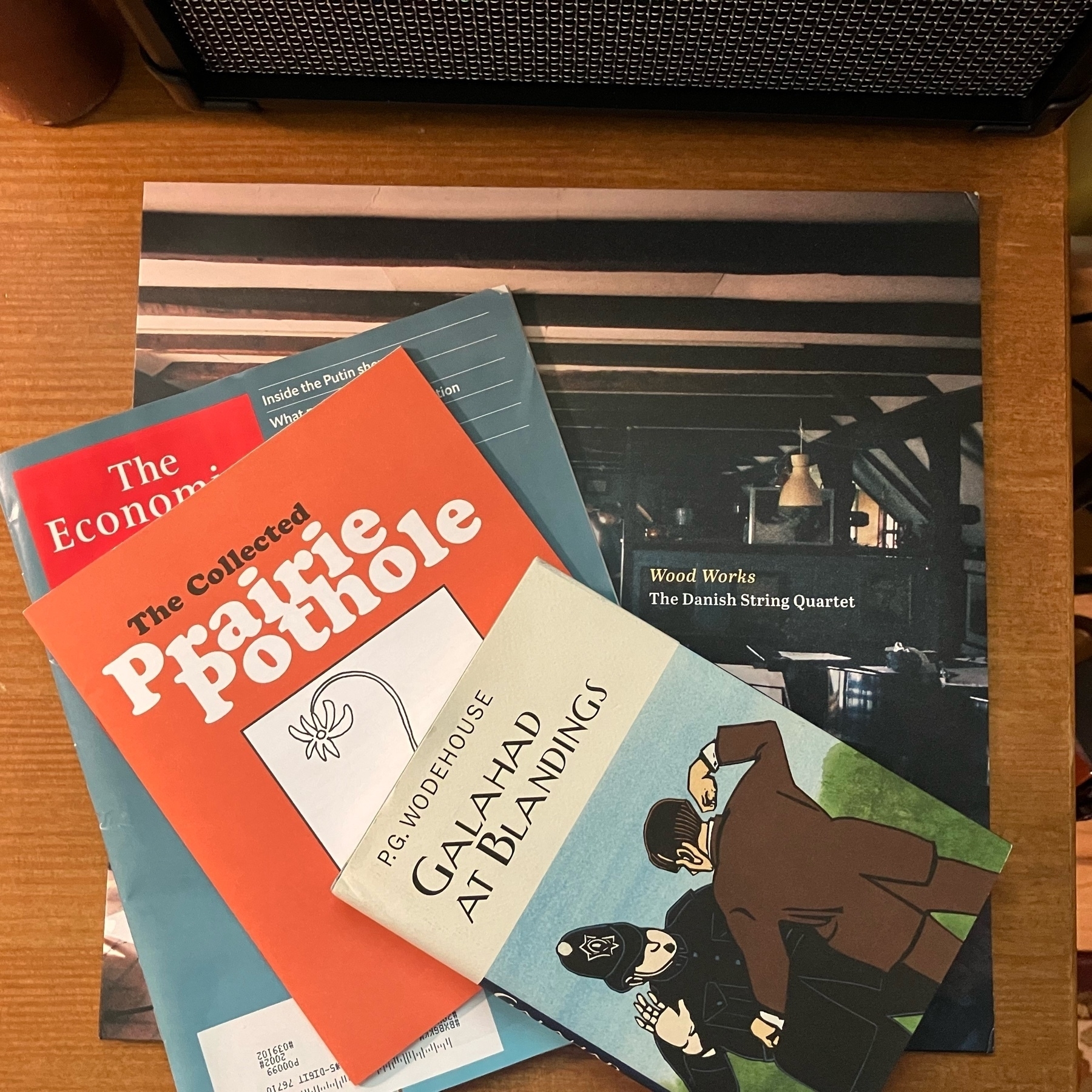

Currently reading: The Code of The Woosters by P G Wodehouse 📚 – I almost know this one by heart. In this difficult season of my life, Wodehouse’s stories have healing powers.
I have said that I think there is a strong case for the exclusion of the Moscow Patriarchate from the [World Council of Churches], and that they have a case to answer; I’m not suggesting that they should have no opportunity for such an answer. I don’t feel sanguine about their willingness to defend themselves in this particular “court”, but I would not advocate any precipitate decision without notice and consultation.
Should it come to this, however, my reasons for supporting an exclusion would be that we have a situation in which the hierarchy of one particular Christian organisation is actively advocating — not merely passively acquiescing in — a war of pure aggression, in which the routine slaughter of non-combatants is evidently a matter of accepted policy, and which is being presented by this hierarchy as a defence of Christian civilisation.
My question would be: If the behavior of the Moscow Patriarchate is insufficient to warrant an expulsion from the WCC, what would be sufficient? What kind of behavior, generally speaking, would lead to expulsion? My immediate feeling (subject to revision or correction) is that if this behavior isn’t bad enough to get you expelled, nothing is, and membership in the WCC is absolutely permanent.
Another dashed-off newsletter, though with some prime Wodehouse content.