
myths and counter-myths
A while back I wrote a brief essay on the relevance of Emile Durkheim’s sociology to an understanding of our present social tensions. For the last year or two I’ve been reading a lot of sociology and anthropology from the first half of the 20th century, because, on the one hand, the social sciences had not at that time fallen under the sway of a compulsion to quantify: they were willing to think analytically about culture without needing calculations and charts. On the other hand, they also differentiated themselves from earlier humanistic thought in some interesting and useful ways.
One of the key such differentiations is the emphasis, in early sociology and anthropology, on the continuities of human experience. That is, though these thinkers were certainly highly aware of the dramatically different social practices that could be found in the cultures of the world, and researched those varying practices with great care and thoroughness, they nevertheless believed that there were certain permanent human impulses that make their way into every culture.
The most important conclusion to be drawn from that insight is that our belief in ourselves as modern persons, or rational persons, different from the primitives who preceded us and who still might persist in strange corners of the world, is an illusion. We are driven by the same needs as all others humans past and present.
I gestured at this point a few years ago in an essay I wrote called “Wokeness and Myth on Campus.” As I’ve said before, I don’t use the word “woke” any more, but I am still fascinated by Leszek Kołakowski’s idea that in every culture there is a technological core and a mythical core. As a culture develops it does not cease to engage with mythical experience, though the specific content of the myths may change and the ways we articulate our myths to ourselves may change. One of Kołakowski’s main points is that we have rarely understood the mythical core of our culture because we have a tendency to deny that we still experience the world mythically. The great value of these early sociologists and anthropologists is that they understood that we do indeed always experience the world mythically as well as rationally, and they try to unpack that.
So, back to Durkheim. In his early book The Division of Labor in Society, he makes a few points that are worth reflecting on. Let’s start with this: “The totality of beliefs and sentiments common to the average members of a society forms a determinate system with a life of its own. It can be termed the collective or common consciousness” (63). This is one of Durkheim’s most famous ideas. He turns from this definition to a definition of crime or criminal action: “an act is criminal when it offends the strong, well defined states of the collective consciousness” (64). And he goes on to say on that same page that “we should not say that an act offends the common consciousness because it is criminal, but that it is criminal because it offends that consciousness. We do not condemn it because it is a crime, but it is a crime because we condemn it.… An act is socially evil because it is rejected by society.”
Now, all of this is related to the argument that Durkheim develops at length in a later book, The Elementary Forms of the Religious Life, in which he says that religion is essentially a means of producing, sustaining, and extending social solidarity. And one of the primary social functions of crime (Durkheim always thinks functionally about these matters) is also to produce, sustain, and extend social solidarity. That is, one of the ways in which we define the collective consciousness is by pointing to acts that violate it, persons that transgress it. It is therefore necessary for social cohesion that we punish malefactors. That punishment is, as Durkheim says “an act of vengeance” (69), but the key purpose of such vengeance is a passionate confirmation of social solidarity.
It was this idea that Kai Erickson extended and confirmed in his book Wayward Puritans: A Study in the Sociology of Deviance. What Erickson wanted to show was that
the deviant act … creates a sense of mutuality among the people of a community by supplying a focus for group feeling. Like a war, a flood, or some other emergency, deviance makes people more alert to the interests they share in common and draws attention to those values which constitute the “collective conscience” of the community. Unless the rhythm of group life is punctuated by occasional moments of deviant behavior, presumably, social organization would be impossible. (4)
The whole purpose of Erickson’s book is to show in great detail how the Durkheimian understanding of deviance helps us to understand what happened in the Salem witch trials.
At the very end of his book, Erickson points out that in our thinking about crime and punishment Americans find themselves in positions similar to those of their ancestors:
Now, as then, we leave few return routes open to people who try to resume a normal social life after a period of time spent on the community’s boundaries, because most of us feel that anyone whose skids off into the more severe forms of aberrant expression is displaying a serious defect of character, a deep blemish which cannot easily be erased. We may learn to think of such people as “sick” rather than “reprobate,” but a single logic governs both of these labels, for they imply that nothing less than an important change of heart, a spiritual conversion or a clinical cure, can eliminate that inner seed which leads one to behave in a deviant fashion (204–05).
But are there “inner seeds” that cannot be extracted? I have often commented that our society today has many means of punishment but no means of restoration. And that has a lot to do with the essentialism with which so many people think about race and ethnicity, and even in some circumstances sex. There is a kind of taint to whiteness or maleness or cishetness that cannot be eradicated. So what possible avenue of restoration to the community might there be? None, I think. Instead, there can only be a perpetual enforcement of a perpetual shame — because that’s what confirms solidarity among those who want to be in solidarity with one another. Precisely the same thing happens in white separatist and nationalist environments; and indeed in several other subcultures that have an illusory sense of themselves as complete and whole.
If we want to push back against such fragmentations of our social order, we need counter-myths. Even my project of Invitation and Repair probably requires me to articulate my ideas in ways that will be mythically compelling (in Kołakowski’s sense). Unfortunately, I don’t have those skills; but I know of some writers who do, and I’ll draw on them.
orienting principles
Many thoughts led to my beginning this Invitation and Repair project, but two of the major ones I have articulated on this blog:
One: “One of the chief tasks of Christians in our time, I think, is to correct errors: to engage patiently and gently in the tedious work of explaining to people that what they think they know about Christianity is simply wrong.”
Two: “I do not wish merely to denounce others, but to uphold and celebrate some form of Christian life and belief. Pascal wrote, ‘Men despise religion; they hate it and fear it is true. To remedy this, we must begin by showing that religion is not contrary to reason; that it is venerable, to inspire respect for it; then we must make it lovable, to make good men hope it is true; finally, we must prove it is true.’ Have I considered that, if I indeed have a strong conviction that my understanding of Christianity is the right one, there are alternatives to denunciation of others, and a vital one is the difficult task of making my model of Christianity so lovable that people will want it to be true?”
I do not criticize Josh Wardle, who deserves to get paid for his work — and I can’t even imagine what his hosting costs are — but I’m sorry to see this. When a small endeavor gets bought out by a big media company it is invariably bad news for the people who enjoy that small endeavor. How long, for instance, before every Wordle page is surrounded by ads on three or all four sides? Or before the game goes behind a paywall? Or, more likely, both?
UPDATE: Counter-take from Kottke here, which I don’t fully agree with, but I do resonate with one person he quotes: “the reality that supporting a small scale thing of beauty at large scale is beyond one person (now) & reasonable options are compromised … is bittersweet.” More “unfortunate” than “bittersweet,” but yes.

Currently reading: Index, A History of the: A Bookish Adventure from Medieval Manuscripts to the Digital Age by Dennis Duncan 📚
Newsletter: Harmonies and Dissonances.
excerpt from my Sent folder: dominant
Anyway, don't you realize that yesterday was a fantastic result for the USMNT? I read our coach's comments. He said we were "dominant." He said that the Canadians "couldn't handle our physicality." Frankly, I don't see how things could possibly have gone better.
(To me, in all seriousness, these sound like the comments of a man whose job is hanging by a thread and in my judgment ought to be hanging by a thread — at best. In fact, that press conference alone is a justification for sacking.)

Currently reading: The Time Machine by H. G. Wells 📚
eating people is wrong
I’m sure what I’m about to say has been said by many before me, but I’m counting on Adam Roberts to let me know about that.
Early in H. G. Wells’s The War of the Worlds, our narrator comes across an artilleryman who seems to be the only survivor of his company, which was otherwise obliterated by the Martians’ heat ray. The two men part, but then near the end of the book meet again, and by this time the artilleryman has done some thinking. He has decided that direct confrontation of the technologically superior Martians will be fruitless — “This isn’t a war…. It never was a war, any more than there’s war between man and ants” — but that some other form of resistance might, over the long term, work. He imagines a future in which the Martians keep some human beings for … well, he doesn’t know what for. He does not suspect what our narrator has learned, that the Martians want humans for food. But in any case, he is sure that the majority of people will meekly welcome their new Martian overlords. But, he also thinks, other, more determined and resourceful, humans will move underground to build a resistance movement, will avoid the Martians and bide their time, will read books and study science and grow in knowledge and power — until they are ready to strike back.
Meanwhile, in The Time Machine (written a couple of years earlier) Wells imagines a far future in which humanity has branched into a passive, infantile race bred for food and a second race that lives a more active and technologically sophisticated life underground — and of course eats the others.
What if we were to imagine a coherent H. G. Wells Fictional Universe in which both of the stories are true? At the end of The War of the Worlds the Martian invaders die from exposure to microbes, against which they have no defenses, but the Martians are a technologically advanced civilization and apparently in great need of a better life environment — Mars is dying — and more reliable sources of food, so one might very well infer that they learn from their unsuccessful first invasion and on a second attempt achieve their aims, setting up precisely the kind of social arrangement the artilleryman envisions, just with the meek obedient humans as their chief food. Suppose that this arrangement lasts hundreds of thousands of years, during which time the humans used for food become increasingly docile and infantile – a development accelerated and intensified by selective breeding – while the underground resistance gradually becomes better adapted for life in the dark. Eventually the Martians die, or are killed, or depart for more attractive planetary alternative, but by that point the two halves of humanity have taken such different evolutionary roads that they seem and perhaps reproductively are different species – which means that the Morlocks feel that no taboo is violated if they replace the Martians as apex predator and continue the practice of raising Eloi for food.
It all fits, I think.
Again, surely earlier readers and critics have already made this point; and in any case almost every reader of Wells knows that he’s obsessed, at this stage in his career, with selective breeding and eugenics. Thanks to certain prominent figures, these themes were omnipresent in late Victorian culture. (Later also: they’re essential to the projects of Morgoth, Sauron, and Saruman in The Lord of the Rings and The Silmarillion.)
But the rise of hopes and fears surrounding artificial intelligence has been accompanied by the decline of the hopes and fears surrounding eugenics. Gattaca gives way to A.I. and then Ex Machina; Ishiguro writes Never Let Me Go but then, fifteen years later, Klara and the Sun. Why go through the lengthy trouble of breeding humans to be slaves when one can manufacture slaves? So can the themes of eugenics and selective breeding of humans still have the claim on our imagination they once had?
ADDENDUM
- Stories about the breeding of slaves often feature the possibility, or the actuality, of a slave revolt -- but not in Tolkien. The orcs and other creatures bred by Morgoth/Sauron/Saruman may fail in various ways, but they never rebel. The possibility of a robot revolt, by contrast, seems to have been baked into the conception right from the beginning.
- The 20th-century fear of selective human breeding was sustained, in the West, by the wars of that century: First the Nazis were thought to be breeding Supermen, then, when the World Wars gave way to the Cold War, the new object of such fears became the Soviet Union. (And the fears weren’t simply manufactured: I remember stories of the American women swimmers in the Olympics hearing the baritone laughs and shouts of the testosterone-filled East German women in the next locker room.) Maybe the collapse of the Soviet system inevitably led to a diminishment in the anxieties associated with eugenics: no more Ivan Dragos, no more Winter Soldiers, no more Black Widows.
- In the reading of The Time Machine in his superb literary biography of Wells, Adam Roberts comments on the moment when, assaulted by Morlocks, the Time Traveler loses his little Eloi friend Weena: “I searched again for traces of Weena, but there were none. It was plain that they had left her poor little body in the forest. I cannot describe how it relieved me to think that it had escaped the awful fate to which it seemed destined.” To this, Adam says, “Better burned alive than raped by Morlocks, it seems.” But surely the Traveler means eaten by Morlocks. Which raises a question I hint at in the main body of this post: Have the Eloi and Morlocks taken such divergent evolutionary paths that the Morlocks could no longer think of the Eloi as objects of sexual interest? I am inclined to think so. After all, the taboo on interspecies sex and the taboo on cannibalism are in a sense mutually exclusive. If you can eat it, you can’t have sex with it; if you can have sex with it, you can’t eat it.
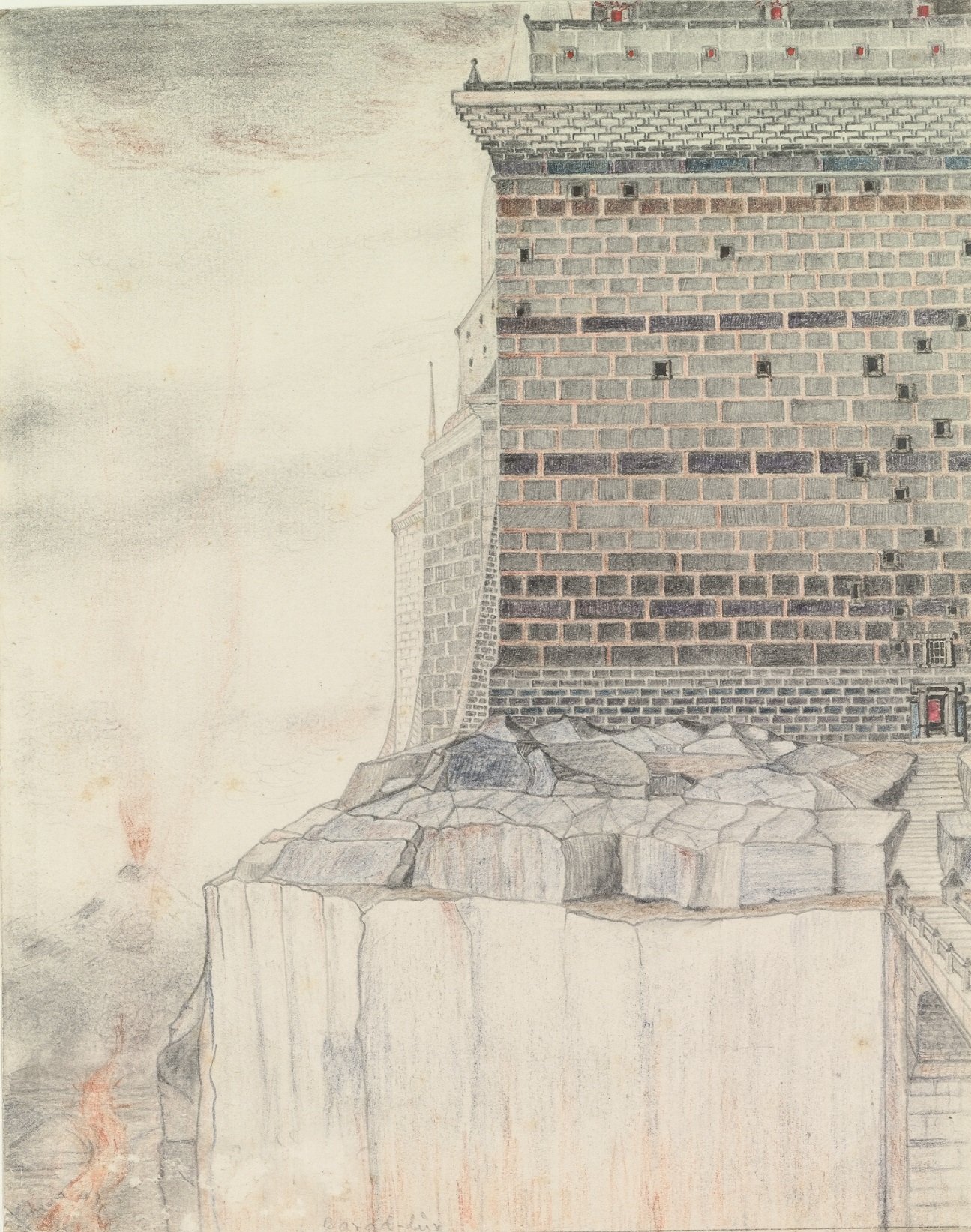
Tolkien’s own drawing of Sauron’s fortress Barad-dûr, with Mount Doom in the distance.