
great
Yesterday my son, who works in the Chicago Loop, saw a woman on a bicycle get hit by a car. She wasn’t seriously injured, but she was knocked to the ground, dazed. He ran up to her to see if she was okay and pulled out his phone to call 911 — but she quickly, urgently said, “No! No! I can’t afford to go to the hospital!” And after taking a moment to gather herself, she got to her feet, picked up her damaged bike, and wobbled off.
And so my son stood there on the corner, surrounded by the glories of Chicago’s architecture, the superb expensive shops on the Magnificent Mile, the wealth that fairly pulsates from every building, and reflected, as one well might, on American Greatness.
a road not taken
Lately I have been reading some of the wartime letters of Dorothy Sayers — who, I have just learned, pronounced her name to rhyme with “stairs” — and have been constantly reminded of something that I wrote about a bit in my Year of Our Lord 1943: the complex network, centered of course in London, of Christians working outside of standard ecclesiastical channels to bring a vibrant Christian faith before the minds of the people of England in the midst of war. People like J. H. Oldham and Philip Mairet and, perhaps above all, James Welch of the BBC — who convinced Dorothy Sayers to write the radio plays that came to be called The Man Born to be King, recruited C. S. Lewis to give the broadcast talks that became Mere Christianity, and commissioned music from Ralph Vaughan Williams — ended up having an impact on the public face of English Christianity that was enormous but is now almost completely unknown.
At one point in researching my book I thought seriously about throwing out my plans and writing this story instead — but I couldn’t bear to let go of the fascinating interplay between ideas being articulated in England and their close siblings arising in the U.S., especially in New York City.
I can’t remember whether I’ve mentioned it here before — a quick search suggests not — but I have long dreamed of writing a book called Christian London: a history of the distinctive and often profoundly influential role that London has played in the history of Christianity. However, no one I have spoken to about this project — my agent, various editors, friends — has shared my enthusiasm. I might write it one day anyhow, and if I do, people like Oldham and Mairet and Welch will be major characters in one chapter.
And one of the desserts: corn mochi with blackberry sorbet and various delicious accessories.

A highlight from last night’s anniversary dinner at Barley Swine: fried buns (like a steamed bun except … fried) with shrimp dumplings.

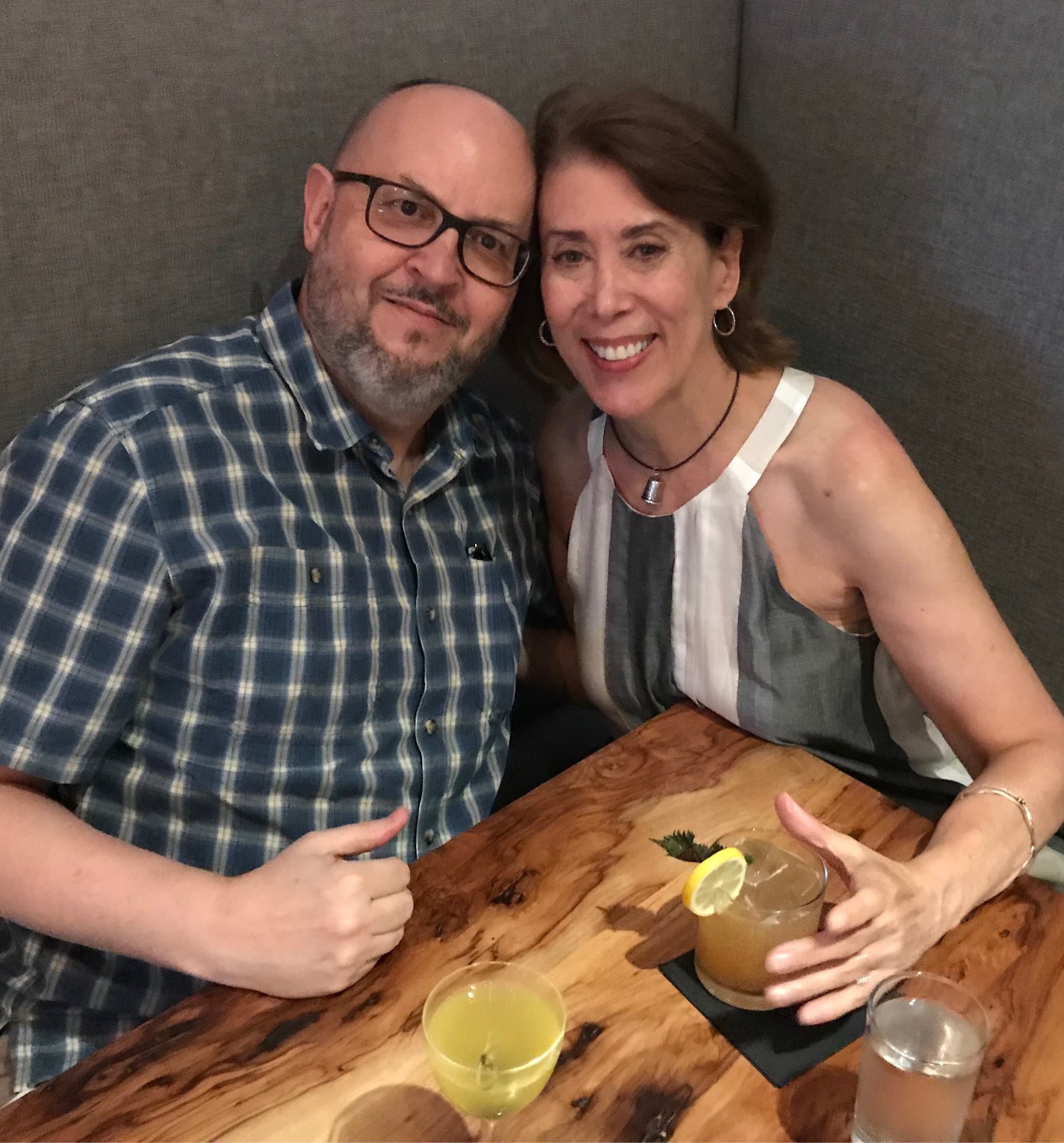
39th anniversary dinner at the amazing Barley Swine in Austin. So, so grateful for my beloved.
here and there
As some of you may have noticed, I’m not posting here very frequently. I think for the foreseeable future I’m only going to be using this blog for longer reflections – long by internet standards, anyway.
From day to day you’ll find me posting to my micro.blog account – and if you haven’t checked out micro.blog, please do! People sometimes describe micro.blog as a “Twitter replacement,” but that’s not quite right. It may be better to think of it as what services like Twitter and Instagram could have been if they had been devoted to the open web and not subservient to the demands of venture capital. It’s a great place for low-key connection with others, and the best possible way to get started in blogging. It’s not free, but then Twitter and Instagram aren’t free either – those services just make you may in currencies other than money. Micro.blog serves no ads, respects your privacy, and allows you to own your turf. Try it!
I continue to post bookmarks – with useful excerpts! – at my Pinboard page, which I have been using for … [checks site] … ten years and two weeks.
Finally, I think my newsletter is pretty fun – a bit of a break from the incessant seriousness of our political moment.

Hose time

First the Eucharistic Feast, then the Breakfast Pizza at Moroso Feast.

the airless room
This is an interview with Kathryn Scanlan about her very peculiar new book, which is made up of selections from a person’s diary — read the interview to learn more, it’s really fascinating.
But I want to talk about a distraction from the real subject of the interview. Here’s a passage:
Etter: Now this is a question I have coming from a journalism background: what does it mean for fiction to take a real life and remix it, scramble it, and fine tune it into something that becomes non-real? What is it like to play with that?Scanlan: A little bit weird. From the beginning, I felt like it was a weird thing I was doing. I don’t necessarily think it’s any particular genre, I think it has elements of all genres. I think it can be called fiction and I would call it that because of the way it’s been selected. If you are only showing part of something, it’s fiction. If you’re omitting lots of things, or if you’re focusing on only something particular, it’s fiction in my mind.
Etter: I think most journalists would probably agree with that definition — maybe not our president.
I read that and thought: Is there any chance of my getting through a recent essay, an article, a story, an interview, without a reference to That Man? Is it really necessary for every member of The Cultured to signal their disdain for him in every single conversation?
I want to say: He’s not sucking the air out of the room, you are.
Yes, I know, it’s just a passing comment. But when “passing comments” of that kind show up twenty times a day, it wears on a fella.
This is why I make my newsletter. It’s a place that I can guarantee will be free from that kind of thing, that will allow me and my readers to spend time in a broader world than that of posted and tweeted and retweeted political vaporing, posturing, and rancor.
Many of you will know this famous letter from John Adams to his wife Abigail: “The Science of Government it is my Duty to study, more than all other Sciences: the Art of Legislation and Administration and Negotiation, ought to take Place, indeed to exclude in a manner all other Arts. I must study Politicks and War that my sons may have liberty to study Mathematicks and Philosophy. My sons ought to study Mathematicks and Philosophy, Geography, natural History, Naval Architecture, navigation, Commerce and Agriculture, in order to give their Children a right to study Painting, Poetry, Musick, Architecture, Statuary, Tapestry and Porcelaine.” Let not Adams have studied in vain.