
I think of this as two imperative sentences.
Diderot
“Rameau’s Nephew” is, in this way, the first debate between two such materialists, both of whom reject superstition and the supernatural but end in radically different places. We live within that dialogue today, with some of us accepting that the material view of a world without inherent meaning can produce only fatalism, others that it can give us the great if ambiguous gift of freedom.
— Adam Gopnik. “We.”
a very, very great deal
Men's ultimate ends sometimes conflict: choices, at times agonising, and uneasy compromises cannot be avoided. But some needs seem universal. If we can feed the hungry, clothe the naked, extend the area of individual liberty, fight injustice, create the minimum conditions of a decent society, if we can generate a modicum of toleration, of legal and social equality, if we can provide methods of solving social problems without facing men with intolerable alternatives — that would be a very, very great deal. These goals are less glamorous, less exciting than the glittering visions, the absolute certainties, of the revolutionaries; they have less appeal to the idealistic young, who prefer a more dramatic confrontation of vice and virtue, a choice between truth and falsehood, black and white, the possibility of heroic sacrifice on the altar of the good and the just — but the results of working for these more moderate and humane aims lead to a more benevolent and civilised society. The sense of infallibility provided by fantasies is more exciting, but generates madness in societies as well as individuals.
— Isaiah Berlin, “The Three Strands in My Life” (1979)
out on the town


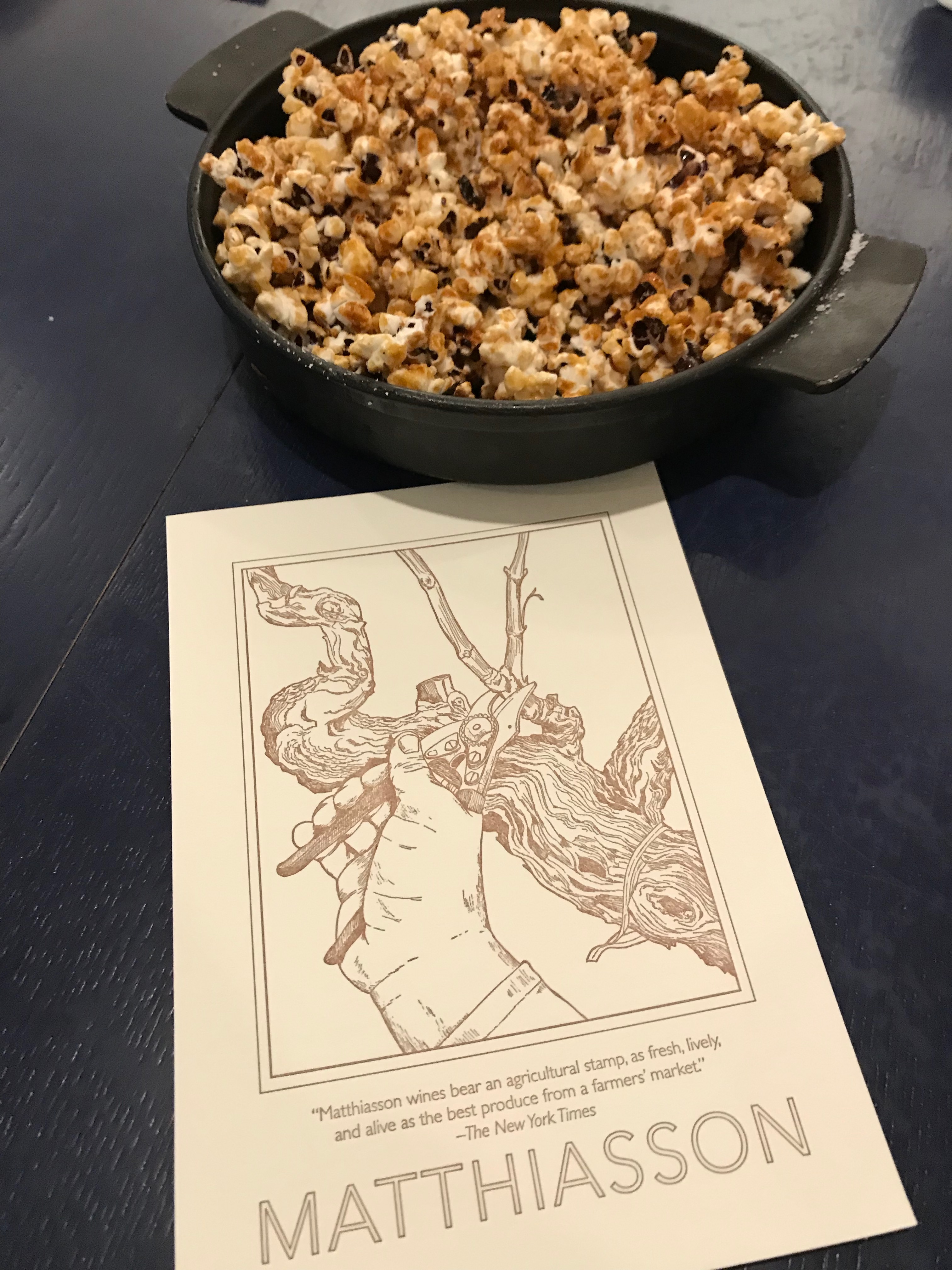
The combination of Corey McIntyre's food and Matthiasson wines is one I won't forget for a very long time. It was wonderful to have Jill Matthiasson at the table to describe the wines and her family’s approach to winemaking.
UPDATE: In response to questions, the food you see is (a) duck fat salted caramel popcorn; (b) carrot and cabbage "barbacoa" on blue corn tortillas, with some amazing queso fresca; (c) scallops and pork tenderloin with some kind of delicious sauce; (d) biscuits with blackcurrants marinated in Matthiasson vermouth with sliced strawberries, candied fennel, and sweet brown butter. AMAZING stuff.


A really special night last night at Milo. (That’s duck fat salted caramel popcorn, which you wouldn’t even believe. And each of the Matthiasson wines was absolutely wonderful.)
nested

I just came across this chart I made for my students a few years ago when we were reading the Arabian Nights — I wanted to show them the layers of nesting of tales.
placeholder for further reflection
- The one central and indispensable axiom of metaphysical capitalism is “I am my own” — I am a commodity wholly owned and operated by myself in service to my own interests, as defined by me. I am my own store of capital.
- Therefore, the socio-political order is to be evaluated strictly in terms of whether it helps or hinders my autonomy.
- Also therefore, questions of political economy are empirical and pragmatic rather than dogmatic. Should I determine that the pursuit of metaphysical capitalism is best aided by economic socialism, then a socialist I shall become.
Kathryn Tanner's altar call
Consider this a follow-up to my recent posts on metaphysical capitalism and some stories about the commodification of emotion and connection — and also a kind of pendant to Derek Thompson’s story in the Atlantic on the religion of workism. This one’s gonna have some long quotations.
Here’s how Kathryn Tanner describes her task in her new book Christianity and the New Spirit of Capitalism:
Whether amenable to capitalism at its start or not, my own Christian commitments as I hope to show are inimical to the demands of capitalism now. I am critical of the present spirit of capitalism because I believe my own, quite specific Christian commitments require it. But I also suggest over the course of the chapters to come that the present-day organization of capitalism is deserving of such criticism whatever one’s religious commitments, because of its untoward effects on persons and populations, its deforming effects on the way people understand themselves and their relations with others. Every way of organizing economic life is flawed. Besides having especially egregious faults (relative to other ways that capitalism has been organized, this one foments, for example, extreme income/wealth inequality, structural under- and unemployment, and regularly recurring boom/bust cycles in asset values), what is unusual about the present system is the way its spirit hampers recognition of those faults. The present-day spirit of capitalism needs to be undermined, therefore, in order for the current system to be problematized — seen as a problem amenable to solution, an object of possible criticism requiring redress. And in order for that to happen, in order for the spirit of present-day capitalism to be effectively undermined, it needs to be met, I suggest, by a counter-spirit of similar power. Without the need any longer of religious backing, capitalism may now have the power itself to shape people in its own image; its conduct-forming spirit may now be its own production, in other words. But as one of the few alternative outlooks on life with a capacity to shape life conduct to a comparable degree, religion might remain a critical force against it.That bolded sentence is a reminder that, as I often say, “the liberal order catechizes,” and that it will catechize us right out of Christianity altogether if we don't provide what I call a “counter-catechesis,” a radically different “conduct-forming spirit.” Tanner makes a very similar argument at length.
In so doing, she repeatedly reminds us that Christianity is, among other things, a counter-economics. Everyone knows how thoroughly economic language is woven into the fabric of the Christian story: we are bought with a price (agorazo); we are bought out of slavery (exagorazo). Though Tanner doesn’t do exegesis in her book, it’s clear that she wants her readers to understand how completely the biblical picture reorients, or ought to reorient, our self-understanding. In a capitalist order it becomes easy, even natural, to think of God as a metaphysical banker, keeping our moral accounts as thoroughly as the hidden gods of capitalism track our FICO scores. But if we can escape that tendency, if we can understand God as the one who has delivered us from bondage, then “rather than being tallied against one’s account, one can be assured one’s sins are forgiven, their burden erased, when casting them upon Christ’s mercy in confession. One can honestly admit faults without fear, assured of God’s mercy in Christ. It is not the lapse that threatens to separate one from Christ but the refusal to confess it, out of fear and a lack of trust in God’s graciousness.”
But if we cannot manage this reorientation of our understanding, then we can come to be terrified of the future and at the same time confined to an understanding of the future as a mere continuation of what now exists:
In order to profit from the difference between present and future, or at least to prevent it from doing any harm, one employs financial instruments that collapse the future present — that is, what the future will turn out to be — into the present future — that is, into the present view of the future.... By virtue of such a collapse of future into present, the future one anticipates loses its capacity to surprise; the future to come simply reduces to the future it makes sense to expect given present circumstances. Those circumstances themselves become a kind of self-enclosed world, as one learns to hope for nothing more from the future than what the given world's present limits allow, what it is reasonable to expect from within them, assuming their continuance.To live within these constraints — constraints which our capitalist order teaches us we must think about constantly if we are to be rational actors and responsible citizens — is to be deprived of both imagination and hope. What is required, for those of us so bound, is to be redeemed from this bondage, to be bought ought of slavery to it, and that requires conversion.
So I was delighted to find, at one important juncture in this book, this liberal Episcopalian giving her readers what amounts to an altar call. I’ll close with that call:
The present does not, however, become urgent here due to scarcity. One has everything one needs — more than one needs — to turn one's life around: the grace provided in Christ. In marked contrast to the efficiency-inducing scarcities of finance-dominated capitalism, it is the very fulsomeness of the provisions for conversion that makes the present an urgent matter, an opportunity to be seized with alacrity and put to good use. There is no point in looking longingly to any past or future with the capacity to make things easier: the time is ripe for action right now and never has been or will be any better. Delaying a present decision to turn one's life around, and neglecting to make the best of what is currently on offer out of a distracted sense of what was or might be, suggest one is simply never likely to turn one's life around, no matter how many times one is offered the opportunity to do so in the future. Any such distraction from the present moment is always available as an excuse in the future, so as to produce thereby a never-ending deferral of decision. The present is urgent here not because the opportunities of the moment might be lost but because they are just so good, so perfectly suited to the predicament one is in and the needs one has, because of their not-to-be-passed-up character, so to speak. Instead of being here today and gone tomorrow, what allows one to turn one's life around in the present — the grace of Christ — is permanently on offer. It has no fleeting character. What prompts one to seize it right away is not the fear of missed opportunity, then, but the immediate, overwhelming attractiveness of the offer.... No failings in the past or present can disrupt the efficacy of a grace designed specifically to save sinners.... There is thus no point in harping on the past or worrying about the future — the present is one's only concern. Not because one cannot do anything about past mistakes or about an uncertain future — because neither is under one's control — but because one can let go of the past without consequence — one's sins are forgiven — and because the future will never be any more threatening than the present is. Contrary to the Stoic-inflected temporal sensibility of financial players, the present is no more under one's control than the past was or the future will be: at every moment in time, one is enabled to turn oneself to God only by God's grace and not by one's own power.Preach it, sister!